
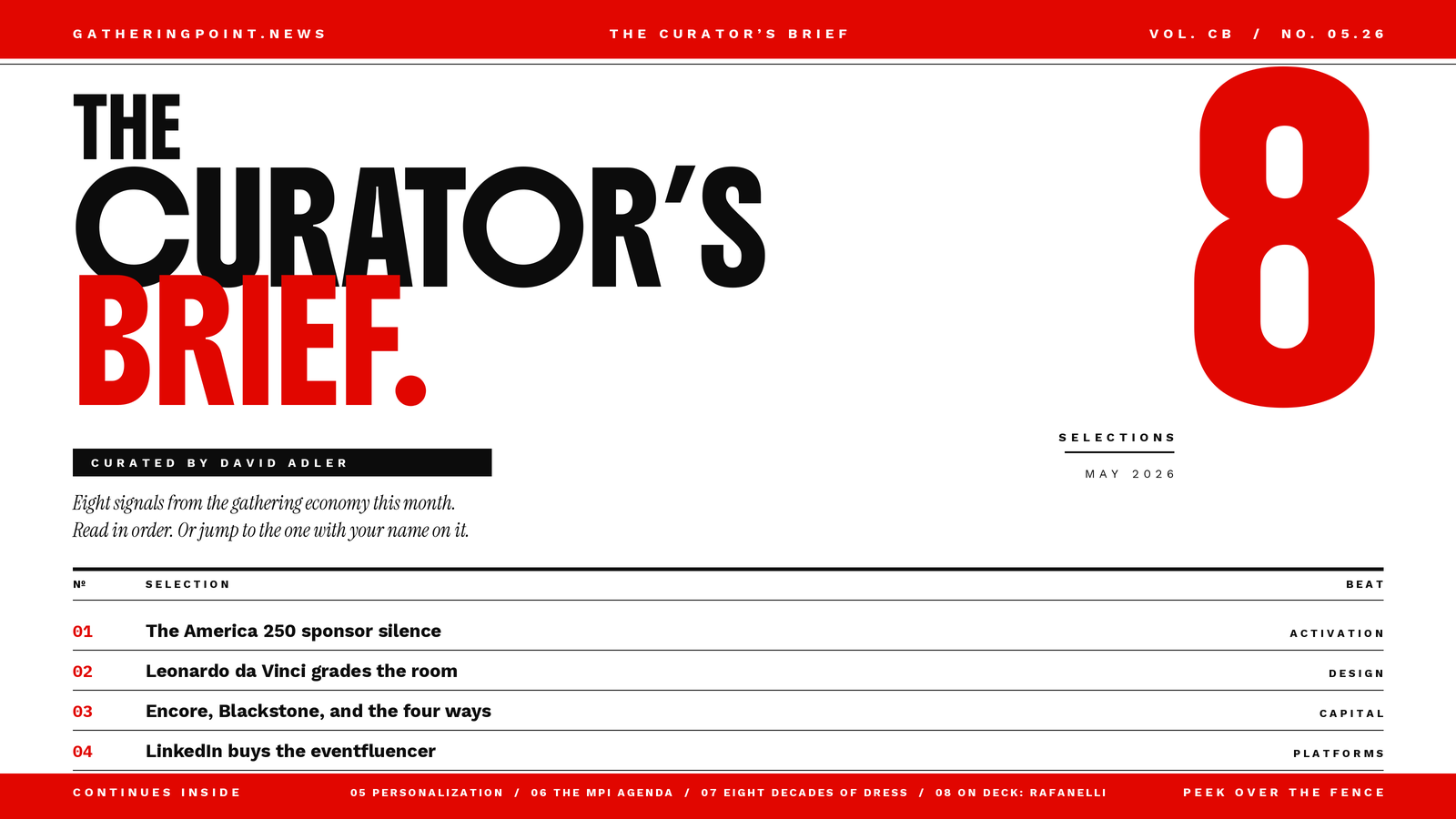
Curator's Brief: The stories under the stories.
May 29, 2026-What capital is buying. What the industry is flinching from. And what the agenda just confessed.
Is America’s 250 Celebration a Yawn For Sponsors?
The 250th lands July 4. The World Cup kicks off June 11. By every historical pattern the activation cycle should be at full tilt right now, and the DMCs are puzzled, because the phones are not ringing on the old schedule. The World Cup sponsor roster runs Adidas, Coca-Cola, Verizon, Bank of America, Airbnb, Visa, McDonald’s. Not on it: American Express, the company whose entire brand is experiential activation. The America250 list is just as thin, and the absences are louder than the presences. Read it against 1976, when PepsiCo and GM bankrolled a Freedom Train through 138 cities, and the silence becomes the story. The honest read the DMCs say over drinks but not on the record: the flag has gotten dangerous, and the most patriotic posture a brand could take in 1976 has become the riskiest seat in the room in 2026. It is not a yawn. It is a flinch. And a flinch, properly read, is an opening. Is It a Yawn? →The flag is now a hot potato
In 1976 every brand wanted its name on it. In 2026 sponsors are flinging it out of their hands. Why nobody wants to sponsor America anymore.
DId You Know Leonardo Da Vinci Had a Side Gig as an Experience Designer, What Would He Think of Today’s Practitioners
Leonardo da Vinci built mechanical lions for the Medici. He wasn’t their court painter — he was their event designer. The best who ever lived. So I built him a soliloquy and sat today’s experience designers in front of him.
He is not impressed. He looks at the $128 billion we spend on activations and brand houses and photo moments engineered for a feed, and he sees decoration. Novelty dressed up as wonder. He had a fraction of our tools and aimed ten times higher. Chase meaning, he says, not novelty — and most of what passes for experiential today does the opposite.
He had this figured out in Milan, in the 1490s. And he’d fire half the room.
What You Need to Know About Private Equity From the Encore Going Public Strategy. ( They May Be Coming For Your Assets)
Blackstone is taking Encore — the world’s largest B2B event production company, 13,000 employees, preferred-vendor deals at 2,200 venues — public on the NYSE under the ticker ECR, seeking around $500 million. The operating story is strong: revenue up to $3.4 billion, a net loss narrowed to $27.2 million from $176.1 million the year before. But the filing is candid about the headwinds, and the real story sits in the structure. A sponsor makes money in four ways, and only one of them depends on whether the business actually thrives. As private equity reshapes the whole gathering economy — Encore, Clarion, Hyve, the agency rollups — every founder who might one day take that call should understand the machine first. The four ways private equity makes its money →
LinkedIn Says It’s Getting Into Events By Embracing Influencers Like We Should Be Doing.
LinkedIn has figured out what the events industry has known for a century: the person with the audience sells the tickets. Per internal documents confirmed by a LinkedIn spokesperson, the platform is launching creator-led events and scaling to four thousand a year, piloting with influencers like Cassie Kozyrkov, Codie Sanchez, and Chris Do, none of whom runs a trade show but all of whom arrive owning the one asset the industry has always coveted and never held: an audience that already belongs to them. This is LinkedIn putting Microsoft’s balance sheet behind the eventfluencer and walking straight into the live-events model, selling access, the room, and the relationship. The threat is not the four named instructors. It is the four thousand. Categories that go industrial get platforms, and platforms decide who owns the convening relationship for the next twenty years. LinkedIn Says It’s Getting Into Events →
The Revolution in the Scalable Power of Personalization (We See You in Songs and Bites)
The industry has spent two years arguing whether AI flattens the meaning out of gathering. The question is backwards. AI’s real power is not the average. It is making the specific cheap. A custom song that once cost three weeks and several thousand dollars now takes an afternoon, which means recognition, the thing that makes a person feel seen, is finally affordable at the scale of a whole room. I have been running the experiment in public: two dozen songs on Suno, each written for one person in the gathering economy, and forty-two edible portraits on Small Bite Architecture, four bites and four cocktails each. Dahlia El Gazzar rendered as a song and as a plate carries the same truth both times, and the reaction is always the same two words. That’s me. For an industry whose entire job is making people feel something in a room, personalization at scale is not the threat. It is the point.
Here is a “Ballsy” Analysis of MPI’s June World Education Congress Agenda
We read all 197 sessions on the agenda of MPI’s World Education Congress, the meetings industry’s annual stocktaking, June 2 through 4 in San Antonio, and treated the program itself as evidence. A conference agenda is a mirror. What an industry chooses to teach itself at its flagship event is the clearest available statement of what it thinks it is and what it is afraid of. Read that way, the menu reveals three cooks in the kitchen, an education team selling rigor, a sponsorship team selling access, and an association that has lost roughly a third of its members since the late 2010s and is matching PCMA move for move. Four arguments run through it: the buyer is tired of the gala, AI is one of the three biggest threads, vendor economics moved from behind closed doors onto the main stage, and the sharpest session names event planning as pink-collar work in a workforce that is 80% women. This is a new way to analyze your own event: hold the agenda up and look. The piece is published as a hypothesis. The conference is the test, and we grade it after June 4. Inside the Meetings Industry’s Annual Stocktaking →
What We Wore to Show Up at Events Over 8 Decades ( Sorry if You are Embarrassed:-)
Fashion wasn’t just fabric. It was code.
The kitten heel said your place. The white go-go boot said you stood with the future. The platform shoe said the gala and the protest could be the same outfit. The shoulder pad said you were here to deal. The conference sneaker said you belonged in the room. The pink pussyhat said the protest had a brand.
Eight decades of what we wore to gather. To the trade show. To the march. To the gala. To the keynote. From the 1955 American Management Association Conference — where every man wore a hat and every woman brought her own notepad, and neither dared wrinkle their suit — to a 2020s where you might show up to a panel in Balenciaga or in hiking boots and a branded cap.
The look wasn’t fixed. It was fluent.
ON DECK
💼 Coming Next Week: BRYAN RAFANELLI, A Wisdom Bank Feature
Chelsea Clinton’s wedding. Thirteen Obama state dinners. The Harris campaign architecture. Vogue’s list. One hundred events a year out of Boston, with offices in New York, Washington, Palm Beach. Bryan Rafanelli sits down with the GP Wisdom Bank.
The preview line that earned him the invitation: we’re not guessing. The famous mood boards are downstream of demographic and psychographic research on the room he is designing for. The flowers are downstream of the strategy.
Wisdom Bank conversation drops soon. Watch for it.


