


Dahlia El Gazzar calls herself the High Priestess of Curiosity and Emotional Disruption, and the title is not a joke she is asking you to be in on. It is the most accurate thing anyone has ever put on her LinkedIn. She is one of the most recognizable voices in event technology, a woman who improvised moonlit dinners in the Egyptian desert before she ever stood on a tech stage, and the single word that holds all of it together is wonder. So when I set out to make her a song, the only honest brief was to make wonder audible. The track is called Wired for Wonder. Handclaps, playful brass, a group-chanted hook that sounds like a room deciding to believe in something. She heard it and said the thing everyone says. That’s me.
I have been running this experiment in public for months, and the catalog now sits at two dozen songs on Suno, each one written for a specific person or moment in the gathering economy. James Lancaster of Northstar got Listening to the Room, a warm folk portrait of an editor whose whole craft is attention. Ryan Simonetti of Convene got Full Shelves, a boom-bap founder anthem with a Jersey street narrative and vinyl crackle on the snare. Femi Oke got She Runs the Room, a Grease-inspired sock-hop tribute with a spoken-word bridge over finger snaps. Sam Lippman got a Broadway build called Watch the Rooms Bloom. Liz Irving, Andrew Roby, Greg Topalian, Iain Morrison, each got their own genre and their own three minutes. The point was never the songs. The point was what the songs proved.
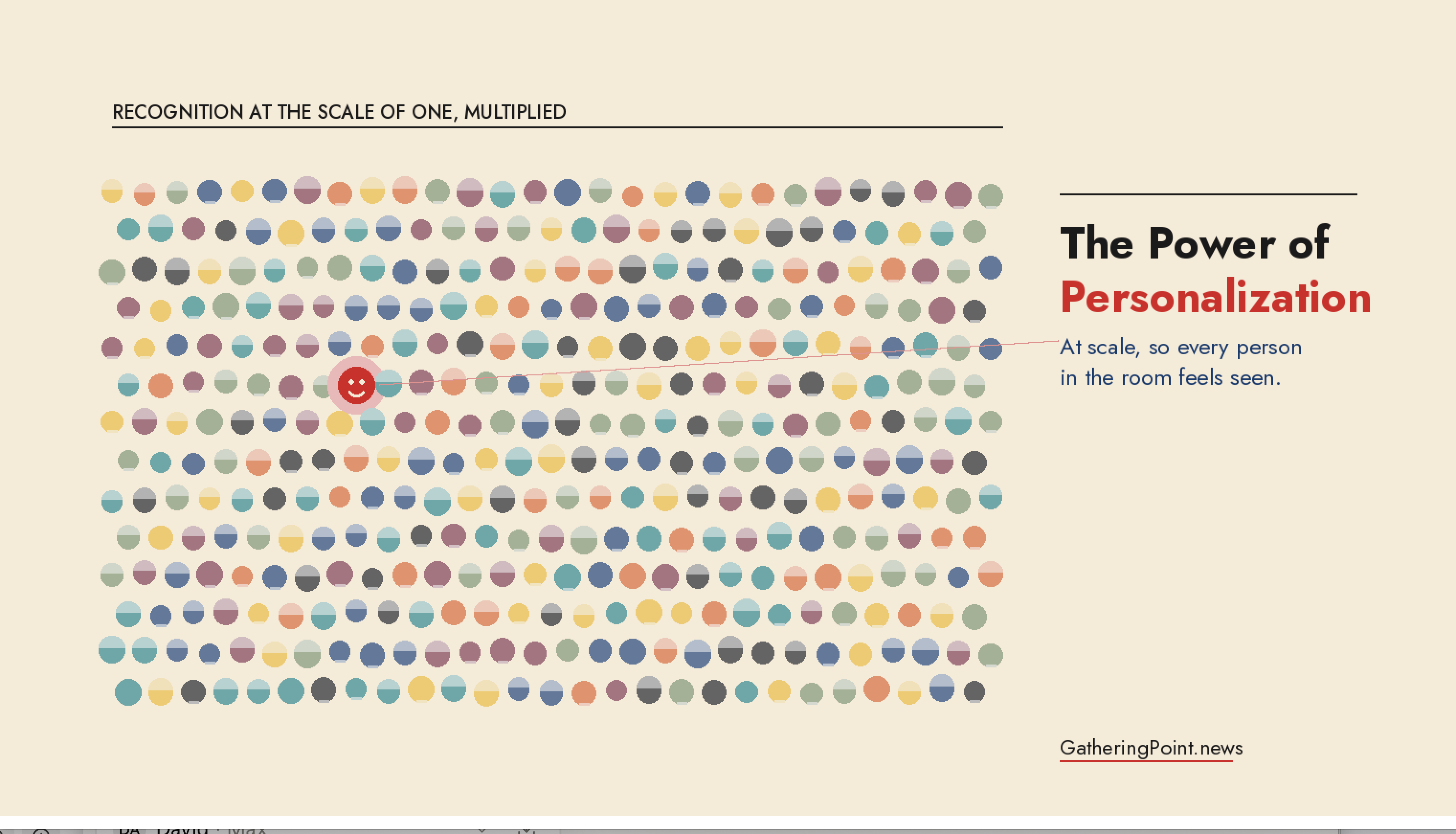
Here is the thesis, and it runs against almost everything the industry has been saying for two years. The fear about AI is that it flattens. That it takes the specific and the personal and the warm and renders it into a beige average, the same generic dinner served to ten thousand people who each thought they were getting something made for them. That fear is real, and it describes a real product that real vendors are selling. But it has the actual capability exactly backwards. AI’s genuine superpower is not the average. It is the opposite. It is making the specific cheap.
Until last year, a custom song written for one person cost three weeks and several thousand dollars, which meant it was reserved for weddings, retirements, and the occasional roast of a departing CEO. Recognition at that price is a luxury good. It does not scale, and because it does not scale, most people in any community go their entire careers without ever being seen in a way that was built only for them. What changed is not that the songs got better. It is that the price collapsed. Wired for Wonder took an afternoon. That collapse does not strip meaning out of gathering. It makes recognition affordable at community scale for the first time in the history of the business.
The bites
A song is one way to render a person. To test whether the effect was about the medium or about the recognition underneath it, I tried another medium entirely, one with no melody at all. Food.
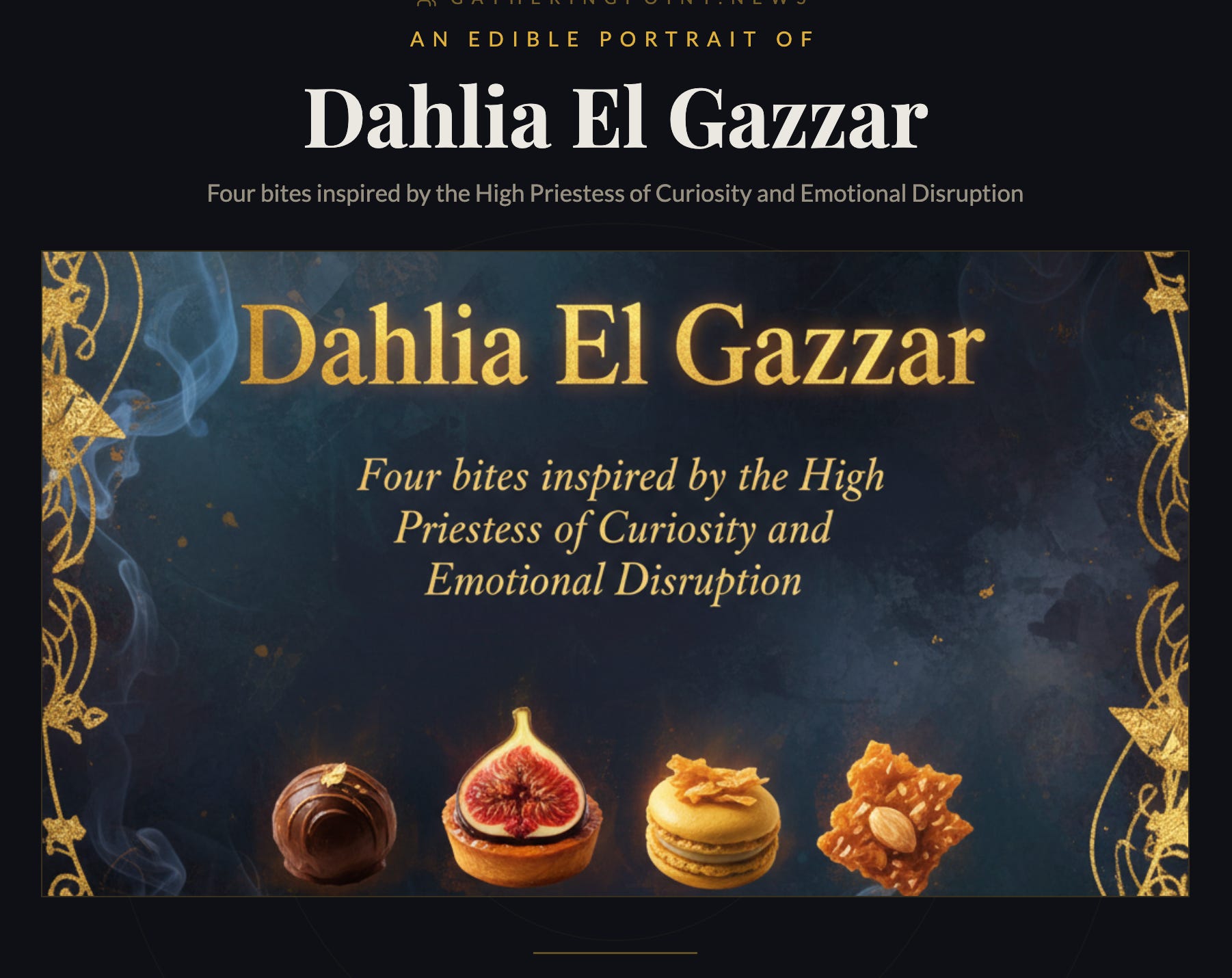
Small Bite Architecture renders people as one-inch bites. Forty-two people in the gathering economy so far, each given four bites and four paired cocktails, and the discipline is portraiture, not catering. The bites are not chosen because they taste good next to each other. They are chosen because each one reads a different chapter of a single person, and the test of the plate is the same as the test of the song. Does the subject look at it and recognize themselves.
Dahlia was the proof, because I already had her song and could put the two media side by side. The Blue Giraffe is a blue cheese and honey-fig phyllo bite with edible flowers and gold leaf, named for the childhood tribe where she learned that if you believe hard enough, impossible things become real. Wonder, made edible. The Camel Race is a spiced lamb kofta with date chutney, for the events she improvised in the desert: pure instinct, magic conjured from nothing. The Perennial is a garden-herb tartlet, for the idea she actually coined, the Perennials, the people who keep blooming through relentless curiosity. The Ruckusmaker is a harissa-glazed shrimp with mango-habanero salsa, for the awards she built to celebrate disruptors. Good trouble on a plate.
Same woman, two media, one understanding. Hear the song and eat the bites and you meet the same person twice, and the second meeting confirms what the first one suggested: the power was never in the tool. The reaction to the food was identical to the reaction to the music, because both were reading something true about her rather than decorating her name. The one correct word was wonder, and once you have the word, you can say it in any medium you choose.
The product nobody else is selling
The reason this matters beyond a playlist is that the events industry already buys personalization, and it is buying the wrong kind. The event-technology vendors selling AI-personalized agendas are selling personalization as logistics: which session you should attend, which booth you should visit, which stranger the matchmaking algorithm thinks you should meet for coffee. That is personalization as surveillance, the platform watching what you click and selling the prediction back to you. It is useful. It is also not what anyone means when they say they felt seen.
The personalization the catalog demonstrates is the opposite posture. It is the host’s recognition, not the platform’s prediction. It does not ask what you are likely to do next. It asserts that someone paid enough attention to know who you already are. The difference between those two products is the difference between a conference app that reminds you where your next meeting is and a room that makes you feel like the gathering would have been incomplete without you. Both get called personalization. Only one of them is worth anything.
I owe an honest accounting of the limits, because the experiment has them. Not every song lands. Rendering a person who did not ask to be rendered is a presumption, and the presumption is the whole risk of the form. Get the word right and the subject is moved in a way that no banner ad has ever moved anyone. Get it wrong and you have told someone, in three minutes of music, that you misunderstood them. That risk does not argue against the practice. It argues for doing it with care, which is the same thing the best hosts have always known: recognition is powerful precisely because it can be gotten wrong, and the willingness to try is what separates a gathering from a transaction.
The catalog is not only people. Miami, We Gather is a community anthem for a city. The Annual State of the Industry is a jazz-pop duet about a morning ritual. The texture of the gathering economy itself, the places and the habits and the recurring moments, turns out to be as renderable as any individual. That is the tell. When personalization gets cheap enough, it stops being a flattering gift you give to important people and becomes a way of paying attention to everything, the cities and the rituals and the room itself.
The industry hates AI. It has spent two years building a vocabulary of resistance, most of it aimed at the flattening, the fakery, the loss of the human touch. The vocabulary is not wrong about the danger. It is wrong about the direction. The same technology that can render ten thousand identical experiences can render ten thousand different ones, and the only question is whether the person holding the tool is trying to save money or trying to see someone. Personalization at the scale of one is not the thing to fear. It is the thing the industry has wanted since the first host learned a guest’s name at the door. It just never used to be affordable. Now it is.
Hear the full catalog on Suno.
GatheringPoint covers the people who build the gatherings. Subscribe at GatheringPoint.news.