
Inside the Meetings Industry’s Annual Stocktaking: What 197 Sessions Reveal About the Business of Bringing People Together
A pre-conference read of the agenda at MPI’s World Education Congress in San Antonio, June 2–4. Built with AI assistance, published as a hypothesis, and open to correction after the room votes.
What this piece is about, in plain language
Every June, the largest trade association in the meetings industry holds its annual conference. A few thousand people who plan corporate events, medical conferences, association meetings, and trade shows gather in one city to learn, sell, buy, and decide where the industry is heading next.
This year, the conference is in San Antonio, June 2 through 4. It is called the World Education Congress, or WEC. The trade association that runs it is called Meeting Professionals International, or MPI.
This piece reads the agenda — all 197 sessions of it — as a window into where the industry is going. If you work in the gathering economy, you already know why that matters. If you do not, the short version is that the people who plan business events move about a trillion dollars in spending around the world each year, and what they decide to learn at their flagship conference signals where that money is going next.
Before the analysis, one note about how this article was built.
A note on how this was made
The WEC agenda has 197 sessions over three days. Reading all 197 at the depth needed to write this piece would take me a full week. I did not have a week. So I used an AI tool to do the heavy reading and pattern-finding, and then I edited the result for publication.
I could not have written this without the AI. I am telling you that up front because it changes the contract between us. You should not trust this piece the way you would trust a piece I reported alone. You should treat it as a hypothesis. Some of it will be right. Some will turn out to be wrong. The real test happens at the conference itself.
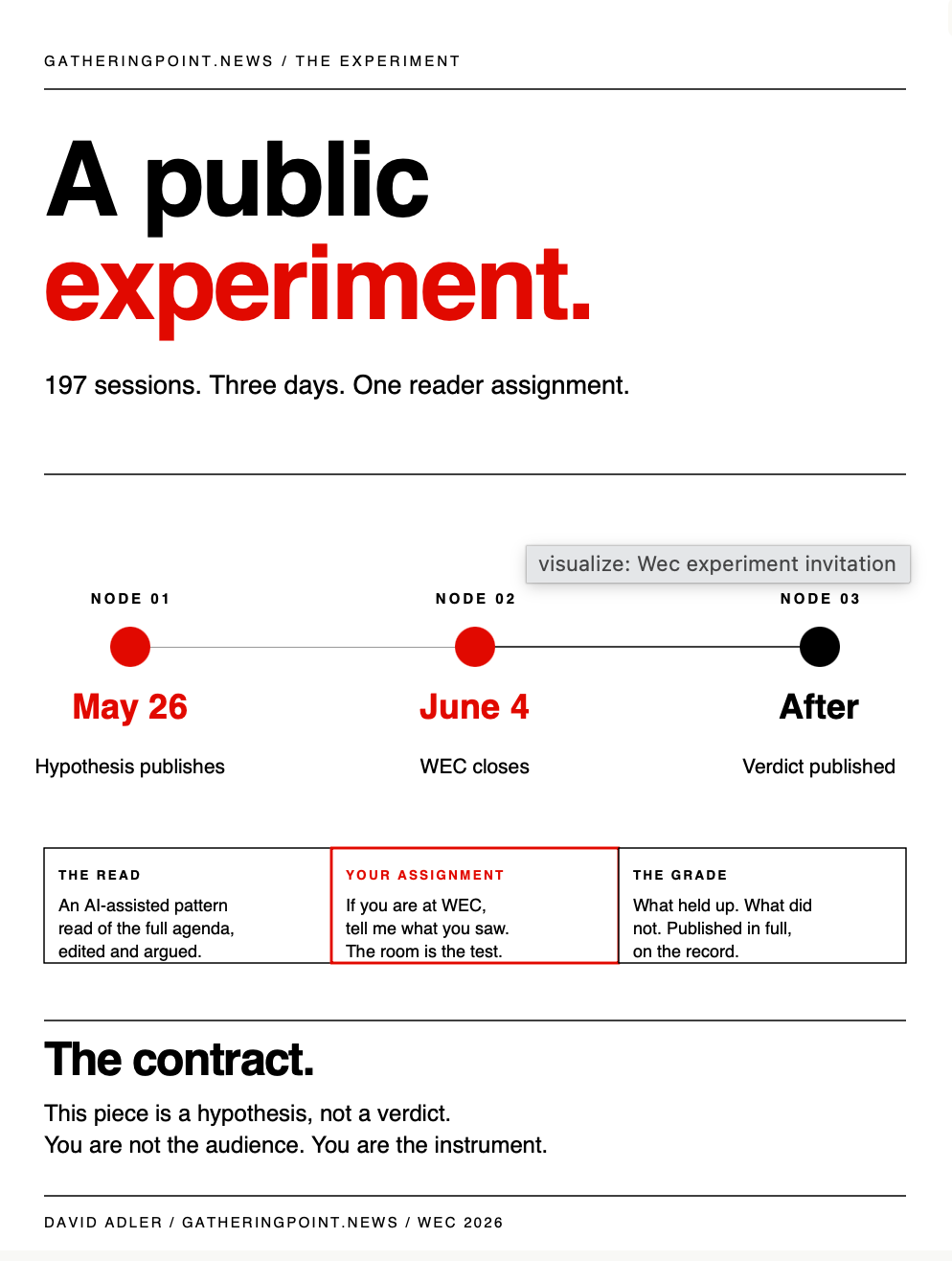
So here is the deal. I am publishing this now, before WEC. After it closes on June 4, I will publish a follow-up that grades what held up and what did not. If you go to WEC, tell me what you saw. That is how the test works.
Now the read.
A bit more orientation, for readers outside the meetings industry
Five things will help the rest of this piece make sense.
MPI is the largest trade association in the meetings industry by membership, but the trajectory matters. At the association’s late-2010s peak, MPI claimed somewhere between 18,000 and 24,000 paid members across roughly 80 to 90 chapters in more than 20 countries. By 2025, MPI’s own press conference numbers were closer to 13,000 members and about 6,500 planner members, across 70 chapters in 75 countries. The pandemic hit professional associations hard across the board, and MPI has not fully recovered. The association has shifted its public-facing language from membership counts toward “community” figures of roughly 60,000 and toward the $26 billion in annual buying power its planner members collectively represent. Those are the numbers an association uses when its membership numbers are smaller than they used to be.
MPI’s membership is split between two big buyer categories that you need to keep straight to follow the rest of this piece. The first is the in-house planner — the person who plans events as part of a corporation, association, or other end-buyer organization. They work at companies like Salesforce or Pfizer or the American Heart Association, and they plan events for their employer. The second is the third-party planning company, which is the firm a corporation or association hires when it does not want to run its events in-house. The major names in this category are HelmsBriscoe, the largest site-selection firm in the industry with roughly 1,500 independent associates and over $4 billion in annual meeting spend influence; ConferenceDirect, the other major site-selection firm with hundreds of associates booking thousands of events a year; Maritz Global Events, the largest by employee count with about 4,000 staff and a specialty in incentive travel and behavioral-science-driven event design; BCD Meetings & Events, the enterprise-scale operator running large-scale corporate programs in over 100 countries; American Express Global Business Travel Meetings & Events, the meetings arm of the largest travel-management company in the world; and BI Worldwide, the multinational that serves 2,000 global corporations across 144 countries. Alongside these, the destination management company sector, known as DMCs, handles on-the-ground logistics in a given city, and independent shops round out the long tail. Both the in-house and the third-party categories are at WEC. They are buying different things from the conference.
MPI does not operate alone. The other major trade association in this sector is the Professional Convention Management Association, known as PCMA. PCMA has about 8,400 members across 17 chapters in 40 countries. It is smaller than MPI by total membership but more concentrated in senior business-events strategists, and it has held steadier through the pandemic.
PCMA’s flagship annual conference is called Convening Leaders. CL26 ran in Philadelphia from January 11 through 14, five months before WEC. The two associations compete directly for the same buyers, the same sponsors, and the same destination-host budgets, and the competition has sharpened over the past three years. Reading WEC without reading PCMA is reading half the picture.
WEC is MPI’s flagship annual conference. It is not the largest meetings industry event by attendance — trade shows like IMEX America and IBTM World draw bigger crowds. WEC is something different. It is the year’s most concentrated gathering of the people who actually plan the events, plus the hotels and destinations selling them venues, plus the production companies and technology platforms selling them services, plus the certification body that grants them the credentials they carry on their business cards. Think of WEC as the annual stocktaking for the meetings industry. WEC 2026 is in San Antonio. WEC 2027 will be in Las Vegas.
The gathering economy is the broader business that MPI and PCMA both sit inside. It includes business conferences, music festivals, sports events, cultural festivals, trade shows, fundraisers, religious gatherings, weddings, and every other format that brings people into a room on purpose. Estimates put the global business-events portion alone at well over $1 trillion in direct spending. The gathering economy is one of the largest service sectors in the world, and it is also one of the least covered by serious journalism. That is the gap GatheringPoint.news exists to fill. WEC matters because it is where one major segment of the gathering economy — the business-events segment — sets its annual agenda, even as the trade association running it is fighting to rebuild what the pandemic took.
With that on the record, here is what the agenda reveals.
Why this matters if you work elsewhere in the gathering economy
This piece is going to be read most carefully by the planners and the third-party operators inside the meetings industry. But the WEC agenda is also worth reading if you work in any of the other major sectors of the gathering economy, because the problems the meetings industry is talking about in 2026 are the same problems your sector is wrestling with right now. The arguments just look different in your room.
If you run a trade show or an exhibition, the WEC agenda is the closest thing the convening world has to a public document about what your hosted buyers are now demanding from their conference experiences. The behavior-change-over-inspiration thesis lives in your sector too, just under different language. The AI track is the conversation the trade show world has been having since the Stova-Bizzabo-RainFocus consolidation cycle started. The succession-crisis session is the one the family-owned trade show businesses have been postponing for a decade.
If you produce concerts, festivals, or live music events, the WEC agenda is a window into how the corporate side of live experience is being rethought. The Aztec Theatre Learning Journey, hosted by a Live Nation venue, is your sector teaching the corporate sector how shared rhythm and collective energy actually work in a room. The biometric measurement sessions are the same audience-data conversation Live Nation, AEG, and Pollstar have been running for years. The behavior-change argument is what every festival producer already knows — the seated rock show is dying, the immersive multi-stage experience is winning — translated for the corporate planner who is just now catching up. The interesting question is what the meetings industry has to teach your sector in return. The certification infrastructure, the procurement discipline, and the senior-buyer operating intelligence at WEC are things the festival world has historically been weaker at. The trade goes both ways.
If you work in sports — the leagues, the teams, the venues, the sponsorship sales operations, the experience-design teams running premium hospitality and fan engagement — the WEC agenda is the corporate convening world’s version of the conversation your sector has been having since the venue-as-platform thesis took hold. The Hard Rock Cafe Learning Journey, sponsored by Encore, is engagement-mechanics content delivered inside a music venue, which is structurally the same move sports venues are making when they sell premium hospitality experiences around the game itself. The senior-buyer track on vendor economics and commissions is the meetings-industry version of the operating intelligence the sports business has been running through Sportico and Sports Business Journal for years. The pink-collar workforce argument is the conversation sports has not yet had publicly but has been simmering inside the operations and hospitality side of every major franchise.
If you are an entrepreneur, a salon founder, an invitation-only retreat designer, a community builder, or anyone running a smaller-scale convening business, the WEC agenda is the institutional version of the work you are doing on a more agile scale. Beth Surmont’s live hackathon session is the framework version of what House of Beautiful Business or Summit Series have been doing intuitively for a decade. The behavior-change argument is the institutional acknowledgment of what every salon founder has known since they hosted their first dinner. The interesting move for the entrepreneurial convener is to read the agenda not for what it tells you about your model — your model is ahead of theirs — but for what it tells you about how the trade association will eventually market your competitors.
And across all four of these sectors, the meta-read is the same. The gathering economy is one industry pretending to be five. The corporate meetings world, the trade show world, the festival and concert world, the sports experience world, and the entrepreneurial convening world all face the same structural questions: how do you design for behavior change rather than passive attendance, how do you measure outcomes that justify the spend, how do you treat the workforce that delivers the experience, and what does AI do to the planner-and-producer job description. WEC is the meetings industry’s 2026 answer. Your sector has its own answer. The piece you are about to read is a hypothesis about one sector that should sharpen your read of your own.
Now, with everyone reading for their own reasons, here is what the WEC agenda actually reveals.
A trade conference agenda is a menu, and three cooks are in the kitchen
A trade conference agenda is a menu. The trade association decides what to put on it. The buyer decides what to order. The menu tells you what the kitchen thinks the room wants to eat.
Three different cooks are working in this kitchen, and you cannot read the WEC menu honestly without seeing all three.
The first cook is the education team. Their job is to deliver content that makes the planner walk out of the conference more capable than when they walked in. Their incentive is intellectual rigor and member development. They program the sessions that build the planner’s craft.
The second cook is the sponsorship team. Their job is to sell sponsorships, booths, and venue placements to suppliers who want to be in front of the planners with budget. Their incentive is revenue. The sponsorships they sell pay for the conference the education team programs.
The third cook is the most important one to name. The association has lost about a third of its members since the late 2010s, and it is competing with PCMA for the members who remain. Every programming decision is also a membership-recovery decision and a competitive-response decision. Sessions are not just being chosen for intellectual value or sponsorship value. They are being chosen because the association needs to give six different kinds of buyer a reason to register, renew, and bring a colleague next year, and because PCMA already ran its 2026 conference in January with arguments MPI now has to match or exceed. The menu is built under that pressure, and you can see the pressure in the breadth of what is on it.
What PCMA already did in January
Before reading the WEC menu, it is worth knowing what the room has already seen this year.
PCMA Convening Leaders 2026 ran in Philadelphia in January, celebrating PCMA’s 70th anniversary. The trade press recap was favorable. Trade Show Executive wrote that the program “redesigned the event experience around human outcomes instead of inherited conference habits” and that “from the moment attendees scanned the program, it was clear this wasn’t a show built around tracks and time slots. It was built around intention.” PCMA organized its education through three narrative lenses — Unity, Legacy, and Momentum — that gave the conference a clear editorial spine.
That matters for reading WEC. The behavior-change-over-inspiration argument I am about to walk you through in the WEC menu is not original to MPI. PCMA executed a version of it five months earlier with a tighter narrative architecture. MPI is now running its flagship with a similar argument but on a much bigger menu — 197 sessions versus PCMA’s tighter program — and without the same three-lens spine. WEC and CL26 are running parallel arguments in 2026, and the comparison is worth making honestly. Whether MPI’s bigger menu delivers a clearer experience than PCMA’s smaller one is one of the things attendees can grade after the room.
What MPI thinks the industry wants right now
With that competitive context in place, four things stand out about what MPI is putting on its menu.
The first is that the buyer is tired of the gala. Cheryl Gentry, founder of Glow Global Events, is running a session called “Beyond the Gala: Designing Events that Transform, Not Just Perform.” In the same time slot, in a different room, Francois Florès of TKNL is running “Designing Events That Change Behavior: From Intention to Impact.” Same argument. Two rooms. Head to head.
The argument is simple. The traditional gala or seated banquet event has stopped delivering. The buyer wants events that change what people do, not events that make people feel something for an evening. Seven sessions on the program make some version of this argument. These are education-team sessions. No sponsor is paying for the room. The thesis is the product.
The sharpest item on the menu
One session on the program is worth a paragraph of its own.
Dr. Keira Solon, a professor at the University of Central Missouri, is presenting a session called “From Pink Collar to Strategic Powerhouse: The Professionalization of Meetings & Events.”
“Pink collar” is a term economists use to describe jobs that are mostly done by women and that pay less than they should, partly because women do them. Teaching, nursing, administrative work, and event planning are classic pink-collar fields. About 80 percent of the meetings industry workforce is women.
Solon is bringing that argument onto the WEC stage. From an academic department. With the term in the title. That is unusual. Most trade conferences would not put that session on the program. MPI did. This is the kind of editorial risk PCMA did not take at CL26, and it is worth giving MPI credit for it.
This is the clearest education-team session on the menu. No sponsor is going to pay for a room where an academic argues that the workforce is structurally underpaid. The session is on the program because someone on the education committee fought for it. If you go to WEC, go to this session. If you write about WEC, find Solon afterward. This is the story most of the trade press will miss.
What the rest of the menu is selling
Beyond the workforce argument, the menu has two more big things on it.
One is artificial intelligence. There are at least ten AI sessions on the program. Some are practical, like “Beyond the Easy Button: Practical AI for Real Hospitality Work.” Some are defensive, like “The Psychology of Connection: Human Skills That AI Can’t Replace.” Some are about restructuring the planner’s job entirely. The official press release said WEC would have “increased focus on AI.” That undersold it. AI is one of the three biggest threads on the program.
The AI track is mixed. Some sessions are education-team programming aimed at helping the planner understand the technology. Some are sponsored vendor showcases on the Marketplace floor, with named platforms presenting their products. Both kinds of session deliver value, but they deliver different kinds of value. A reader of the agenda can tell them apart by the room. Anything on the Marketplace floor is closer to the sponsorship side of the kitchen. Anything in a numbered breakout room is closer to the education side.
The other big thread is senior-buyer content. This is the part of WEC aimed at the C-suite of the third-party planning companies, the CEOs and presidents of HelmsBriscoe, ConferenceDirect, Maritz Global Events, BCD Meetings & Events, Amex GBT M&E, and their peers; the senior vice presidents running meetings procurement at the global travel-management firms; the CEOs of the major DMCs; and the CFOs across all of these categories. These are not the in-house planners. They are the people running the companies that plan events as a service. Their economics are different. Their incentives are different. Their education needs are different. WEC is increasingly building content for them.
Michael Varlotta is teaching “The New Vendor Economy: Commissions, Bonuses and Rebates Explained.” That session would not have appeared on a trade conference five years ago. The vendor-economics conversation used to happen behind closed doors. Now it is on the main menu.
The senior-buyer track does double duty. It serves the buyer who wants procurement intelligence. It also serves the association by concentrating the most valuable attendees — the people who actually authorize spend — into a tighter cluster that sponsors and suppliers can target with precision. Both cooks are happy with this track. The education team gets to deliver serious operating content. The sponsorship team gets to tell their suppliers exactly where the decision-makers will be sitting.
It is also worth saying that PCMA’s natural audience skews more senior than MPI’s, so this track is partly MPI playing on PCMA’s home turf. The senior-buyer content at WEC is the association telling its third-party-operator members that they do not need to register for both conferences. That is a competitive move.
What each kind of buyer gets
A menu is only useful if it serves the person ordering. Here is what WEC delivers for each kind of attendee.
If you are a mid-career in-house planner, you get a methodology track. The four keynotes are the framework layer. Jim Kwik closes the conference with a session called “Being Unforgettable: Mastering Your Mind and Memory and Hosting Experiences People Never Forget.” That is a memory-and-attention framework explicitly applied to hosting events. The breakouts are where you apply it. Bring a notebook. Run a debrief on the flight home.
If you run a third-party planning company, a DMC, or an independent planning shop — meaning you are buying registration not for yourself as a planner but for yourself as the operator of a planning business — you get the senior-buyer track. Vendor economics, hotel data from STR, succession planning, the C-suite roundtable. This is the quiet half of the program. It is also the half that pays for the registration, because operating intelligence at this level is hard to find anywhere else in the industry calendar.
If you plan medical meetings, you get a vertical conference inside a vertical conference. Twelve medical-tagged sessions, a certificate program, procurement content from Biogen, and a peer roundtable. Pharma compliance content is sharper than the marketing suggests.
If you are a supplier, destination, hotel brand, or production company, the question is not what you learn at WEC. You already know the operating content. The question is whether WEC delivers enough qualified buyers in front of you to justify what you paid to be there. This is the part of the menu that exists because suppliers fund the conference. Sponsorships, booth space, and venue placements pay for the program the rest of the attendees receive.
The Learning Journeys are the association’s strongest answer to the supplier question. These are immersive off-site sessions held in San Antonio venues like Hard Rock Cafe, the Aztec Theatre (a Live Nation venue), and The Alamo. Each Journey runs for several hours and delivers a captive audience of planners to a venue or sponsor that wants to be on their consideration set for future bookings.
The Hard Rock Cafe Journey is sponsored by Encore, the production-and-AV company. It is already at capacity. That is not buyers voting for the content. That is Encore’s brand strength inside the planner community converting into seat demand. The Aztec Theatre Journey, hosted by a Live Nation venue, has 68 spots left. The Alamo Journey, with no major commercial sponsor wired into it, has 38 spots left on the first slot. The pattern is clear. Journeys backed by a sponsor with a buyer-acquisition strategy fill faster than Journeys without one.
For the supplier reading this, the read is straightforward. WEC has built a more sophisticated buyer-introduction format than the traditional trade show booth. Whether that format converts into pipeline is a measurement question your sales team should be running on the registrations you sponsor.
If you are a rising leader, you get a leadership-development track that is more substantial than its marketing footprint. Pat Russell-McCloud, Charlene Liu, Courtney Stanley, and Antwone Stigall anchor it. This is education-team programming. No sponsor is paying for these rooms.
If you volunteer for an MPI chapter, you get a full chapter-leaders track across all three days. The trade association is recognizing the people who do its unpaid work, and that recognition is more important than it looks. Chapter volunteers are the labor force that keeps MPI’s regional presence alive in a period when the national association has lost members. The chapter-leaders track is the association investing in the people holding the local rooms together.
Where I might be wrong
I owe you the honest version of this.
I have argued throughout this piece that MPI built a coherent program with four big arguments running through it. That might be right. It might also be wrong.
Here is the other possibility. A trade conference program is built by a committee balancing speaker submissions, sponsor commitments, certification requirements, and political obligations to chapters and communities. The patterns I see in the agenda might be the result of independent speakers bringing their own arguments and MPI booking the ones that fit. Gentry talks about behavior change everywhere she speaks. The trade association booking her is not the same as the trade association authoring an argument.
I have also been more generous about MPI’s confidence than the membership trajectory supports. The association is smaller than it was a decade ago. The 197-session program might be evidence of editorial ambition. It might also be evidence of an association trying to be everything to everyone because it cannot afford to lose any segment of buyer. Both readings are true at once. Which one dominates depends on which kind of session you attend.
I have also been generous about WEC’s originality. PCMA Convening Leaders ran its 2026 conference in January with a similar argument and a tighter narrative architecture. The behavior-change-over-inspiration thesis is in the air across the industry right now, and MPI is part of that conversation rather than the source of it. The honest read of WEC is that it is the larger association responding to a more agile competitor that has been editorially sharper for several years. The response is real. The originality is not.
I have also argued that the Learning Journeys exist primarily as buyer-acquisition vehicles for sponsors. That is the underlying economics of how trade conferences fund themselves. MPI could counter that the educational content is the point and the sponsorship is the funding mechanism that makes the content possible. Both readings are true at once. The honest version of how trade conferences work is that the cooks in the kitchen are constantly negotiating, and the menu is the visible record of where that negotiation landed for this year.
The structural patterns I named are real. Whether MPI intended them or stumbled into them is something I cannot answer from outside the room.
The test that matters
This is the test, and the reason I am asking you to read this piece as a hypothesis rather than a verdict.
AI can read a 197-session menu and tell you what is on it. AI cannot tell you how the food tastes. AI also cannot reliably tell you which cook made which dish, or whether the chef next door already served a better version of the same meal in January.
The patterns above are visible in the program. Whether those patterns hold up in the actual rooms, with actual people, is the test that only the conference itself can run.
Some specific things to watch for. Does Solon’s pink-collar session pack the room or stay quiet? Does the behavior-change argument show up in the breakouts the way it shows up in the session titles? Do the Learning Journeys feel like education or like sales calls in disguise? Do the sponsored sessions deliver real value or do they read as paid placements? Does the program feel like a confident association making big bets, or does it feel like a smaller association working hard to hold its membership base together while catching up to a more agile competitor? Both could be true at once.
If you went to PCMA Convening Leaders in January, your read of WEC will be sharper than mine. Tell me what you noticed.
If you go to WEC, come back and tell me what the room delivered. The comments are open. So is my inbox. After the conference closes on June 4, I will publish a follow-up piece grading what held up.
The trade association put 197 items on the menu. Three cooks made the menu. A competitor served a similar menu five months earlier. The agenda is the hypothesis. The conference is the test. AI can read the hypothesis. Only you, in the room, can tell us whether the menu delivered what it promised.
See you on the other side of June 4.


