


My longtime photographer called with what he took for a storage problem and I recognized as a eulogy. Sitting in his garage were seventy thousand photographs he had shot for Washington Dossier, the society magazine I started at 21: decades of galas, embassy receptions and ballrooms, the social archaeology of Washington gatherings. His wife wanted the garage back, and he was going to throw the lot out. I bought the collection on the spot, which turned out to be the cheap part, because an archive nobody can search is only a heavier kind of garage. What has changed is that AI now does the threshing. Lightroom‘s face recognition identified people across thousands of frames. QR codes tied each photo to its original coverage in a historical exhibition, so image and story traveled together. And, because the tools now permit this kind of mischief, I turned the era into songs, drafted with Claude and ChatGPT, heavily edited by me and produced in Suno, which live on YouTube as a narrative film and a playlist. One person with a subscription stack turned a garage into an exhibition, a soundtrack and a living archive.
Every organizer has a garage like that: years of photographs, session recordings, programs and hallway conversations, captured once, used once and filed. AI has made the second, third and tenth use of that material nearly free, and it has changed what a content farm is. For fifteen years the term meant keyword sludge from warehouses of underpaid writers, then underprompted machines, and generative AI finished that model by making generic content worthless. The smartest people in the events business are now farming a different crop. Not text. Trust. The first-person account of someone who was actually in the room is the one thing AI cannot fake at scale, and your event grows it in absurd abundance. This guide walks the four fields you own and probably never harvest: the floor, the faces watching your stage, the week after load-out, and the boxes in the garage. Then it turns to a fifth reader, the AI agent that may be judging your event before any human does.
In brief: what’s in it for you
Your event already produces the one thing AI cannot fake: first-person accounts from people who were in the room. Collect them yourself, at the show.
People are polite in the moment, so pair the stories you harvest with a survey you write before the event.
Every old photo and recording can be reused, and the older the archive, the more there is to connect.
Before anyone attends, an AI agent may judge your event on what you have published, so publish accounts it can read.
Your event archives could be a gold mine. We now have the tools to harvest them.
Be the one who asks the question
The interview is the most important intelligence tool an event’s managing director has, and I mean the interview conducted personally by the person whose name is on the show. Politicians call it a listening tour. An event is a listening tour that assembled itself: your entire market in one building, wearing name tags, for three days. At Washington Dossier I worked those rooms nearly every night in black tie, so relentlessly that my neighbors decided I was a maître d’, and they were closer than they knew, since a good one remembers names and notices who is talking to whom. So nothing makes me more apoplectic than a show office full of staff catching up on email while the floor is live. The email will exist next Tuesday; the floor exists for a few dozen hours a year. When the decision-maker hears an exhibitor’s frustration directly, it lands at full voltage instead of arriving pre-shrunk and softened by a staffer, and a transcribing voice app in your pocket records every corridor conversation without breaking eye contact.
Before the show: let your speakers do the sharing
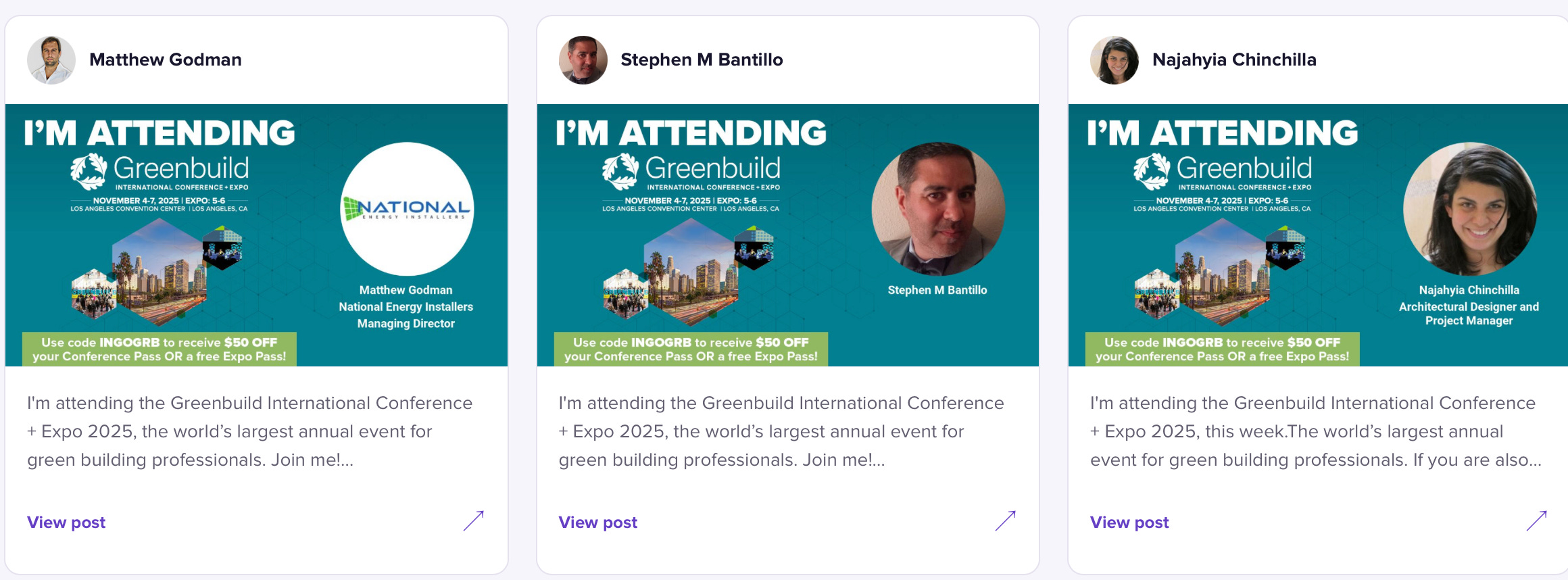
The harvest starts before the doors open, and most organizers leave that stretch to chance. Every speaker, sponsor and exhibitor is about to post some version of “I’m speaking at,” and InGo, the company Michael Barnett runs on the premise of turning attendees into advocates, has built a business out of making that moment effortless. According to InGo’s own blog, each participant receives an email with a post already drafted, one click leads to a page where a personalized version goes out in seconds, and the reminders reach only the people who have not yet shared, with different messages for attendees, speakers, sponsors and exhibitors and, by default, eight send opportunities across the event’s life. InGo says it gets 20 to 40 percent of speakers, sponsors and exhibitors to share, against 2 to 4 percent for most events; that is the company’s claim and I have not verified it. These posts belong in a guide about harvesting because they are testimony in miniature, a named person on the record saying why a room is worth being in, and they are the earliest content your event produces. In my inference they are also among the first things an attendee’s agent will read.
Field one, the floor: ask a specific person a specific question
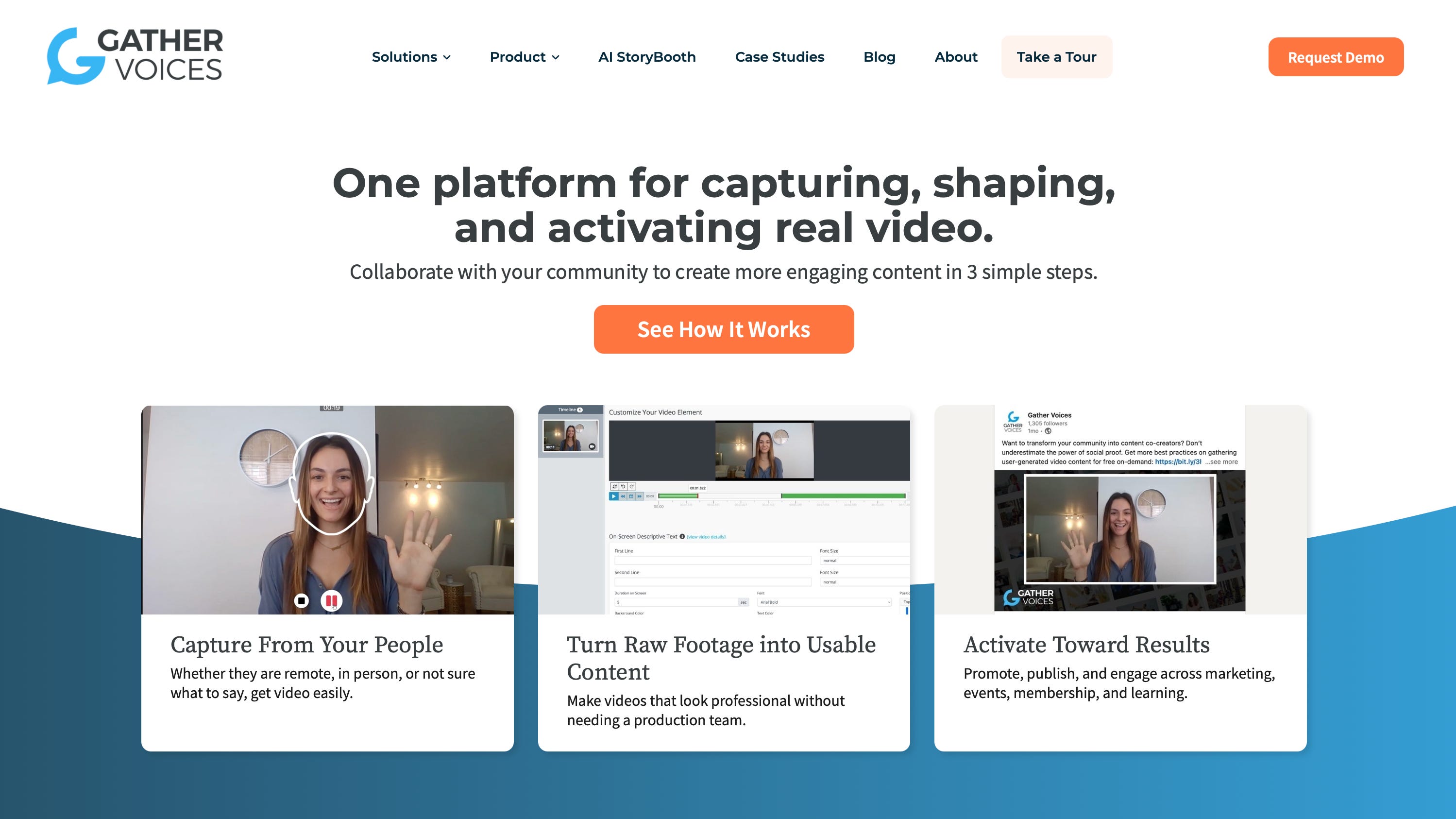
Michael Hoffman built his company, Gather Voices, on a heresy he could not shake while running the video agency See3: agency video does not scale. The inversion is to stop producing content about your community and start collecting it from them, because most people will never volunteer to perform but nearly all will answer a good question at the right moment. The results are not subtle. PCMA captured attendee stories at its annual meeting and put three of them on its homepage, the American Association of Orthodontists pulled more than 80 usable videos in three days, and ASAE collected over 1,600 stories across five years without adding headcount. The tool is Gigi, an AI interviewer that walks an attendee through a structured story on-site and produces branded, captioned video by the dozen.
I can report on Gigi from the guest’s chair. I sat down with her and she asked me [one or two of her actual questions]. I answered. Afterward a note from the Gather Voices team told me the interview had been turned, automatically, into finished videos in two aspect ratios, a vertical cut for phones and a horizontal cut for screens, each with its own share link. I did nothing in between, and that is the innovation: the gap between telling a story and holding a shareable piece of media collapsed from weeks to nearly nothing, which turns the guest into the distributor.
The tools differ at the margins (Vocal Video, Vouch, StoryPrompt and VideoAsk run variations), but the principle does not: ask a specific human a specific question at the moment they have something to say. If you could not hire anyone, a phone on a tripod near the coffee is a booth, a QR code is a crew, and Descript, which lets you edit video by editing its transcript, is the post-production house. The machine drafts. You farm.
Field two, the faces: people are polite, so watch the room

At a gathering of exhibition leaders, an executive leaned over to Mark Brewster in the back of a breakout and said the session was, bluntly, awful: the speaker had missed the point and the room was tuning out. Two minutes later the speaker wandered over, and the same executive smiled and said, “Great job up there.” Brewster, founder and CEO of Explori, the London platform whose benchmarks draw on more than three thousand trade shows, conferences and corporate gatherings, has watched versions of that exchange for fifteen years. “Humans are fundamentally polite,” he told me. “You cannot trust people to be completely true with you in the moment.” The honest verdict on your event is delivered in the back row, and it never reaches the stage.
That is why the room is the best focus group you will ever convene, if you watch it instead of asking it. When two thousand people laugh at the same instant, that instant is the clip. Computer-vision companies like Zenus sell anonymized, aggregate engagement readings, but the free version works: put one person at the back with a notes app and one instruction, timestamp every laugh, lean-in and spontaneous round of applause. That list is your edit decision list, and you know which moments to clip without watching a single hour of tape.

Brewster’s remedy for politeness is not to listen harder but to plan the listening before the event exists. He wants organizers to write the survey first, decide what share of attendees should hold which belief afterward, and design the event backwards from that number. He also argues that the industry’s response rates of eight to twelve percent are a symptom of neglect, since the survey usually arrives as one more tired email. His counterexample is Nicola Kastner at the Event Leaders Exchange, whose surveys have never drawn fewer than 74 percent, with the best just shy of 90, and who has never spent a dollar on incentives. She announces from the stage what changed because of the previous round of feedback, and her emcee repeats the point, so attendees know the survey is coming and what it did.
Here is the conundrum that follows for anyone farming testimony. A video collected on the floor is collected in the moment, and in the moment people are polite. The cheerful clip and the honest survey answer can come from the same attendee within the same afternoon. This is my inference from Brewster’s argument, not something he said. Harvest stories to make the event’s value visible, and run a survey designed in advance to learn whether that value is real, and do not mistake one for the other.
Field three, the week after: follow up while it’s warm
The traditional post-event playbook was a thank-you blast, a survey and silence, and the waste is almost comic: the Center for Exhibition Industry Research has found that 81 percent of trade show attendees carry buying authority, while research from Certain and Salesforce puts the share of event leads who never receive a single follow-up near 80 percent. The first 48 hours after an event are a second harvest window, with attendees back at their desks and the ideas still warm, and a simple link asking what they are bringing back to their team on Monday will surface material no booth could catch. Platforms now assemble a different recap for each attendee, and the finished videos that reached my inbox from the event were exactly that, a personal recap made from my own words.
My own version I call tribal personalization, and it is deliberately smaller than the software: a thirty-second phone video made for one person beats a polished video made for a list, because it proves someone was paying attention. Lately my thank-you notes are becoming songs, written with an AI, edited hard and sent to one recipient, and nobody deletes a song written about them. The deepest version converts the harvest into a standing crop. Gather Voices asks everyone who records on-site whether they would do it again during the year, and ninety-seven percent say yes, which turns a one-day interview into a year of ambassadors.
Field four, the garage: your old shows are the treasure
The last field is behind you. The New York Times kept five to seven million photographs in a basement archive staffers call the morgue, and began digitizing them with Google Cloud, using machine vision to read the handwritten notes on the backs of prints and spinning the result into a franchise called Past Tense. Every organizer with a few shows behind them owns a morgue, and what AI changes is how many lives one asset can lead. Take a single photograph from an opening night years back. Face recognition names the people in it, which turns an anonymous crowd into community members you can invite back. A QR code ties it to the original coverage. It goes on a wall at the anniversary edition, into a where-are-they-now email, and onto a registration page for the twenty-year attendee who finds herself young in the corner of the frame. Take a session recording: a transcription tool makes it searchable, an editor pulls the best ninety seconds, and the same material becomes a vertical clip, a quote card, a newsletter item and a seed for next year’s program. None of this needs new content. It needs someone to open the boxes.
One caution, earned the hard way: the value of all this farming is that a specific human said or did a specific thing. Let a model rewrite what people said, or synthesize testimony nobody gave, and you have rebuilt the old content farm with better lighting and burned the only asset you were growing. The machine can find, sort, clip, caption and reformat. It cannot be the witness.
The longer you’ve farmed, the more connects
The deepest reason to farm early is that content compounds, and the new tools finally let you see the compounding. I wrote a profile of Michelle Mason, who has led ASAE, the American Society of Association Executives, since 2021 (ASAE’s Gatherer of the Gatherers), and then built an avatar of Emmett Hay Naylor, who founded the organization in 1920 with 67 charter members. Mason told me she had never studied the first person to hold her job, so the two had never been read side by side. When I did, the story found echoes across a century: both built their work around gathering people for a shared purpose, both were shaped by mothers who brought people together around a table (a detail Mason did not know about Naylor, per my story), and both built an institution against outside suspicion, Naylor facing the antitrust climate of the early 1920s and Mason the threat to associations’ tax status in 2024. Naylor wrote a 1921 book arguing that cooperation is natural and competition the artificial condition, and Mason arrived at a similar view from a different life. I did not set out to find those connections, and the story presents them as a discovery in my reporting, not as established history. They surfaced because both stories sat in the same searchable pile of material, and the line between a founder’s words and today’s chief executive is exactly what no person can trace across a century unaided and a machine can surface in an afternoon.
An Avatar of an AI generated imagined Emmett Hay Naylor
Without the jargon, the method has three steps. A transcription tool turns every speech, recording and document into searchable text. A language model reads that text and finds where two sources echo or answer each other across decades. A video avatar tool then gives a historical figure a speaking presence, which is why it must be labeled as synthetic and why, under the rule I set out above, it should say only what the source material supports. The lesson is the one the garage taught me: the older and deeper the archive, the more connections there are to find, so every year an organizer does not capture is a year of connections that can never be drawn. Farming started late is still farming started, because with these tools the oldest material is often the most valuable.
The fifth reader: software decides before anyone attends
Everything above assumes a human eventually looks at what you harvest, and that assumption is expiring. Attendees are starting to send software to do the first round of their shopping: agents that read an event’s agenda, roster, session descriptions and published testimony, then report back before the registration page is ever opened on whether the show justifies the airfare and which sessions justify the week. I have written about the buying side of this in The Disclosure Economy, my Gathering Architecture paper on agents deciding event attendance, and about the extraction side in “Strip-Mined”.

What these pieces share is that an agent can only weigh what has been written down. My inference, not a measured finding, is that an organizer who has harvested nothing hands the agent a brochure and sponsor copy, which any sensible reader discounts, while an organizer with a deep shelf of named, dated, first-person accounts from people who were in the room hands it the one kind of evidence it cannot manufacture. The testimony you collect on the floor is therefore also your pitch to a reader that never attends. A practical corollary, also my suggestion: publish your testimony and session material as text with speakers named and dates attached, because a video with no transcript is invisible to a machine. The caution is the other edge of the same blade, since the machine readability that lets an agent vouch for your show also lets it lift your agenda, roster and sessions without ever buying a ticket, so decide before you publish what you are willing to have read, and by whom.
I think often about how close those seventy thousand photographs came to the landfill, and how ordinary the phone call sounded. The era we covered now has an exhibition, a searchable archive and a soundtrack, and people who attended those rooms decades ago scan a QR code and find themselves young again, mid-laugh, mid-deal, mid-gathering. Your event is growing that crop right now, on the floor, in the faces, in the inboxes, in the boxes. The only question is whether you own a combine or a dumpster.
GatheringPoint covers the people who build the gatherings. Subscribe at GatheringPoint.news.