
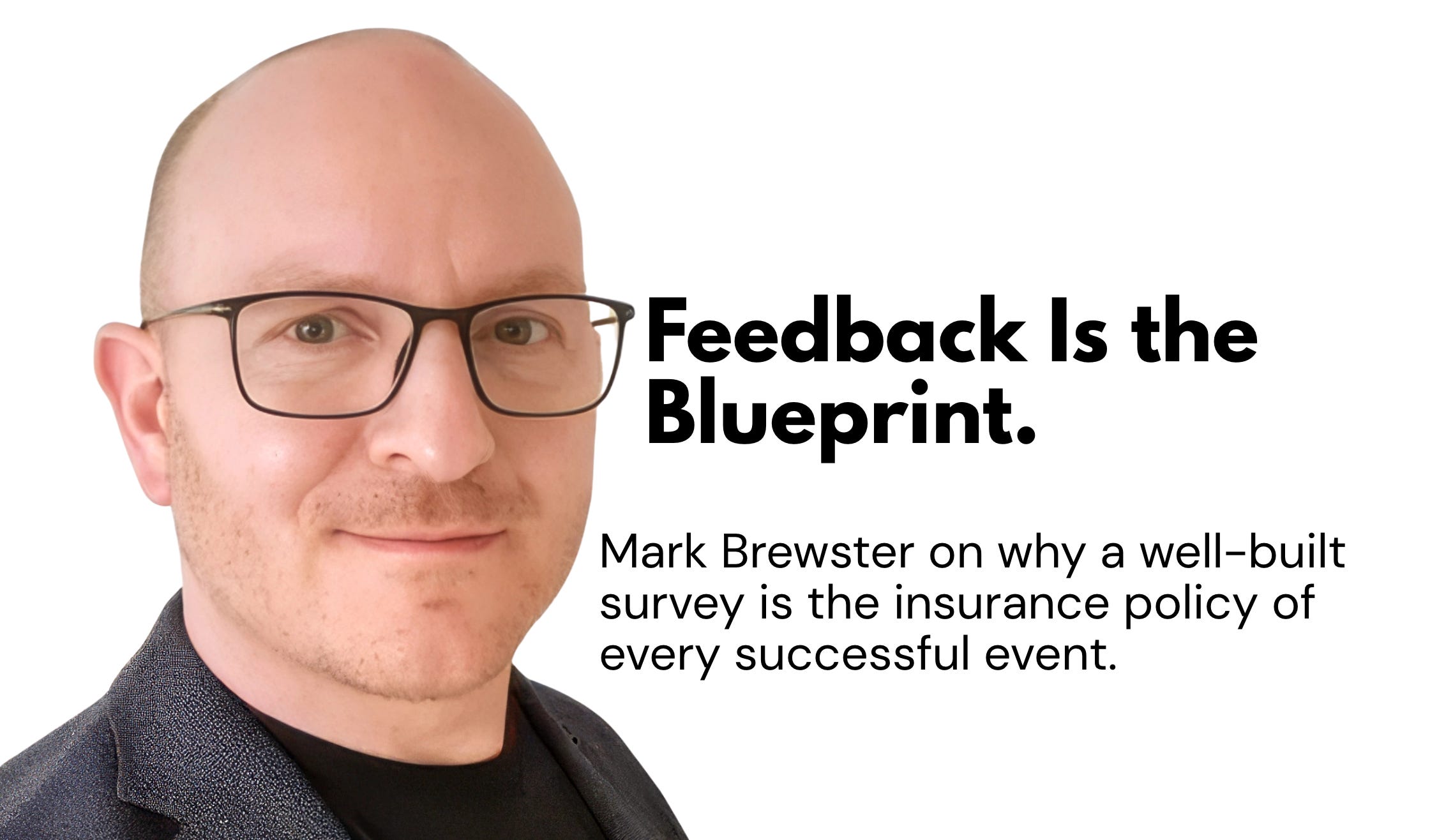
Mark Brewster Wants the Events Industry to Write the Survey First
The feedback approach the industry is slow to adopt , and the one man who keeps arguing for it.
At a recent SISO gathering of major exhibition leaders, an executive leaned over to Mark Brewster in the back of a breakout and said the session they were sitting in was, bluntly, awful. The speaker had missed the point. The content was thin. The room was tuning out. Two minutes later, the speaker wandered over to say hello. The same CEO turned, smiled, and said, “Great job up there.”
Brewster watched the whole exchange. He has watched versions of it for fifteen years. To him, it is the cleanest illustration of why the events industry cannot trust its own ears.
“Humans are fundamentally polite,” he said over a video call last week from a hotel office in London. “You cannot trust people to be completely true with you in the moment. There’s far too much etiquette required in human communication to get the real feedback that you need to understand how you performed.”
Brewster is the founder and CEO of Explori, the London-based platform that holds the largest event-feedback dataset in the world. Over three thousand trade shows, conferences, and corporate gatherings contribute to its benchmarks. More than three million data points on attendee and exhibitor sentiment sit inside it. UFI, the global exhibition industry association, uses Explori as its official research partner. Questex signed a three-year agreement last September. This month, The Expo Group in Irving, Texas announced a partnership giving it exclusive rights to Explori’s thought leadership in the US association market.
Brewster is also the co-founder and chairman of ELX, the Event Leaders Exchange, the invitation-only community of senior corporate event executives that he helped launch in 2022 to push the entire discipline toward a more rigorous standard of measurement. Two companies, one argument. The argument is that the events industry has the feedback loop running in the wrong direction.
The Boy with the Laminated List
Mark Brewster grew up in Surrey, the son of a French mother and an English father, in a household that ran the way a small business runs. The family lived first in South London and later in the commuter belt. His father was an early entrant in British IT recruitment, and the dinner-table conversation was about strategy, pricing, and market differentiation. Brewster, in his own description, had pearls of business wisdom poured into his ears at an age when most teenagers were trying to figure out how to get out of the house.
The chore list was where the philosophy met the carpet. To earn pocket money, Brewster and his older sister had to do work around the house, and the work came with specifications. The list of jobs was, literally, laminated. It included washing the car, mowing the lawn, polishing shoes, polishing the brass ware and the cutlery. Each task came with a service-level description of what a job well done looked like. After the weekly car wash, his father would walk the perimeter of the vehicle, inspect, and point out the parts that had been missed.
“I always just wanted to get the job done in the early days,” Brewster said. “I ended up learning to take pride in doing a good job initially to get him off my back. Then I discovered I liked doing it well. I would end up spending fifteen, twenty minutes longer on it. I developed the OCD thing about how to wash cars.”
That sentence is the origin of everything in the rest of this profile. The man who would spend his career arguing that surveys must be designed properly, promoted properly, analyzed properly, and acted upon properly first learned the principle on a driveway in Surrey, working off a laminated list while his father walked the car.
He also learned about feedback there, in its harshest form. His father was, in Brewster’s words, very brutal when giving it. “Sometimes really to his detriment. There’s a skill in giving feedback so that the person receiving it can take it rather than feel attacked. That’s one of the things my dad got wrong his whole life.”
His mother was the counterweight. Brewster speaks of her in a register he does not extend to anyone else in the conversation. “I can cry talking about my mum,” he says. “Universally loved by anyone that gets to know her. The definition of warmth and kindness and decency and generosity.” If his work ethic comes from his father, his values come from her. His parents separated when he was fourteen.
By thirteen, Brewster had maxed out the chores his father was willing to pay him for. He wanted more pocket money than the laminated list could earn. His father, in a piece of parenting that was either inspired or self-interested or both, told him he had skills. He knew how to wash cars. He had a bike. He could borrow the family’s buckets and chamois leathers and the bottle of Fairy liquid. He could knock on the doors of the neighbors and sell.

He did. Some shooed him away. Others, in what Brewster now thinks must have been straightforward acts of kindness toward an enterprising thirteen-year-old, gave him a try. He ended up with twenty-five customers, busting his weekends washing cars, doing a stunning job because he did not want to have to knock on any more doors. Eventually he learned to ask his customers, after the work was done, whether they were satisfied. Most volunteered the answer without being asked, but the asking is the part that matters. At thirteen, in a Surrey driveway, Brewster ran his first survey.
The other formative wrinkle came in a piano lesson. He was bright and sporty but not what his school would have called academic. The depth of the disconnect did not surface until a piano teacher noticed him leaning forward to read sheet music and realized he could not actually parse the notes. His vision was fine. The dyslexia had not been diagnosed at Caterham School, where he was a student, because dyslexia was not yet on the syllabus. He compensated as so many bright dyslexic children do, by leaning into the spoken word. He talked. He listened. He told stories. To this day he calls people rather than emails them, sends voice notes rather than texts, picks up the phone without checking whether a meeting is on a calendar. The compensation became the career.
The Second Attempt
The career arc that followed school was less straight than the chore list. After a Business Management degree at Solent University in Southampton, Brewster joined Mash Media, the British trade publishing group run by Julian Agostini. Agostini was, to most of his employees, a dominant and even intimidating figure, the kind of charismatic alpha who could clear a room without raising his voice. Brewster was the rare one who pushed back. The two of them would sometimes fight until they were both furious with each other. They ultimately became good friends. The respect was always mutual. By the age of twenty-three, Brewster was an event director under Agostini, launching consumer shows, self-training by reading every exhibitor-theory book he could find, including the work of the British exhibitor trainer Simon Naudi.
Sales was where the marketing instinct from school met the spoken-word instinct from his piano lesson. Brewster sold advertising space at Mash, but he sold it the way his father probably sold IT recruitment. He talked to his clients about their creative, their brand, their competitive positioning, their insecurities. He customized everything. He did not just sell the space.
Two of those advertising clients would later become Explori investors. Arran Coole, an event tech entrepreneur then at ASP, would become his co-founder. Bart Van Bijnen, who co-ran the registration company N200, would put money in. Richard Armitage, who ran the UK distribution for the German exhibition systems firm Octanorm, would become the first outside angel investor in 2014, with roughly two hundred thousand pounds of seed capital that he still holds shares against today. Each of them had bought advertising from Brewster at Mash. Each of them had been treated, as he put it, like the value of their return on investment mattered from the moment the conversation started. Each of them was, eventually, willing to put cash behind the person rather than the deck.
Between Mash and Explori there was a first attempt that did not work. In 2006 Brewster broke off to start a small research business called Aesthetic Research Limited. ARL was, in its bones, exactly what Explori would later become: a survey platform that delivered performance benchmarking, only aimed at cosmetic surgeons and aestheticians rather than the events industry. The concept was sound. The execution was not. Brewster had chosen the wrong business partner to help him build the platform, and after two years of trying, the team still did not have a launch product ready. He had warmed up the market without anything to sell to it. Credibility was leaking. So was the money. He returned to Mash, for a short stint as publishing director, watching the industry from the editorial desk and sharpening the thesis. He never gave up on the idea. Benchmarking feedback, he believed, could work in many industries. Events was one of them. By the time he founded Explori with Arran Coole in October 2011, he had spent nearly a decade learning exactly where the data gaps were and exactly which partner to build with.
Arran was the contrast in leadership style, not in values. Brewster and Coole share, by Brewster’s account, very similar morals: the “do the right thing” line that runs through Explori’s company values belongs to both, and to the rest of the leadership team that has lived and breathed it for fifteen years. The difference between them is temperament. Brewster is impatient and combative. Arran, working closely with him in the early years before stepping into a non-executive role, taught him a different way of leading: kindness and togetherness rather than charisma and the carrot and stick. Where Julian Agostini moved a room with force of personality, Arran moved it by making everyone in it feel held. Brewster learned patience from him. He also learned that the founder who built the first attempt alone needed someone next to him on the second.
The second attempt was not easy. The initial platform required a two-year rebuild that Brewster has called unbelievably painful. The institutional breakthrough came in a meeting with Kai Hattendorf, then CEO of UFI, the global association for the exhibition industry. Hattendorf saw in Brewster’s benchmarks something the world’s exhibition industry had never had: a single instrument that could measure customer health across thousands of shows at once. UFI made Explori its official research partner. The credibility followed. The first major international organizer to adopt the platform was ITE, the British company now known as Hyve. The customer logos compounded from there.
The Fog of War on the Trade Show Floor
Walk any large exhibition and ask ten attendees how it is going. You will get ten answers that may or may not have much to do with the event itself.
“Events are a gossip fest,” Brewster said. “It’s a superhighway of opinions about content, about the event itself, about the organizing team. An exhibitor can be trying to form their own opinion about the quality of the meetings and the kind of value they feel they’re getting. And they go and speak to the company on the booth next to them. They might go and see a couple of other companies. One says, I think this is all right, it feels okay. Another says, no, they really missed the level this year, we’re not seeing any of the right kind of ICPs. Then a key buyer says, yeah, I’m not getting a lot of value from the content this year. Another person says it’s been brilliant for us.”
Perception, in other words, is built by consensus, and consensus is built by whoever the exhibitor or attendee happened to talk to at the coffee station that morning. The number of meetings booked, the badge scans, the app engagement, the exit-polled smiles. Those are proxies. Some of them are useful. None of them tells you what the attendee thinks once they have left the building and sat down on the plane home.
Organizers know this and work around it. They often rely on observational judgment. They trust their operations lead. They ask a few friends. They read the room. Brewster does not dismiss any of that. At ELX, Nicola Kastner runs a wash-up session with her team within an hour of every event closing, before anyone has a chance to decompress over a glass of wine. Brewster thinks the exercise is critical. He also thinks it is not enough.
“Sometimes your personal observational judgment can be sugar-coated,” he said. “Other times you can be hypercritical of your own work and the survey corrects your judgment. You’re like jeez, people really valued that session. That’s interesting.”
The survey, in Brewster’s framing, is the instant replay. The referee on the field, moving at full speed, calls it the way it looked. The booth reviews the tape. The game gets decided by the tape. Events are episodic. They happen once. They cannot be re-run. The feedback loop is the only way any of it gets better next year, but many treat it like an afterthought.
The Afterthought
The numbers are damning. Very often, a trade show can expect an attendee survey response rate between eight and twelve percent. Most organizers accept this as the natural ceiling. Brewster thinks it is a symptom of neglect.
“They could be getting thirty to forty percent,” he said. “They can get a massive sample that is so much more robust. But they don’t, because they’re busy chasing the rebook on site. And the survey is an afterthought. The first thing people hear about it is it landing in their inbox.”
By the time that email arrives, the attendee has already been thrashed by pre-event promotion, mid-event app nudges, and follow-up drip campaigns from every exhibitor who scanned their badge. The survey enters the inbox as one more ask from an organizer, they are already tired of hearing from. Then the industry reads the anemic response rate and concludes that attendees are survey fatigued.
Brewster heard someone say this on stage at a London industry conference last year. The speaker asked the room: hands up if you like completing surveys. Nobody raised their hand. The speaker nodded, satisfied.
“To me it was ridiculous,” Brewster said. “If you ask the same question differently. Hands up if you like completing registration forms, hands up if you like jet lag, hands up if you like downloading the event app, hands up if you like booking your travel. Nobody likes the points of friction. But if you flip the question and say, how many of you like having your voice heard? Every hand would go up. Everyone wants their voice heard and to be understood and to have the opportunity to provide feedback.”
The problem is not that people are tired of surveys. The problem is that the industry is tired of being told things it would rather not hear. When the NPS drops and the verbatim comments say the content missed, a common response is not to fix the content. It is to question the validity of the research.
The Kastner Protocol
RELATED ARTICLE FROM PREVIOUS GATHERINGPOINT.News FEATURE
At The Event Leaders Exchange (ELX), Nicola Kastner sits at the center of a network that quietly shapes one of the most powerful forces in business. More than three hundred senior leaders participate in the community, collectively influencing over 160,000 events each year and nearly $12 billion in spend. Those numbers are large enough to move markets, but the shift she represents is bigger than the spend.
Read the full piece →
The counterexample sits inside the community Brewster helped launch. Nicola Kastner, the CEO at ELX, runs the ELX Annual Congress, the organization’s flagship event. Kastner’s surveys do not perform the way many industry surveys perform. Her lowest response rate on record is seventy-four percent. Her highest, just shy of ninety. She has never spent a dollar on incentives.
What she does, according to Brewster, is refuse to treat the survey as a postscript. It is woven into the event from the first minute onstage. At the opening of ELX’s events, Kastner often walks through the specific changes the team made since the last event, each one credited to member feedback. She references the survey again partway through the program. Her master of ceremonies, Chloe, references it a third time. Attendees know the survey is coming. They know when it will arrive. They know exactly which features of the event they are sitting in exist because someone like them filled one out a year earlier.
“Everyone knows the event design is oriented from their feedback,” Brewster said. “It’s a truly customer centric model. The survey is a critical part of it. It’s a small minority of people that won’t complete.”
There is a corollary story Brewster tells about a hotel in Greece called Sani. He stayed there with his family. Over the course of the week, three different members of staff, a waitress, a front-desk clerk, and the deputy general manager, stopped him to say, by the way, you will get our survey, and it really matters to us. Would you fill it out?
The survey itself, when it arrived, was bad. Fifteen minutes long. Badly designed grid questions. Brewster, by his own admission one of the most survey-fatigued people alive, filled it out anyway.
“That’s a three-hundred-sixty-five-day business model,” he said. “It has feedback continuously. It can iterate what it does day to day. An event exists momentarily. You have one opportunity to really get the intelligence you need for such an episodic product. When you don’t promote the survey, when you don’t give it the love that it needs, when you’ve got such a limited window of opportunity to get the feedback, it is such a missed opportunity.”
The Kastner case is not about clever survey design. It is about culture. Response rate is a function of whether the respondent believes the organizer is listening. Everything else is decoration.
The Inversion
Here is where the conversation turned, midway through a Friday morning call that had already run an hour.
The question on the table was how a general manager should build an event strategy. Brewster was desc loyalty looks like when there is no relationship underneath it.
ribing the ELX approach to strategic design: define the objectives, make them measurable, put a hard number on each one, then design the event backwards from the metric.
“If one of the outcomes, is we want people to see our brand as the leading innovator in its space, that’s easy,” he said. “You design a survey question that says, by comparison to the other companies in the market, how would you describe the level of innovation you see from us? You give them a balanced five-point scale with a midpoint. The objective might then be, we want at least fifty percent of people to see us as the leading innovator. That would be the success metric. You make that decision in strategic event design. That’s the metric we want at the end of it. Then you go, right, how do we communicate that? What are the communication points that need to land throughout the event to shift perception so that at least half of people will see us as the leading innovator? The metric comes first. Then you design the event to achieve the metric.”
In public relations, there is a visionary tool that works the same way. You write the press release before the event. You draft the lead the way you want it to read on the morning after. You decide what the story is going to be. Then you go back and design the event to produce that story. The press release becomes the blueprint.
Brewster had never heard the analogy before. He liked it.
“I actually think that is another compelling way to represent the tone of the market you would want, what you’d want people to be saying,” he said. “It’s pretty close to what I’m suggesting. The difference is that the survey is the hard measurement. It tells you the truth about exactly what you’ve achieved in moving hearts and minds. You can be that precise. Like, that year around, we want fifty percent of people to believe we’re the leading innovator. That is so incredibly flexible around exactly what you want to achieve. That’s why it’s such a dream come true measurement tool, and why it’s such a crime that sometimes it gets discredited, bad-mouthed, treated as a tactical afterthought.”
This is the inversion. Feedback is not the receipt. Feedback is the blueprint.
When Brewster and his team launched the first ELX Congress in Chicago, they had forty-five members and needed critical mass. They were bringing in sponsor partners for the first time. The event had to do specific things: build the foundation for growth, prove the value to both members and partners, establish a reason to come back. So Brewster wrote the survey before the event was designed. He sent it to his leadership team. They designed the event from the survey outcomes they were trying to establish.
The survey has been the north star of ELX events ever since. Not because Brewster wants to be right, but because the survey is the only instrument in the event organizer’s toolkit that can force the honesty that the rest of the industry spends its energy avoiding.
The Industry Gets Better When It Stops Discrediting the Mirror
The push against surveys, in Brewster’s reading, is not really a push against surveys. It is a push against bad news.
“Surveys are the harshest feedback you can get,” he said. “People are conditioned by their response to failure and rejection. Where you might go, okay, so the number of meetings was down this year versus last year, you don’t take that personally as an event organizer. But when somebody says the content sucks, and you can see that your NPS is down, your satisfaction is down, loyalty is down, and the event has become less important, and a lot of the verbatim comments talk about the areas for improvement, that can hurt. Sometimes the measurement’s too hard to take. Like sometimes people don’t want to see their bank balance. Or the weight they put on on the scales. I shouldn’t have had that cheesecake last night. Sometimes people don’t want the truth. It’s the nature of the species that we are. And so you’ve got a whole load of nonsense human behavior going on to discredit surveys, where surveys are actually the nearest thing to the truth that we can get.”
What would it take to move the industry off this position? Brewster’s answer was not about survey technology. It was about culture.
Operationalize the survey into every team, he said. Put it at the front of every event design, not the back. Decide before the event what metrics will define success. Write the questions then. Promote the survey intentionally the way Kastner does. Close the loop after the event so that next year’s attendees understand that this year’s event exists because someone like them advised the team what to change.
Then accept what the results say, take the analysis seriously, and use the findings in your strategy.
“The industry will improve immeasurably when people actually start to use their surveys properly,” he said. “People don’t consider completing a survey to be a chore or a point of friction when the survey is well designed and they know it really matters.”
The Veracity Premium
There is a reason the valuations of face-to-face businesses have gone vertical in the last twelve months, and Brewster names it the way an economist names an asset class. Trust has become the scarcest commodity in marketing. People do not trust what they see on a screen. They do not trust influencer feeds or AI-generated content or paid placements. They do trust what they walk through, shake hands with, and watch happen in a room. In-person wins as a channel because in-person is the channel where the buyer can still verify what is real. That is the veracity premium, and it is what every major holding company in the events space is paying multiples against right now.
Brewster thinks the premium is at risk for a reason most of the industry has not yet named, and his framing of it is more nuanced than the easy slogan suggests. There is a right way and a wrong way to sell content opportunities to sponsors. The wrong way is when the program tips and the sales pitches start to dominate the substance, when the stage time someone bought drowns out the industry insight someone earned. The wrong way is rare in the events he benchmarks. Most conferences and shows, in his reading, know they have to get the balance right, and most do. The ones that lose the balance get punished in the data. The veracity premium holds for the ones that hold the line, and the room can tell the difference long before the survey does.
The other pressure is operational. Inflation has settled back down across most categories. Energy costs are about to spike again on the back of conflict in the Middle East. Venue costs and hotel costs and organizer costs all rise together, and the bill, as Brewster put it, ends up at the door of the exhibitor and the sponsor. At the same time, every market segment is launching more events. More B2B festivals. More proprietary corporate event programs. The supply curve is going up. The cost curve is going up. The customer is going to have more choices and less budget.
In a market like that, Brewster’s view of the single biggest lever the industry can pull is not what most operators expect. It is not the technology. It is not the AI layer. It is not the venue strategy. It is the sales playbook.
“Exhibitor and sponsor loyalty,” he said. “A massive driver of that is, who’s selling this to me? Do they know our business? Are they selling me the right thing? Or is this, whether the event’s good or not, a transactional relationship?”
The model he reaches for is the Jon Weiner playbook. Weiner is an independent entrepreneur, not an executive on anyone’s payroll, and his track record in the B2B festivals category is the one that defines the category. He launched Money2020, sold it to Ascential, which Informa later acquired and folded into what is now its festivals division. He launched Shoptalk and sold it to Hyve. He launched HLTH and sold it to Hyve. His latest launch, HumanX, is the newest example of the format. Brewster also points to Jay Weintraub. The shared trait between the two of them is that neither sells space. They sell the buyer’s outcome. They customize the package to the customer’s actual goal. They go into the dirt with their teams, and they stay in the dirt long after the launch is done. The opposite model, the one Brewster sees most often, is the exhibition salesperson who books the booth, takes the commission, and moves on. In a market with too much supply and too much cost pressure, that salesperson is about to find out whatThe winners in the next cycle, in Brewster’s reading, will be operators who do three things at once. They will hold the veracity line, which is to say they will refuse to sell what is supposed to be earned. They will retool the sales motion from transactional to consultative, the way Weiner and Weintraub already have. And they will measure what is actually happening in the room with the kind of rigor that survives the boardroom and the bank covenant. The events that do all three will see their valuations hold. The events that do none of them will be the ones the consolidators eventually buy at a discount and either revive or wind down.
It is the same argument he has been making for fifteen years, dressed for the cycle that is about to start.
This is the tune Brewster has been playing his whole career. It is easy to hear him as an evangelist for his own platform. He is one, obviously. But the platform is just the instrument. The argument he keeps making, at industry conferences and in back-room breakouts and on Friday morning calls with writers who happen to be on cruise ships headed for Barcelona, is that the events industry already has the tool it needs to get better. It just keeps putting the tool in the wrong place in the process.
Toward the end of a separate conversation, asked what he wanted from the work, Brewster did not say market dominance, or a unicorn valuation, or a quick exit. He said something stranger.
“I want to be loved,” he said. “I want to be respected. I want to leave a legacy. I’m really not interested in a quick sale of a business for cash, not if that business isn’t sustainable and loved for the impact it has.”
It is an old-fashioned answer. It is also why he keeps making the argument.
Write the survey first.
Design the event backwards from it.
Then, when the feedback comes in, use it.
Ten deposits from the founder and CEO of Explori on feedback, culture, and the discipline of telling the truth.
On the inversion. “The metric comes first. Then you design the event to achieve the metric.”
On polite lies. “Humans are fundamentally polite. You cannot trust people to be completely true with you in the moment. There’s far too much etiquette required in human communication to get the real feedback you need to understand how you performed.”
On the gossip economy. “Events are a gossip fest. It’s a superhighway of opinions about content, about the event itself, about the organizing team. Perception is built by consensus, and consensus is built by whoever the exhibitor happened to talk to at the coffee station.”
On the reframe. “Hands up if you like completing surveys. Nobody raises their hand. But if you flip the question and say, how many of you like having your voice heard? Every head would go up.”
On the episodic product. “An event exists momentarily. You have one opportunity to really get the intelligence you need for such an episodic product. When you don’t give the survey the love it needs, it is a total crime.”
On measurability. “If an objective is important to you, it should be measurable. It can’t be fluffy and ethereal and just a concept.”
On hard truth. “Sometimes the measurement is too hard to take. People don’t want to see their bank balance, or the weight they put on. Sometimes people don’t want the truth. It’s the nature of the primitive little species that we are.”
On culture over cleverness. “You don’t need to be clever. You just need to care. It’s more about culture and values than it is about strategic genius.”
On the discipline of feedback. “If you can’t take feedback, if you don’t have the emotional resilience to embrace it, learn from it, and get better, then you don’t have the necessary growth mindset to optimize and refine at each step of the way.”
On the nearest thing to truth. “Surveys are the harshest feedback you can get. They are also the nearest thing to the truth we can get.”
CLICK TO SEE Mark Brewter’s Edible Profile
.Tell Me What You Really Think


