
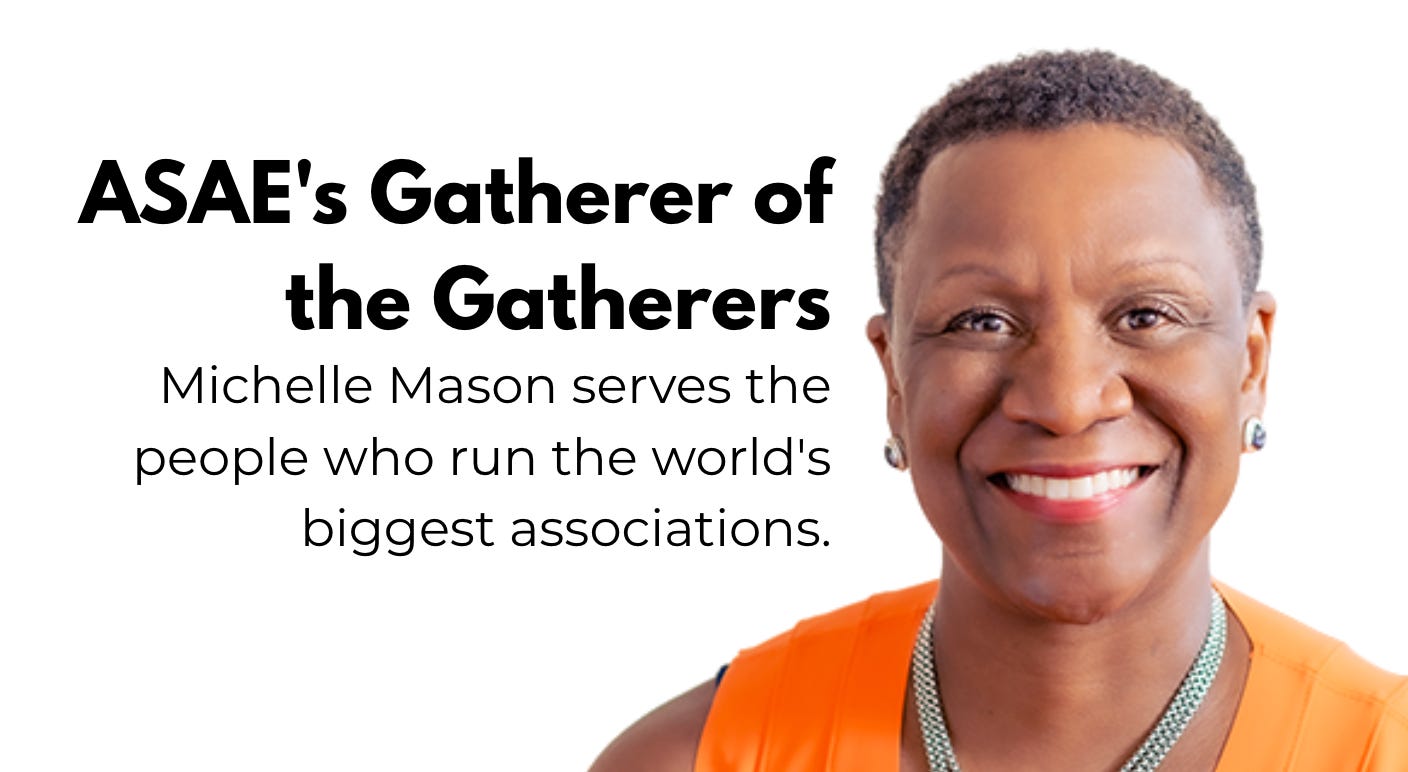
ASAE’s Gatherer of the Gatherers
Michelle Mason serves the people who run the world’s biggest associations.
A note on method. This profile emerged from a conversation that took an unexpected turn before it officially began. The office tour that preceded the interview turned out to be the interview. What follows is built entirely from what was said, observed, and discovered. Some of what surrounds Mason’s story involves Emmett Hay Naylor, the man who founded ASAE in 1920, a figure she had never studied. That parallel was discovered in the course of reporting this piece.
GatheringPoint exists for one reason. To give the leaders of the gathering economy the long-form treatment they have never received and have always deserved. Most people won’t read every word. But the ones who want real intelligence on the people shaping this industry will. This is for them.
Meet Michelle Mason.
Consider the scale for a moment.
Nearly 50 thousand members. Not followers. Not subscribers. Not users. Association executives and industry partners, each one a professional whose job is to help create the conditions for people to find each other, trust each other, and accomplish together what none of them could accomplish alone. Add up everything those members produce and the organizations they serve, the trade shows, the annual conventions, the certification programs, the expositions, the governance structures, the advocacy campaigns, the standards bodies, the research foundations, and you arrive at a sector that generates $116 billion in revenue, supports 1.1 million jobs, convenes 52 million participants across 272,000 events every year, and contributes $28 billion in taxes to federal, state, and local governments annually.
It is one of the most powerful engines of the gathering economy and one of the most underreported. The business press covers tech. It covers finance. It covers entertainment. The sector that convenes American medicine, American manufacturing, American agriculture, and dozens of other industries, and does it year after year with the reliability and scale that no other segment of the gathering economy can match, rarely gets the front page it has earned. Every destination in the world is targeting the association market. Las Vegas. Vienna. Singapore. Chicago. Dubai. Barcelona. The convention bureaus of every major city on earth have a team whose entire job is to win association business, because association business is the most fertile ground in the gathering economy. Association meetings book years in advance. They bring the same professional community back to the same city on a recurring cycle. They generate room nights, food and beverage revenue, local economic activity, and downstream business leads that compound over the decade following the first visit. A city that wins a major association annual meeting does not just win one week of hotel occupancy. It wins a relationship with the most influential professionals in an entire industry, many of whom will return individually, book smaller meetings, and recommend the destination to every other association in their network.
GatheringPoint exists to cover the people who build these gatherings. Which is why this profile begins not with a title or a biography but with a question that has been running underneath this publication since its founding. What does it mean to turn association into a verb?
Not the noun. Not the institution, the membership card, the annual dues structure, the board resolution. The act. The moment when people who share a purpose find each other and decide, together, that what they cannot do alone is worth attempting with others. That moment is not a product. It is not a deliverable. It is not a KPI on a dashboard. It is a human event, and it is the founding premise of the organization that serves the nearly 50,000 professionals who build it every day.
That organization is ASAE. The American Society of Association Executives. And the person who runs it, entering her sixth year leading the institution, is Michelle Mason.
Mason does not run a trade association in the conventional sense. She runs the meta-community. The gathering of the gatherers. The organization whose members are themselves the architects of thousands of other organizations, each one a living experiment in what happens when human beings decide that association is not a noun but something they do. Every decision she makes, every framework she builds, every program she launches, every office she designs, ripples outward through those members and into the industries, professions, and public interests those members serve.
Collaboration is not a soft skill in this world. It is the core competency. The ability to bring people with competing interests, different backgrounds, and divergent agendas into a shared space and create the conditions for productive work, genuine trust, and collective progress is the most important professional capability the association world has to offer. It is also the capability that the rest of the economy most urgently needs and least knows how to develop. Mason understands this. Her entire career has been an argument that collaboration is not something that happens naturally when you put people in a space. It is something you architect, deliberately, before anyone walks through the door. And the responsibility for building that architecture falls on the people she serves.
She is the role model for that world. Not because of her title. Because of what she understands about why people gather, where that understanding comes from, and what it looks like when someone builds an entire career, and an entire institution, around the proposition that belonging is not a feeling. It is something you build.
She had said, in the weeks before, that you had to come and see the space.
It was not an incidental invitation. It was a statement of thesis. Walking through the offices of ASAE in Washington, D.C. before sitting down with Mason for this Wisdom Bank conversation, something became clear before a single question was asked. Every detail in the space had been decided on purpose. The arrangement of areas. The quality of light. The decision about where to put the door and what to place beside it. These were not decorating choices. They were policy. They communicated, before anyone spoke, who was welcome here and what kind of community ASAE intended to be.
“Everything about it is about belonging,” came the observation partway through the morning, after nearly an hour of conversation. “It’s about thinking about the little details. It’s about understanding how different people react and respond.”
Mason nodded, then said something that reframed everything that had come before it. “And that’s what my mother brought to me.”
There is a particular kind of leader who understands that a physical space is an argument. Mason is that kind of leader. She thinks in systems. She designs belonging the way other executives design org charts. The office did not happen to her. She built it the way she builds everything, with the premise that the conditions you create for people determine what they can become.
Her mother never saw it.
How It Started
The suspicion was reasonable, by the standards of the time.
When Emmett Hay Naylor gathered the trade association secretaries of New York City into a space in 1919 and proposed that they form a community of their own, the legal environment made the idea genuinely dangerous. Since 1890, the Sherman Antitrust Act had declared illegal every contract, combination, or conspiracy in restraint of trade. The prevailing assumption in Washington and in the courts was simple and not entirely wrong: competitors who meet are plotting. Businessmen who share information about prices and production are fixing markets. An association is a trust in disguise. The gathering itself was suspect.
Naylor disagreed. He had been watching something happen during the World War that changed his understanding of what a space full of competitors could actually produce.
When the United States entered the war in 1917, the federal government established the War Industries Board and did something that would have been unthinkable in peacetime. Backed by the full authority of President Wilson and the implicit threat of commandeering plants that refused to comply, the Board pushed every industry in America to coordinate production through trade associations, giving Washington a single voice from each sector. Competitors who had refused to acknowledge each other’s existence were suddenly sitting at the same table, sharing information, aligning on standards, and solving problems together. Industrial production increased 20 percent. Men who formerly would not trust each other in the smallest matter were, as Naylor wrote in his 1921 book, working together more happily and more profitably than they had ever thought possible.
The war ended. The government restored antitrust enforcement. The associations remained.
What Naylor understood, and what he spent 327 pages of his 1921 book arguing, was that the wartime experiment had not proven that cooperation was possible under duress. It had proven that cooperation was natural, and that competition, the assumption that every interaction between rivals is a zero-sum transaction, was the artificial condition. The gathering was not the threat. The gathering was where things actually got done. “Co-operation,” he wrote, “is the lifeblood of trade.” He founded ASAE on that insight. Sixty-seven charter members in 1920. One book that nobody had asked him to write. And a profession that had been doing the work without knowing it had a name.
Those were large shoes. Two pairs of them, in fact.
John H. Graham IV stewarded the organization from August 2003 until his death in January 2020, a seventeen-year tenure during which ASAE more than doubled its membership, built a wealth of innovative products and services, and guided the profession through an era of unprecedented growth with a sustained emphasis on diversity and inclusion in association leadership. Graham died as ASAE was marking its centennial. He left behind an organization that had become the undisputed professional home of the association world, and a community that mourned him with the kind of grief you reserve for someone who shaped not just an institution but a generation of careers. Susan Robertson served as interim president and CEO while the board conducted its search. Mason arrived in September 2021.
She had known Graham. She had worked at ASAE during his tenure, early enough in her career that he was already a mentor by the time she left for Milwaukee and Chicago. Her first visit to the Kennedy Center had been with Graham and his family. “I think about him in terms of the decisions I make and what I do,” she said. “I literally stand on his shoulders.”
By the time Mason arrived, the organization Naylor founded and Graham scaled had become the professional home of nearly 50,000 association executives and industry partners representing 7,400 organizations in 50 countries. These are the gathering economy elite. The CEOs and executive directors who run the organizations that convene American medicine, American technology, American manufacturing, American hospitality, and dozens of other industries. The people whose annual meetings fill convention centers, whose room block commitments shape hotel development pipelines, whose event calendars determine which cities win the business of the next decade. When Mason models a behavior, builds a program, or redesigns an office, that decision ripples through every one of the communities those members serve.
She approached the inheritance the way Naylor approached his founding act: by treating every assumption as an experiment and refusing to wait for permission. The office renovation was not decorating. It was a hypothesis. The incubator was a structural experiment. The tax fight mobilization was a test of collective power. The AI certification she required of herself before mandating it for her staff was a demonstration of the principle she articulates in conversation: you cannot ask people to go somewhere you have not gone first.
Naylor started the idea. Graham scaled it. Mason is building its second century, arriving at the moment when everything the organization stands for is being tested by a world that has never been more skeptical of institutions, more distracted from community, or more in need of exactly what ASAE exists to provide.
She is five years in. She is not close to done.
The Table She Set
She was not expecting the question about her mother. The conversation had barely found its footing when the prepared list of questions was set aside and the space got quiet.
“Mom was very special to me,” Mason said. “And I would say this is pretty raw. I didn’t expect this question because she actually just passed.”
What followed was not an interview in the conventional sense. It was something closer to a reckoning. The kind of conversation that happens when someone who has spent a career building communities for other people finally sits still long enough to trace where the instinct came from.
It came from a kitchen in Prince George’s County, Maryland. From a woman who could not be in that kitchen while she was cooking, who commanded that space completely, but who, when the food reached the table, gathered everyone she could find. Siblings. Grandchildren. Great-grandchildren. “We ate all over the home,” Mason said. “The kitchen. The dining room. The living room. But we were one family, one family unit.” Her mother prepared everything herself. She dressed sharply and held her opinions firmly and told her children not what they wanted to hear but what they needed to hear. She was involved in Prince George’s County politics, not at a level of notoriety, her daughter said, just at a basic level, enough to be engaged.
She also ran a daycare out of her home. At the celebration of life, the pastor asked everyone she had touched to stand. Half the congregation rose.
Mason paused when she told that part. She was not performing the grief. She was inside it. “I now understand who I am,” she said. “Who I’m becoming.”
The family’s inheritance was service, structurally and specifically. Her brother served in the Air Force and then the federal government. Her sister retired as a sergeant in the DC Police Department and is now in her second post-retirement career in the Prince George’s County school system. Her father died when Mason was a toddler, before she had any memory of him. He wrote poetry. He served in the military. He was, her mother said, the love of her life. “My mom told me limited stories about him. I know she was going through a lot of pain, but she did a great job raising us.”
When asked whether running ASAE was, at some level, running an adult version of her mother’s daycare, Mason went quiet for a moment. “I never thought of it from that perspective,” she said. “But maybe an adult version of it. Yeah. We all do the same thing.”
The Accidental Career, the Non-Traditional Education
She stumbled into the association world the way many people do, hers was through a temp job. The Chemical Manufacturers Association. She was young, still figuring out what she wanted to do in life, working her way through school in a way that was not traditional and that she spent years not leading with publicly.
“I have two master’s degrees, all the things,” she said. “It wasn’t traditional, and that’s the story I’m starting to tell more of now because I didn’t want that to be my identity. I needed to do the work.”
She went to Strayer University. Then the University of Maryland for her master’s of science and her MBA. Then she went back to Strayer to teach as an adjunct instructor, and to Mount Mary University in Milwaukee at the graduate and undergraduate levels. Business ethics. Intro to business, because she wanted to capture students early in their careers. Adult learners, specifically.
“I wanted them to know not to give up,” she said. “I didn’t give up, but I also wanted to help them understand that there were opportunities. To be an example for them.”
She still loves the classroom. Plans to return to it in some form after this chapter. The parallel to her mother’s daycare, once named, is not lost on her. “We all do the same thing,” she said. “It’s all about relationships.”
Her first kitchen cabinet member was her mother. Not metaphorically. Her mother was the person who told her what she needed to hear rather than what she wanted to hear, who said sink or swim when reassurance would have been easier, who modeled the difference between managing a household and serving a family long before Mason had the vocabulary to name that distinction. Everything that followed in her professional life, every mentor relationship, every sponsor, every honest voice, was built on that template.
At the Chemical Manufacturers Association, two people extended that template into her professional world. Langley Spurlock and Cecelia Spearing sat her down and told her they were going to support her, but she had to do the work herself, and they were not going to leave her side. Spurlock, who saw something in her before she saw it in herself, gave her the opportunity to fail, the opportunity to learn, and the encouragement to earn her CAE. Spearing, who has since passed, brought the same candor and care. Both of them kept showing up. “Every milestone moment I’ve had throughout my service in the association community, Langley has been there,” Mason said. “He has been supportive.” He is still in the DC area, still in her life.
John Graham completed the cabinet. He was the one who took her to the Kennedy Center when she was a young staff person. He demonstrated, without ever making it explicit, what it looked like to lead an institution as a servant rather than a sovereign. The defining characteristic of all of them, her mother, Langley, Cecelia, Graham, was the same. They told her not what she wanted to hear but what she needed to hear. “They keep me grounded,” she said.
Milwaukee, 2006
She was vice president of research at ASAE, her first tour of duty there, when a large opportunity materialized in Milwaukee. Managing director of strategy and innovation at ASQ, the American Society for Quality, a global organization focused on quality control and Six Sigma. She took it. She moved.
Her mother was worried. The family unit, the dinners, the love, all the things. Mason told her: this is my time. You’ve had your time. Her mother moved from the South to the North decades earlier. She got over it quickly.
Three months into Milwaukee, Mason called her. Culture shock is not an exaggeration. Washington to Milwaukee in 2006. She was looking for something like reassurance. What she got was eleven words.
“You can sink or you can swim,” her mother said. “My kids swim.”
Mason repeated that phrase in conversation the way you repeat something you have said to yourself ten thousand times. “That stayed with me,” she said. It is a management principle now, whether she planned it that way or not. You uproot your life. Three months in, someone tells you to continue the race. You do.
From Milwaukee she moved to Chicago, taking on a CEO role after leading that organization through a transformation. She had started out wanting to advance. Somewhere along the way it became less about her and more about what she could set in motion for others. “I don’t know when it happened,” she said. “But I learned I could be more effective working with and through others and setting the conditions for others to be successful.”
Watch the Story in Video
Coming Back
She returned to ASAE as president and CEO in September 2021. The organization she returned to was not the organization she left. Post-COVID. Staff working remotely. Culture diffused. The centennial had come and gone during a pandemic. Graham was gone. She had to bring the organization back together in person, which meant building something people would want to come back to.
The new offices were not a renovation. They were a declaration of intent, every detail designed to signal what ASAE intended to be: a place where belonging was not aspirational language on a wall but a physical reality you felt the moment you walked in. The layout, the light, the placement of every shared space, all of it an argument for the kind of collaboration that Mason believes is the core skill the association world must now embed in everything it does. “We had to be entrepreneurial,” she said. “We had to take risks. We had to do things in a different way.”
The first major decision, made with full board support, was an incubator. ASAE has three legal entities: the 501(c)(6) for advocacy and core membership, the 501(c)(3) research foundation, and a for-profit subsidiary. All three were going through transformation simultaneously. Rather than sequence the work, Mason pulled the band-aid off. All three at once. The for-profit subsidiary became the incubator, the place where ideas could be tested without putting the core organization at risk.
Three new business lines emerged and are now fully operationalized inside ASAE. Ready Me, a cohort-based leadership development program focused on essential skill development, currently chaired by Jeff Freeman of U.S. Travel. A compensation evaluation practice, filling a gap for smaller associations that cannot afford to build that infrastructure independently. And an Association Governance Institute, positioning ASAE as the definitive source on association governance, running CEO assessments, board assessments, and CEO programming with elected leaders.
The incubator itself is now being formalized as a permanent function. A blank sheet is back out. Acquisition, build, or partner, all three on the table.
“We can go anywhere,” Mason said.
The Tax Fight
In the weeks before the 2024 annual meeting, Mason’s chief public policy and governance officer returned from maternity leave. She had been monitoring federal tax reform closely. On what might have been her first or second day back, she looked at Mason and said: it’s going to happen.
Mason’s response was two words. “Let’s go.”
The association community had been watching the threat to association tax status. ASAE had to be the one to mobilize. Mason included a call to action in her annual meeting remarks. A pop-up session followed, standing room only. They hired a strategic communications firm. Two volunteer leaders stepped forward to serve as co-chairs, and the campaign ran through them, not through Mason. She stayed in the background, by design.
“It is about service, it’s about orchestrating the strategy,” she said. “I was in the background because it’s about the members’ voice and letting them feel a part of it. That belonging, that they’re part of something bigger.”
They mobilized. They raised funds. The association tax exemption was not included in the legislation. “The best thing could happen prepared, the worst thing could happen prepared, and nothing happened. But we were prepared.”
The win belonged to the community. That was the point.
Conscious Inclusion
In November 2021, almost immediately after she arrived, Mason brought a strategic approach to the board. Not DEI as the term was then commonly used. A framework centered on what she called conscious inclusion, built to be embedded across the entire enterprise rather than housed in a single department. The board accepted the recommendation in 2022, years before the political environment made such frameworks a target.
The distinction mattered more than it might have seemed at the time. Conscious inclusion is not a sentiment. It is a collaboration prerequisite. If the association world’s core value proposition is that it creates conditions for people with different expertise, different backgrounds, and different agendas to work productively together, then the conditions inside the organization that serves those people must model exactly that. You cannot teach collaboration from a homogenous table. You cannot build belonging from a siloed department. Mason understood this from the beginning. The framework was not a response to a political moment. It was an operational argument about what it takes to do the work.
When executive orders arrived challenging DEI programs in 2025, ASAE’s approach had already been woven into every function: hiring, onboarding, programming, governance. “From the time you’re onboarded to the time you transition from ASAE, it’s about whether we are welcoming, whether there’s a sense of belonging,” Mason said. Because conscious inclusion was distributed rather than siloed, the work continued. “It’s just who we are,” Mason said.
At a previous organization she trademarked the phrase “welcoming environment.” She is building a movement around conscious inclusion now. Not a reaction to a political moment. An evolution that started before the politics made it complicated, and that was designed from the beginning to outlast them.
The Hidden Giant in the Room
There is a fact about the American association world that the events industry knows intimately but the wider world has never properly absorbed. Associations are among the largest gathering organizations in the country. Not the most glamorous. The largest, by almost any structural measure that matters.
According to ASAE’s own research, in 1953 associations received 95.7 percent of their revenue from membership dues. By 2016 that number had fallen to 45.4 percent for trade associations and just 30 percent for professional associations. The revenue that replaced it did not come from investment portfolios or digital subscriptions. It came from gatherings. From trade shows, annual conventions, expositions, and certification programs built around in-person learning. The modern American association is, in its financial architecture, an event company with a membership program attached.
Mason commissioned Oxford Economics to study 20,000 associations and quantify what the sector actually produces. The findings are definitive. Associations directly support 1.1 million jobs and provide $71.4 billion in wages throughout all 50 states. More than 272,000 events attract nearly 52 million participants annually, directly support 342,000 jobs, and generate $42 billion in spending in communities nationwide. Associations and their events generate almost $28 billion in federal, state, and local taxes each year, with events alone generating an additional $7.5 billion in taxes to state and local governments. Trade and professional membership associations generate $116 billion in revenue. Nearly 63 million Americans volunteer through an association.
That is not a niche industry. That is a pillar of the American economy that has been running quietly in the background while the business press chases the next technology story. Mason commissioned this research because her members had been too busy doing the work to tell their own story. She built the data infrastructure, then handed it to nearly 50,000 association executives and said: now you have the number. Go use it.
Every major vendor in the gathering world targets the association market for the same reason. The hotel groups send their senior sales teams to the ASAE Annual Meeting because the association executives in attendance control not just one annual convention but the year-round meeting calendar of their organizations: board meetings, committee gatherings, educational conferences, and regional events that together represent a portfolio of business no corporate account can replicate. The immediate economic impact of the ASAE Annual Meeting and Exposition alone is fifteen to eighteen million dollars over four days. About 20 percent of the association professionals who attend book a meeting in the host city within the next five years. That single statistic explains why CVBs treat the ASAE Annual Meeting as one of the most valuable events on the calendar, not for its own room nights but for the decade of business development that follows.
This Years Annual Meeting
ASAE’s own gathering architecture reflects all of this. The Annual Meeting is the broad gathering, the open convening: five thousand people in Indianapolis this August 15 to 18 at the Indiana Convention Center, moving through more than a hundred education sessions, an exposition floor, and an opening concert at White River State Park headlined by Babyface, the Indianapolis native and thirteen-time Grammy Award-winning songwriter and producer who co-founded LaFace Records and helped shape the careers of Usher, Toni Braxton, TLC, Outkast, and Pink. The keynote program includes mentalist and author Oz Pearlman, Harvard Business School professor Amy Edmondson whose work explores how organizations foster innovation and learning under uncertainty, and CNN host and producer Van Jones. The preconference includes a CEO-level AI strategy session led by Trent Gillespie of Stellis AI, a former senior Amazon executive, focused on how AI will reshape what members need from associations over the next five years.
The Babyface choice is not decorative. It is architectural. He spent forty years not performing but creating conditions for artists around him to become more than they could have become alone. LaFace Records was a convening structure. That is the same principle Mason applies to ASAE every day.
The CEO Conclave is the counterpart: by sponsor invitation only, kept deliberately small, high-trust and off the record. The 2026 edition runs September 17 to 20 at the Grand Hyatt Baha Mar in Nassau, the Bahamas. The 2027 edition moves to the Laguna Cliffs Marriott Resort in Dana Point, California. One format is the campfire everyone gathers around. The other is the conversation that happens after the fire dies down, when only the people who need to say something difficult are still sitting there. Both are expressions of the same belief: the condition of the gathering determines the quality of what is possible inside it.
She has also booked the Annual Meeting host cities through 2034. Indianapolis in August 2026. Charlotte in August 2027. Chicago in August 2028. Washington D.C. in August 2029. Columbus in August 2030. Orlando in August 2031. St. Louis in August 2032. Baltimore in August 2033. Milwaukee in August 2034. Nine cities. Nine convention centers. Nine sets of economic development agreements locked in advance, delivering certainty to host communities and to every vendor in the gathering ecosystem who needs to plan their own pipeline years ahead.
Belonging requires commitment. Commitment requires planning. Planning at scale, over years and decades, is what distinguishes a community from a crowd.
Role Modeling at Wholesale Scale
There is one more dimension to Mason’s role that the gathering industry has not fully reckoned with. She is not simply the CEO of a professional association. She is the role model for nearly 50,000 association executives who are themselves running the gatherings, the trade shows, the conventions, the certification programs, and the annual meetings that together constitute the organizational backbone of the American economy.
The collaboration skills that the association world teaches, the ability to bring people with competing interests into productive relationship, to build trust across difference, to create the conditions for collective action, are not soft skills. They are the hardest skills. And they are the skills that every industry, every government, and every community in the world most urgently needs right now. Mason’s job is to embed those skills more deeply into the professional practice of 50,000 people who will carry them into every sector they serve.
When Mason embedded conscious inclusion as an enterprise value rather than a department, she gave 50,000 association executives a model for how to advance that work without making it a target. When she created an incubator inside a for-profit subsidiary to test new business lines without endangering the core organization, she gave those same executives a structural template for innovation inside a nonprofit model. When she required herself to complete the AAIP AI certification before making it mandatory for her staff, she demonstrated the leadership principle she articulates in conversation: you cannot ask people to go somewhere you have not gone first.
She is also careful to note that none of it happened alone. The board, led during the risk assessment period by chair Heidi Brock, set the direction. The staff executed. The volunteer leaders fronted the campaigns. Mason’s job, as she describes it, is listening, synthesizing, and creating the conditions for others to succeed. “At the end of the day, we are a relationship business, we are a community, and we are a very diverse community,” she said. “And so when I think about my job, and if I do it very well, then that’s success. Where we collectively are successful.”
The unmeasurable number is the aggregate impact of 50,000 association professionals making better decisions because the person who leads their professional home modeled better behavior. The associations those professionals run collectively represent hundreds of billions of dollars in economic activity, millions of members, and the organizational infrastructure of industries from healthcare to hospitality to technology to agriculture. When the CEO of ASAE changes how she thinks about something, the ripple moves through the entire system.
Most CEOs affect their organization. Mason affects the organizations of the people who run their organizations.
The Definition of an Association, and What It Could Become
At some point in the conversation the question arose of whether an enthusiast community, a group of people who build and modify lowrider cars, a knitting circle, a group of people obsessed with a particular kind of truck, could be or become an association.
Mason did not dismiss the question. She answered it precisely.
“When we fundamentally think about an association, it’s a collective group of people joined together for a common purpose.” Trucks. Ethnicity. A body of shared knowledge. Any of those can anchor a community. The organizational system creates its own structure and norms. But the boundary between who those professionals are and who benefits from that infrastructure is one Mason sees expanding.
“That’s one of the areas we’re actively exploring about lifestyle,” she said. “You’re an association professional, but you have other interests that you want to create community around.”
She also flagged Associations Insight, an information-as-a-service platform ASAE has been developing for three years, now powered by AI, capable of producing pulse surveys within weeks rather than the six to twelve months the old model required. The vision is predictive analytics for the sector. Where are associations growing? Where are they declining? What does the data say about where the community is going before the community itself has figured it out?
The membership model question is real and she does not pretend otherwise. Quality versus quantity. Stickiness versus growth for growth’s sake. The next generation’s relationship to institutional belonging. “We’re in the thick of this,” she said. “I don’t have the answer. But we can’t afford to ignore it.”
The Gathering Argument
The question put to her was GatheringPoint’s own thesis: that physical gathering has become more valuable, not less, in a world saturated with digital information, precisely because it is the one thing that cannot be faked or automated. Does she agree? And do the associations that understand this run differently from the ones that don’t?
She agreed, then sharpened it.
“The more digital our world becomes, the more valuable human connection becomes. For years, many of us assumed technology would reduce the need for physical gathering. What we’ve discovered instead is that technology is extraordinarily effective at distributing information but much less effective at creating trust, belonging, and shared identity.”
Then she said the line that should be on the wall of every association headquarters in the country.
“Information scales. Relationships don’t.”
You can send a piece of content to a million people instantly. Trust is built one conversation at a time. Credibility is built through repeated interactions. Community is built through shared experiences. Those things still happen most powerfully when people come together. “Digital tools are incredibly effective at maintaining connections,” she said. “Physical gatherings are often where those connections are formed in the first place.”
When people gather in person, she argued, something happens that is difficult to replicate anywhere else. They exchange ideas, certainly. But they also read body language, build rapport, develop empathy, discover common ground, and create memories together. They leave not only with knowledge but with relationships. And relationships are what move communities forward.
She did not see events as competing with digital technology. She saw them as completing it.
Then she went one step further.
“In that sense, I would argue that gatherings are not simply events. They are trust-building machines. That’s what makes them so valuable.”
She paused, then confirmed what the question was really asking. The associations that understand this are run differently from the ones that don’t. She did not need to explain why. The answer was already in everything she had said that morning.
The Avatar and the Founder
One more thread worth naming, because it connects this profile to something larger.
GatheringPoint has spent the past year building what it calls the Event Organizer’s Time Machine, a series of historical avatars reconstructed in their own voice to speak to practitioners today. Thomas Jefferson. Benjamin Franklin. Socrates. Plato. Confucius. The premise is simple: history has always been interpretation, and AI makes it possible to give forgotten builders a voice that reaches the people still building inside what they started.
Emmett Hay Naylor is the newest entry. He founded ASAE in 1920, wrote the first book ever published on association management, and built the organization from sixty-seven charter members in a year when the government was prosecuting associations as illegal conspiracies. He died in 1938 having never imagined the person who would one day sit at his desk.
Late in the conversation, Mason was asked whether she had ever studied the first person who held her job.
“I have never studied the first person, no,” she said. Then, without prompting: “I believe the person didn’t look like me. But the fundamental principle of human connection is the same. Bringing people together for a common purpose. That will never change.”
She said that without knowing his name. Without knowing that he too was formed by a mother who gathered people around a table. Without knowing that he built this institution while fighting the exact kind of institutional resistance she faces today, different in form, identical in function. Without knowing that he wrote, in 1921, that co-operation is the lifeblood of trade, that constructive discussion is the one sure way of approximating essential truths, and that the association exists to help people grow hearts and souls, not merely fill pocketbooks.
She arrived at his conclusions a century later, from a completely different life.
That is the whole argument.
The Deposit
The Wisdom Bank question is always the same: if you could put one thing into the permanent record for the next generation of practitioners, one thing that took you the longest to earn, what is it?
Mason had been asked something like this before, in different forms. But in the context of this particular conversation, after talking about her mother and Milwaukee and the tax fight and the incubator and conscious inclusion and whether a lowrider club could become an association, she landed somewhere specific.
“Never confuse managing an association with serving one.”
She did not stop there.
The temptation in leadership, she said, is to believe that your value comes from being the person with the answers. The reality is that your greatest value often comes from asking the right questions, bringing the right people together, and creating the conditions for others to contribute. “Communities become powerful when people feel ownership,” she said. “That’s the lesson that took me the longest to learn because it’s counterintuitive. As leaders, we’re trained to direct, to solve, to lead from the front. But community builders have to learn when to step back. Sometimes your job is not to be the voice everyone follows. Sometimes your job is to make sure voices that haven’t been heard finally have a chance to shape the conversation.”
The second thing she would leave behind: relationships are the real infrastructure of every community. Not strategy. Not technology. Not governance or funding or growth. “When communities face uncertainty, and every community eventually does, it is relationships that determine whether they endure. Trust can never be built at scale before it is built person by person.”
The third: do not underestimate the impact you can have before you have authority. Every meaningful community she has ever seen was strengthened by people who chose to contribute before they had a title. They mentored someone. They volunteered. They welcomed a newcomer. They shared an idea. They created a connection. “People are looking for more than information,” she said. “They’re looking for connection, purpose, and belonging.”
And then the sentence that earns every word that came before it. “The tools will change. Technology will change. Business models will change. AI will change the way we work. But the human desire to be part of something meaningful is remarkably constant. The leaders who understand that, and who build around that truth, will create communities that endure long after any individual event, initiative, or leader is gone.”
She paused. Then: “In the end, that’s the work. Not building organizations that depend on us. But building communities that become stronger because of one another.”
The final question was simpler. What do you love about your job?
“The people.”
A beat.
“You knew that.”
She was right.
The Michelle Mason Wisdom Bank
Never confuse managing with serving. The moment you forget who you are there for, the members feel it before you do.
Information scales. Relationships don’t. You can reach a million people with content. Trust is built one conversation at a time. Never confuse the two.
Gatherings are not events. They are trust-building machines. The association that understands this is run differently from the one that does not. Everything else follows from that distinction.
Collaboration is not a soft skill. It is the hardest skill. The ability to bring people with competing interests into productive relationship is what the world most needs and least knows how to teach. Build it into everything you do.
Belonging is architecture, not atmosphere. You build it deliberately or you do not have it. There is no middle ground.
Sink or swim is not cruelty. It is clarity. The people who love you most will tell you to keep going when you want to stop. Listen to them.
Stay in the background when it matters. The moment the CEO becomes the headline, the members become the footnote. Orchestrate the strategy. Let the community own the win.
Conscious inclusion is a precondition for collaboration, not a policy. You cannot build genuine collective work from a homogenous table. Build inclusion into the operating system so there is nothing left to target.
Trust cannot be built at scale before it is built person by person. Relationships are the real infrastructure. Everything else is overhead.
The human desire to belong is remarkably constant. The tools will change. The technology will change. Build around what does not change and the community will outlast every individual event, initiative, and leader, including you
GatheringPoint covers the people who build the gatherings. The Event Organizer’s Time Machine playlist, including the Emmett Hay Naylor avatar, lives on GatheringPoint’s YouTube channel. Subscribe at GatheringPoint.news.
Michelle Mason Edible Profile
A few years ago I started asking a question that nobody in the events industry was asking. If the people we write about are extraordinary, why do we only reach them through words? We read about them. We quote them. We analyze them. But we never taste them.
SmallBiteArchitecture.com was built to answer that question. Every GatheringPoint Wisdom Bank profile ships with an edible companion, eight one-bite experiences, four food and four cocktail, each one a physical translation of a moment from the piece. The premise is the same one Mason has built her career on. You do not just want people to understand something. You want them to feel it in their body before their brain has processed it. That is what a great gathering does. That is what a great bite does. One bite. Two chews. The argument lands before you know it landed.
For Mason the bites were obvious the moment the profile took shape. Her mother’s kitchen in Prince George’s County is warm cornbread with slow-braised collards and smoked turkey. Conscious inclusion, distinct ingredients made inseparable, is a layered terrine of beet, goat cheese and pistachio. The incubator, three legal entities transformed simultaneously with the band-aid pulled off, is a three-spirit split-base Negriata poured all at once. The association economy, the hidden giant finally given its number, is a gilded petit four served at the scale it deserves.
The campfire and the conclave are a smoked barrel-aged Manhattan. The open gathering everyone gathers around and the quiet conversation after the fire dies down, both in the same glass.
One bite. Two chews. She built the table. Now you can sit at it.
Visit SmallBiteArchitecture.com for the full edible profile and all eight recipes.
Every GatheringPoint Wisdom Bank profile ships with a companion song. The reason is simple. There are things a profile can tell you and things only music can make you feel. The deposit, the wisdom, the argument of a career, those live in prose. But the person, the full weight of who someone is and what they built and why it mattered, that lives somewhere else. Music is where we put the things that words cannot finish.
For Michelle Mason I chose the register of Pink. Not Diana Ross. Not Motown grace. Pink.
Because Pink does not ask for your approval. She does not wait for the room to be ready. She walks in, states the case, and dares you to disagree. She built a career on being exactly who she was in a world that kept suggesting she should be someone else. She is defiant without being angry. Certain without being arrogant. And underneath every song she has ever recorded is the same premise: we built this with our hands, we are not finished yet, and nobody handed us a thing.
That is Michelle Mason. A temp job that became a calling. A non-traditional education she spent years not leading with. Milwaukee in 2006 when her mother said sink or swim. A hundred and six year old institution she came back to lead, post-COVID, post-loss, and built into something that declared its values in every detail of its physical space before it said a word.
The lyric “association is a verb” is not grammatically correct. It is editorially necessary. Bob Dylan said the times they are a-changin’ and nobody corrected his grammar. The idea was right. Same principle here. Association is not a building or a dues structure or a membership category. It is the act of coming together. The moment we stopped treating it as a verb, we started forgetting what it was for. Mason is trying to give it back its verb energy.
Pink would understand that immediately.


