
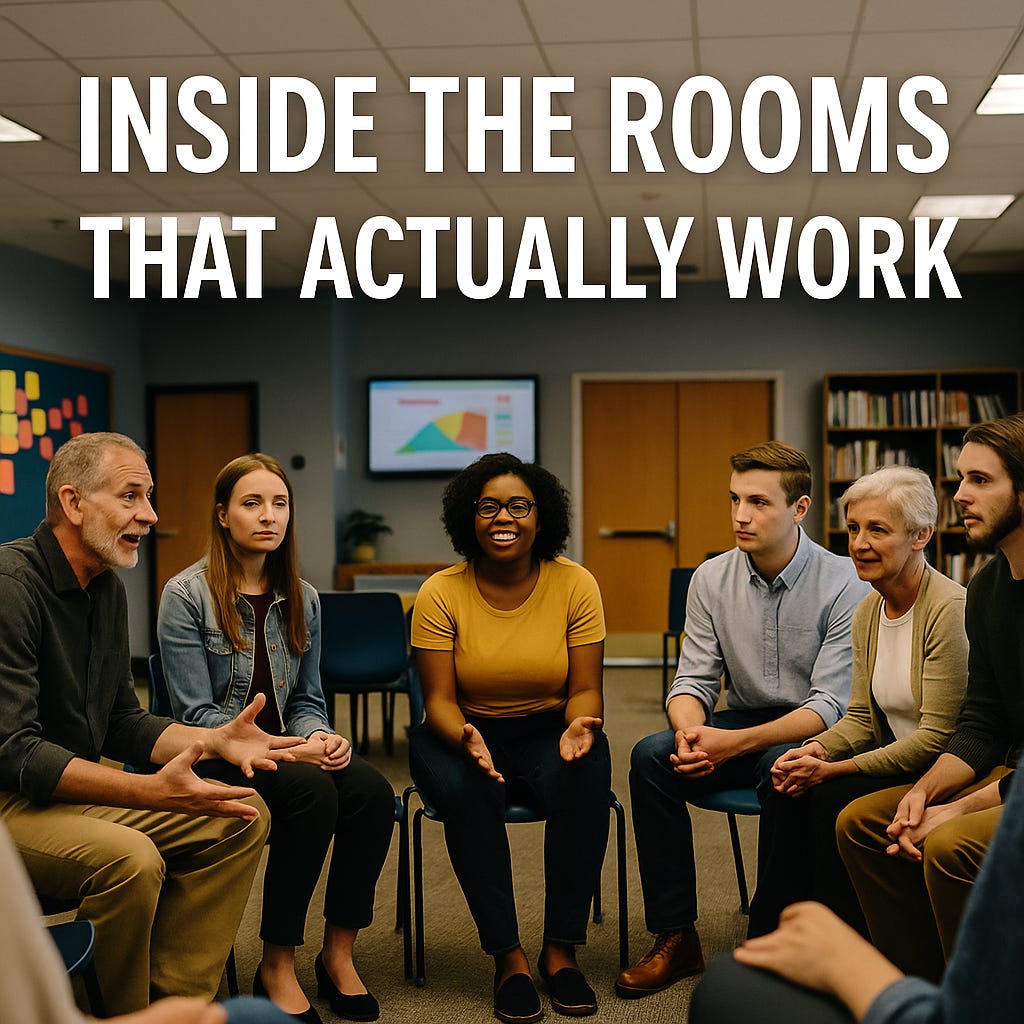
PART 2 — Inside the Rooms That Actually Work
What Camp David, C2 Montréal, digital choirs, dance floors, and closing circles all have in common.
Belonging is often described as a feeling, but Robin never trusted that definition. “Belonging isn’t a sentiment,” she said. “It’s an outcome.” She meant that belonging doesn’t arise because people like each other or agree with each other. It emerges because the conditions of the room — psychological, structural, emotional — have been deliberately shaped to make connection possible. The more rooms we studied, the more obvious it became that belonging is not an accident. It’s engineered.
The first place we saw this clearly was in diplomacy. People remember the Camp David Accords for their political impact, but Robin focused on the room design: identical cabins, repeated walks, controlled pacing, staff boundaries, and the absence of cameras. These weren’t conveniences. They were interventions. Carter understood that people do not negotiate from adrenaline. They negotiate from regulated nervous systems. Conflict is not resolved by argument but by lowering the physiological threat response long enough for logic to return.
“You can’t build trust at speed,” Robin said. “You have to slow the body before you can open the mind.”
And that was the lesson: belonging begins with safety, not agreement.
Explore more diplomatic formats here → /rooms/diplomatic
From diplomatic rooms, we moved into the commercial ones — markets, trade floors, innovation spaces — to see how belonging functioned under pressure, movement, and novelty. Robin always said the agora was the original social experiment. People didn’t gather only to buy goods; they gathered to test proximity. Markets worked because they created low-stakes negotiation between strangers: eye contact, calibration, mutual risk.
C2 Montréal revealed the modern version of all this. For anyone unfamiliar, C2 is a business-and-creativity summit founded by Cirque du Soleil and Sid Lee — part conference, part laboratory, part theatrical experiment. It’s built on the idea that you can’t think differently if you sit the same way you always have. That’s why sessions happen on rope bridges suspended above the floor, inside translucent conversation pods, or under structures that rain indoors. The spectacle isn’t decoration; it’s a tool. The environment disrupts corporate stiffness just enough to free people from performance. But what most attendees never notice is the layer beneath it: roaming facilitators timing the interactions, grounding conversations when they drift, and shifting energy when it spikes. Without them, the sensory novelty would devolve into chaos. With them, it becomes choreography — curiosity made operational.
Novelty creates curiosity, but facilitation creates coherence.
Digital space revealed this even more starkly. Early in the pandemic, Daybreaker — the global dance and wellness community known for its sober sunrise gatherings — found itself facing a question no one knew how to answer:how do you create connection when people can’t share a room, a beat, or even a breath? Their solution was a playful, improbable experiment they called the Global Brainstormer — a livestream where thousands of people helped co-create a piece of music in real time.
A musician and a song writer appeared onscreen with no script, no setlist, and no audience he could see. The only input came from the chat: single words, emojis, fragments of mood — “hopeful,” “anxious,” “lighter,” “keep going.” As comments accelerated or softened, so did the melody. Crescendos rose from clusters of encouragement. Drops happened when the group collectively went quiet. Entire emotional arcs unfolded from nothing but typed text and shared attention.
It shouldn’t have worked. There were no chairs, no faces, no body language, none of the traditional cues facilitators rely on. And yet the group fell into a kind of distributed synchrony — a digital version of breathing together. People weren’t watching a performance; they were shaping one. Daybreaker had turned a livestream into an instrument, and the audience into the conductor.the same way a skilled facilitator regulates a room: sensing when energy dipped, when emotion surged, when the group needed lift or release. The fact that it happened online made the principle clearer: belonging isn’t about proximity. It’s about rhythm, attention, and the person guiding the experience.
Digital rooms don’t fail because they’re digital.
They fail when noe musician and songwriter wasn’t simply responding — he was regulating, one is trained to hold them.Robin watched and said, “This is facilitation. Just a different medium.”
She was right. The musician wasn’t performing; he was reading the group like a conductor reads a pit orchestra. He sensed when energy dipped, when emotion surged, when tension needed release. Digital rooms have no architecture to hide behind. Their success depends entirely on the person guiding the experience.
Screens don’t prevent belonging.
Unfacilitated screens prevent belonging.
Explore digital and hybrid formats here → /rooms/digital
But the clearest demonstration of belonging came from celebration — the rooms that are dismissed as entertainment, but in reality are among the most sophisticated forms of social regulation. After lockdowns lifted, people flocked not to conferences but to dance floors. They weren’t seeking distraction; they were seeking rhythm — the ancient mechanism for synchronizing nervous systems.
At a sunrise Daybreaker in New York, you could feel it immediately: a hundred strangers settling into a shared pulse. No speeches, no agenda, just a form of emotional engineering that societies have practiced for thousands of years. Weddings, protests, vigils, parades — they all rely on rhythm to make cohesion felt rather than explained.
“Joy isn’t frivolous,” Robin said. “It’s governance.”
Explore celebration and ritual formats here → /rooms/celebration
But belonging doesn’t solidify in the elevation. It solidifies in the integration — the reflective moments at the end of a gathering where meaning is absorbed and coherence becomes memory. We saw this most clearly at a climate retreat in Vermont. No stage, no production. Just a facilitator standing before a wall of butcher paper, guiding a group through a simple closing exercise: What surprised you? What shifted? What will you carry forward?
The room softened. People spoke less to impress and more to articulate what they had actually felt. Patterns emerged: anxieties shared, insights repeated, fears named. The facilitator didn’t direct; they interpreted. They held the space so the group could see itself with clarity.
And that was the final piece.
Belonging requires reflection, not just elevation.
Explore reflective and integration formats here → /rooms/reflective
As Robi right. Thn and I stepped out of that retreat center, the architecture of belonging felt unmistakable. Safety creates openness. Curiosity creates collaboration. Synchrony creates unity. Rhythm creates identity. Reflection creates meaning. And in every case, the variable that determined success wasn’t the room or the ritual or the con wastent.
It was the facilitator.
The person trained to read the emotional weather.
The person who guides pacing and tone.
The person who makes it safe to contribute and safe to disagree.
The person who can feel when a room is contracting, expanding, or ready to transform.
Part 1 diagnosed the failure.Robin researched a replay and said, “This is facilitation. Just in a different medium.” She
Part 2 showed the proof.
Part 3 asks the hard question:
If facilitation is the missing discipline — where is the institution that teaches it?
That’s where the story turns next.


