
PART 1 — Why Most Meetings Fail Before They Even Begin
The hidden architecture that decides who gets heard — and why most leaders don’t even know it exists.
Editor’s Note: Most gatherings don’t fail because people are unprepared. They fail because no one is trained to manage the room — to regulate tension, shape participation, or create the conditions for trust. We keep using inherited formats that suppress the very outcomes we claim to want. This three-part manifesto exposes the mechanics behind those failures, shows where gatherings actually work, and argues for facilitation as a modern leadership discipline. If we want better decisions, better culture, and better connection, we start by rethinking how we convene.
It began over coffee on a gray Washington morning, the kind when the city feels introspective and unfinished. Across from me sat Robin Leeds — a veteran political strategist and now a sought-after consultant known for her work in justice, equity, and coalition-building. She has spent her career inside the rooms where campaigns, advocacy groups, and federal stakeholders try — and too often fail — to create real dialogue.
She didn’t ease into the conversation.
“We’ve got to stop managing the room,” she said. “And start engaging it.”
She wasn’t talking about personalities or messaging. She meant the room itself — the geometry, the choreography, the unspoken rules that decide who speaks and who stays silent. Robin has spent her career inside the spaces where political decisions take shape: campaign operations, coalition sessions, policy negotiations. She has seen too many conversations fail not because people lacked conviction, but because the room had already set the limits of what was possible.
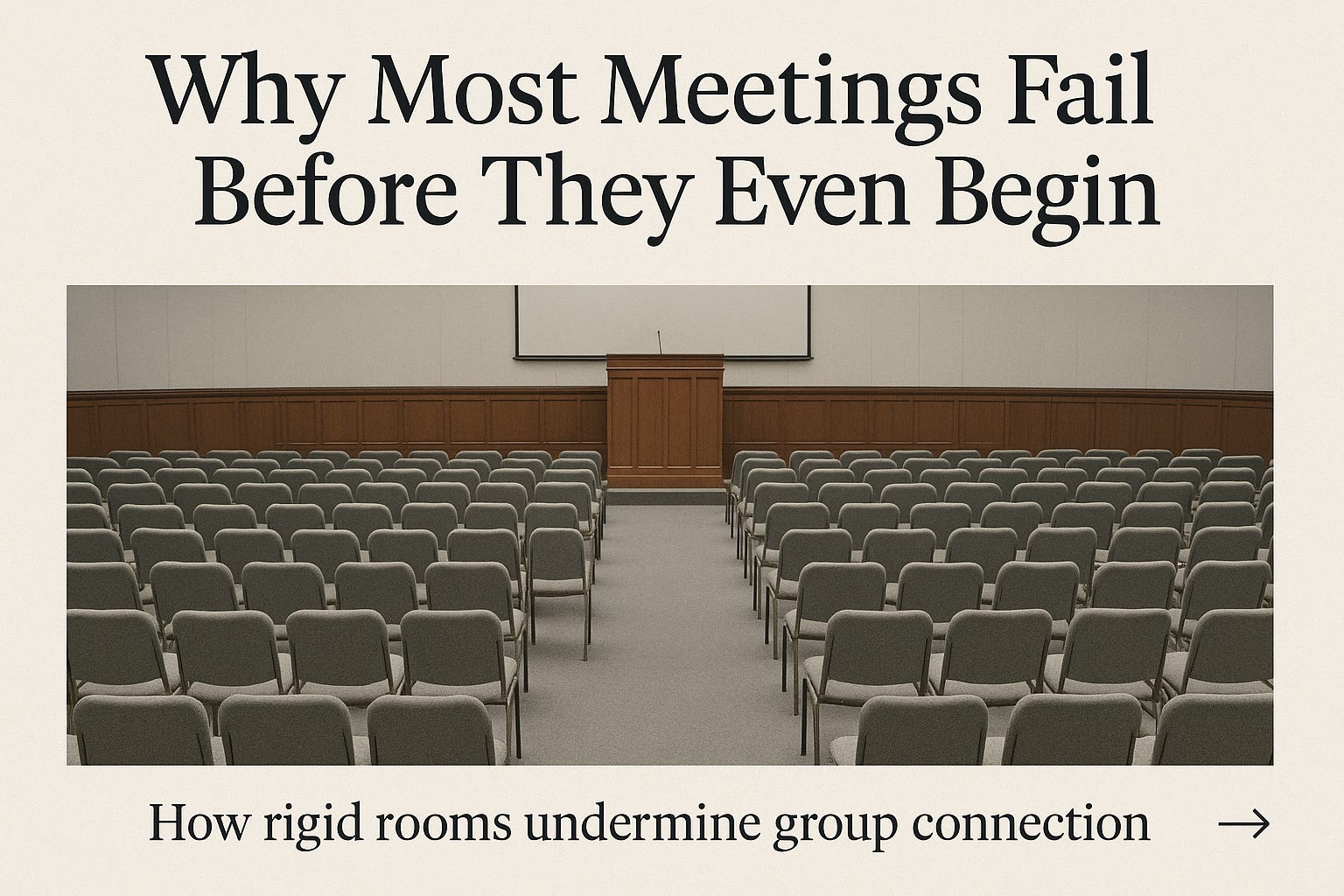
Her comment hit harder than she probably expected. Years earlier, when I was consulting for the U.S. State Department, I walked into their main auditorium and discovered the chairs were literally bolted to the floor. It was architectural certainty masquerading as neutrality. The space was designed not for movement, not for rethinking, but for compliance. If the furniture refused to adapt to the moment, how could the people inside it?
“You see this everywhere,” Robin said. “A room fails and everyone blames the people. No one blames the format.”
She was right. We talk about “meetings” as if they are interchangeable, but gatherings fall into distinct categories with their own psychological demands. A negotiation requires containment. A rally requires elevation. A brainstorm requires looseness. A strategy session requires depth. A celebration requires rhythm. A crisis meeting requires control. Yet institutions constantly funnel them through the same inherited template: a stage, rows, microphones at the front, and a program designed for presentation, not participation.
This is the quiet systemic failure: we confuse gathering with logistics.
We treat the room as if it were neutral. It never is.
Most people never learn this distinction. They inherit the formats without interrogating their origins. The auditoriums, the boardrooms, the lecture halls — all of them descend from institutions built for one-way communication: sermons, trials, and instruction. Their DNA is hierarchy, not exchange. Their architecture enforces obedience long before the agenda begins
But the deeper failure is not architectural; it is educational. Every serious field has a training pathway. Yet the people who run our most consequential rooms — where trust is built, where conflict is processed, where culture is shaped — receive almost none. Group psychology, emotional regulation, tension pacing, architectural listening, participation choreography — these are treated as personality traits rather than competencies.
“We train people to speak,” Robin said. “We don’t train them to convene.”
It is one of modern leadership’s greatest blind spots. Convening is treated as instinct rather than discipline. And so rooms continue to malfunction — not because people are unskilled, but because they lack a framework for understanding how humans behave when gathered.
I’ve always said the events business is in the goosebump business, not because we chase spectacle but because goosebumps are the body’s signal that a room has become coherent. They’re physiological evidence that the nervous system trusts the moment — that learning, insight, or connection is being encoded. Those moments are never accidental. They emerge because someone is regulating the room’s emotional physics: pacing, silence, rhythm, proximity, the difference between openness and overload.
Once we saw the difference between formats and conditions, we began tracing how gatherings actually evolved.
The earliest rooms that resemble our current meeting spaces weren’t designed for discussion. They were designed for hierarchy: stages elevated above rows, podiums for proclamations, seats fixed in place. They were the physical inheritance of sermons, trials, and lectures. “We inherited these rooms,” Robin said. “We didn’t choose them.”
Even now, offsites, summits, and town halls are held in rooms modeled after these older forms. These spaces aren’t broken — they’re simply mismatched to the tasks we’re asking them to perform. A stage is not a neutral choice. A podium is not a neutral choice. Rows are not a neutral choice.
For the fuller breakdown, readers can explore the Legacy Rooms → /rooms/legacy
But democracy shifted the emotional needs of gatherings. People wanted to speak back. They wanted visibility. They wanted to influence the room rather than observe it. So the next evolution — the conversational room — emerged through necessity.
A single long table with no head. A circle of chairs. A Jeffersonian-style dinner. A structured dialogue where questions outranked statements. In these rooms, authority flattened. People looked at each other, not toward a front. The nervous system settled. Curiosity rose. It was the first significant architectural correction to the old formats.
Explore conversational formats here → /rooms/conversational
Still, conversation alone wasn’t enough. Large groups flatten nuance. That’s when intimacy emerged as the next evolution. Small containers — paired dialogues, trios, quiet walks — created a different kind of openness. Honesty surfaced faster. Stakes lowered. People disclosed what they would never say in a larger group.
Intimacy is not sentiment; it is precision.
It reveals what broader rooms conceal.
See intimate formats here → /rooms/intimacy
But intimacy must be reintegrated into the collective, and that’s where participation enters. Unconferences, peer exchanges, self-organized workshops — these formats didn’t decentralize authority for novelty’s sake. They redistributed authorship. They turned attendees into architects. The room became a network instead of a hierarchy.
Find participatory formats here → /rooms/participatory
Finally, innovation rooms emerged — spaces built to suspend defensiveness and encourage imaginative risk. Design sprints. Creative labs. The theatrical experimentation of C2 Montréal, where novelty becomes a cognitive tool. Innovation isn’t chaos; it is facilitated exploration.
Explore innovation rooms here → /rooms/innovation
By the time we mapped this arc, the insight felt inescapable: format matters, but not on its own.
A room succeeds only when someone trained is regulating the human system inside it.
That realization sharpened when Robin and I met for dinner a few nights later. The plates arrived, but we were already drawing on the paper tablecloth — marking where conversation died, where intimacy appeared, where participation surged, where innovation collapsed. The pattern was unmistakable: leaders kept trying to force outcomes from rooms structurally incapable of producing them.
What they wanted — creativity, strategy, alignment, honesty — required different emotional conditions than their rooms allowed. And in every case, the missing ingredient wasn’t more content or better messaging. It was someone trained to hold the space.
“If you want creativity, lower fear,” Robin said.
“If you want conflict resolution, slow the pace.”
“If you want strategy, suppress performance.”
“If you want belonging, regulate the nervous system.”
And then she said it — the sentence that became the spine of this entire trilogy:
“Rooms fail because no one is trained to run them.”
Not trained to present.
Not trained to command.
Trained to hold.
To regulate.
To steward.
We walked out into the warm night with a shared sense that something foundational had been hiding in plain sight. If Part 1 was the diagnosis — the anatomy of how gatherings succeed or collapse — then Part 2 would be the fieldwork. It would take us inside the rooms that actually produce belonging, to understand not just the theory but the practice.
Part 2 begins there — in the rooms where belonging isn’t accidental, but engineered.


