
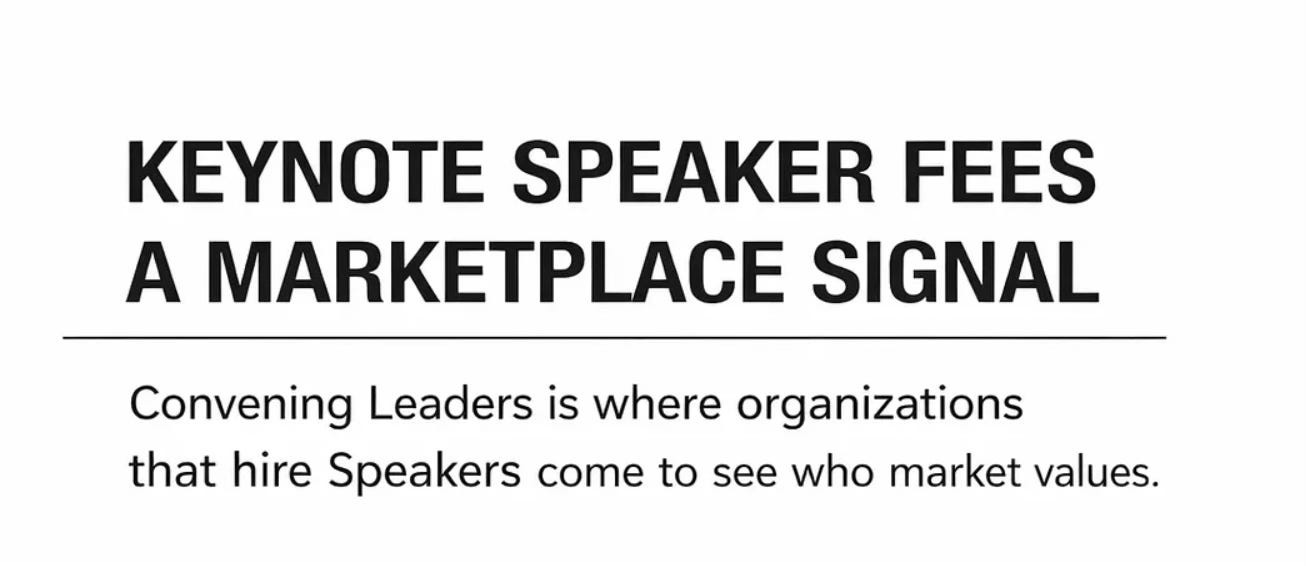
Convening Leaders-Reading the Main Stage: Meaning, Money, and Why These Voices Show Up
How keynote economics reveal the power, leverage, and audience gravity of a conference
The main stage at PCMA Convening Leaders is not built to teach event professionals how to do their jobs better in the narrow sense. It is built to signal something larger: that this room, and the people sitting in it, carry real purchasing power.
That signal is not conveyed through marketing language or mission statements. It is conveyed through who shows up, who says yes, and what those voices typically command elsewhere. Read the keynote lineup closely and the conference reveals itself not just as a gathering of ideas, but as a marketplace — one where influence, authority, and budget gravity quietly intersect.
This is why PCMA Convening Leaders functions as one of the most important speaker-hiring environments in the meetings industry, even though it is rarely described that way. Corporate planners, association executives, and event leaders who routinely spend significant money on keynote talent gather here in one place. Speakers and bureaus understand this. So does the market.
The opening keynote, Hidden Potential, delivered by Adam Grant, establishes that dynamic immediately. Grant is not booked because event professionals need another lesson in organizational psychology. He is booked because his work carries weight in boardrooms where decisions are made about leadership, talent, and investment. In the broader speaking market, Grant is widely reported to command fees in the high six figures, often in the $200,000–$300,000 range for major corporate and association engagements. He is represented by elite agencies such as CAA Speakers and The Lavin Agency.
His presence at Convening Leaders is not about tactics. It is about positioning the audience as peers to the executives and institutions that routinely pay those rates.
That positioning continues with the inclusion of Zanny Minton Beddoes, editor-in-chief of The Economist. Her keynote is framed around global economic and geopolitical context, and while that may seem distant from the daily mechanics of event planning, it serves a strategic function. Event professionals increasingly operate under macro pressures — travel volatility, geopolitical risk, currency shifts, and board-level scrutiny. Beddoes’s market range, typically estimated between $75,000 and $125,000 and handled through top-tier international bureaus, signals that this is not industry-insider commentary. It is an invitation for attendees to see themselves as participants in global economic conversations, not just implementers of logistics.
The program then shifts register with the appearance of Tabitha Brown, whose keynote centers on authenticity, influence, and trust. Brown operates in a different speaking economy altogether, one rooted in cultural capital rather than institutional authority. Her typical fees, often reported in the $50,000–$100,000 range depending on scope, are managed through major entertainment agencies rather than traditional speaking bureaus.
For event professionals, her relevance is not symbolic. Events succeed or fail on emotional coherence. Brown’s presence reflects a market reality: organizations are paying for voices that can shape culture, not just deliver content.
The closing main-stage moment with Trevor Noah makes the economic logic of Convening Leaders unmistakable. Noah exists almost outside the conventional keynote market. His fees for live appearances are widely understood to exceed $300,000 and are often significantly higher, handled through elite entertainment representation rather than the association circuit. His participation is not about content transfer. It is about cultural relevance.
For event professionals, this matters because it reframes how the profession is perceived by the outside world. This is a room influential enough to attract voices that usually engage global media, political leaders, and mass audiences. That kind of presence does not happen accidentally. It happens where budgets exist.
Away from the celebrity curve, the most direct return on investment appears in the pre-conference Negotiation Intensiveled by Deepak Malhotra, a Harvard Business School professor and negotiation expert. In the open market, Malhotra’s negotiation programs, typically delivered through executive-education channels, are commonly priced between $40,000 and $75,000 for private engagements. This is where Convening Leaders quietly reveals its hierarchy of learning. The deepest, most actionable skills are available, but they are gated by cost, time, and capacity. For event professionals, this session matters because negotiation directly affects venue contracts, sponsorship agreements, vendor relationships, and internal budget conversations. The value here is not abstract. It is financial.
The smaller AI- and data-focused workshops occupy a different but equally telling space. Facilitators in this category typically command fees in the $15,000–$35,000 range and are represented by boutique consultancies or innovation-focused bureaus. These sessions matter less for their star power than for what they foreshadow. They signal where professional credibility is moving, even if the main stage is not yet ready to center data literacy and analytics as leadership requirements.
Taken together, the keynote and featured session lineup explains why Convening Leaders consistently attracts speakers who sit well outside the traditional meetings-industry circuit. They come because this audience spends money. Real money. On ideas, on voices, on legitimacy, and on people who can influence outcomes.
For event professionals, understanding this context is essential. These sessions are not simply about inspiration. They are signals of purchasing behavior. They show which kinds of voices organizations are willing to pay for, which kinds of authority are rising, and how conferences like Convening Leaders function as a live pricing index for intellectual and cultural capital.
The main stage is not just a platform.
It is a market.
And that, more than any individual takeaway, may be the most consequential message of all.
Transparency note: All fee ranges referenced above reflect widely reported industry estimates from public speaking markets and bureau listings. PCMA does not disclose speaker compensation, and actual arrangements vary by format, timing, and relationship.
Related reading
Reading the Agenda: What Your Agenda Says About Your Conference
Reading the Main Stage: What the Keynotes Reveal About Who the Conference Is For
.


