


This is part two of a two-part profile. Read part one here first.
The tent went up on the West Side Highway, close enough to the ramp that everyone in the industry still just calls the ramp, the one that ran down into the pit before there was a museum or a bronze parapet with the names cut into it. Jaclyn Bernstein and Rob Hulsmeyer were inside that tent, not as a mourner and not as a spectator, but helping running it. Their job was to mobilize the readers, track who was going up next, keep the rotation moving through a program that had no VIP section at all. Political figures and people who had lost someone waited their turn sitting together, indistinguishable from each other, because on that stage there wasn’t supposed to be a difference.
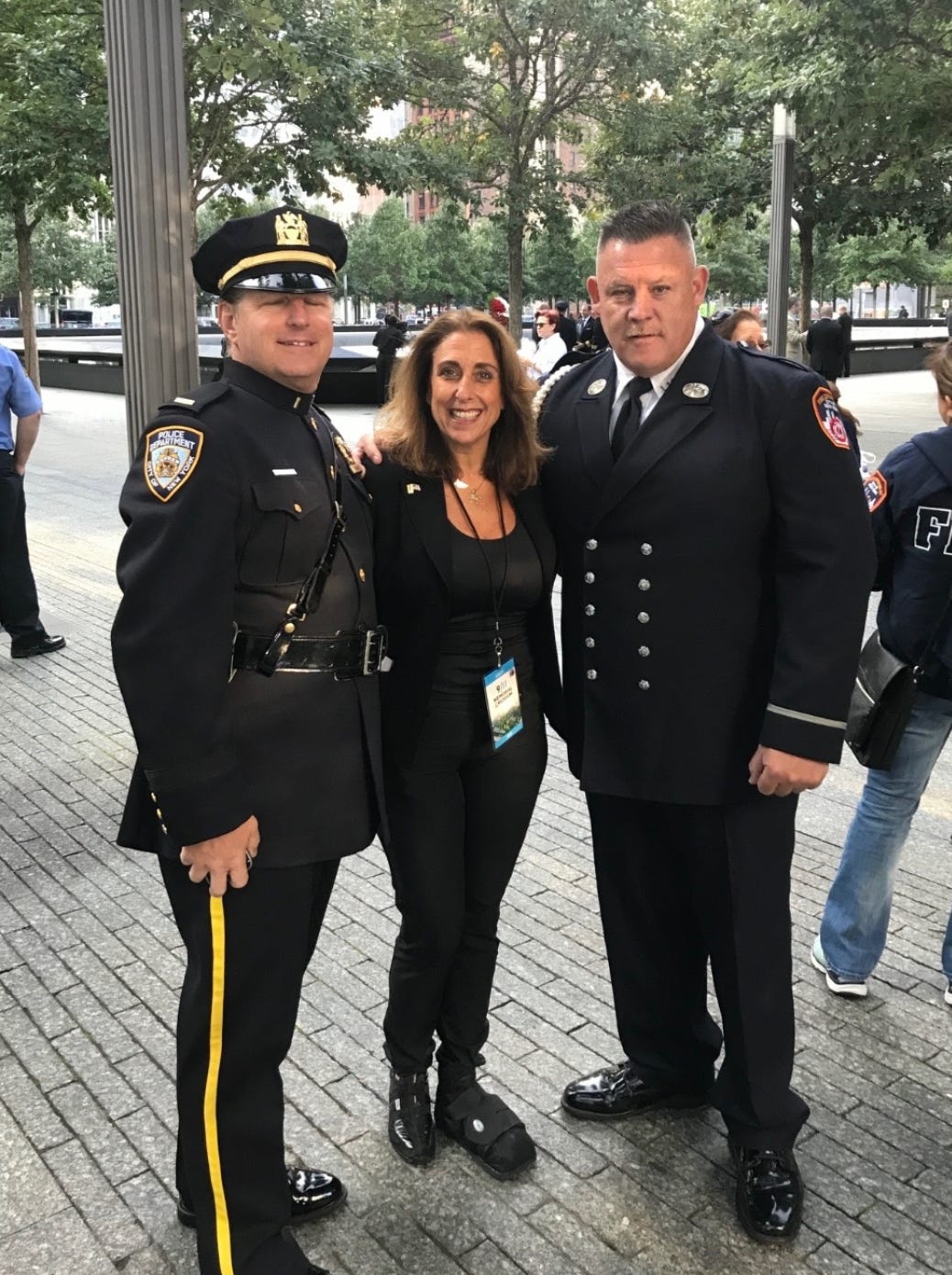
That first year, her team also served as directional staff down by the two wooden pools that sat where the towers had stood, the temporary basins that came before the permanent memorial’s bronze and granite. Each person walking down the ramp to pay their respects was handed a single flower, an honor the event designer that Empire had asked to participate, John Daly had written about in Special Events Magazine, the power of a simple flower to hold a moment that words couldn’t. Bernstein remembers a wind gust moving through the site that first year, and everyone standing there half-startled that it was those we lost letting us know they were there. She has been involved in some version of that operation every September since. In two weeks she will do it again, for the twenty-fourth time.
This was never just a professional obligation for her. Daniel Suhr, the first FDNY firefighter killed that morning, had been captain of the football and baseball teams at James Madison High School, the same Brooklyn school Bernstein attended, and the school renamed its athletic field in his honor decades later. Someone on her block died that day too. Her mother had already been to funerals that fall before Bernstein ever got to hers. The city she was serving at that first ceremony wasn’t an abstraction to produce an event for. It was the block she grew up on.
Bernstein is the president and owner of Empire Force Events, a destination management company Jaclyn worked at from college and then brought in Rob Hulsmeyer a few years later, that has built its identity on being the closest thing New York City has to a living export, the pace and the resourcefulness and the refusal to say no, delivered by a person rather than a brochure. That’s the argument the first half of this profile made. This half is about where that argument was tested hardest, and about the parts of Bernstein’s life she has never fully separated from her work, because on one September morning in 2001, there was no separating them left to do.
$1.6 million, and a van with a hand-painted sign
On September 10th, Bernstein was in Washington, D.C., as the featured speaker at an ILEA event on surviving and thriving in the industry. She flew back to New York the next morning on an 8:30 flight. She was in the air when the first tower was hit, the plane diverted back toward Washington when the Pentagon was struck too, and eventually landed in Baltimore, leaving her grounded for hours in a city that wasn’t hers, trying to reach a home that no longer looked the way she’d left it.
Her business partner, Rob Hulsmeyer, had been scheduled that morning for a 10 a.m. meeting five blocks from the towers, a meeting that had originally been set for 9 and was pushed back the night before for no reason anyone could later explain. Had it stayed at 9, he would have been in the subway under the World Trade Center when the first plane hit. An employee who lived a block from the towers was alone in the shower when the second plane struck, with no idea the buildings were about to fall, and made it out with fifteen minutes to spare.
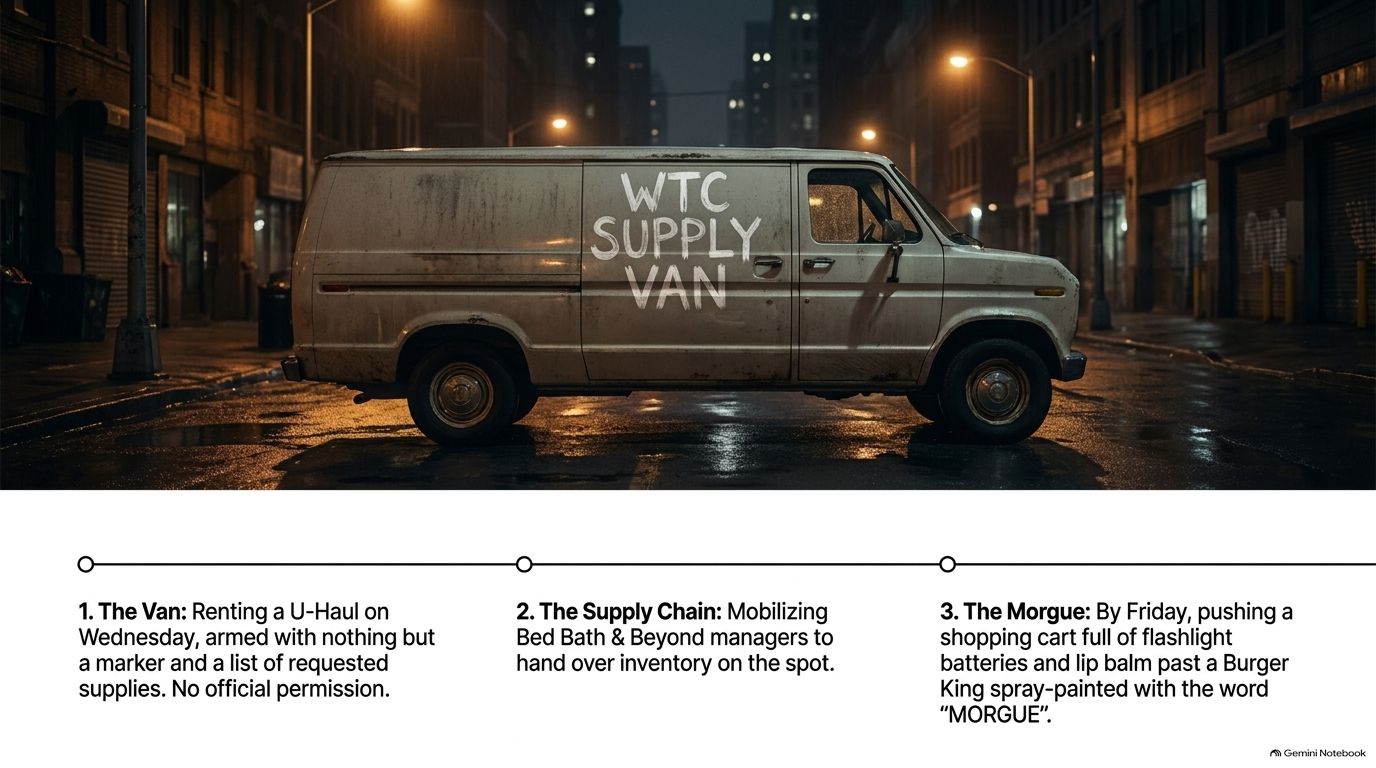
By Wednesday, Bernstein, Hulsmeyer, and their Director of Production, Kevin White, decided sitting still wasn’t an option. They rented a van from a U-Haul lot, wrote WTC SUPPLY VAN, DONATIONS NEEDED across the side of it, and started driving toward the volunteer command centers with a list of what people said they needed. They had no formal channel and no official permission, just a van and a marker. A regional vice president at Bed Bath & Beyond, reached by phone by a store manager who’d never heard of any of them, told his stores to hand over whatever they asked for. Hardware stores, drugstores, bagel shops did the same. By that night they were driving food directly into what people had already started calling Ground Zero.
Bernstein and Hulsmeyer went back Friday, working the east side of the site this time, before the National Guard had finished the fencing that would later seal it off. She spent most of that day pushing a shopping cart around, handing out underwear, lip balm, mouthwash, and flashlight batteries to rescue workers who hadn’t showered since Tuesday, retrieving warm clothes from the basement of a Burger King that had MORGUE spray-painted across its front in orange letters. Refrigerated trailers lined the West Side Highway that day, doors shut, waiting.
Empire Force’s total revenue loss in the aftermath came to roughly 1.6 million dollars, a figure Bernstein put in writing herself within months of the attacks, back when the number still felt too large to say out loud. The company spent another eleven thousand dollars buying World Trade Center lapel pins, small flags attached, and handed them out at every industry event for years afterward, giving away something close to eleven thousand of them in total. At the first Anniversary’s Memorial Event in 2002, while working in the readers tent Robert De Niro accepted Bernstein giving him one and asked her to put it on him herself. She watched him wear it, later, on television.
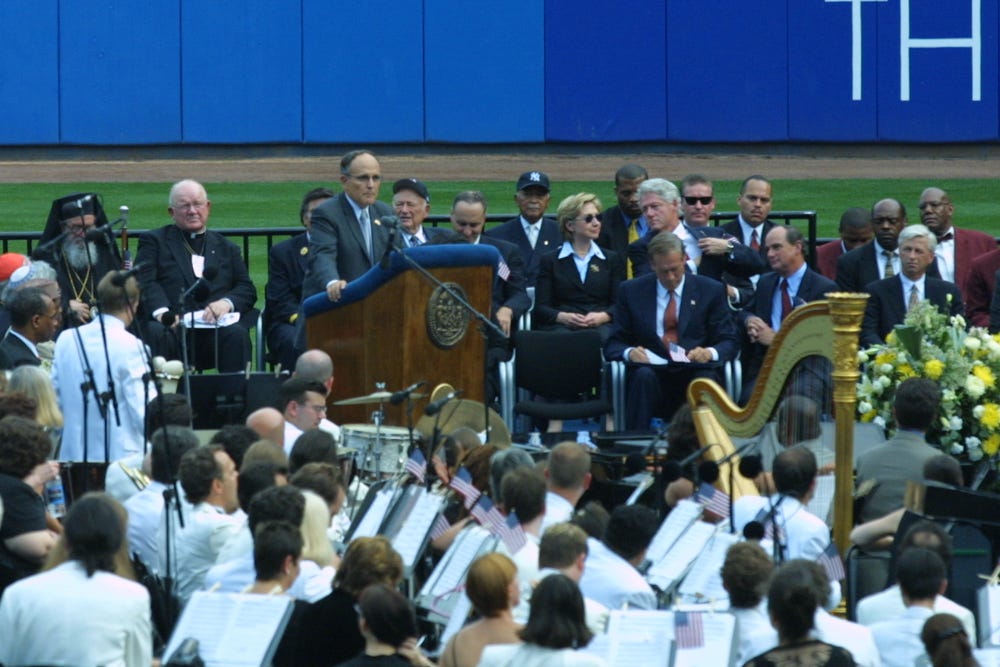
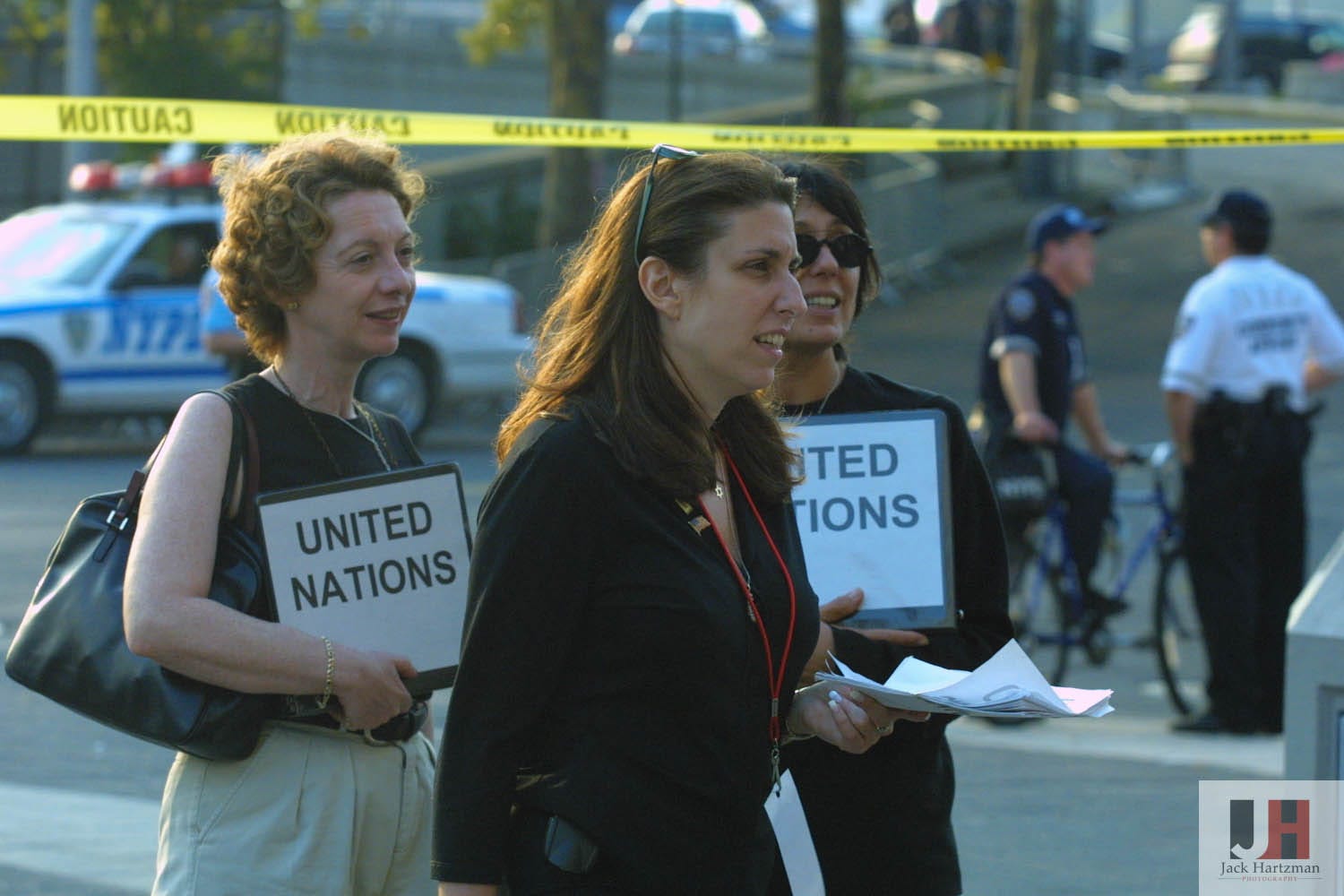
Twelve days after the towers fell, Empire Force was already back at work on something bigger than its own recovery. Bernstein and her team handled logistics and staffing support for the United Nations delegation at A Prayer for America, the interfaith memorial service held at Yankee Stadium on September 23rd, hosted by Oprah Winfrey and James Earl Jones, with Giuliani and Governor Pataki speaking and performances from Bette Midler, Lee Greenwood, and Placido Domingo in front of tens of thousands of mourners. It was the kind of job that offered no time to grieve on the company’s own schedule. There was a stadium full of diplomats and grieving families to move through safely, and somebody had to know how to do it.
CEME, and the anthrax that came next
The city’s crisis didn’t end when September did. Weeks later, anthrax spores started showing up in mail delivered to newsrooms and government offices, and for a stretch that fall, on top of everything still smoldering downtown, people across the industry were opening their mail with gloves on. I helped start the Convention, Exhibition, Meeting and Event Coalition that same season, an industry-wide push to physically walk companies back into a city many of them had quietly decided to avoid, and Bernstein signed on as its Client Services Co-Chair. We worked together for years after that, and if there was one constant across every gathering the coalition threw, it was her.
We held events at Gracie Mansion, the mayor’s residence, where more than once a Broadway performer opened the evening by singing New York, New York in front of a room full of meeting planners whose own companies had told them the city wasn’t safe enough to book. Bernstein worked bringing New York City back harder than anyone in the room, personally thanking company after company for keeping their events in New York instead of quietly moving them elsewhere, for using local caterers and local boats and local staff rather than relocating somewhere that felt less like a target. It wasn’t charity. It was the same instinct that had her pushing a shopping cart through Ground Zero weeks earlier, aimed now at a slower kind of emergency, the one where a city loses its business not all at once but company by company, unless someone keeps showing up to ask them to stay.
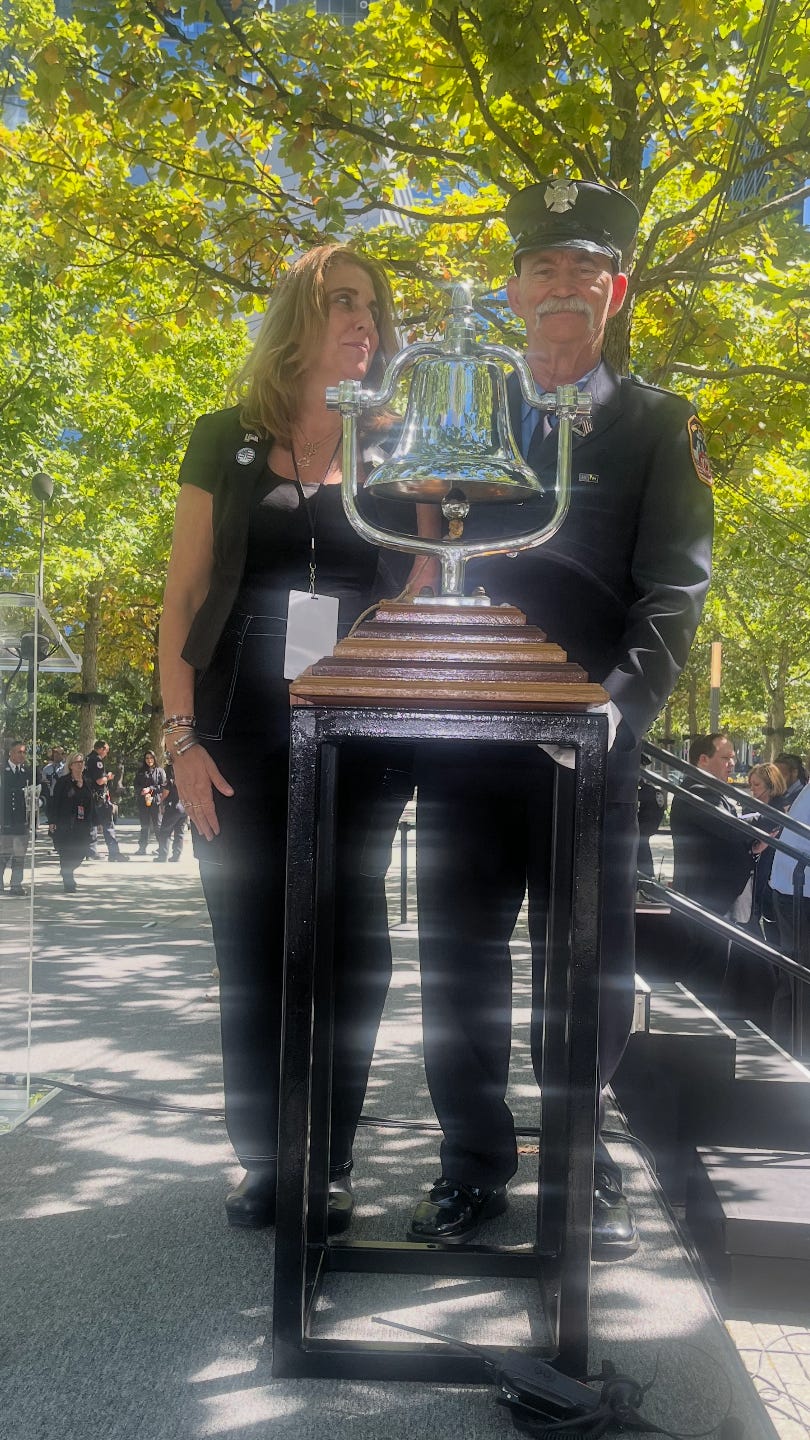
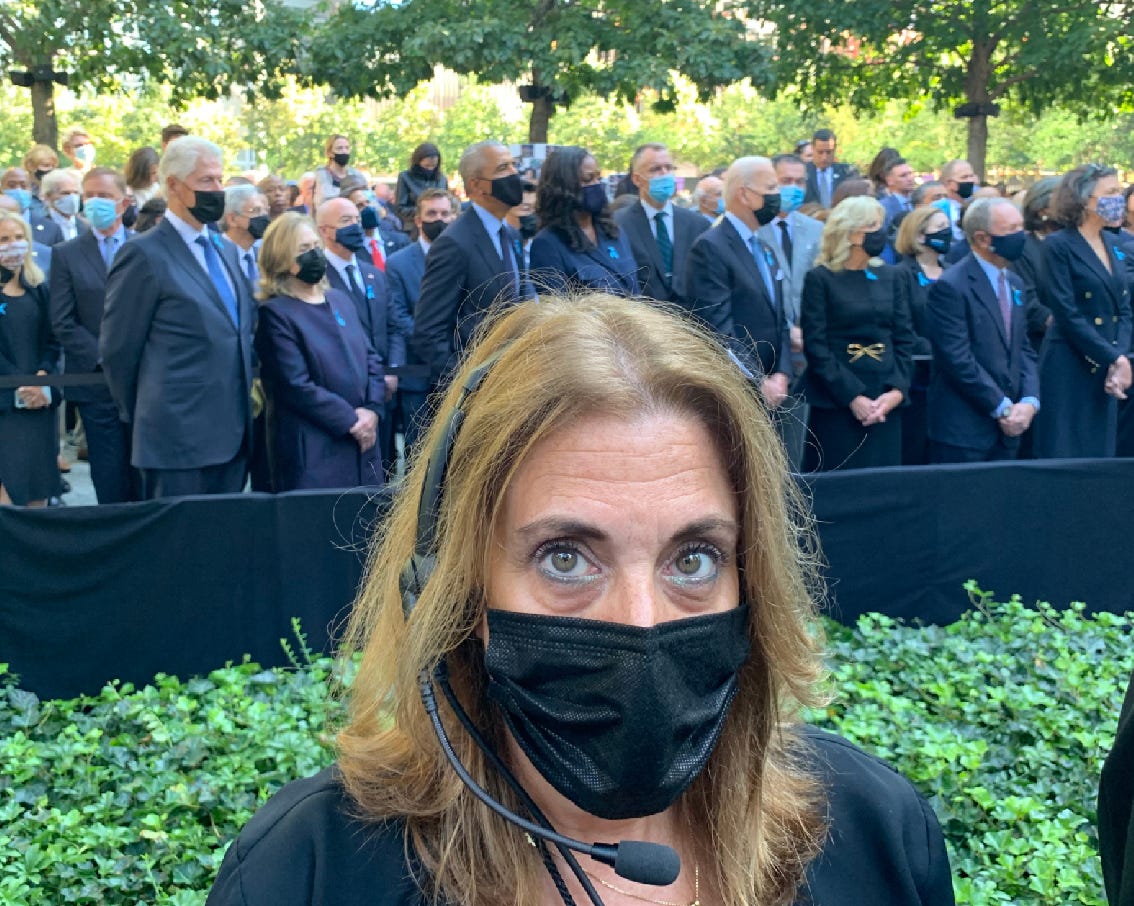
The first memorial ceremony was held in 2002, produced initially through the mayor’s office before the responsibility eventually passed to the National September 11 Memorial & Museum once it opened. Empire Force has worked every one since, without exception, closing its own office each year to be there. That first year, the company mobilized roughly fifty staff to run the tent Bernstein and Hulsmeyer was already help leading as well as other logistics in helping families & readers maneuver through the ceremony and site. Her role today looks nothing like it did then. The readers’ tent is someone else’s job now, run by the museum’s own staff. Her focus has shifted to the families, coordinating their access, their proximity to the stage, the private grief that has to be managed alongside a nationally televised broadcast. Some years it is a full team. Other years, she says, it is just her.
She has worn other people’s names on her wrist for years at a time. One bracelet carried the name of Madeline Amy Sweeney, the Flight 11 attendant whose calm, detailed account of the hijackers’ seating helped investigators identify Mohamed Atta before the day was even over. A colleague named Patti Coons gave Bernstein that bracelet. Another belonged to Dennis Michael Edwards, who worked at Cantor Fitzgerald and died in the North Tower. Hulsmeyer wore that one first, then passed it to Bernstein, who wore it for years until she found Edwards’s sister at a recent ceremony and told her, for the first time, who had been carrying her brother’s name.
I had my own small piece of that ceremony in those early years, before there was a permanent memorial to run it from. In year three or four, Bernstein assigned a colleague, Michael Cerbelli, and me to work the pit, managing the flowers that family members placed at the bottom of the temporary reflecting pools, the wooden ones that stood in for what would eventually become bronze and granite. It was quiet work, mostly standing and watching people kneel, and it meant that even in those early years, she was already the one helping organize who did what down there, not just another volunteer standing beside the rest of us.
Michael and I hadn’t known each other well before that day. We barely spoke, at first, there wasn’t much to say standing where we were standing. But something about doing that kind of work together, watching strangers grieve at close range for hours at a stretch, bonded us in a way that ordinary friendship rarely manages. We’ve stayed close ever since, in the particular way people do when they’ve stood next to each other during something neither of them will ever fully explain to anyone who wasn’t there.
The unveiling she postponed three times
That same fall, Bernstein was supposed to be planning her own father’s unveiling, the Jewish memorial ceremony held a year after a death, scheduled to fall in October. Jewish custom generally holds that a mourner stays away from funerals during that first year. She went to more than one anyway that October, to stand beside colleagues from Windows on the World who were there to mourn people lost in the towers that she also knew. She postponed her own father’s headstone and unveiling three times that fall, something she has said she has never fully forgiven herself for, because there was always something for New York City, or at the office, that needed her more urgently that year.
For years she wore his kreeah every day, the black mourning sash cut at a Jewish funeral, the same way she still wears the bracelets now every September. She has never framed this as a contradiction, tending to everyone else’s grief while her own sat unfinished. It reads, instead, like one impulse doing two jobs at once. The woman who couldn’t put her own mourning down long enough to honor her father properly is the same woman who has never once, in twenty-five years, put down the ceremony for thousands of strangers either.
What the pit still asks of her
Twenty-five years is long enough that most of the people working the ceremony today are employees of the museum itself, not outside volunteers who remember what the readers’ tent looked like before there was a museum at all. Bernstein is one of the handful left who aren’t. Her connection, as she puts it, is simply that Empire Force has never not been there.
That kind of continuity is not a skill a piece of software can replicate, no matter how good the prompt. It requires a person who was stranded over New Jersey flying into New York City that morning, who pushed a shopping cart past a Burger King – that’s still there - with the word MORGUE spray-painted across it, who has never finished mourning her own father and now her mother, still, every September for a quarter century, shown up to help thousand other people mourn theirs. Whether that adds up to loyalty or something closer to faith is not really a question Bernstein has ever stopped to answer for herself. She just gets on the plane even if nervously.
GatheringPoint covers the people who build the gatherings. Subscribe at GatheringPoint.news.
Running a Destination Management Company in NYC: She Doesn’t Just Plan Events, She Makes It Feel Like Home

Don’t Miss Part 2 : She’s Never Missed a Single September- A 9/11 Tribute