


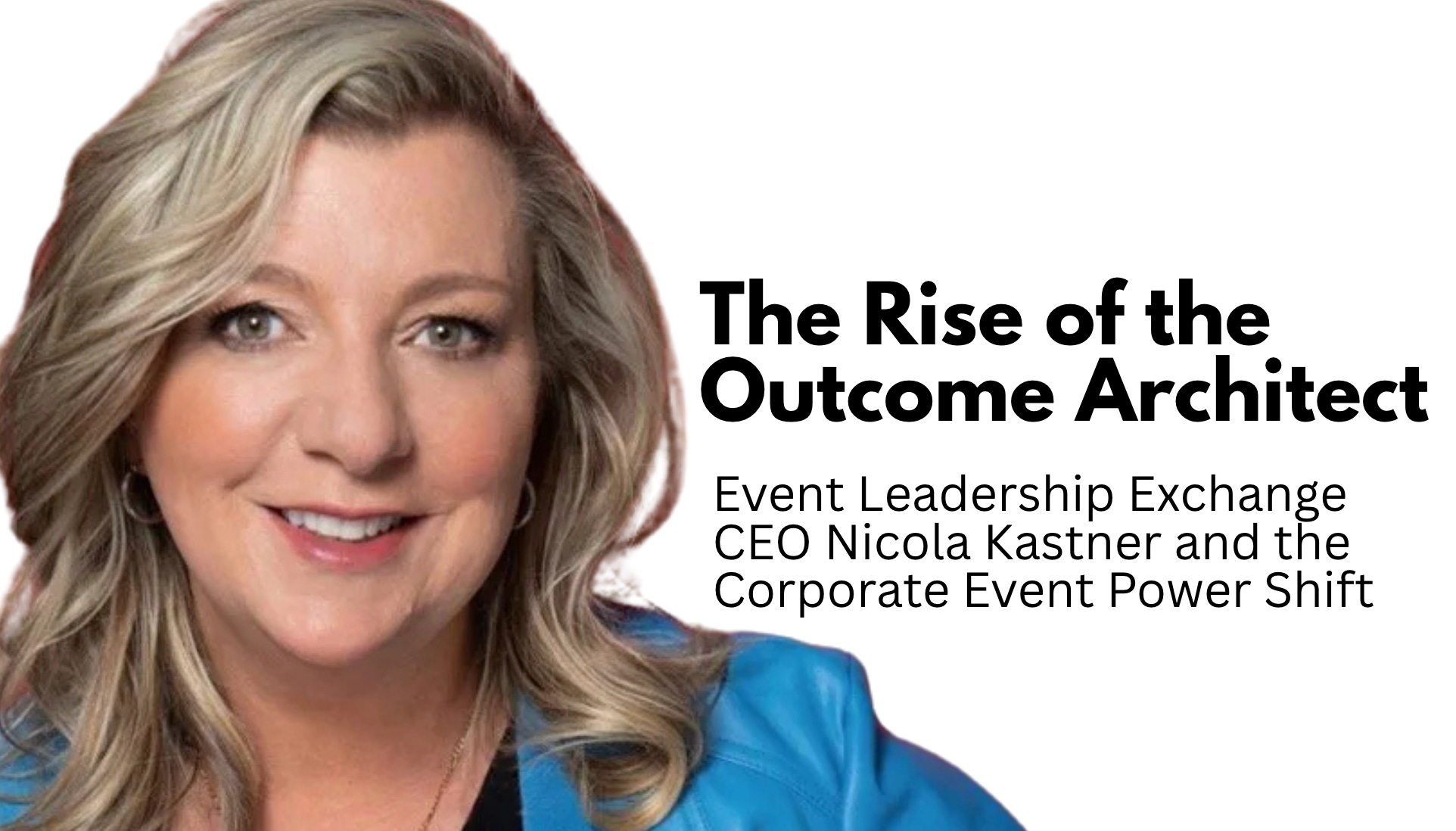
At The Event Leaders Exchange (ELX), Nicola Kastner sits at the center of a network that quietly shapes one of the most powerful forces in business. More than three hundred senior leaders participate in the community, collectively influencing over 160,000 events each year and nearly $12 billion in spend. Those numbers are large enough to move markets, but they only hint at what is actually happening. ELX is not a conference circuit or a content platform. It is a 365-day community where the leaders behind the world’s most important corporate gatherings rely on one another for candid advice, strategic perspective, and practical support in shaping how events drive real business outcomes.
Walk into Dreamforce , SAP’s Sapphire, or Workday Rising, IBM Think, Canva Create and the difference is immediate. These are not conferences in any conventional sense. They are controlled environments where a company compresses time, attention, and decision-making into a shared moment. Customers, partners, employees, analysts, and media are all operating within the same structure, responding to the same signals, and reacting to the same narrative. In that setting, deals accelerate, alignment sharpens, and perception shifts in ways that no digital channel can replicate. For a brief period, the company is not describing its strategy. It is executing it.
The scale of this shift is beginning to show up in hard numbers. Corporate events already represent a sector measured in the hundreds of billions and are projected to move toward the $600 to $700 billion range within the next several years. This is not simply about more events. It reflects a deeper reclassification of what events are. They are no longer support functions. They are environments where business outcomes are created.
The Future of Corporate Events?
Kastner’s authority in this space comes from having built her career from the ground up. Born in England and moved to Canada at eleven, she did not set out to become a central figure in the event industry. She wanted to travel. That instinct led her to study hospitality at Toronto Metropolitan University, where a course on incentive travel reframed her thinking. The realization was simple but powerful. Experiences could drive behavior, and behavior could drive results.
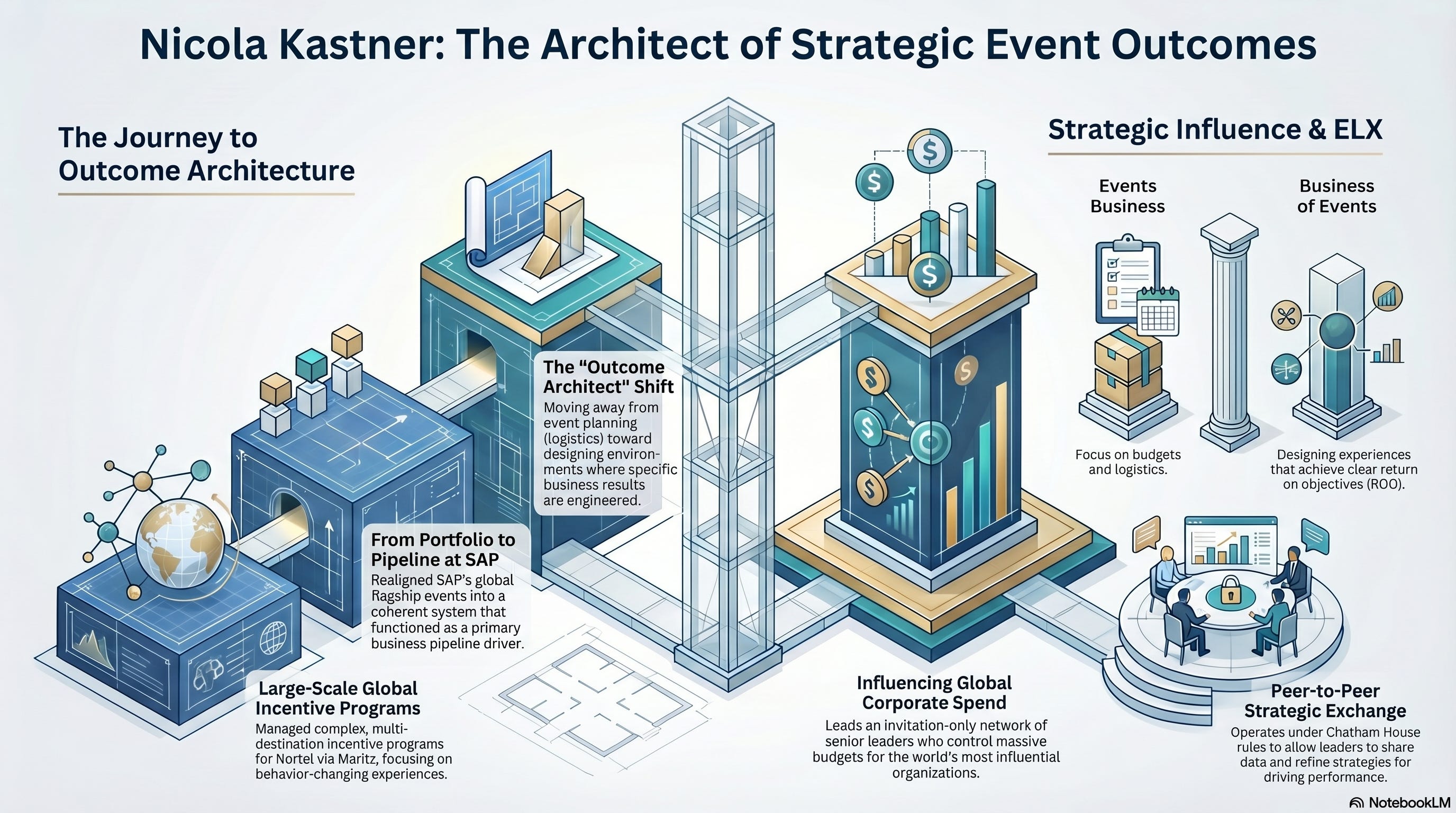
She learned the business by doing the work. Early roles in dmc’s led to agency work, where she advanced by taking on responsibilities before she was formally ready. At Maritz, she helped design and run large-scale programs for clients including Nortel Networks. That clients support team at Maritz grew from a small team into a seventy-seven-person operation managing global incentive travel at scale. The insight she developed during that period continues to define her approach. The value of an experience is not in the moment itself but in what it causes people to do afterward.
At SAP, that understanding expanded into a different category of importance. SAP’s flagship event, Sapphire, functioned as one of the largest pipeline drivers of the year, a moment when relationships advanced and decisions that might otherwise take months were compressed into days. That reality challenges the traditional way events are evaluated. They rarely generate profit through registration or sponsorship alone, but they influence the conditions under which revenue is created in a way few other channels can match.
When Kastner was asked to rethink SAP’s global event portfolio, she encountered the structural challenge that defines corporate events at scale. Multiple flagship programs existed across divisions, each tied to distinct audiences and internal ownership. The task was not to improve individual events but to align them into a coherent system. The barrier was not execution. It was governance. Events are not neutral assets. They are stages, and control of the stage determines who holds influence.
The companies that have moved beyond this fragmentation treat their flagship gatherings differently. They operate them as central platforms rather than departmental properties, aligning leadership around a shared objective. The comparison to the Super Bowl becomes meaningful in this context because it reflects how attention, timing, and execution are concentrated into a single moment that drives everything around it.
Through ELX, Kastner is now shaping how this thinking spreads. The community is intentionally structured to prioritize contribution over access. Membership is by invitation, participation is required, and conversations operate under conditions that allow leaders to share real information without attribution. She personally interviews every member before they enter, looking beyond titles to understand how they think and what they have actually changed inside their organizations. The result is a network where the quality of insight is significantly higher than what is typically shared in public forums.
Kastner runs ELX with the same discipline she applies to event strategy. Members do not pay to join, which removes transactional expectations and shifts the emphasis to contribution. Strategic partners support the model under strict conditions that prevent the environment from turning into a sales platform. Within ELX gatherings, the focus is on interaction, co-creation, and decision-making rather than passive consumption. Leaders compare how events are tied to pipeline, how success is measured, and where resources should be reallocated or eliminated.
At the center of her thinking is a distinction that reframes the entire industry. The events business focuses on logistics and execution. The business of events focuses on outcomes. It begins with defining what an event is meant to achieve and builds the experience to produce that result. Measurement is embedded from the beginning, not added afterward as justification. Kastner emphasizes return on objectives rather than relying solely on traditional ROI models, recognizing that events operate within broader systems and cannot be meaningfully isolated.
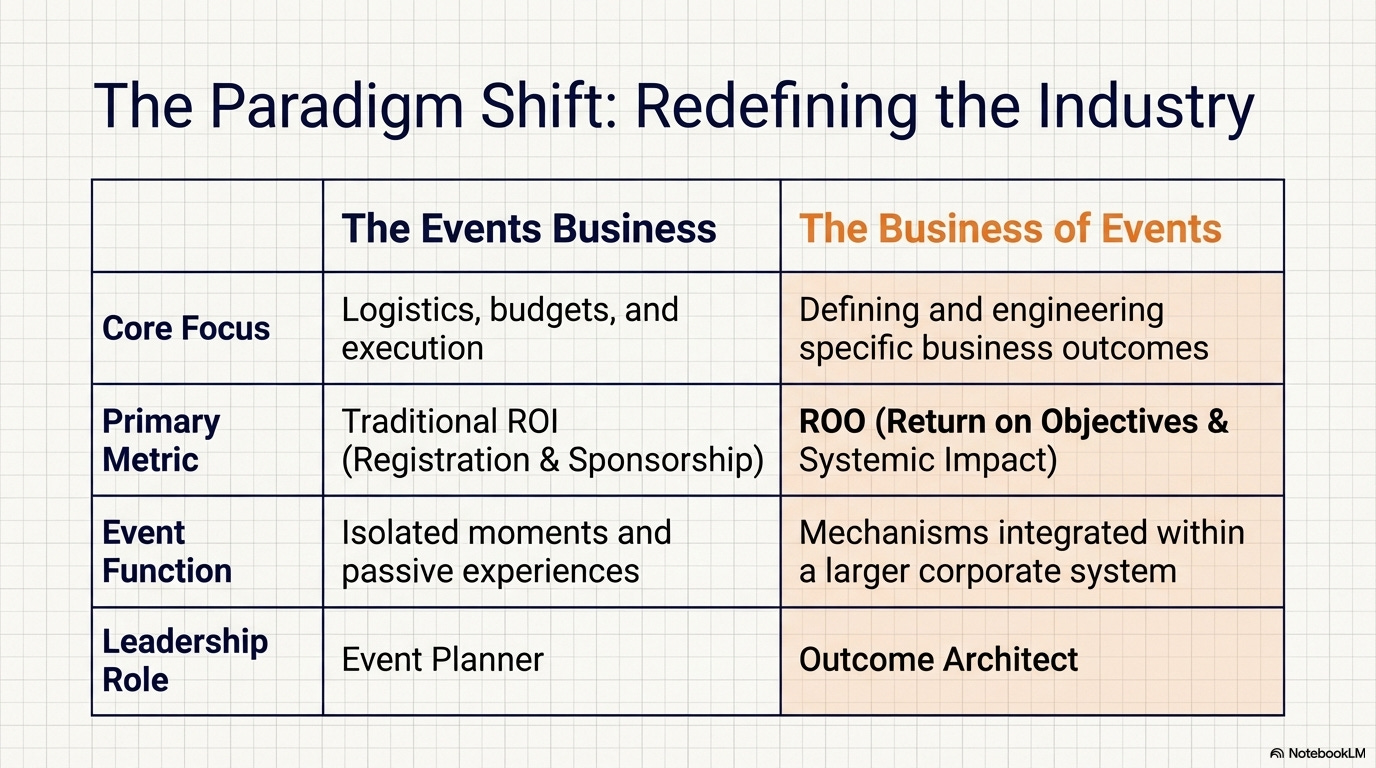
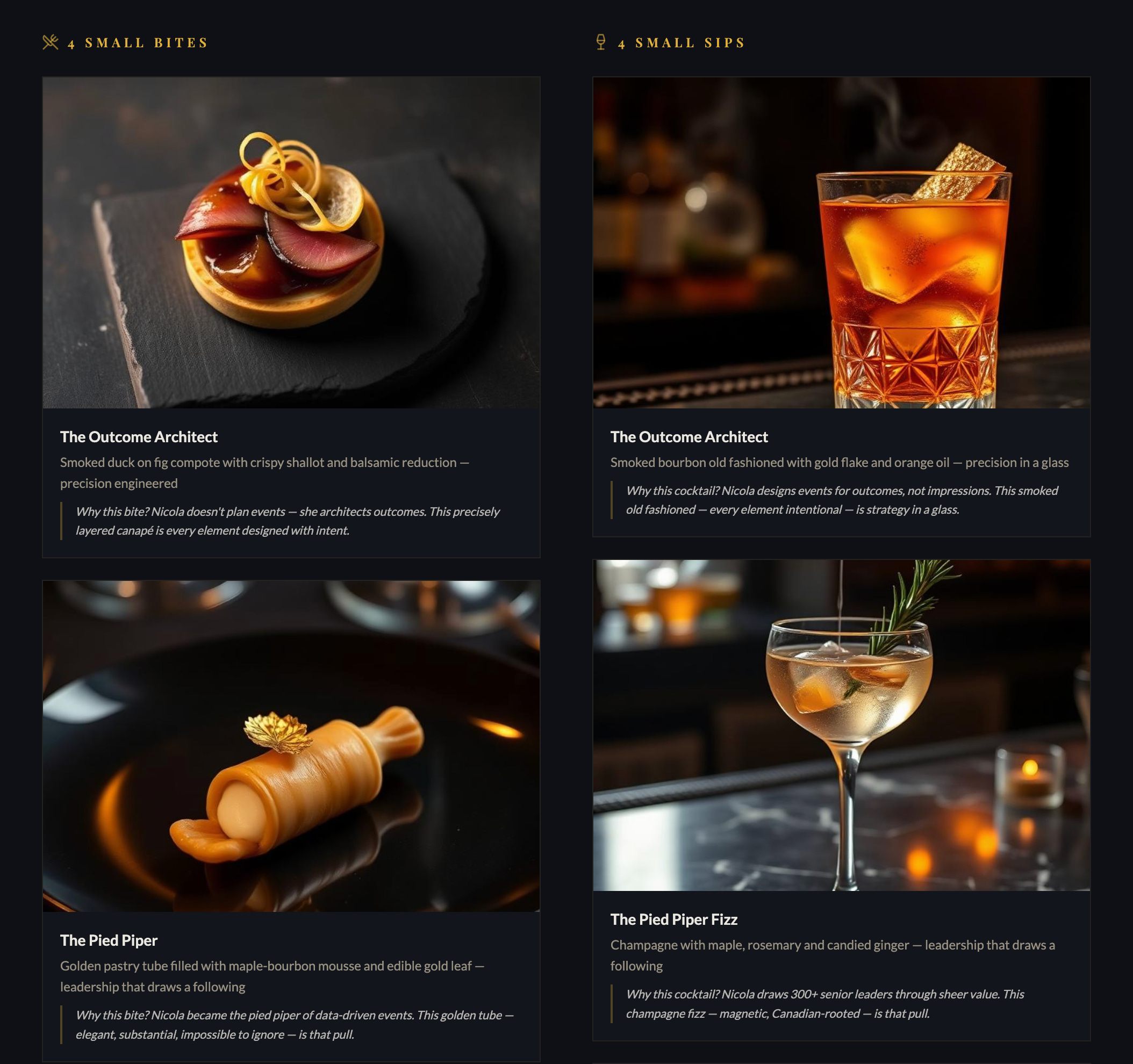
This is where her role can be understood as that of an outcome architect. She designs environments where specific business results are more likely to occur and aligns every element of the experience with that intent. The approach connects directly to the broader shift taking place across industries. As digital channels become saturated and attention fragments, events have emerged as one of the few places where a company’s narrative is experienced directly. There is no filter between message and response. The event becomes a test of credibility rather than a projection of it.
The growth of corporate events reflects this reality. Companies are not investing more because events are fashionable. They are investing more because events are one of the few environments where strategy, behavior, and outcome intersect in real time. As more organizations recognize this, these gatherings will continue to move toward the center of how business is conducted.
Nicola Kastner has built her career at that intersection, translating what was once seen as a support function into a strategic capability. Through her work at SAP and now through ELX, she has helped define a role that is becoming increasingly essential.
Not an event planner. An outcome architect.

Events are mechanisms, not moments
If nothing changes because the event happened, it was well executed but strategically irrelevant.
Execution is not the differentiator
Most organizations are good enough at logistics. Very few are clear on what their events are actually supposed to do.
Define success before you build
If measurement starts after the event is designed, you are measuring activity, not impact.
ROI is often misunderstood
Events do not live in isolation. Measure against objectives or risk proving something incomplete.
Trust is the real currency
You can feel immediately when a room is real. Without trust, nothing meaningful moves.
Collaboration is engineered, not assumed
It only works when the environment is designed for it. Otherwise, people stay in their lanes.
Most flagship events are underpowered
Not because of budget or creativity, but because no one owns them at the level required to make them matter.
Knowing what to stop is strategic
Continuing to invest in low-impact events is one of the biggest hidden costs in the industry.
The role is changing
The future is not about managing events. It is about designing outcomes and proving their value.


It’s great to see others jumping on board with the perspective George P. Johnson Experience Marketing first started to bring to the fore in the late 1990s, at first only for IBM, globally, and later, for many other of the business world’s largest events and complete event portfolios, some of which are mentioned in this article. I know it, because I had a part in it.