


There is a moment, somewhere in the middle of almost every event, when the day tips out of its carefully constructed shape and becomes something else entirely—less like a plan being executed and more like a system that has to be shaped in real time.
It doesn’t break. It tilts. The plan is still there, but it’s no longer in charge.
The speaker goes long. The lighting cue lands half a beat late. Someone important arrives early, or not at all. A client who was calm in the morning starts asking questions in a different tone. Nothing is technically wrong, and yet everything feels different.
It’s in that space that the sentence shows up.
“I think I have ADHD.”
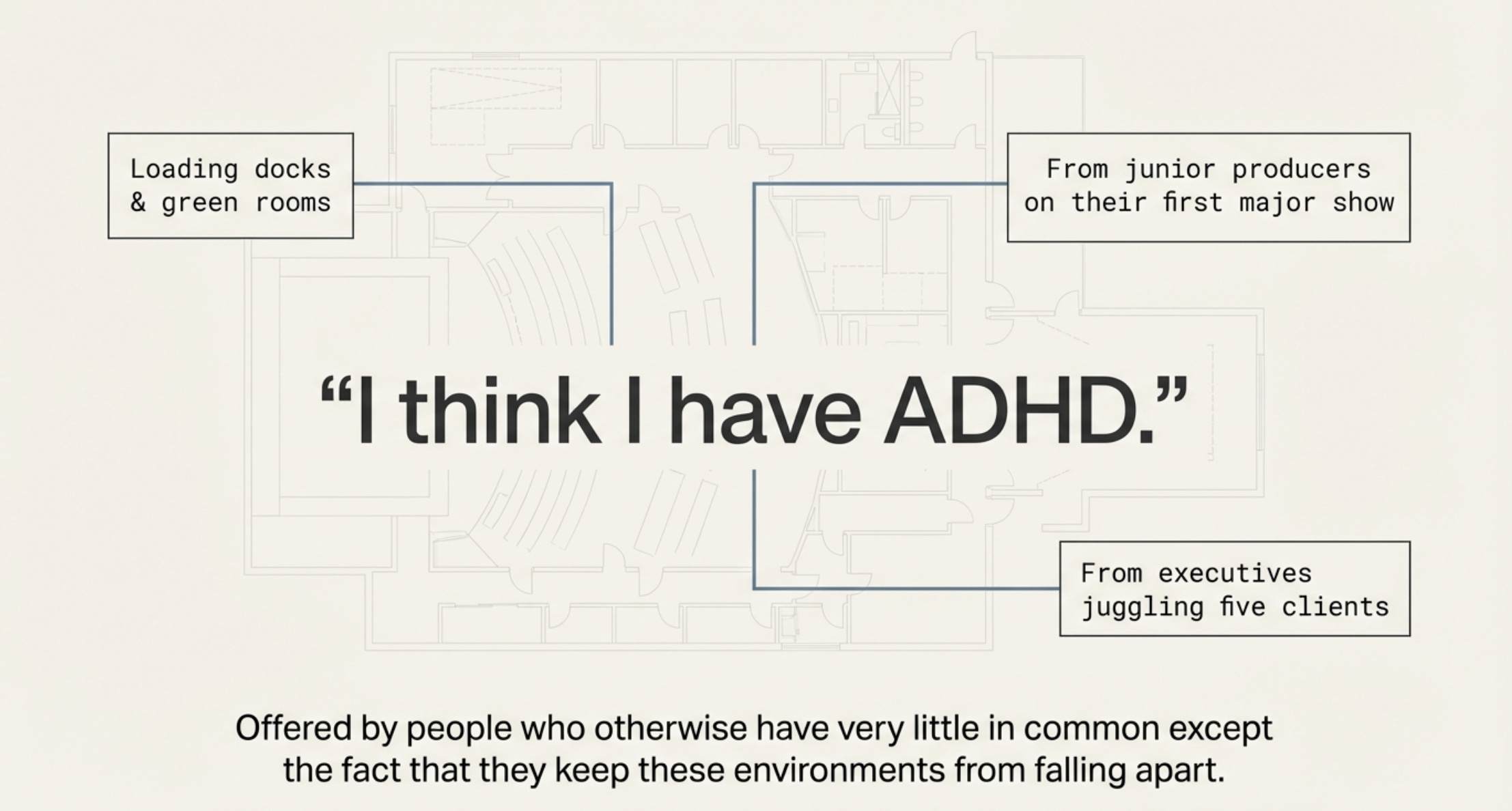
I’ve heard it in ballrooms and loading docks, in green rooms and hotel bars at the end of long days, offered by people who otherwise have very little in common except the fact that they keep these environments from falling apart. It doesn’t stay at one level of the business. You hear it from junior producers on their first major show and from the people running agencies, from planners juggling five clients and from executives who haven’t touched a run-of-show in years but still recognize the feeling. The phrasing barely changes. The tone doesn’t either. It lands somewhere between explanation and quiet admission, as if everyone is describing the same internal weather using the only language available.
The clinical meaning of Attention Deficit Hyperactivity Disorder is far more precise than the way the phrase gets used here. It refers to a defined condition with real consequences, not a shorthand for being busy or energized by chaos. There is no evidence that this industry is filled with it at higher rates than any other.
But that’s not really what people are talking about.
What they’re circling is the experience of having a mind that doesn’t move in straight lines suddenly operating in an environment that doesn’t either.
Events are not static environments. They are live systems. Variables stack, collide, and shift in ways no document can fully predict. A run-of-show suggests order, but anyone who has stood in a control room at something like IMEX or SXSW knows the real work begins when that order starts to bend.
Check out this great Notebook LM Presentation Deck

Watch what happens just before doors. Conversations overlap without collapsing. Decisions are made mid-sentence. Someone solves a problem that hasn’t fully appeared yet. Another abandons a plan because they can already feel where the room is going.
From the outside, it looks like chaos. Up close, it has its own coherence.
Most work is designed for stability and sequence. Events are not. They demand responsiveness. They reward people who can move with incomplete information, who can shift between detail and big picture without stopping to explain how they got there, who can act before certainty arrives.
In another environment, that might feel like distraction.
Here, it feels like control. Which is why that line, I think, I have ADHD keeps surfacing. It captures the sensation, even if it misses the mark. Because not everything that looks like ADHD is ADHD. Sometimes it’s fluency in motion.
That realization tends to arrive in an unexpected place. Not backstage, but in front of a screen, building something with AI that didn’t exist an hour ago. You write something, see what comes back, adjust it, refine it, change direction, try again. You stop thinking about finishing. You start thinking about getting closer.
And suddenly the rhythm feels familiar. You’re not executing a plan. You’re shaping something as it unfolds.
The language around prompting treats it like a technical skill. But the people who move fastest aren’t the ones searching for the perfect instruction. They’re the ones who engage with the response, adjust quickly, and iterate without waiting for certainty.
It’s the same behavior that runs a live event.
For years, this industry has trained people to work this way, not by design but by necessity. You cannot pause a live environment. You stay inside it and shape what happens next where staying close to the signal matters more than protecting the plan.
Now more industries are starting to operate like that. Less fixed, more responsive. Less about execution, more about iteration.
And that changes who has an advantage. The people who have spent years reading rooms, adjusting in motion, and making decisions without full clarity are not learning something new.
They’re recognizing something familiar.
You can see it in who actually thrives on the operations side of this business. It’s not always the most organized person. It’s the one who has been trained, somewhere, in consequence. Emergency rooms. Kitchens at peak service. Military units. Broadcast control rooms. Different backgrounds, same pattern.
They don’t freeze when the plan breaks. They expect it to. They decide, move, adjust, and keep going.
That’s not personality. That’s conditioning. And it’s exactly what this industry rewards.
There is, undeniably, an upside to this way of thinking. Fast-switching, highly responsive, able to track multiple threads at once and stay engaged while things shift. In the right environment, it looks like performance.
But there is also a cost.
The same responsiveness that works in the room doesn’t always turn off outside of it. The hours are irregular. The inputs are constant. The demand to stay alert accumulates. What feels like energy can become fatigue. What feels like awareness can fragment into overload.
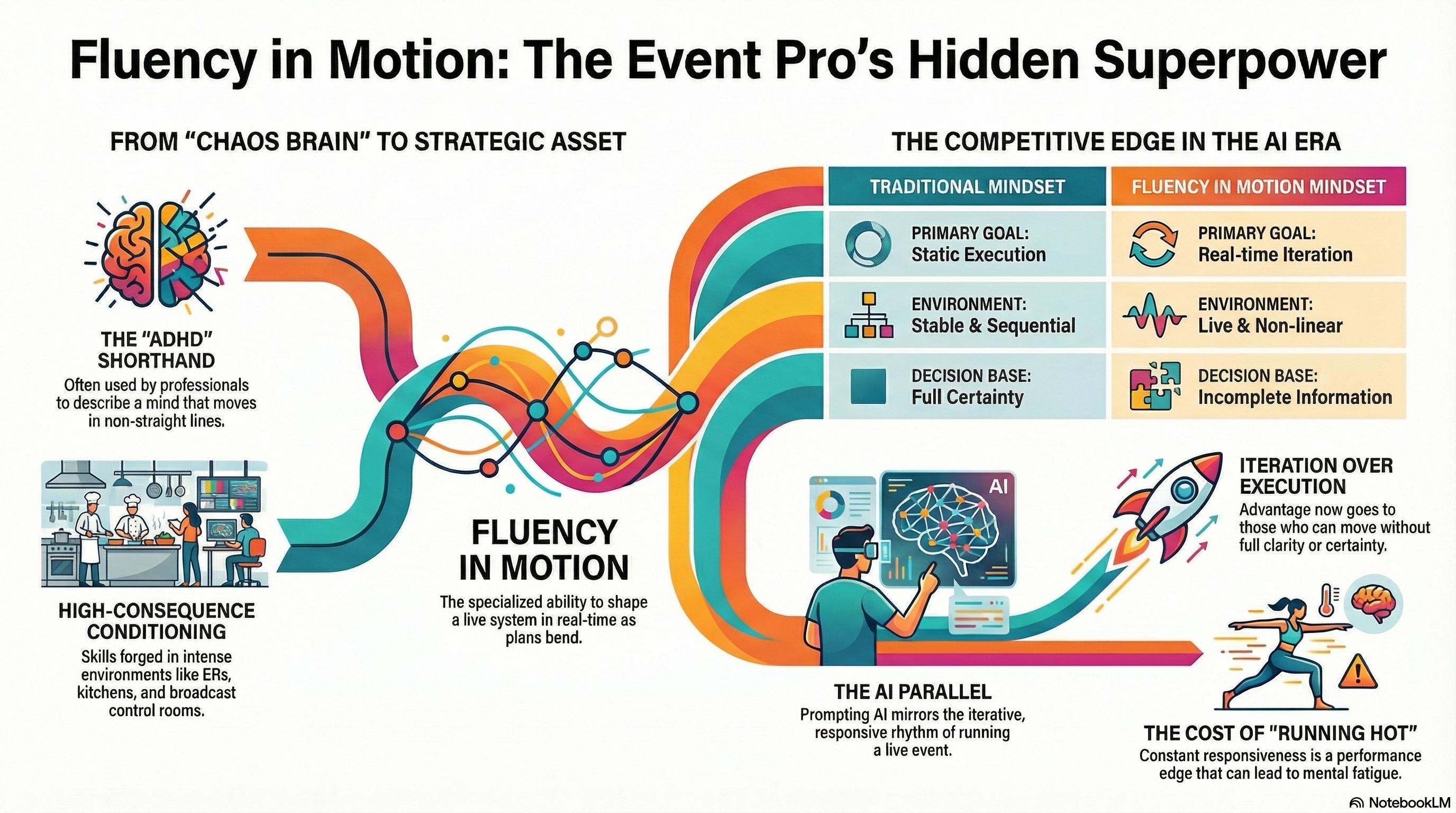
The industry has long rewarded people who can run hot.
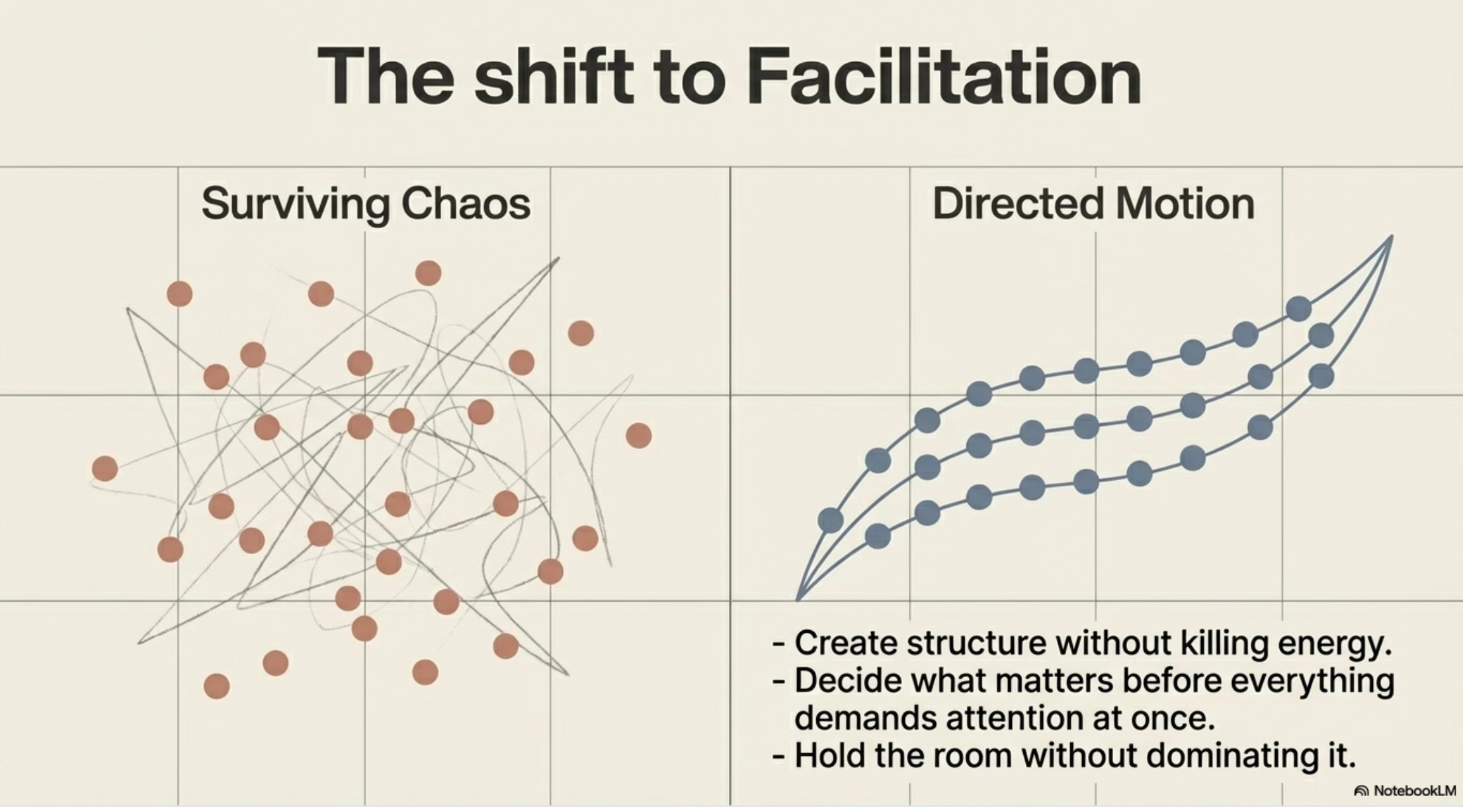
The next phase won’t. Because chaos, on its own, is not a strategy.
What will matter now whether you are shaping a room or shaping a response from a machine—is the ability to direct that motion. To create structure without killing energy. To decide what matters before everything demands attention at once.
In events, those people have always been there. They are the ones who can hold the room without dominating it, who can sense where things are going and nudge them there.
We call them facilitators, when we remember to call them anything at all.
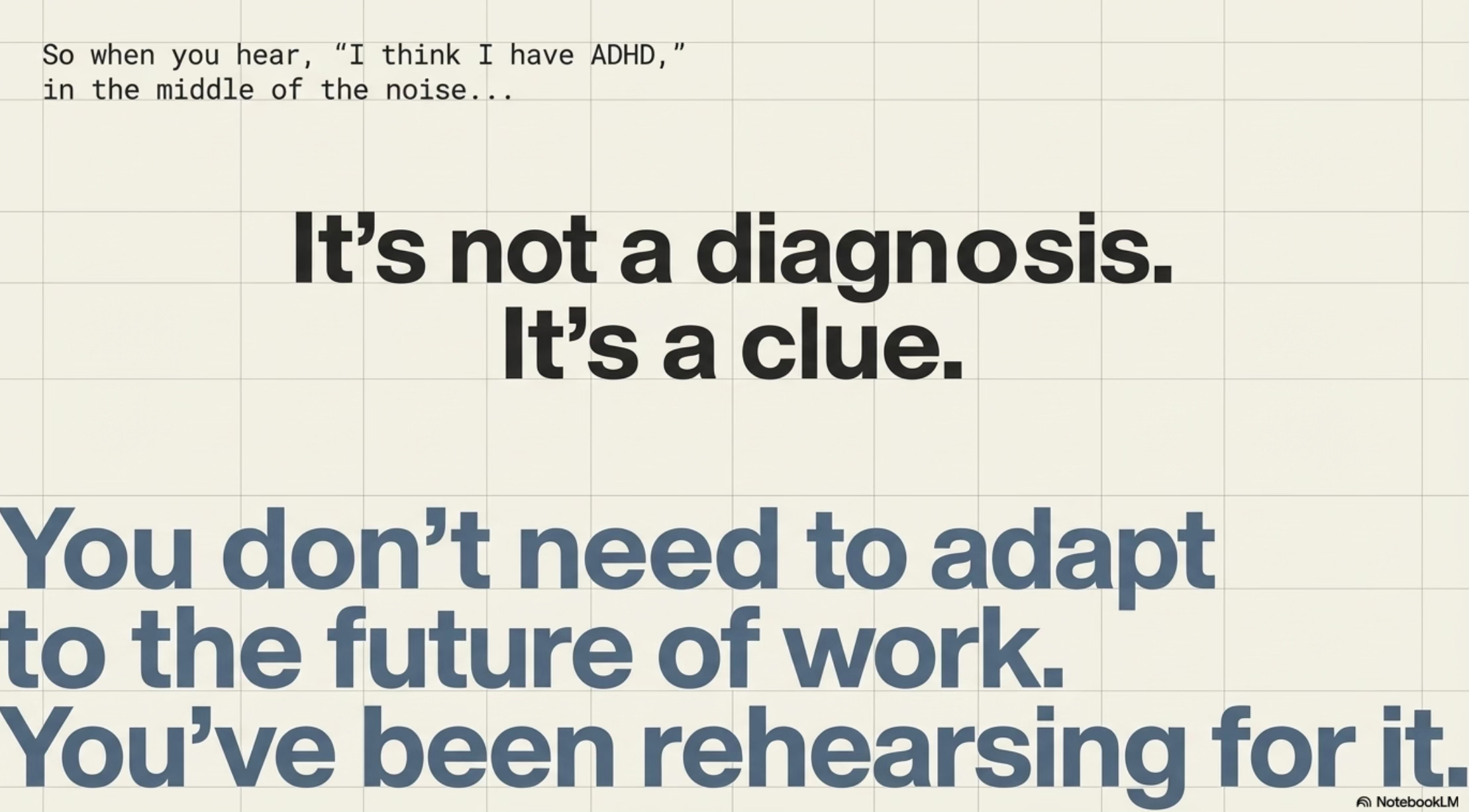
So when someone says, again, somewhere in the middle of the noise, “I think I have ADHD,” it might still land the same way.
Familiar. Light. Recognizable.
But it’s worth hearing something else underneath it.
Not a diagnosis. A clue.
That the way this industry has trained people to think quickly, responsively, without the comfort of certainty is no longer confined to live events.
It’s becoming a broader way of working.
And for those who have been doing it all along, the realization is not that they need to adapt. It’s that they’ve been rehearsing for this
.


