


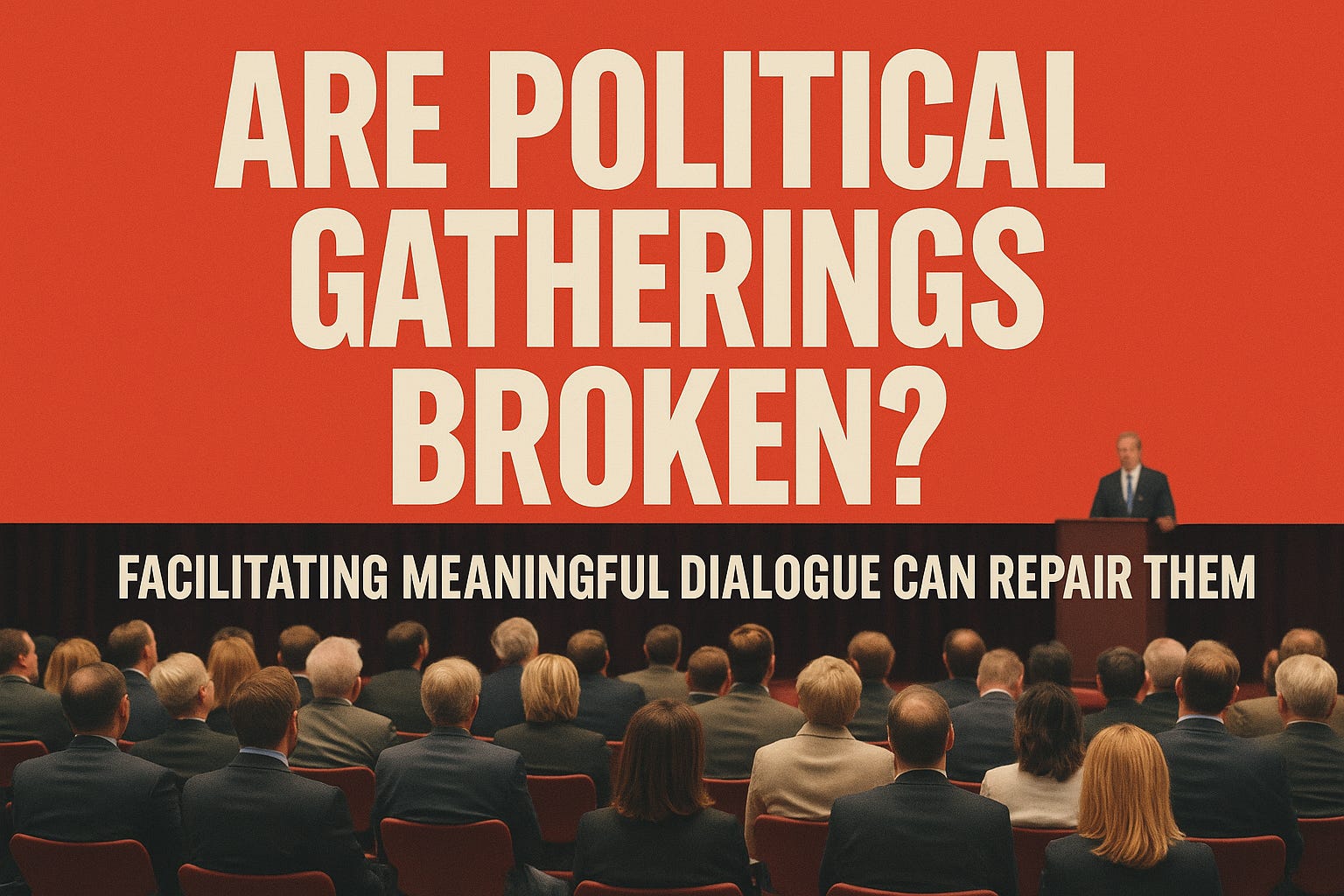
Editor’s note: this piece is part of my ongoing advocacy for making facilitators the new superstars of our industry, and for putting facilitated formats to far more universal use, because they produce better results than the panel and podium default most gatherings still reach for. A list of the formats and facilitators referenced in this story runs at the end.
It began in a conversation with my friend Robin Leeds, a veteran political strategist, Clinton Presidential appointee, organizer, and longtime advocate for equity and justice in public life. We were reflecting on how brittle our public discourse has become. Meeting after meeting. Speech after speech. Panel after press conference. The performance of inclusion is there. But the listening isn’t.
Robin put it simply: “It’s time we stop managing the room, and start engaging it.”
For Robin, engagement isn’t about getting more people to speak. It’s about building a room where people can actually hear each other, solve problems together, and leave with an agenda they helped write. Too many political and civic gatherings still do the opposite. They’re designed to deliver a message rather than absorb one, and people are invited into the room but not meaningfully into the process. They sit through speeches and panels and carefully managed discussions, and they leave without having helped shape what comes next.
“We bring people together,” Robin says, “and then we expect them to sit quietly and nod along. That’s not democracy. That’s theater.”
Robin pushes back on one popular fix, though.
Everyone wants to reach for simple speaker talks and audience listens right now,” she says. Put it in a room full of political operatives and you haven’t ended the performance and the focus on the need for an action plan with measurable outcomes. You’ve just changed who gets to perform. The audience is still watching. Nobody’s still accountable for anything when the room empties out.”
Her concern isn’t simply that these meetings are performative. It’s that they squander the two most valuable things a gathering can produce: community and collective action. A well designed room, she argues, becomes a series of circles rather than rows, spaces where people move past talking points, hear each other’s lived experience, and work on shared problems instead of performing positions. The goal isn’t consensus for its own sake. It’s finding enough common ground to build trust, and enough trust to act.
Her fix isn’t a better conversation technique. It’s a different definition of success.
“I don’t care how good the dialogue felt,” she says. “I care what got decided, who owns it, and whether anyone checks in thirty days from now. A meeting that produces a beautiful exchange and zero commitments is still a failure. We’ve just dressed the failure up in better vocabulary.”
She’s turned that into a short list of operating rules for the campaigns and coalitions she advises. No opening remarks longer than it takes to read them aloud once. No seat in the room without an assigned question or task. Every session ends with a written commitment, a name attached to it, and a date. Someone follows up at thirty and sixty days, in writing, whether or not the commitment was met. Robin would add one more now: break the room into smaller circles first, so people are testing ideas with each other before anyone reports back to the whole group.
“None of that is clever,” Robin says. “It’s just accountability. Performance dies the minute you make people responsible for an outcome instead of an impression.”
Robin has spent decades in campaigns, coalitions, strategy sessions, caucuses, and so-called listening sessions. Her conclusion: political gatherings too often protect the institution rather than engage the people inside it.
“The irony is that our political gatherings are often the least political spaces we have,” she says. “They’re not built to debate, discover, or build. They’re built to protect.”
Good facilitation, she says, builds a disciplined path from listening to relationship, from relationship to shared purpose, from shared purpose to action. It ends by asking the question too many meetings never reach: what are we prepared to do together?
Robin’s rules are about the room. But the deeper failure happens after the room empties, and it’s one I’ve watched up close for years of building gatherings for a living, and one the impresario Richard Attias understood before almost anyone else in the convening business.
Attias produced the World Economic Forum’s Davos meetings for over a decade and co-founded the Clinton Global Initiative, and CGI’s entire model was built around exactly this problem. When Bill Clinton launched it in 2005, a CGI pledge wasn’t a handshake or a headline. It was a Commitment to Action, required to be new, specific, and measurable, and CGI tracked it afterward, publicly, year over year. That single design choice, accountability built into the format itself rather than hoped for after the fact, is why CGI commitments were fulfilled at a far higher rate than the pledges most conferences generate and forget by the time everyone is back at the airport.
Here’s my sincere advice, and it applies to a Jeffersonian dinner as much as a national convention: whatever time you spend designing the format, spend equal time staffing the follow up. Not equal enthusiasm. Equal staff. Equal budget line. Judge that investment by outcomes: what the gathering set in motion, what participants actually delivered, what changed because the room came together. The follow-up isn’t an afterthought you bolt onto good facilitation. It’s the other half of it, the same half Attias built into CGI two decades ago, and no amount of circles, Socratic questions, or brilliant conversation replaces it.
An intellectually stimulating format is not an outcome. A World Café can produce brilliant conversation and zero institutional memory the moment the chairs get stacked. The idea that a good format alone converts into action is magical thinking just dressed up as design instead of dialogue. Something being interesting is not the same as something happening.
Most organizations put their entire budget into the day and none into the ninety days after. That’s backwards. If nobody owns the follow through, the meeting was theater with better production values. Keep that principle in your pocket. It applies to every format below, not just the ones that feel intellectually stimulating enough to seem self-executing.
Robin has seen it all. She’s been in the back rooms, the green rooms, the cabinet meetings, the caucuses, and the so-called “listening sessions” that were anything but. Decades of off-the-record chatter have confirmed the same thing: most political meetings are broken. They’re defensive, over-managed, and strangely performative, more about managing optics than outcomes. Everyone talks about engagement, but the real work happens in the margins, in the side conversations, in the hallway whispers that reveal what people actually think.
“The irony,” Robin says, “is that our political gatherings are the least political spaces we have. They’re not built to debate, they’re built to protect.”
This is why she believes the moment is ripe for a reset, a serious national conversation about the frameworks that actually make people engage. Not just convening the faithful, but building environments where curiosity can replace choreography.
And she warns, this isn’t about charisma or charm, what Gen Z might call “rizz.” The best facilitators, like the best teachers, lawyers, and organizers, don’t seduce a room. They steward it. They know how to hold tension, frame questions, and read a group’s emotional temperature. They create clarity, not applause. In a culture that’s addicted to performance, true facilitation is an act of humility, and an instrument of progress.
Robin and I often talk about how shocking it is that so few of our politicians or public leaders know even the basics of facilitation. We live in Washington, and we’ve been to the dinners and lunches, the salons and strategy sessions, the off-the-record gatherings filled with people who hold enormous power. Yet when we talk about facilitation, the art of collaboration, of structured conversation, of emotional intelligence applied to group dynamics, they’re fascinated. It’s new to them. They look at us like we’re describing some lost art. And what’s shocking is, it’s not hard. These are learnable skills, basic tools that could transform how leaders lead if they simply took the time to learn them.
At too many gatherings, whether political, civic, or corporate, audience members are expected to absorb rather than contribute. The model assumes that message discipline equals effectiveness, when in fact it kills the spark of innovation and belonging that democracy needs to thrive.
And here’s the truth: emotional contagion isn’t missing, it’s just misdirected. Every meeting generates energy. Every speaker, every pause, every silence transfers emotion to the room. Even bad meetings create emotional contagion, just in the wrong direction. Frustration spreads. Cynicism spreads. Apathy spreads. People walk out not only uninspired but infected with disconnection. Robin and I both feel this deeply. We’ve sat in too many rooms where the wrong energy takes over, a kind of controlled detachment masquerading as professionalism. Facilitation doesn’t erase emotion, it channels it. It takes that raw current and steers it toward understanding, empathy, and shared purpose.
Real dialogue requires discomfort. It’s the friction that lights the fire of understanding. But facilitation turns that friction into fuel rather than smoke.
We can’t rebuild public trust without emotional courage. Facilitation, done right, creates the conditions for that courage to surface. It replaces the rigid choreography of control with a structure for genuine exchange. It allows people to feel seen, heard, and part of something larger.
But let’s be clear: this isn’t just about redesigning the room. It’s about rethinking the entire experience, and understanding what kind of meeting you’re actually creating. Not every gathering has the same purpose, and not every format should look alike.
There are decision meetings, where alignment and clarity are key. Creative meetings, where freedom, curiosity, and play drive outcomes. Relationship meetings, designed to deepen trust and build connection. Learning meetings, where reflection matters more than output. Strategy meetings, where debate is productive, not personal. Ritual meetings, which hold culture together and remind people why they belong. Each demands a different architecture, a different emotional arc, and a different type of facilitation. And every one of them, regardless of architecture, needs the same follow-through staffing behind it. The format changes. That requirement doesn’t.
For example:
A World Café creates collective insight through small, rotating conversations.
An Open Space meeting empowers participants to set their own agenda.
A Jeffersonian Dinner builds intimacy around one question and shared listening.
A Fishbowl invites transparency, voices move in and out of the inner circle.
A Town Hall 2.0 replaces podiums with proximity, citizens talking with, not at, one another.
And then there’s my guru on participatory design, Adrian Segar, who has spent decades proving that participation is not chaos, it’s structure disguised as freedom. His book Conferences That Work is the field guide for anyone who wants to turn passive audiences into living systems of collaboration. Segar’s formats, Solution Rooms, Peer Conferences, and Group Spectives, demonstrate that when you build a framework for interaction, the crowd becomes the content. He taught me that great meetings are not about what’s on the stage, they’re about what’s happening between the chairs.
The problem is that most leaders don’t know what kind of meeting they’re hosting. They default to the same predictable structure: speaker, slides, applause. But in a time when trust is fragile, we need meetings that don’t just inform, they transform, and transformation without a follow-up plan is just a good afternoon.
When a party isn’t in power, or when a movement loses momentum, the instinct is often to close ranks. But the smarter move is to open the circle. Facilitation is the discipline of doing just that: creating spaces where diverse voices can challenge, illuminate, and co-create meaning. It’s how movements modernize. It’s how coalitions expand. And it’s how leaders, real leaders, emerge.
Robin and I have seen this pattern for years. In fact, it’s part of what pulled us into this work. We were both tired of being bored, by panels, by content, by so many rooms that felt like theater pretending to be dialogue. But we also knew there was another way. Because early in our careers, we saw great facilitators in action.
They weren’t running the show, they were shaping it with the people in the room. They asked the right questions. They shifted the energy. They made people feel present and necessary. And we both never forgot how that felt. Engaged. Connected. Seen.
That realization came full circle again recently, in a conversation with my friend Taylor Buonocore-Guthrie, a trained facilitator and experience designer, who reminded us just how much intention it takes to create real engagement. The setup, the flow, the tone: it’s all engineered. And when done well, it feels effortless. But it isn’t.
At GatheringPoint.news, we believe this is the future. Facilitation and great convening isn’t a secondary skill, it’s the engine behind meaningful engagement. The ability to make people feel included, relevant, and activated is what separates a room people remember from one they scroll through and forget.
And if we have anything to say about it, the great facilitators of today are going to be the superstars of tomorrow. They should be treated like the headliners they are. Not behind the scenes. Not last on the budget line. They are the ones who can turn passive audiences into active collaborators.
The mistake too many institutions still make is defaulting to traditional formats: panels where no one actually interacts, speakers who deliver but don’t invite, and spaces where the audience is treated like an afterthought.
Robin’s challenge wasn’t about tweaking the script. It was about redesigning the experience, and rethinking who it’s for.
Because when you build a room that doesn’t listen, people eventually stop talking. When you build one that does, everything changes. And when you staff what happens after the room empties, that change actually sticks.
My List of 158 Formats for Great Facilitation and Convening

A meeting is not a meeting is not a meeting. The room changes when the structure changes — which is why the same panel can put a hundred people to sleep while a well-run fishbowl or 1-2-4-All can unlock a decision in twenty minutes. Each format here is an operating system for a different kind of work: alignment, decision, conflict, learning, trade, or b…

90 IceBreakers That Could Transform Your Meeting or Event

This is a working list of 90+ icebreakers, and if you plan gatherings for a living, it belongs in your toolkit. Sorted by group size, energy, and what the room needs: learn names, build trust, spark creativity, energize a group that’s been sitting since eight. Not party tricks. A working reference, built the way a good facilitator thinks: match the form…