


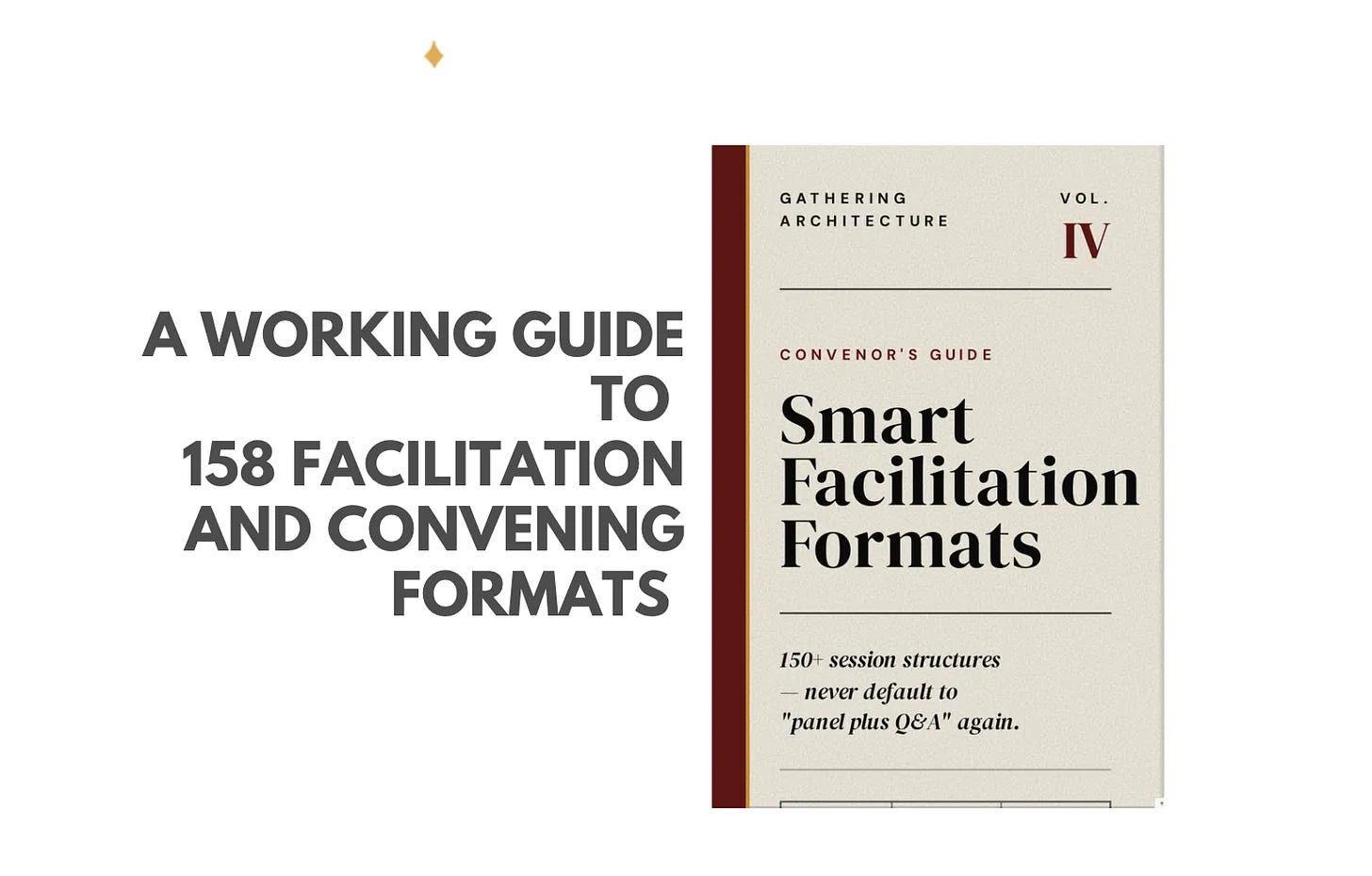
A meeting is not a meeting is not a meeting. The room changes when the structure changes — which is why the same panel can put a hundred people to sleep while a well-run fishbowl or 1-2-4-All can unlock a decision in twenty minutes. Each format here is an operating system for a different kind of work: alignment, decision, conflict, learning, trade, or belonging.
The format is the container; the facilitator is the current that runs through it. Choose the right container and someone who can hold the room, and you stop wasting time and start producing clear signals and behavioral change.
If you go on to Gatheringarhcitecture.com you can further define what you want to use. Think of this as a strategic hinge, not a menu. Start with the signal the gathering must produce — a decision, an alignment, a de-escalation, a commitment. Then choose the structure engineered to produce that signal. Then assign the facilitator who can hold the room inside that structure. Intent → format → facilitator → outcome.
158 ways to run a session that isn’t a panel. Includes the classics — World Café, Jeffersonian Dinner, Open Space Technology, Fishbowl Dialogue, 1-2-4-All, and Design Sprint — plus the strategic, diplomatic, and ceremonial structures most organizers never see. Pick a goal below to narrow the list, or just scroll. Every format opens to a full guide with when to use it, when not to, and how to run it.The Facilitated Meeting Format Library
Every session format in Gathering Architecture, grouped by intent. Each entry links to a full guide with when to use it, when not to, and how to run it. Take a look…
Crisis & Conflict
Crisis Stabilization Circle (5-12 people · 2–3 hours)
Everyone sits in a circle to deal with a crisis before it spirals — getting emotions under control and agreeing on immediate next steps.
Best for: High conflict + politically sensitive + 5–12 participants.
Crisis Command Session (5-12, 12-50 people · 2–4 hours)
The person in charge runs rapid-fire decisions when something has gone wrong and the clock is ticking.
Best for: Hierarchical groups under immediate threat.
Conflict Resolution Workshop (12-50 people · 3–4 hours)
A facilitated session designed to de-escalate tension and clarify next steps — with ground rules, structured turns, and a written summary of agreements.
Best for: High conflict + Mixed power + 12–50 participants.
Conflict Containment Circle (5-12, 12-50 people · 2–3 hours)
A cooling-off session where a heated group speaks one at a time, with pauses built in, so they can think clearly before making any decisions.
Best for: Preventing escalation and restoring cognitive clarity before substantive work.
Flash Stabilization Huddle (5-12, 12-50 people · 10–15 minutes)
A 10–15 minute containment format that slows a tense room fast, names what is happening, and aligns one immediate next move before escalation spreads.
Best for: High-stakes moments when a team needs a rapid reset before continuing work.
Three-Breath Reset Briefing (5-12, 12-50, 50-250 people · 5–10 minutes)
A micro-format using breath, naming, and one-sentence orientation to reset a stressed room before a critical decision or announcement.
Best for: Leaders who need to steady a room in under 10 minutes before speaking or deciding.
Containment Check-In Loop (5-12, 12-50 people · 15–20 minutes)
A rapid round where each person names what they see, what they need, and what must happen next — without debate or rebuttal.
Best for: Teams that need a quick emotional and informational scan before they can proceed.
Mass Reset Assembly (250+ people · 30–45 minutes)
A large-room stabilization format for 250+ that combines acknowledgment, emotional grounding, and a visible shared reorientation after disruption.
Best for: Conferences, summits, or institutions that need to calm and re-center a very large audience after a shock.
Collective Grounding Plenary (250+ people · 20–30 minutes)
A plenary architecture that helps a large group metabolize uncertainty, hear a credible frame, and regain enough steadiness for the day to continue.
Best for: 250+ participants after bad news, a major disruption, or a destabilizing public moment.
Signal & Settle Town Hall (50-250, 250+ people · 30–60 minutes)
A crisis-era town hall where leaders acknowledge reality, settle emotion, and issue the next practical signal to a large audience.
Best for: Large communities that need both emotional containment and directional communication after disruption.
Trust Recovery Session (5-12, 12-50 people · 2–3 hours)
A repair format for teams or stakeholders after a broken promise, failed rollout, or credibility rupture — focused on truth, accountability, and conditions for re-engagement.
Best for: Groups that want to keep working together but cannot move forward without explicitly addressing a trust break.
Post-Failure Reorientation Lab (5-12, 12-50 people · 2–4 hours)
A structured lab that turns a failed initiative into usable strategic learning, directional reset, and next-step clarity without collapsing into blame.
Best for: Teams emerging from a visible miss who need to learn fast and re-enter action.
Crisis Town Hall (50-250, 250+ people · 30–45 minutes)
An unscheduled, rapid-response town hall convened when something has broken publicly — designed to acknowledge, orient, and issue the next credible signal before rumor fills the vacuum.
Best for: Moments when silence from leadership is more dangerous than an imperfect message.
Decision-Making
High-Stakes Negotiation Table (12-50 people · 3–5 hours)
A structured negotiation under binding authority with defined concessions — formal articulation of agreed terms producing a circulated memorandum of understanding (MOU) or binding agreement.
Best for: Decide + High conflict + Hierarchical + 12–50 participants. Also suited for inter-organizational partnership terms, diplomatic pre-agreements, and joint venture negotiations.
Stakeholder Negotiation Lab (12-50 people · 3–4 hours)
Different groups with competing interests sit across the table and negotiate on the clock, with a facilitator keeping things fair.
Best for: Mixed power, high-conflict environments.
Structured Mediation Session (5-12 people · 3–4 hours)
A neutral mediator helps two sides work through a disagreement and walk out with a written agreement or memorandum of understanding.
Best for: Mixed power + high conflict + under 50 participants. Works for inter-departmental disputes, cross-organizational tensions, or diplomatic back-channel resolution.
Options Weighing Forum (12-50, 50-250 people · 3–4 hours)
Small groups evaluate the pros and cons of 2–3 options, then come together to pick the best path forward.
Best for: Mixed-power groups under high conflict needing to evaluate trade-offs before deciding.
Quick Decision Huddle (5-12 people · 45–75 minutes)
A small group gets in a room, sets a timer, and nobody leaves until a decision is made.
Best for: High urgency small groups.
Devil’s Advocate Review (5-12, 12-50 people · 2–3 hours)
One team presents a plan, another team tries to poke holes in it, and leadership decides if it holds up.
Best for: High-urgency executive decision environments where proposals need adversarial testing.
Governance Assembly (50-250 people · 2–4 hours)
A formal meeting with motions, votes, and minutes — like a board meeting or town council session where decisions become official.
Best for: Large hierarchical decision environments.
Leadership Wrap-Up Session (5-12, 12-50 people · 2–3 hours)
The boss pulls together what all the committees came up with and makes final calls on what moves forward.
Best for: Hierarchical groups under moderate urgency.
Decision Review Meeting (12-50 people · 2–3 hours)
A structured look-back at a decision that was already made — evaluating assumptions against new data to see if the original call still holds.
Best for: Decide + Moderate urgency + 12–50 participants.
Distributed Decision Matrix Session (12-50 people · 2.5–3 hours)
Multiple small teams score a list of options independently, then compare results to find the best choices.
Best for: Moderate urgency decisions with 12–50 participants.
Strategic Options Roundtable (12-50 people · 2.5–3.5 hours)
A structured comparison of competing paths before narrowing — public articulation of option trade-offs producing a summary of evaluated options.
Best for: Decide + Moderate conflict + 12–50 participants.
Coalition Ratification Council (12-50 people · 2–3 hours)
A formal session approving shared cross-group agreement — public signing or ratification statement producing a circulated MOU or ratified agreement with named signatories.
Best for: Decide + Mixed power + Moderate urgency + 12–50 participants. Ideal for formalizing partnership MOUs, cross-organizational commitments, or diplomatic accords.
Executive Council (5-12 people · 2–3 hours)
A small leadership group meets behind closed doors to make a specific decision — everyone states their position, and nobody leaves without a commitment.
Best for: Small leadership groups with clear decision mandates.
Fishbowl Dialogue (12-50, 50-250 people · 90 minutes–2 hours)
A few people discuss in the middle while the rest watch, then people rotate in — so every perspective is heard and nothing happens behind closed doors.
Best for: Contentious decisions where stakeholders distrust private negotiation.
Formal Pro & Con Debate (5-12, 12-50 people · 2–3 hours)
Two sides formally argue for and against a proposal, then the group votes — structured like a real debate with timed arguments.
Best for: Decide + Moderate conflict + 5–12 participants.
Prioritization Forum (12-50 people · 2–3 hours)
A structured session where the group ranks a list of options against shared criteria — producing a prioritized action list.
Best for: Decide + Minimal conflict + moderate urgency.
Deliberative Congress (250+ people · Full day)
A formal legislative-style gathering with room-level deliberation feeding a binding plenary vote — for 250+ with structured representation.
Best for: Binding decisions at scale (250+).
Track II Dialogue (5-12, 12-50 people · Full day or multi-day)
An unofficial, off-the-record dialogue between influential non-officials from opposing sides — building trust and exploring solutions that official channels can’t yet touch.
Best for: High-conflict situations where official negotiations are stalled or politically impossible. Works for geopolitical disputes, industry rivalries, or deeply divided organizational factions.
MOU Drafting Workshop (5-12, 12-50 people · Half-day (3–5 hours))
Parties collaboratively draft a Memorandum of Understanding in real time — with a facilitator managing clause-by-clause negotiation, producing a document both sides can take back for ratification.
Best for: Organizations or delegations that have reached conceptual agreement and need to formalize terms. Works for partnerships, joint ventures, cross-border agreements, and inter-agency cooperation.
Multilateral Negotiation Table (12-50, 50-250 people · Full day or multi-day)
Three or more parties negotiate shared terms simultaneously — with rotating bilateral breakouts feeding a plenary agreement. Produces a joint communiqué or MOU framework.
Best for: Complex multi-party situations where bilateral negotiations alone can’t resolve interdependencies. Government, NGO, and corporate partnership contexts.
Shuttle Diplomacy Session (5-12 people · Half-day to full day)
A mediator moves between two parties who aren’t ready to face each other directly — carrying proposals, testing concessions, and narrowing gaps until a face-to-face meeting becomes productive.
Best for: Extremely high conflict where direct negotiation would escalate tensions. Inter-departmental feuds, labor disputes, or geopolitical standoffs.
Partnership Framework Session (5-12, 12-50 people · 3–4 hours)
Two or more organizations map their respective assets, needs, and red lines — then co-design a partnership framework that becomes the basis for a formal MOU.
Best for: Early-stage partnerships where both sides need to understand what they’re getting into before committing. Corporate alliances, NGO collaborations, academic-industry partnerships.
Treaty Review & Renewal Session (5-12, 12-50 people · 3–4 hours)
Parties to an existing agreement review its performance, renegotiate outdated terms, and produce an updated MOU or renewal addendum.
Best for: Partnerships, MOUs, or agreements approaching expiration or underperforming. Government treaties, vendor contracts, coalition charters.
Ecocycle Planning (5-12, 12-50 people · 60–90 minutes)
Map every activity, project, or initiative onto a lifecycle — birth, maturity, creative destruction, or renewal. Makes visible what should be grown, what’s mature and needs maintaining, what should be killed, and what’s ready to be reborn.
Best for: Strategic planning sessions where the portfolio of activities has grown organically and nobody’s sure what to keep, kill, or reinvent.
Complexity-Based Decision Session (5-12, 12-50 people · 2–3 hours)
Uses the Cynefin framework to categorize the problem first — is it simple, complicated, complex, or chaotic? — then matches the right decision approach to the situation.
Best for: Leadership teams facing ambiguous problems where the usual playbook isn’t working.
Distributed Decision Relay (12-50, 50-250 people · Half-day to multi-day)
A handoff-based decision format where different teams or time zones evaluate the same choice in sequence using a shared structure before final consolidation.
Best for: Distributed organizations that cannot gather everyone live but still need structured collective input.
Hybrid Consensus Map (12-50, 50-250 people · 60–90 minutes)
A hybrid format that integrates in-room and remote perspectives into one live consensus picture before a formal decision is made.
Best for: Mixed-presence groups that need a fairer shared read before committing.
Asynchronous Ratification Sprint (12-50, 50-250 people · 24–72 hours)
A structured async review and sign-off process that lets stakeholders challenge, amend, and ratify a proposal within a fixed time window.
Best for: Partnerships, boards, or distributed teams that need orderly ratification without a single live session.
Red Team Truth Session (5-12, 12-50 people · 90 minutes–2 hours)
A high-pressure truth format where a designated team challenges assumptions, exposes blind spots, and tests whether a plan can survive adversarial scrutiny.
Best for: Leadership teams or high-stakes initiatives that need reality-testing before commitment.
Protected Dissent Forum (12-50, 50-250 people · 60–90 minutes)
A format that gives minority, uncomfortable, or politically risky truths structured protection before a group locks in commitment.
Best for: Systems where people know something important but are unlikely to say it without visible protection.
Reality Exposure Hearing (12-50, 50-250 people · 2–3 hours)
A structured hearing where inconvenient evidence, stakeholder testimony, or frontline experience is put directly in front of decision-makers under formal attention.
Best for: Leaders who need to confront realities their system may be screening out or softening.
Alignment & Vision
Cross-Generational Dialogue (12-50 people · 2–3 hours)
A structured exchange across experience levels that pairs newer and veteran voices to surface blind spots, shared priorities, and hidden assumptions.
Best for: Align + Mixed power + 12–50 participants + Low urgency.
Opening Commitment Session (12-50, 50-250 people · 90 minutes–2 hours)
A structured kickoff that defines stakes and expected outcomes before discussion begins — each participant states what success looks like.
Best for: Align + Moderate urgency + Minimal conflict.
Listening & Synthesis Summit (50-250 people · Half-day (3–4 hours))
A multi-room listening session where breakout groups surface perspectives, then a central facilitator harvests and synthesizes themes into a shared theme map.
Best for: Align + Moderate conflict + 50–250 participants.
Bridging Dialogue Forum (12-50 people · 3–4 hours)
People from different backgrounds or organizations have a guided conversation to understand each other before trying to agree on anything.
Best for: Mixed-power environments with moderate conflict.
Diplomatic Pre-Negotiation Dialogue (5-12, 12-50 people · Half-day (3–4 hours))
A structured conversation between parties who aren’t yet ready to negotiate but need to understand each other’s interests, constraints, and bottom lines. Produces a shared ‘conditions for negotiation’ document.
Best for: Cross-organizational or cross-sector situations where distrust prevents formal negotiation. Pre-MOU relationship building.
Strategic Scenario Workshop (12-50 people · 3–4 hours)
Small groups explore 3–4 possible futures and develop contingency plans for each — so the organization isn’t caught off guard.
Best for: Align + Moderate urgency + Hierarchical or mixed power.
Executive Reset Forum (5-12, 12-50 people · 2–3 hours)
A leader-driven recalibration where leadership names what has changed, what the new direction is, and what team members need to do differently.
Best for: Hierarchical + Moderate urgency + alignment needed.
Strategy Offsite Intensive (5-12, 12-50 people · Full day (6–8 hours))
A full-day retreat where a leadership team steps out of daily operations to rethink their strategy together.
Best for: Hierarchical groups needing immersive strategic recalibration.
Cross-Sector Alignment Forum (50-250 people · Half-day (3–4 hours))
Organizations from different sectors sit at the same table to find shared goals they can act on together — often producing a letter of intent or preliminary MOU framework.
Best for: Mixed power + 50–250 participants + cross-sector alignment. Ideal precursor to formal partnership MOUs.
Multi-Day Strategy Arc (50-250 people · 2–3 days)
A 2–3 day gathering that moves from ‘here’s what’s happening’ on Day 1 to ‘here’s who owns what’ by the final day.
Best for: 50–250 participants recalibrating direction.
Shared Vision Plenary (250+ people · Full day (6–8 hours))
A large-scale session articulating long-term collective direction — public articulation of shared vision producing a vision statement summary.
Best for: Align + 250+ participants + Low urgency.
Strategic Renewal Summit (250+ people · Full day (6–7 hours))
A large-scale directional reset combining reflection, debate, and visible commitment — ending with 3 renewed priorities distributed within 72 hours.
Best for: Align + 250+ participants + Moderate urgency.
Large-Scale Alignment Assembly (250+ people · Half-day (3–4 hours))
A plenary session for 250+ that moves from a shared context briefing to breakout priority-setting to a closing commitment moment.
Best for: 250+ participants needing directional clarity.
Institutional Memory Session (12-50 people · 2.5–3 hours)
Veterans of the organization tell the story of key turning points, and the group harvests lessons that exist nowhere in writing.
Best for: Align + 12–50 + Long-tenured organizations.
Alignment Roundtable (12-50 people · 2–3 hours)
A guided conversation where everyone writes down their priorities, then the group discovers they already agree on more than they thought.
Best for: Moderate-size groups (12–50) seeking coherence.
Jeffersonian Dinner (12-50 people · 2–2.5 hours)
Everyone sits at one long table for dinner with one rule: only one conversation at a time, so every voice is heard equally.
Best for: Mixed-authority groups that need genuine alignment.
Heat Map Conversation (5-12, 12-50 people · 15–30 minutes)
Before open discussion, participants are asked to name the thing they’re most afraid to say, most excited about, or most confused by — surfacing the real energy in the room before polite conversation buries it.
Best for: Teams or groups where the real issues live beneath the surface. Offsites, retreats, and any gathering where polite avoidance is the bigger risk than conflict.
What I Need From You (WINFY) (12-50, 50-250 people · 45–60 minutes)
Each functional group states what it needs from every other group to succeed — and each group responds with ‘yes’, ‘no’, ‘I’ll try’, or ‘whatever — we don’t control that.’ Cuts through months of passive-aggressive misalignment in 45 minutes.
Best for: Cross-functional teams with unclear dependencies, finger-pointing, or coordination failures. Offsites, project kickoffs, and organizational restructuring.
PeerSpirit Circle (5-12, 12-50 people · 60–90 minutes)
Participants sit in a circle around a centerpiece and speak one at a time using a talking piece — an ancient practice formalized for modern organizational use.
Best for: Groups needing deep listening, trust-building, and equitable voice — especially across power differences.
Town Hall (50-250, 250+ people · 60–90 minutes)
A large-group gathering where leadership shares direction, answers unfiltered questions, and lets the whole community feel heard in one room.
Best for: Organizations, communities, or companies that need broad transparency, shared context, and a live channel for hard questions.
Ask Me Anything Town Hall (50-250, 250+ people · 45–75 minutes)
A stripped-down town hall where leadership skips the presentation entirely and spends the full session answering pre-submitted and live questions.
Best for: Communities that have already heard the update and now need candor, not another slide deck.
Fishbowl Town Hall (50-250, 250+ people · 60–90 minutes)
A hybrid town hall where a rotating inner circle of employees or community members interviews leadership on behalf of the room, with an empty chair anyone can take.
Best for: Large groups where a traditional Q&A goes stale or gets dominated by the same three voices.
Skip-Level Town Hall (12-50, 50-250 people · 60–90 minutes)
A town hall run by senior leadership directly with employees two or more levels below, deliberately bypassing middle-management filtering.
Best for: Organizations where signals from the front line aren’t reaching the top, or where trust in the chain of command has thinned.
All-Hands Town Hall (50-250, 250+ people · 45–60 minutes)
The company-wide standing town hall — regular cadence, mixed agenda of business update, recognition, and Q&A, designed to keep the whole organization on one page.
Best for: Distributed or fast-growing organizations that need a shared drumbeat and a single source of truth.
Virtual Town Hall (50-250, 250+ people · 45–60 minutes)
A fully remote town hall built for distributed audiences, using live chat, polls, and moderated Q&A to replace the physical room’s cues with digital ones.
Best for: Distributed organizations, member communities, or public agencies that can’t gather in one place but still need the town-hall function.
Learning & Innovation
Integration Plenary (50-250 people · 90 minutes–2 hours)
After a packed conference, a facilitator pulls together the key takeaways from all the sessions into 5 things the whole room agrees on.
Best for: Learn + 50–250 participants + multi-session events.
Structured Brainstorm with Silent Start (12-50, 50-250 people · 90 minutes–2 hours)
Everyone writes ideas on sticky notes silently for 10 minutes before anyone speaks — then the group clusters, discusses, and builds on the best ones.
Best for: Learning or innovation under mixed power.
Innovation Narrowing Lab (12-50 people · 2.5–3 hours)
The group takes a long list of ideas and ruthlessly cuts it down to the 2–3 that are actually worth pursuing.
Best for: 12–50 participants in moderate urgency innovation contexts.
Deep-Dive Discussion Circle (5-12 people · 2–3 hours)
A small group spends 2–3 hours exploring one topic from every angle — no agenda pressure, just depth.
Best for: Learn + 5–12 participants seeking depth.
Expert Panel with Structured Q&A (50-250 people · 90 minutes–2 hours)
3–4 experts present on a topic, then the audience asks structured questions — not open mic, but categorized and moderated.
Best for: Learn + 50–250 + expert knowledge transfer.
Peer Learning Exchange (12-50 people · 2–3 hours)
Practitioners share what’s actually working in their own contexts — not theory, but real lessons from the field.
Best for: Peer-level + learn + minimal conflict.
Innovation Accelerator Forum (50-250 people · Full day (6–8 hours))
A structured collaboration pushing ideas into execution phase — competitive presentation, peer critique, and immediate execution assignment.
Best for: Learn + High urgency + 50–250 participants.
High-Intensity Sprint Session (12-50 people · 3–4 hours)
A high-energy work session in timed blocks where teams produce real, publishable output by the end of the day.
Best for: High urgency + 12–50 participants.
Design Sprint (5-12, 12-50 people · 3–5 days)
A multi-day sprint where a team goes from problem to testable prototype — mapping, sketching, building, and testing with real users.
Best for: Small-to-medium teams facing a defined problem under time pressure.
World Café (12-50, 50-250, 250+ people · 2–3 hours)
Small groups rotate through tables discussing different questions, with each table building on what the last group discovered.
Best for: Learning + minimal conflict + any group size.
Open Space Technology (50-250, 250+ people · Half-day to full day)
Participants propose their own sessions and self-organize — no preset agenda, just shared passion and the law of two feet.
Best for: Large learning gatherings with minimal conflict.
Civic Listening Forum (50-250, 250+ people · 2–4 hours)
A public hearing-style session where community members testify and officials listen — structured for dignity, not debate.
Best for: Political + public testimony + any size.
Community Deliberation Circle (12-50 people · 2–3 hours)
A moderated dialogue where community members weigh trade-offs on a public issue using structured deliberation materials.
Best for: Political power + moderate conflict + community issues.
Purpose-Driven Opening (5-12, 12-50, 50-250, 250+ people · 5–15 minutes)
Instead of starting with logistics, housekeeping, and sponsor thank-yous, the gathering opens by immediately naming why everyone is here and what’s at stake — plunging participants into the purpose before they settle into passivity.
Best for: Any gathering that tends to start flat. Conferences, offsites, team meetings, and workshops where the opening sets the wrong tone.
Generous Authority Facilitation (5-12, 12-50 people · Ongoing (facilitation approach, not standalone session))
The host takes clear, active ownership of the gathering — making bold choices about who speaks, when the room shifts, and what’s out of bounds — so that guests are freed from the anxiety of an unstructured or overly democratic process.
Best for: Gatherings where a hands-off host leads to awkward silences, dominant voices, or aimless conversation. Dinners, workshops, and team offsites.
Exclusion as Design (5-12 people · 30–60 minutes (pre-event planning exercise))
A deliberate exercise in defining who should NOT be in the room — clarifying the gathering’s purpose by articulating who it’s for and, just as importantly, who it isn’t for. Not about exclusivity, but about making the gathering specific enough to be meaningful.
Best for: Planning sessions for any gathering where the invite list has expanded beyond usefulness. Pre-event design work for offsites, conferences, and community events.
1-2-4-All (5-12, 12-50, 50-250, 250+ people · 12–20 minutes)
Everyone reflects alone for 1 minute, then pairs for 2 minutes, then groups of 4 for 4 minutes, then shares with the whole room. Ensures every voice is heard before the loudest ones dominate.
Best for: Any group where not everyone speaks up in open discussion. Works at any scale.
Troika Consulting (5-12, 12-50, 50-250 people · 30–45 minutes)
In groups of three, one person presents a challenge while the other two consult — then they rotate. Every person gets both help and practice giving help.
Best for: Peer-to-peer problem-solving where everyone has real challenges and relevant experience.
TRIZ (Stop Counterproductive Activities) (5-12, 12-50, 50-250 people · 30–45 minutes)
Ask the group: ‘What are we doing that’s making things worse?’ Then systematically stop doing those things. The most counterintuitive Liberating Structure — improvement through subtraction.
Best for: Teams stuck in unproductive patterns they can’t name. Offsites, retrospectives, and process improvement sessions.
Impromptu Networking (12-50, 50-250, 250+ people · 15–25 minutes)
Pairs meet for exactly 5 minutes each, answering one powerful question. Then they switch partners. Surfaces the room’s hidden energy and expertise fast.
Best for: Conference openings, workshop warm-ups, or any gathering where people don’t know each other yet.
Pro Action Café (12-50, 50-250 people · 90 minutes–2.5 hours)
Participants bring real projects they need help with. The group rotates through café-style rounds of questions — not advice — that help the project owner think more clearly and move to action.
Best for: Groups with active projects that need peer reflection, not just brainstorming.
Human Spectrogram (12-50, 50-250 people · 15–30 minutes)
Participants physically move to positions in the room that represent their answer to a question — making the invisible distribution of opinion visible to everyone at once.
Best for: Surfacing group opinion quickly, energizing a room, or opening a difficult conversation with movement.
The Solution Room (12-50, 50-250 people · 60–90 minutes)
Each participant writes down their most pressing problem. Then in timed rounds, small groups help each person think through their challenge — leaving with peer-supported next steps.
Best for: Conference openings or closings where attendees need practical peer advice.
The Three Questions (12-50, 50-250 people · 30–60 minutes)
A structured opener where every participant answers three questions: who are you, what do you want from this gathering, and what experience do you bring? Surfaces the room’s hidden expertise.
Best for: Conference or workshop openings where participants don’t know each other’s backgrounds.
Pecha Kucha / Ignite Session (12-50, 50-250, 250+ people · 60–90 minutes)
Speakers present exactly 20 slides at 20 seconds each (Pecha Kucha) or 20 slides at 15 seconds each (Ignite) — forcing clarity and energy, then the audience engages.
Best for: Introducing many ideas quickly and sparking follow-up conversations.
Round-Robin Brainstorm (5-12, 12-50 people · 45–90 minutes)
Each person shares one idea in turn — ensures equal airtime and prevents dominant voices from taking over.
Best for: Small-to-medium groups where quieter voices tend to get drowned out.
Reverse Brainstorm (5-12, 12-50 people · 60–90 minutes)
Ask ‘How could we make this problem WORSE?’ then flip the insights into real solutions. Great for groups that feel stuck.
Best for: Groups that have hit a creative wall or keep circling the same ideas.
Mind Map Workshop (5-12, 12-50 people · 60–90 minutes)
Start with a central concept and branch outward visually as a group — good for exploring connections between ideas that aren’t obvious.
Best for: Complex topics where relationships between ideas matter more than volume of ideas.
Rapid Prototyping Lab (5-12, 12-50 people · Half-day (3–4 hours))
Teams build rough physical or digital prototypes of their ideas in 90-minute sprints — then test them on each other. Ideas become tangible fast.
Best for: Innovation sessions where ideas need to become concrete enough to evaluate.
Brainwriting 6-3-5 (5-12, 12-50 people · 45–60 minutes)
6 people write 3 ideas in 5 minutes, then pass their sheet to the next person who builds on those ideas. After 6 rounds, 108 idea-variants exist on paper.
Best for: Groups that need volume and variety of ideas without groupthink.
CFP Writing Sprint (5-12, 12-50 people · 2–3 hours)
Participants collaboratively draft and peer-review conference talk proposals in structured rounds — arriving with an idea, leaving with a polished submission.
Best for: Preparing speakers for conference CFP deadlines, especially first-time presenters who need peer feedback.
Content Creation Workshop (5-12, 12-50 people · Half-day (3–4 hours))
A structured session where teams co-produce social media posts, blog drafts, or promo materials together — with real-time peer editing and a publish-ready output goal.
Best for: Marketing teams or communities who need a batch of content produced fast with collaborative quality control.
Event Promo Jam (5-12 people · Half-day (3–4 hours))
Organizers co-create the full marketing plan for an upcoming event in one session — copy, visuals, channel strategy, and launch timeline — leaving with assets ready to deploy.
Best for: Event teams under deadline pressure who need a coordinated marketing push created collaboratively.
Insight Evidence Review (5-12, 12-50 people · 60–90 minutes)
A data-facing review format where a group interprets evidence, distinguishes signal from noise, and decides what the findings actually mean.
Best for: Teams with new research, dashboard shifts, or market evidence that should shape choices.
Signal Pattern Lab (5-12, 12-50 people · 90 minutes–2 hours)
A structured lab for connecting multiple weak signals into a meaningful pattern before those signals are obvious to everyone else.
Best for: Strategy teams, organizers, or leaders who need to interpret scattered inputs across a system.
Metrics-to-Meaning Workshop (12-50 people · 2–3 hours)
A workshop that turns KPIs, dashboards, and scorecards into operational interpretation so teams know what the numbers require them to do differently.
Best for: Organizations overloaded with metrics but underpowered in strategic interpretation.
AI Reframing Studio (5-12, 12-50 people · 90 minutes–2 hours)
A facilitated human-plus-AI format where participants use generated alternate framings to challenge how a problem has been defined.
Best for: Strategy or design groups stuck inside one inherited frame and open to structured AI assistance.
AI Scenario Stress Test (5-12, 12-50 people · 90 minutes–2.5 hours)
A format that uses AI-generated scenarios and edge cases to pressure-test a strategy, policy, or plan before the real world does.
Best for: Teams that need to examine how a decision or plan behaves under multiple plausible futures quickly.
Human + AI Synthesis Lab (5-12, 12-50 people · 2–3 hours)
A mixed synthesis format where participants compare human observations with AI clustering, summarization, or patterning to build a sharper shared read.
Best for: Rooms working with lots of notes, interviews, feedback, or open-text inputs that need fast synthesis without losing human judgment.
Live Signal Room (5-12 people · Continuous or 20-minute intervals)
A real-time sensing format where a facilitation or leadership team tracks emerging signals from the room during a live program and adjusts accordingly.
Best for: Complex events where sentiment, confusion, or resistance can shift quickly and shape the rest of the program.
Tension Sensing Briefing (5-12, 12-50 people · 15–20 minutes)
A short diagnostic briefing that reads where tension, confusion, or resistance is building before a leader or facilitator chooses the next move.
Best for: Event teams or executives who need a rapid room read before making a public decision or pivot.
Room Temperature Scan (12-50, 50-250 people · 10–15 minutes)
A structured scan of the room’s current state — energy, confusion, trust, resistance, and readiness — used to adjust facilitation in the moment.
Best for: Facilitators who need a fast, repeatable way to assess whether the room can absorb the next move.
Identity & Culture
15 Toasts (5-12, 12-50 people · 2–3 hours)
Gather 15 people and ask each to share a personal story around a common theme — each story ends with a toast. The format creates a space where vulnerability is honored, not just positivity, and the ritual of toasting turns storytelling into collective witness.
Best for: Intimate gatherings where depth of connection matters more than breadth. Team bonding, milestone celebrations, farewells, or any moment where the group needs to feel what they share.
Intentional Closing Ceremony (5-12, 12-50, 50-250, 250+ people · 10–30 minutes)
Instead of letting the gathering fizzle out with ‘any final thoughts?’, the host designs a deliberate closing moment — a last story, a collective gesture, or a structured reflection — that seals the meaning of what just happened.
Best for: Any gathering that matters enough to deserve an ending. Conferences, retreats, milestone dinners, project completions, and team farewells.
Night Of (5-12, 12-50 people · 3–4 hours (evening))
A curated evening experience — often a dinner, salon, or performance — designed as a complete world with rules, rituals, and structure that distinguish it from a normal social event.
Best for: Creating transformative social experiences for cultural organizations, creative communities, or milestone celebrations.
Heard, Seen, Respected (HSR) (5-12, 12-50, 50-250 people · 30–40 minutes)
In pairs, one person tells a story of a time they were NOT heard, seen, or respected — while the other listens silently without offering advice or solutions. Then they switch. Builds empathy and trust by honoring difficult experiences.
Best for: Teams recovering from conflict, cross-cultural groups, or any gathering where empathy is prerequisite to productive work.
Collective Story Harvesting (5-12, 12-50 people · 90 minutes–2 hours)
One person tells their story while three listeners each track a different layer — facts, feelings, and values — then reflect back what they heard. Surfaces meaning the storyteller didn’t see.
Best for: Teams processing complex experiences, organizational transitions, or cross-cultural understanding.
Recognition & Reinforcement Ceremony (12-50 people · 90 minutes–2 hours)
A formal ceremony celebrating individual and team contributions — public recognition creating shared institutional memory.
Best for: Strengthen + 12–50 participants.
Mission Renewal Summit (12-50, 50-250 people · Half-day (3–4 hours))
A deep session where the group asks whether its original mission still fits — and rewrites it together if it doesn’t.
Best for: Strengthen + existential mission questions.
Mission Reaffirmation Gathering (12-50, 50-250 people · 2–3 hours)
A session designed to publicly reaffirm shared mission during instability — heritage storytelling and collective statement producing a mission reaffirmation brief.
Best for: Strengthen + moderate urgency + mission instability.
Recognition & Culture Summit (50-250 people · Half-day to full day)
A half-day or full-day event with awards, team activities, and a closing moment where the whole group declares what they stand for.
Best for: 50–250 participants strengthening cohesion.
Mission Rally (250+ people · 60–90 minutes)
A 60–90 minute ceremony with personal stories and a collective oath — designed to make hundreds of people feel like one team.
Best for: 250+ identity-heavy gatherings.
Recommitment Gathering (12-50, 50-250 people · 60–90 minutes)
A session designed to publicly reaffirm shared mission and direction — the group reads and recommits to its mission statement together.
Best for: Strengthen Identity + Moderate urgency.
Mobilization & Action
Purpose-to-Practice (P2P) (5-12, 12-50 people · 2–3 hours)
A complete design sequence: define purpose, then principles, then participants, then structure, then practices. Builds an entire initiative architecture from scratch in one session — each element constrained by the one before it.
Best for: Launching new teams, initiatives, or organizations. Works when the group needs to go from ‘why do we exist?’ to ‘how do we operate?’ in one session.
Coalition Planning Session (12-50 people · 3–4 hours)
A cross-role strategy alignment session where coalition members map shared tactical goals and publicly list their commitments.
Best for: Mobilize + Mixed power + 12–50 participants.
Mobilization Strategy Lab (12-50 people · 3–4 hours)
A high-urgency strategy session where the group identifies 3–5 leverage points and assigns action teams before anyone leaves the room.
Best for: Mobilize + High urgency + 12–50.
Tactical Action Cascade (12-50 people · 2–3 hours)
A session that sequences interdependent actions into a cascade — each team’s action triggers the next team’s, creating a coordinated chain.
Best for: Mobilize + high urgency + sequenced actions.
Multi-Stakeholder Planning Session (50-250 people · Half-day (3–4 hours))
Representatives from many organizations plan a shared initiative together — producing a joint action plan, partnership MOU, or shared commitment framework with named owners from each organization.
Best for: Mobilize + mixed power + 50–250. Often produces the operational annex to a formal MOU.
Coalition Alignment Forum (12-50, 50-250 people · 3–4 hours)
Coalition partners find their overlapping interests and name what they can act on together — producing a shared priorities statement.
Best for: Mobilize + mixed power + finding shared ground.
Movement Activation Forum (12-50 people · 3–4 hours)
The group names what they care about, picks from a menu of action options, and each person publicly commits to a first step.
Best for: Mobilization under moderate urgency.
Coordinated Action Hub (50-250 people · Half-day (3–4 hours))
Small teams plan their part of a bigger mission in parallel, all feeding into one master board so everyone can see the full picture.
Best for: 50–250 mobilization under high urgency.
Community Impact Assembly (250+ people · Full day (5–7 hours))
A structured public gathering focused on visible outcome pathways — public statement of intended impact producing a published impact roadmap.
Best for: Mobilize + 250+ participants.
Movement Convention (50-250, 250+ people · Full day or 1.5 days)
A day-long rally that builds from ‘who we are’ to ‘what we know’ to ‘what we’ll do’ — ending with everyone pledging a concrete action.
Best for: Movements, associations, or communities needing renewed commitment at scale.
Decision Cascade Briefing (5-12, 12-50, 50-250 people · 30–45 minutes)
A format for translating a decision into a clean cascade message so every level of the system can repeat what changed, why, and what happens now.
Best for: Organizations that have made an important call and need message discipline before execution begins.
Leadership Decision Reveal (12-50, 50-250, 250+ people · 30–60 minutes)
A formal reveal format where leaders announce a decision, explain its rationale, and name the immediate operating implications.
Best for: High-visibility decisions that require credibility, coherence, and an authoritative public explanation.
Decision FAQ Forum (12-50, 50-250, 250+ people · 45–75 minutes)
A structured post-decision question forum designed to surface misinterpretation, reduce rumor, and prevent passive resistance before rollout.
Best for: Organizations where a decision will trigger concern, interpretation gaps, or narrative drift.
Commitment Reinforcement Session (5-12, 12-50 people · 60–90 minutes)
A follow-up format that re-anchors a major decision by reconnecting it to owners, rationale, and consequences after the initial announcement has faded.
Best for: Important decisions that risk erosion, quiet resistance, or selective memory after the first wave of communication.
Decision Memory Ritual (12-50, 50-250, 250+ people · 20–30 minutes)
A symbolic but operationally useful ritual that gives a major decision a repeatable phrase, visible marker, or shared act so it stays alive in the culture.
Best for: High-consequence decisions that need to become part of identity, not just a line item in meeting notes.
Why This Call Holds Review (5-12, 12-50 people · 45–60 minutes)
A reinforcement format that revisits a controversial or difficult decision and tests whether the original rationale still holds under pressure.
Best for: Decisions likely to be reopened unless leaders actively reinforce the logic behind them.
Owner Accountability Grid (5-12, 12-50 people · 45–75 minutes)
A visible tracking session where commitments are converted into named owners, deadlines, dependencies, and escalation paths.
Best for: Groups that leave mobilization sessions energized but vague about execution responsibility.
Execution Pulse Review (5-12, 12-50 people · 30–45 minutes)
A recurring review format that checks what moved, what stalled, and what needs intervention before execution momentum decays.
Best for: Teams or coalitions managing multiple active commitments over time.
Blocker Escalation Board (5-12, 12-50 people · 30–60 minutes)
A format for surfacing execution blockers, assigning escalation owners, and clearing constraints fast enough to keep momentum alive.
Best for: Cross-functional work where teams are stuck waiting on decisions, resources, or approvals.
Momentum Checkpoint Forum (12-50, 50-250 people · 60–90 minutes)
A structured checkpoint that tests whether a coalition, initiative, or campaign still has energy, clarity, and forward motion after the launch phase.
Best for: Programs that start strong but risk fading once the first wave of attention passes.
Progress Signal Roundtable (5-12, 12-50 people · 45–60 minutes)
A roundtable dedicated to visible progress signals — what changed, what landed, what others can now see, and what still needs reinforcement.
Best for: Teams or ecosystems that need to keep progress legible across multiple actors.
Next-Wave Activation Session (12-50, 50-250 people · 90 minutes–2 hours)
A mobilization format that turns early wins into a second coordinated push before the system slips back into maintenance mode.
Best for: Initiatives that have reached initial traction and now need a stronger second phase of action.
Manager Cascade Workshop (12-50, 50-250 people · 2–3 hours)
A translation workshop that turns strategy into manager-ready language, team behaviors, and day-to-day leadership moves.
Best for: Organizations where managers will determine whether strategy actually changes frontline behavior.
Leader-to-Manager Translation Lab (12-50 people · 2–4 hours)
A lab where senior leaders and managers jointly turn strategic intent into priorities, rituals, feedback loops, and operating expectations.
Best for: Moments when strategy will fail unless leaders and managers create a shared operating interpretation.
Behavioral Adoption Briefing (12-50, 50-250, 250+ people · 20–30 minutes)
A tightly structured briefing that defines what staff should now do differently, what to stop doing, and how the new behavior will be noticed and reinforced.
Best for: Rollouts where behavior change matters more than message awareness.
Trade & Marketplace
Reverse Pitch Fair (12-50, 50-250 people · 2–3 hours)
Instead of suppliers pitching to buyers, buyers pitch their needs to a room of suppliers — reversing the usual power dynamic and letting the best solution find the right problem.
Best for: Trade environments where buyers have complex needs and want suppliers to self-select based on fit.
Speed Matching Sessions (12-50, 50-250 people · 2–3 hours)
Buyers and sellers rotate through timed 8–12 minute meetings — like speed dating for business. Both sides score each match, and top-scored pairs get follow-up time.
Best for: High-volume trade events where both sides need maximum exposure in minimum time.
Buyer Advisory Panel (12-50, 50-250 people · 90 minutes–2 hours)
A small panel of key buyers shares what they’re actually looking for, what frustrates them, and what would make them say yes — while suppliers listen and take notes.
Best for: Giving suppliers direct market intelligence from the people who write the checks.
Deal Room Sprint (5-12, 12-50 people · Half-day (3–4 hours))
Pre-matched buyer-supplier pairs get a private room and a fixed window — 30 to 60 minutes — to negotiate terms, with a facilitator keeping things on track. Often ends with a signed letter of intent or preliminary MOU.
Best for: Late-stage trade events where relationships are already warm and decisions need to happen.
Procurement Showcase (50-250 people · 2–3 hours)
A buying organization presents upcoming contracts, requirements, and timelines to a room of qualified suppliers — structured RFI in live format.
Best for: Government, enterprise, or institutional procurement where transparency and competition matter.
Partnership Onboarding Session (5-12, 12-50 people · 2–3 hours)
A post-deal format that turns signed agreement into real working norms, joint rhythms, and operational expectations across partner teams.
Best for: New partnerships that have terms on paper but not yet a functioning day-to-day relationship.
Post-Deal Alignment Forum (12-50 people · 2–4 hours)
A structured alignment forum where two sides review what the agreement means operationally, culturally, and politically after the deal closes.
Best for: Partnerships or acquisitions where relationship quality after signature will determine whether value is realized.
Joint Commitment Kickoff (12-50, 50-250 people · 60–90 minutes)
A launch format that publicly marks a new partnership or agreement and converts it into visible first-phase joint action.
Best for: Cross-organization efforts that need both symbolic launch energy and practical coordination.
Pre-Deal Trust Roundtable (5-12, 12-50 people · 90 minutes–2 hours)
A pre-transaction roundtable designed to surface motives, seriousness, red lines, and working style before formal negotiation begins.
Best for: Potential partners who need to test trust before discussing hard terms.
Reciprocity Mapping Session (5-12, 12-50 people · 90 minutes–2 hours)
A format that maps what each side values, what each can offer, and where reciprocal exchange is genuinely possible before transaction design begins.
Best for: Parties exploring whether a deal structure or partnership has real mutual value.
Low-Risk Exchange Forum (5-12, 12-50 people · 60–90 minutes)
A pre-deal format built around small, reversible exchanges that test seriousness and working chemistry before a larger transaction is attempted.
Best for: Parties who need a credible first step before committing to a larger agreement.
Library home: gatheringarchitecture.com/formats — open and free.