
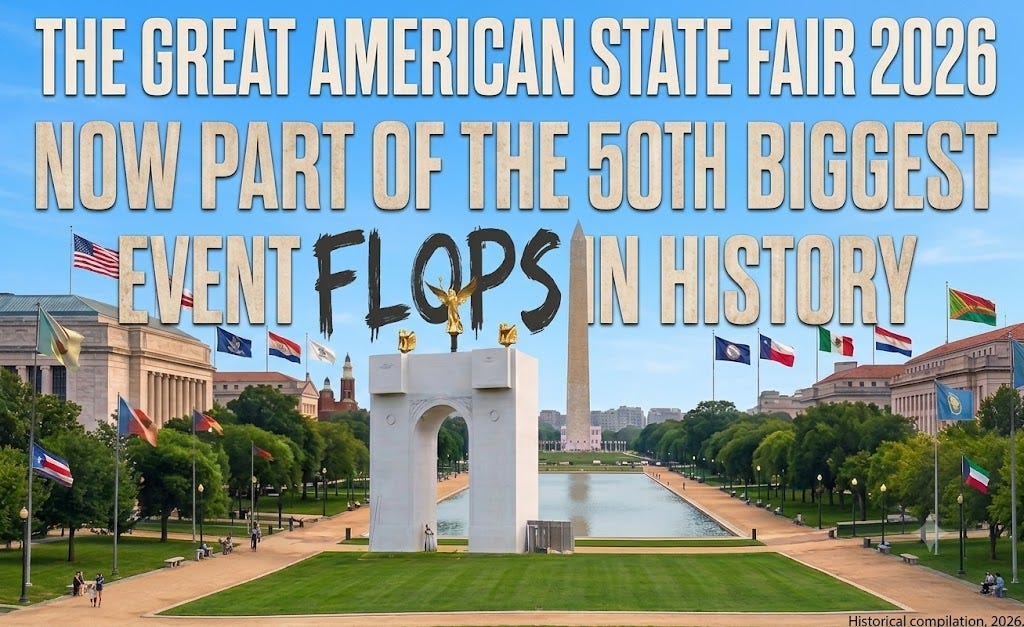
A NEW ENTRY FOR THE BIGGEST EVENT FLOPS IN HISTORY?
When we published The 50 Biggest Flops in Event History, we didn’t expect to be revisiting the list so soon. Then America handed its most important gathering brief in 250 years to the wrong designers
When we published The 50 Biggest Flops in Event History, we noted one pattern running through nearly every entry: the gap between ambition and execution is always widest when the wrong people are in the room. See our coverage from last week that compared the Great American State Fair to the highly successful Cannes Lions Creativity Festival that happened the same week.
Fyre Festival had a marketing genius and no event professionals. Woodstock ‘99 had a stage and no crowd management. Balloonfest ‘86 had a spectacular idea and no contingency plan. The most troubled World’s Fairs had civic vision and no experience architects. In every case, the failure was not the concept. It was the credentials of the people responsible for executing it.
The Great American State Fair may belong on this list for a reason none of our previous entries share: it is the only event in recent memory where the professional infrastructure to do it correctly already existed, was fully built, was funded by Congress, and was deliberately set aside.
The Smithsonian Institution -- all 21 of its museums, 14 education and research centers, the National Zoo, and more than 200 affiliated institutions -- had built a complete programming framework called “Our Shared Future: 250” as a founding partner of America250, the organization chartered by Congress in 2016 to lead the nation’s semiquincentennial celebrations. George W. Bush and Barack Obama served as honorary co-chairs. A bipartisan congressional caucus of more than 350 members -- the largest in U.S. history -- stood behind it. The people who understand how to design a gathering at national scale, how to build an experience that a country carries in its memory for generations, were already in the room. They had been in the room for ten years. Hagley Museum & Library
In 2025, federal resources were diverted away from that bipartisan commission to Freedom250, a White House-aligned organization created to produce its own version of the celebrations. America250 received only $25 million of its congressionally appropriated $150 million, with concerns the remainder would be reallocated to Freedom250. The professional institutional infrastructure -- the Smithsonian, the bipartisan commission, the decade of planning -- was replaced by a White House-backed nonprofit that hired the advance firm behind the January 6 Ellipse rally to produce the flagship event. That firm, Event Strategies Inc., had received millions of dollars in no-bid contracts from the Trump administration for semiquincentennial work. The specific amount paid for the Great American State Fair has not been publicly disclosed. Freedom250 is not required to reveal its vendor contracts.
What arrived on the National Mall on June 25 is now a matter of public record. Gates opened thirty minutes late. The power failed. The ice cream melted. The Ferris wheel broke down on opening night. More than half the performers withdrew before the event opened, saying they had never been told it was politically affiliated. Visitors wandered for an hour trying to find the entrance to a free, public event on the most symbolically powerful gathering canvas in the Western hemisphere. A jazz band played to ten people.
This is where the Great American State Fair differs from every other entry on our Flops list. Fyre Festival failed because its organizers were fraudulent. Woodstock ‘99 failed because its organizers were reckless. The Great American State Fair failed because its organizers were replaced. The professionals were there. The plan existed. The institutional knowledge was ready. It was set aside -- and what took its place was a rally that ran out of principal after opening night and had nothing underneath to sustain sixteen days.
Every event begins with a promise. The larger the promise, the more consequential the choice of who delivers it. America’s 250th birthday was the largest gathering promise this country has made in fifty years. The Smithsonian was ready. The bipartisan commission was ready. Experience designers, cultural architects, and institutional planners who have spent careers understanding how a nation gathers were ready.
They did not get the brief.
That is not a political failure. It is a gathering failure. And it is why the Great American State Fair may not just belong on The 50 Biggest Flops in Event History -- it may belong near the top.
From The 50 Biggest Flops in Event History -- the ones that echo loudest this week:
Fyre Festival (2017) -- Marketing outran reality. Talent wouldn’t come. The infrastructure wasn’t there. Sound familiar?
Woodstock ‘99 (1999) -- An iconic name, a grand promise, and organizers who lost control of their own narrative before the gates opened.
Balloonfest ‘86 (1986) -- A spectacular idea that nobody thought through past the moment of launch.
Four Seasons Total Landscaping (2020) -- When the people responsible for choosing the venue have never chosen a venue.
World Scout Jamboree Collapse (2023) -- Power failures, heat, inadequate infrastructure, and a civic gathering that collapsed under the weight of its own ambition.
Hillary Clinton Javits Center Party (2016) -- The confetti cannons were loaded. The glass ceiling was ready to shatter. The production was built entirely around an outcome that didn't arrive. The performers on the Mall knew that feeling.
Delhi Commonwealth Games Collapse (2010) -- A national celebration, federal money, and a production that embarrassed the country that hosted it.
Trump Tulsa Rally (2020) -- When the advance team oversells the crowd and the room tells the truth.
The Great Trade Show Fadeout (2000s-2010s) -- What happens when exhibitors show up with no brief, no design, and nothing to say.
Tesla Cybertruck Demo (2019) -- The centerpiece attraction fails publicly on opening day. The cameras are already rolling.
WeWork Summer Camp / IPO Collapse (2018-2019) -- When the event is really a pitch dressed as a celebration, and the audience figures it out.
The full list of 50 -- every failure, every lesson -- is here
.


