
You Are About to Have Your Mind Changed at Cannes Lions This Week
A field note for first-timers, veterans, and everyone fighting six hours of jet lag on the Croisette.
You landed in Nice, took the taxi along the coast, checked into whatever room you could get at whatever rate the festival week commands, and you are now operating on approximately four hours of sleep and a body clock that believes it is three in the morning. This is the correct condition in which to arrive at Cannes Lions for the first time. Disorientation is the appropriate entry point. The Croisette is going to rearrange how you think about your industry regardless, and it is easier to let something rearrange you when you are too tired to resist it.
Here is the main story.
Going On Now: The Cannes Lions Field Guide 2026 (Don't Read This if the FOMO is Hard to Take)
Editors Note: This is one of my favorite events ever! The program is dynamic and what you plan on attending gets completely uprooted based on what is in your path that moment. If you are there enjoy the journey. If not, add to your bucket list. This could just be the future of great event design. See very brief sampling of what is expected for the week.
For the veterans, the rearrangement stopped happening years ago. What replaced it is something more useful: the ability to read the week as a system rather than experience it as a spectacle. The first-timer walks the two kilometers of Mediterranean coastline between the Palais des Festivals and the activations running along the beach and thinks: this is extraordinary. The veteran walks the same two kilometers and thinks: who moved the money this year, and where is it going.
Both are right. And this year, where the money is going tells a story the events world has been waiting for the marketing industry to tell for a very long time.
What the First-Timer Sees
The Palais hands out the hardware. The Lions themselves — nineteen categories, Grand Prix winners announced each evening on stage, the shortlisted campaigns that become next year’s business school case studies — are the official reason twelve thousand delegates flew across at least one ocean to be here. But the first-timer who spends the week inside the Palais is missing the festival.
The actual Cannes Lions is on the beach, at the port, and on the water. Spotify is taking over Plage Macé with a full programmed activation by day and headline music performances by night — Raye, Central Cee, and Mike D on Tuesday; Mumford and Sons, John Summit, and Lykke Li on Wednesday — and separately maintains an invitation-only villa in the hills above the city for the executives whose budget decisions the beach panels are ultimately about. The Wall Street Journal has built a two-storey structure on the end of a pier, with four enormous windsocks flying above it as the most recognizable landmark on the waterfront. Amazon Port started four years ago as an empty parking lot to the left of the Palais — this year it is being designed as a French village, with each storefront representing a different Amazon property: Prime Video, Twitch, Wondery, Amazon Live, AWS, Fire TV, Alexa+, Prime Sports, and IMDb — and it is now the largest single activation at the festival. UTA Beach, making its debut this year as United Talent Agency’s biggest Cannes presence ever, is a two-storey air-conditioned beachfront hub running daily main stage sessions, executive salons, and invite-only evening events, with Priyanka Chopra Jonas, Paris Hilton, Kara Swisher, Draymond Green, and will.i.am among the confirmed talent. And then there are the yachts. Cognitiv has the E-Motion Yacht on Yacht Row, running daily sessions and invite-only evening events. Three of the largest names in digital out-of-home have pooled their Cannes presence onto a single vessel, Yacht Nela, moored directly behind the Palais, running networking sessions and happy hours across the week. The yacht is the purest expression of the access hierarchy running across the whole festival: you cannot find it by walking the Croisette, you cannot register for it online, and the conversation happening on its deck is precisely the one the beach activation was designed to make you want to be part of.
The first-timer looks at all of this and sees a festival. What they are actually looking at is the marketing industry’s formal capitulation to a thesis the events world has held for years: that the medium that moves people is not a campaign, a platform, or a media buy. It is an event. The Croisette is where that capitulation is going to become architecture, in public, for five days straight.
What the Veteran Knows
The veteran has watched this shift happen in slow motion over many years of festival attendance, and what they notice in 2026 is not the activations themselves but the seriousness with which the marketing industry is now running them. This is no longer hospitality as a side budget. The tiered access design running across the Croisette — the beach for scale, the villa for access, the dinner at Hotel du Cap-Eden-Roc on Cap d’Antibes for the conversations that decide things — is the event design toolkit the events industry developed over fifty years, now operating with a marketing industry budget behind it and a marketing industry audience in front of it.
The most instructive data point this year is not one of the large activations. Influential Beach, which has built its Cannes identity around creator-economy panels for years, is dropping the panels entirely in 2026. Hospitality is the explicit focus: fresh juices, lounge areas, off-the-record roundtables, meetings over exceptional cuisine overlooking the Mediterranean. The beach that ran content has concluded that the highest-value thing it can offer at Cannes is not programming. It is access and unstructured time in a good setting. The market has voted. The room is beating the content. This is the events world’s central argument — that presence and proximity do work that no produced session can replicate — now running as a business decision inside the marketing industry’s own activation.
The people who built that argument are on the Croisette this week to watch it run. Erica Boeke of XP Land is there.
Julius Solaris of Boldpush is there, weeks after releasing research showing that forty-nine percent of event professionals rank peer-to-peer networking as the single most important factor in event success while only eight percent allocate meaningful programming time to structured connection — a precise description of the gap the Croisette has been monetizing for decades.
Michael Barnett of InGo, the event referral and attendee growth platform, is there.
Liz Lathan of Club Ichi is there.
Michela Giovannotto of BizBash is there. Brian Feit of BMF, the global experiential agency that has been producing some of the Croisette’s most sophisticated activations for years, is there — along with dozens of others from across the gathering economy who have made the trip this year not as passengers in the marketing industry’s week, but as students of the form.
The detail worth noting about Michela Giovannotto’s presence is structural: BizBash was founded in 2000 and acquired by Informa in 2023, and Cannes Lions is owned by Informa plc following Informa’s $1.6 billion acquisition of Ascential, the festival’s previous owner. The ownership map of the events industry and the marketing world’s flagship festival have converged into a single corporate parent. The veterans read that as confirmation of something they already knew. The first-timers are about to learn it the hard way, which is the best way.
What It Feels Like on the Ground
The cognitive load of the Croisette is genuinely high. The published festival programme tells you where the panels are. The unpublished schedule, which is the one that matters, is assembled in real time from text messages, wrong turns, and the specific serendipity of running into the person you came to France to meet while you were walking somewhere else entirely. The deck chairs change from minute to minute. Nobody planned to run into you outside the Martinez at four in the afternoon, but something consequential will come from it anyway, because that is what the Croisette does.
At a certain point in every festival day, every attendee arrives at the same decision: stop trying to optimize the week and be present for the conversation that is actually in front of them. The jet lag helps. When you are too tired to perform, you are available to connect. The first-timers, running on four hours of sleep and the adrenaline of being somewhere genuinely extraordinary for the first time, will find that moment by Tuesday. The veterans, who arrived with a full week of scheduled dinners and pre-arranged meetings, will find it by accident sometime Wednesday afternoon, outside an activation they were only stopping at for ten minutes.
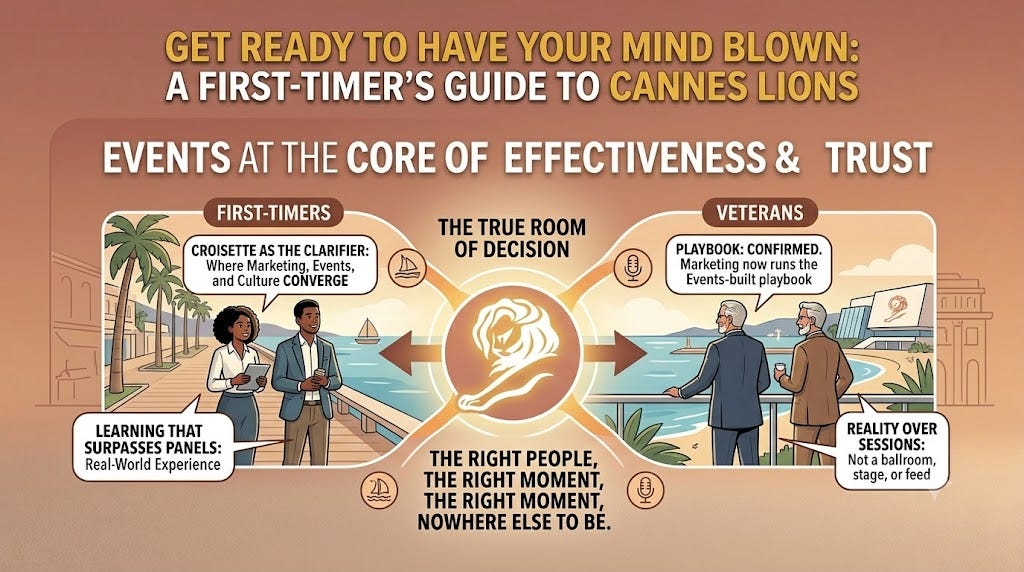
Both will be glad they came. The first-timers because the Croisette will show them something about how marketing and events and culture are converging that no conference panel has managed to articulate as clearly. The veterans because it will confirm, again, that the events world built the playbook the marketing world is now running, and that the room where the industry’s future gets decided is not a ballroom, a stage, a deck, or a feed. It is the place where the right people are, in the right moment, with nowhere else they need to be.
Go find those people. The jet lag will pass by Thursday.
GatheringPoint covers the people who build the gatherings. Subscribe at GatheringPoint.news.


