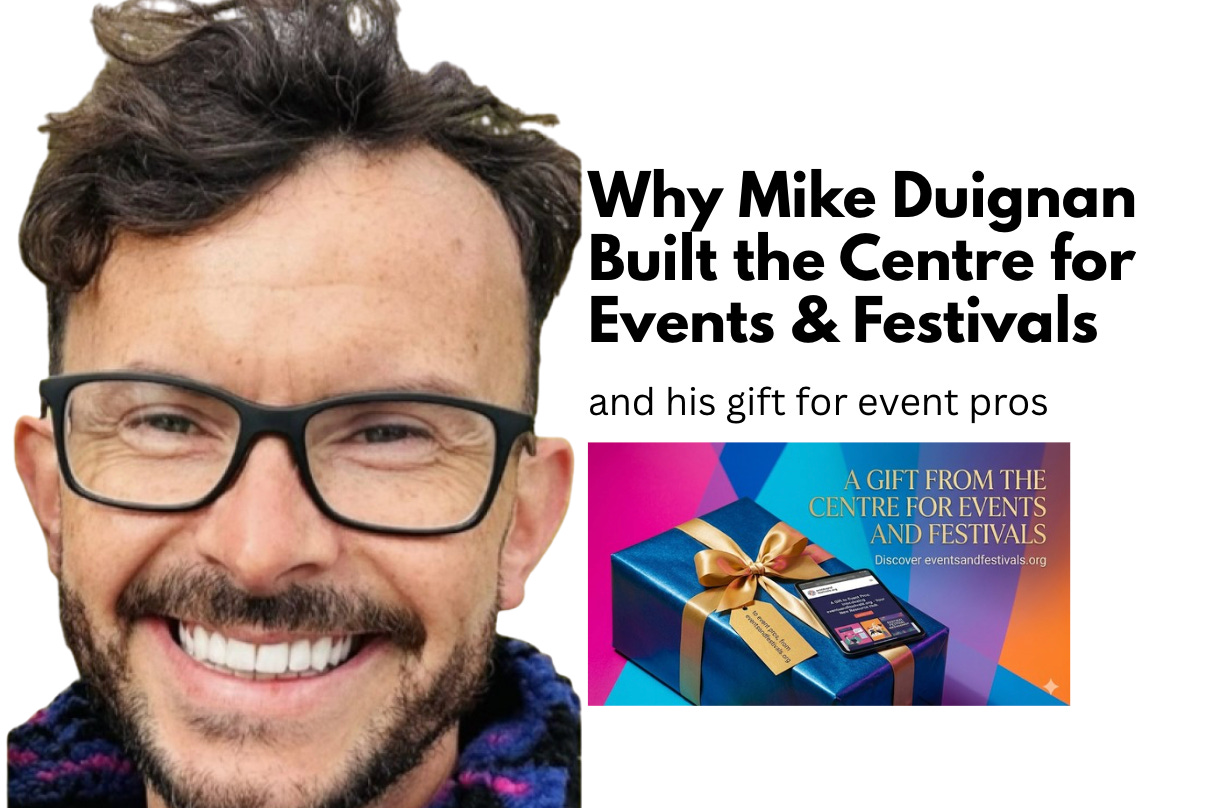
Why Mike Duignan Built the Centre for Events & Festivals—and his latest gift for event pros
What Mike Duignan has actually built with the Centre for Events & Festivals—and why it arrives at a moment when the industry finally has the tools to build for itself.
The post was easy to miss. A LinkedIn note, a link to eventsandfestivals.org, a phrase calling it a love letter to event professionals. The kind of thing that passes through a crowded feed and disappears. I clicked anyway. What stopped me was not the language. It was the build.
This was not another industry site dressed up as a community. It was a working attempt to put tools around problems the events business has been tolerating for years. Not talking about in panels. Not admiring in white papers. Actually trying to solve. That is what Mike Duignan has done here.
He has built a place that tries to make sense of the parts of this business that usually remain informal, uneven, or trapped inside private networks. How people move through a career. How they show what they know. How the value of an event gets explained beyond attendance and revenue. How burnout gets acknowledged before it becomes identity. How accessibility gets designed into the process instead of appended at the end. How mentoring, recognition, publishing, jobs, standards, and tools can sit inside one ecosystem instead of drifting around as separate categories.
The first thing you notice is that the site is not organized like media and it is not organized like an association brochure. It behaves more like a working operating layer. You move from Fellowships to the Professional Development Planner, then into the tools in the lab, and a picture starts to form. The picture is not theoretical. It is procedural.
You can map your development. You can test for burnout. You can build an advocacy case. You can work through accessibility. You can think about workforce planning through CrewCycle. You can use ImpactPath to think through outcomes. You can use EventAtlas to think strategically. You can move to EventMentor if what you need is not another article but another person. You can go to EventsPRO if you want the formal development side. You can look at the CEF Jobs Board if you are trying to understand where the field is going in practical labor terms.
That is why this doesn’t feel like content. It feels like work someone did on behalf of the rest of the field. That is also why it feels like a gift.
Most people in this industry do not have the luxury of stepping back far enough to build this kind of connective tissue. They are producing the next event, solving the next venue problem, answering the next client demand, getting the next sponsor over the line, dealing with the next staffing issue. The work is live, local, deadline-driven, and all-consuming. Even when the audience is global, the labor is rooted in a place and a moment. You rarely get enough altitude to ask how the whole thing should work.
Duignan did.
What he appears to have recognized is that the industry has been functioning with a patchwork logic for a long time. Careers are real but hard to describe. Skill is visible inside a trusted circle but hard to signal outside of it. Value is constantly asserted but usually in a narrow economic frame. The human cost of the work is obvious to the people doing it and oddly invisible in the official language around it. The same goes for accessibility, mentoring, workforce progression, and the broader social and civic value of what events do.
What sits inside the Centre for Events & Festivals is a response to that condition. Not a theory of the industry. A build. And this is where timing matters.
For years, something like this would likely have required a much larger institutional structure: more money, more development overhead, more intermediaries, more time between idea and execution, and more people standing between the person who saw the problem and the person trying to solve it. [Inference] Newer build environments such as Replit and adjacent rapid-development tools change that equation. They make it possible to prototype, ship, test, revise, and improve specialized tools far faster and with far less drag than older software models allowed. They shorten the distance between creator and user. They reduce the amount of interference in the process. They make continuous improvement realistic instead of aspirational.
That matters here because this ecosystem is not static. It is built around the kinds of problems that only get better through repeated contact with the people using them. A burnout tool gets better when event professionals push on it. An advocacy tool gets sharper when people try to use it in the real world. A development planner becomes more useful when people bring actual career messiness to it. A system like this improves by staying close to the field, not far from it.
That may be the most important part of the story.
What Mike Duignan has built is not just useful because of what it already contains. It is useful because it has been built in a way that can keep evolving. The creator can stay close to the problem. The user can stay close to the creator. The loop is shorter. The friction is lower. The tools do not have to emerge fully finished to matter. They can improve in public, with use.
From an American vantage point, that part of the story is easy to miss. The business here has long been local, relationship-driven, and operationally immediate. For years, that was enough. It certainly was for me. You knew your market, your network, your standards, your shortcuts, your trusted people. You did not need a larger map because your daily work did not reward having one.
Over time, that starts to change.
The more years you spend in this business, the more visible the blind spots become. You start to see how much of the field exists beyond your own circles and how much important work is being done without a shared frame. You begin to see that the industry has always been larger than the way it describes itself. You also begin to see how hard it is to prove that largeness in ways that travel.
That is where this project lands.
The ImpactCalc and EventAdvocate tools are obvious examples. They take the value conversation beyond attendance, square footage, or hotel nights and push toward a broader accounting of what events do to economies, societies, people, and places. BurnoutMeter does something equally important in a different register. It gives language and structure to something the industry has normalized. AccessPlan treats accessibility as planning logic, not cleanup. VolunPlan suggests that volunteer pathways deserve structure too, not just gratitude.
Even the architecture of the ecosystem tells you what Duignan thinks matters. The Professionalisation Ecosystem page makes the case visually. The Events and Festivals Professional Excellence Framework sits at the center. From there, standards, fellowships, awards, applications, insights, debates, journals, and tools connect outward. It is an attempt to say that this field does not have to remain a loose federation of habits and relationships. It can have an underlying logic.
That ambition could easily have turned pompous. It doesn’t, because the thing that keeps cutting through is usefulness.
The site keeps asking the same quiet question: what would actually help the people doing this work?
That is why I keep coming back to the word gift.
Not because it is charitable. Because it is labor someone undertook that most of the rest of the field has not had the time, position, or patience to undertake for itself.
You can see the people around it through the CEF Advisory Board. You can see the research side through the Journal & Books. You can see the professional development arm through EventsPRO. You can see the tools directly in the CEF Lab. And you can move through the full site at eventsandfestivals.org.
I would not rush through it.
This is one of those builds that makes more sense the longer you stay with it. The first reaction is that someone has made a site. The second is that someone has built a system. The third, at least for me, was that someone has finally done some of the unpaid structural thinking this industry has needed for a very long time.
That is why it matters now.
And that is why it feels like a gift.
CEF cheat sheet- Take a peek.
Here is the quick path through the ecosystem:
Centre for Events & Festivals
Main entry point.
Professionalisation Ecosystem
Best overview of how the framework, fellowships, awards, research, and tools connect.
Fellowships
Recognition and progression structure.
Professional Development Planner
Career and growth mapping.
ImpactCalc
Impact calculator.
EventMentor
Mentor matching and development.
EventAdvocate
Advocacy and value-building tool.
BurnoutMeter
Burnout assessment.
AccessPlan
Accessibility planner.
CrewCycle
Workforce lifecycle planning.
ImpactPath
Theory of change and outcomes planning.
EventAtlas
Event strategy dashboard.
VolunPlan
Volunteer development planning.
Journal & Books
Publishing and research materials.
EventsPRO
Courses and professional development.
CEF Jobs Board
Jobs platform.
CEF Advisory Board
People behind the initiative.