
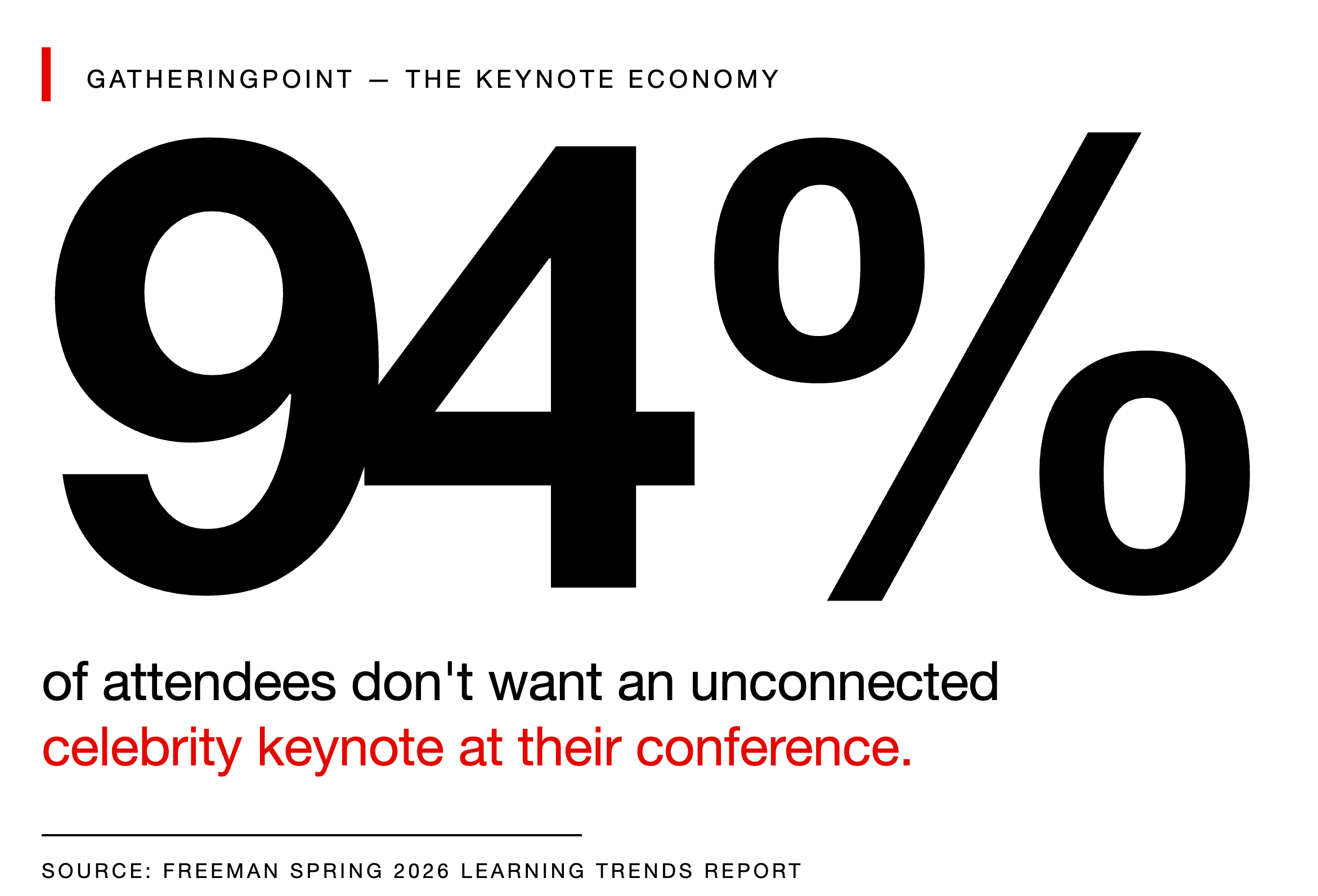
Why 94% of Attendees Don't Want Celebrity Keynotes
New Freeman research shows the booking strategy that built the modern conference is quietly losing the room.
A note from the editor. This runs long. 3,400 words, roughly a fifteen-minute read. The keynote question has been misunderstood for fifteen years across two industries, and the Freeman Spring 2026 Learning Trends Report finally gives us the instrumentation to name the pattern. Worth the time if you organize events, book speakers, or sit on a program committee. The argument in one sentence, for readers who want it up front: decouple the booking. Marketing talent in marketing slots. Learning talent in learning slots. The rest is the evidence.
Ten years ago the argument was about the Las Vegas super clubs. A corporate event would book Hakkasan at the MGM Grand, or XS at Wynn Las Vegas, or Omnia at Caesars Palace, or Tao at the Venetian for the opening-night reception, pitch it to attendees as a networking moment, book a DJ or a pop act as the draw, and then watch conversation stop the moment the volume hit. The partner meeting that justified the trip evaporated. The sponsor who paid for premium brand visibility watched their activation lounge empty out at the first drop. The networking function collapsed inside a marketing success, and the industry spent the better part of a decade arguing about whose fault it was.
The argument was never resolved. It was relocated. Today the same structural mistake is being made one room over, at the general session slot on Tuesday morning, and the data that proves it has just been published. According to the Freeman Spring 2026 Learning Trends Report, 59 percent of professional conference and trade show attendees prefer industry experts on the keynote stage. Fewer than 1 in 15 prefer celebrities. That is the flattest preference signal in the entire 66-page document. And across the industry, the keynote slot itself is drawing, on average, roughly half the room.
The room is different and the slot is different, but the architecture is the same. Programming decisions driven by stakeholders who are not in the audience, measured against audience objectives the programming was never designed to serve. In 2015 the objective was relationship-building and the spectacle was the band. In 2026 the objective is learning and the spectacle is the celebrity. The slot changes. The mistake doesn’t.
The Concert Built the Conference
The headliner bands in the Vegas superclub era served a function, and the function worked. They drove registration. They drove press coverage. They gave mid-career attendees a reason to ask their managers for budget approval: I’m going to the conference where Lenny Kravitz is playing. The booking itself was an acquisition lever, and for a decade it performed. What it did not do was support the thing the reception was ostensibly for, which was relationship-building among attendees and sponsors who had flown in specifically to meet each other. Those two functions, acquire attendees and connect attendees, were put in the same room at the same volume, and the louder of the two won every time.
The defense inside the company was unassailable on paper. Post-event surveys asked attendees how they rated the concert. The concert scored high. Attendees who had stood at the edge of a superclub for three hours unable to hear themselves think gave 4-out-of-5 because the DJ had in fact played their favorite song. The survey did not ask how many business conversations they had. The survey did not ask whether the sponsor they flew in to meet ended up canceling the dinner because the entertainment overlapped. The metric that was measured went up. The metric that wasn’t measured went to zero. Nobody asked the second question, because nobody wanted the answer.
The tech user conferences ran the same play at industrial scale, and the historical record is cleaner there because the bookings were public. Oracle OpenWorld built its reputation partly through the Appreciation Event on Treasure Island, a private concert tucked into the registration package at $2,650 or more. Between roughly 2006 and 2019, Oracle OpenWorld attendees saw Elton John (twice), Aerosmith (twice), Billy Joel, Tom Petty and the Heartbreakers, Sting, Lenny Kravitz, Stevie Nicks, Black Eyed Peas, John Mayer, Roger Daltrey, Don Henley, the Steve Miller Band, Gwen Stefani, and Macklemore, among others. Salesforce Dreamforce built Dreamfest into an even larger model: Foo Fighters in 2008 and again in 2015, Black Crowes, Stevie Wonder with Will.i.Am, Metallica in 2011, 2018, and 2025, Red Hot Chili Peppers, Green Day, Bruno Mars, U2, Lenny Kravitz with Alicia Keys, Fleetwood Mac, Janet Jackson, The Killers, and Elton John in 2024.
These bookings worked as marketing. Dreamforce grew from a few thousand attendees in the early 2000s to more than 170,000 onsite by the late 2010s, and the Dreamfest headliner was one of the levers that built that scale. The band was the reason the plane ticket got approved. The conference did the business. What also happened, inside those rooms, was that the networking function collapsed when the band played, and for years the companies running the events pretended it didn’t matter because the post-event surveys asked about the concert.
Eventually they stopped pretending. Both Oracle and Salesforce figured out, quietly and without ever publicly conceding the earlier mistake, that the fix was architectural rather than programmatic. Dreamfest is now a separately ticketed Wednesday-night event at Chase Center, with its own venue, its own frame as a philanthropic benefit for UCSF Benioff Children’s Hospitals (over $120 million raised cumulatively as of 2025), and a schedule that keeps it well away from the Monday and Tuesday networking hours. The spectacle got its own building and the networking got its own time slot. Two jobs, two rooms, two tools. The decouple works.
Nobody Asked the Second Question
The reason the fix took a decade was never programming. It was governance. The decisions that put the band in the reception slot were not made by the people paid to design attendee experiences. They were made by a small circle of executives (the CMO, the head of customer marketing, the enterprise sales lead, sometimes the CEO directly) who picked acts they personally wanted to meet. The backstage pass list was engineered around the company’s top enterprise customers and the C-suite that wanted a green-room photo with a rock star. The booking was, underneath the defense, a personal perk for the people writing the check, professionally laundered as an attendee benefit. The critique that it suppressed networking was technically correct and politically unwelcome. Nobody at the VP level wanted to be the person who told the CEO his favorite band was a governance problem.
The association and corporate-event world documented by Freeman has a different governance structure but the same outcome. Seventy-two percent of organizers in Freeman’s survey cited budget as the top blocker to changing general sessions. Forty-eight percent cited precedent or tradition. Forty-five percent cited boards, committees, or other programming groups. Twenty-two percent cited sponsor contracts. Those last three are the whole story. Nearly half of all organizers, on the record, told researchers that programming decisions are shaped by governance structures that predate the audience currently in the room. The committee has bylaws. The sponsor contract specifies keynote visibility. The board member from 2014 wants to be consulted. The industry’s decision architecture was designed for an earlier era of live events, and it has not been updated.
Inside that data, the sharpest number comes from what Freeman calls the NowGen cohort, event professionals aged 23 to 46, the generation now running the work. Fifty-nine percent of them cite precedent as a blocker, meaningfully higher than the overall 48 percent. The organizers closest to the audience, the ones who will still be running shows in 2040, feel the weight of tradition most acutely. They know the model isn’t working. They cannot, within their current org charts, change it.
The Third Function
There is a third reason celebrity keynotes persist that neither the marketing argument nor the governance argument fully captures. Bragging rights. The attendee who returns to the office on Monday and says, casually, I saw Anderson Cooper speak last week is getting something the organizer sold them whether or not it appeared on the conference prospectus. The name is a social asset. It signals that the event was serious enough, well-resourced enough, and important enough to attract a recognized face. A CFO who approves the conference registration wants her team to come back with stories that validate the spend. A sales leader who funds a prospect’s trip to a trade show wants the anecdote that sticks in a follow-up email. The celebrity keynote is, partly, the souvenir the attendee carries home.
For events without the brand equity of a Dreamforce or the critical mass of a CES, the name was the unique selling proposition. It was how a conference broke through a crowded category. A marquee journalist or a former president or a Shark Tank investor in the keynote slot was the difference between a registration page that converted and one that didn’t. The attendee got the story to tell on Monday. The marketing team got a campaign asset. The event got permission to charge what it charged. The name in the headline did the work the rest of the program couldn’t do on its own. For a long time this was smart event marketing, and for a certain class of event it still is.

The events-industry trade show that operationalized this understanding most explicitly is Connect Marketplace, produced by the Atlanta-based company formerly known as Collinson Media & Events, which acquired BizBash in recent years. Connect’s keynote roster over the last decade reads as a deliberate study in the bragging-rights booking: Presidents Barack Obama, George W. Bush, and Bill Clinton; Michelle Obama; Nicole Kidman; Peyton Manning; Robin Roberts; Shaquille O’Neal; Cal Ripken; Michael Phelps. The audience at Connect is meeting planners, the people who book celebrity speakers for their own events. Connect is, functionally, a proof-of-concept demonstration of the model it sells. The booking strategy works at Connect precisely because the attendees recognize the strategy; many of them will apply some version of it to their own events within the year.
The Freeman data does not kill this logic. It complicates it. A name like Anderson Cooper, who currently commands a $100,000 to $200,000 live speaking fee, delivers a recognizable story. A lesser celebrity delivers a weaker one. And the attendee who returns to the office having heard a working operator explain precisely how to solve the problem they’ve been stuck on for six months returns with something arguably more valuable: a usable idea. The bragging right is an aesthetic benefit. The applicable insight is a practical one. What has shifted, and what the Freeman report captures, is that attendees have begun separating these benefits in their own minds. They still appreciate the name. They no longer confuse it with the reason to come back. Only 27 percent of attendees return to an event the following year, per Freeman’s separate research. That number does not move because the keynote was famous. It moves because the program was useful. The bragging right, measured over a two-year attendance cycle, turns out to be a weaker retention tool than the booking strategy assumed.
What the Report Actually Teaches
Strip the headline numbers away and the Freeman research lands on four findings that organizers can act on Monday morning. Each one is supported by specific attendee data and each one points toward the same architectural conclusion.
First, clarity of purpose at the outset beats spectacle every time. Eighty-seven percent of attendees say it is important that speakers provide real-world examples and challenges. Eighty-four percent want implementable takeaways. Seventy-six percent want the session’s objectives stated clearly at the start. These are not design flourishes. They are the baseline competencies attendees now expect, and the gap between attendee-rated importance and attendee-rated effectiveness is wide across all three. Speakers are being booked for the wrong attributes and briefed for the wrong outcomes.
Second, relevance to the attendee’s profession is the currency that matters. Sixty-four percent of attendees rate keynote speaker quality highly. Only 55 percent say the content was professionally relevant to them. Among trade show attendees specifically, the relevance rating drops to 46 percent. The gap between “I liked the speaker” and “the speaker’s content mattered to my work” is where the keynote model is breaking. Fixing the gap is not a matter of booking better-known speakers. It is a matter of briefing speakers to speak to the specific audience in the specific room, which is a governance and preparation problem rather than a talent problem.
Third, attendees define value by what they leave with, not what they saw. Sixty percent of Freeman’s respondents cite take-home, implementable learning as the primary marker of a valuable session. Fifty-eight percent cite a changed perspective. Fifty-four percent cite insights they can teach others at their organization. The aesthetic experience of a big-name keynote, the photo op, the social media share, the bragging right, shows up far lower in the value hierarchy. Organizers who continue to optimize for the aesthetic layer are optimizing for the wrong metric.
Fourth, general session aesthetics matter less to attendees than organizers believe. Sixty-five percent of attendees say big screens and visual polish do not make a keynote better. This is one of the cleanest attendee-organizer gaps in the report, and it carries a direct budget implication. The production spend that goes into main-stage aesthetics is, by the audience’s own account, not the spend that drives their perception of keynote value. The same budget redirected toward smaller rooms, expert-led sessions, and facilitated exchanges would produce a stronger return on the metrics attendees say they actually care about.
Taken together, the four findings point in one direction. The keynote slot is worth less to attendees than the programming that surrounds it. The budget currently concentrated on the main stage is available for redeployment. The speakers attendees want are not the speakers the current booking process is optimized to produce. The architecture of the program needs to catch up to what the audience has been saying for several cycles of research now.
The Slot Is Disassembling
The speaker-bureau economics beneath this argument are moving in a direction the industry has not fully processed. The professional speaker market sits at roughly $2.19 billion in 2025, projected to reach $2.61 billion by 2030, which is healthy growth but not explosive. Inside that number, industry experts are gaining pricing power and traditional celebrity speakers are holding ground but not expanding. Multiple bureau sources in late 2025 and early 2026 cite the same figure: nearly half of clients report higher ROI from thought leaders than from celebrity speakers. Motivational speakers, the commodity tier that filled out ballrooms in the 2010s, are losing ground fastest. At the top of the market, the line between celebrity and expert has blurred. Brené Brown commands celebrity-tier fees. So does Simon Sinek. So do Adam Grant, Mel Robbins, Ian Bremmer, Malcolm Gladwell, and Cassie Kozyrkov. The audience is paying more for authority than for fame, and the market has noticed.
The 60-minute keynote slot itself is being disassembled. Industry reporting from late 2025 and early 2026 confirms a steady move toward 20-to-30-minute sessions, multiple shorter formats interleaved with interaction. The big-name who used to command a six-figure fee to fill one hour on a main stage is now being asked to do a 25-minute opening, a moderated Q&A, and a closed-door session with the sponsor’s top customers. Some will. Many won’t. Their deal was built on the hour. This is a slow-rolling repricing event the bureaus see coming and the speakers largely don’t.
One consolidation signal worth watching. In January 2025, Sports Business Journal reported that Athletes First, the sports talent agency, signed a partnership with Washington Speakers Bureau to market more than 50 athletes, coaches, and executives for speaking engagements. The deal reads two ways. The sports-agency side sees speaking as a rising revenue stream. The bureau side needs a fresh pipeline of celebrity-adjacent talent because the traditional athlete-on-the-circuit pool is thinning. Probably both are true. Either way, it is a market signaling that the celebrity-speaking business is being industrialized at the exact moment organizer demand for pure celebrity is softening.
The value proposition bureaus now advertise has moved from “we have access to famous people” to “we have curation and the judgment to tell you the speaker you want is wrong for your audience.” That repositioning is quiet, consistent, and recent. It maps directly to the Freeman data. The economic pressure that will eventually force the governance conversation is already underway.
Where the Argument Doesn’t Apply
None of this is a case against celebrity bookings as such. The best-resourced events in the industry have legitimate reasons to book a famous name. A major corporate product launch with a $5 million production budget and a Wall Street Journal press goal can justify an Obama or a Clinton on marketing grounds alone, and the bureaus still close those deals on the merits. Consumer-facing festivals operate on a different logic entirely: the celebrity is part of the entertainment product, and the audience paid to be proximate to fame. Anniversary galas and milestone events can support a name booking because the room has gathered for a ceremonial function, not an instructional one. Cases where a celebrity is also a domain expert belong in a separate category: an astronaut speaking on leadership, a former head of state speaking on geopolitics, a novelist whose work actually reframes how marketers think about narrative. The booking earns its fee because the speaker was selected for what they know, and the fame is incidental.
The Freeman data is specifically about professional conferences and trade shows: medical meetings, industrial gatherings, association annuals, corporate user conferences. In that set, the model is breaking. Attendees have told researchers, repeatedly and with increasing volume, that they prefer the operator, the practitioner, the working expert who can address the specific problem they traveled to the event to solve. Organizers keep booking the retired athlete anyway.
The world where the ten-year-old reception debate is still unresolved has also narrowed, but not disappeared. Pharma sales incentive trips still book superclub buyouts with a resident DJ and still advertise the evening as a networking opportunity. Direct-sales annuals and broker-dealer conventions still run the big-name-headliner reward night with the same stated function. Automotive dealer conferences, some financial services regionals, and associations that adopted the headliner model in the 2010s to compete for attendance continue to slot the act into the window where relationship-building is supposed to happen. The critique never reaches those rooms because the organizers making the decisions are mostly not at IMEX or PCMA, not reading the Freeman reports, not in the conversations where the fix has been worked out. The debate is still alive; it is just happening at lower volume, in smaller rooms, inside companies that haven’t caught up to what the tech giants figured out a decade too late.
Two Jobs, Two Rooms
The architectural fix is not complicated. Decouple the booking. Put the marketing talent in a marketing slot. Put the learning talent in a learning slot. If the celebrity sells registration, and sometimes they do, book them for the Wednesday-night separately ticketed event, the VIP sponsor dinner, the opening reception that operates as a signal rather than a networking window, the after-party that the business program has already cleared. Put the industry expert on the Tuesday-morning main stage, where the attendees actually are and where the problem they came to solve is supposed to be addressed. Two jobs, two tools, two rooms. Sponsors still get their brand-adjacency moment. The CEO still gets the green-room photo. The attendee still gets the learning session that justified the travel budget. Nobody loses.
The events industry has already solved this problem twice. Once at the Vegas superclub reception, once at Oracle OpenWorld and Dreamforce. Both solutions took a decade longer than they should have, because the people who would have had to kill the old model were the people it served. The third fix is the keynote slot. The evidence is already on the record. The market is already repricing. What remains is the governance conversation that has always been the real constraint. Somebody on the program committee has to be willing to lose the board meeting.
The 1 in 15 was always the number. A decade ago, when the argument was about the reception, nobody was measuring. This time Freeman did. What remains is the conversation on the program committee that nobody has yet been willing to have.
GatheringPoint covers the people who build the gatherings. Subscribe at GatheringPoint.news.


