


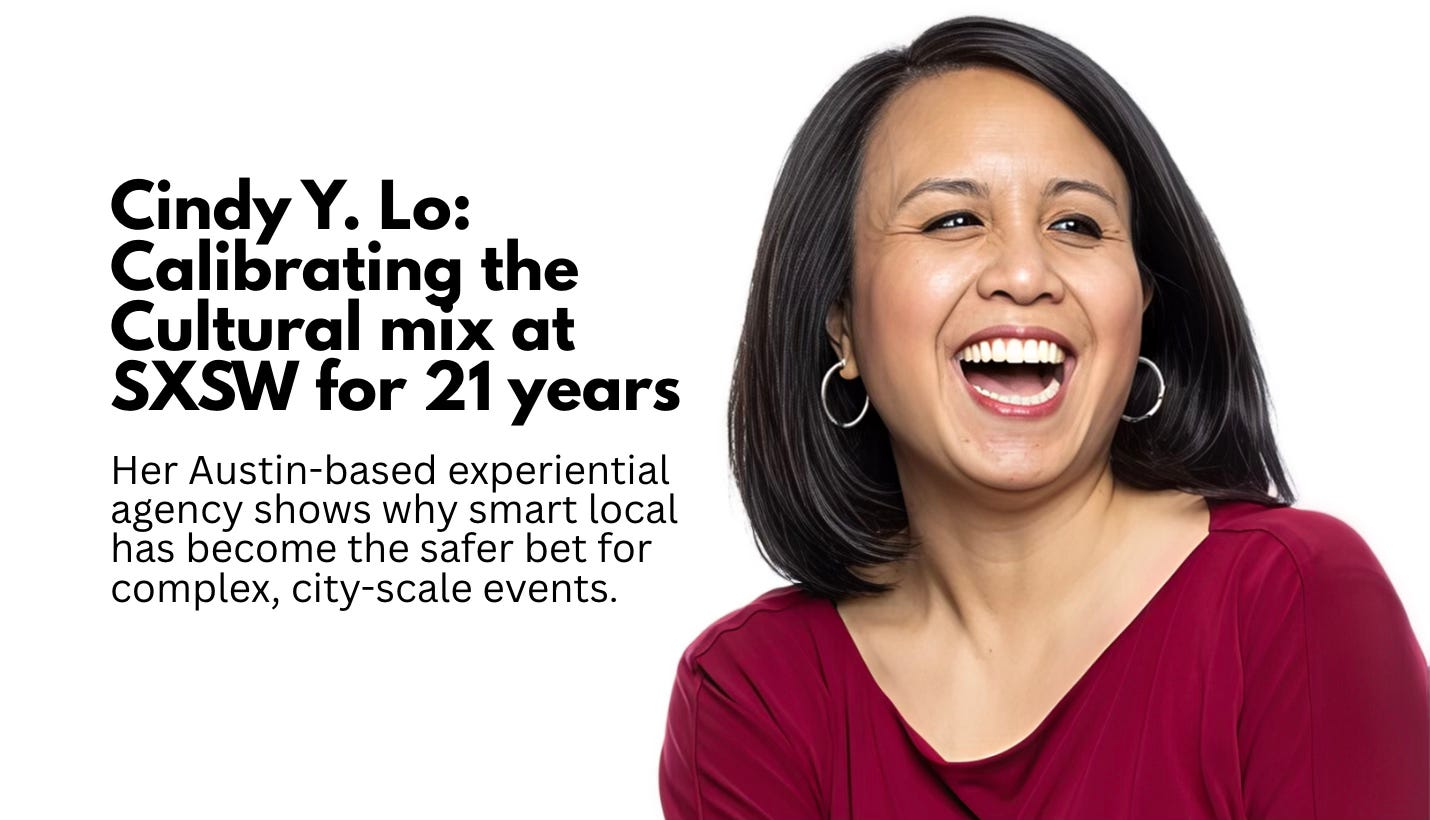
Editors Note: For years, the events industry equated scale with sophistication. Bigger agencies, bigger decks, bigger ideas that could be dropped into any city with minimal adjustment. What we’re learning now—often painfully—is that experiential work doesn’t scale evenly. It concentrates. It demands judgment. It rewards people who understand a place deeply enough to say no.
For much of the last decade, the experiential world operated under a reassuring illusion, one reinforced by scale, polish, and the smooth authority of national decks: that a strong idea, properly designed, could move from city to city with only minor adjustments, as though place were a neutral backdrop and not a force capable of reshaping the experience itself.
What has unsettled that belief is not fashion or taste, but consequence. Events have become more expensive to produce, more visible when they fail, and more entangled with the cities that host them, which means the cost of misunderstanding a place now surfaces quickly, often publicly, and rarely forgives. Permits stall. Neighborhoods push back. Budgets stretch. Audiences register insincerity before brands realize it has appeared. Context, long treated as a detail to be managed, has reasserted itself as the work.
This has not rendered national agencies irrelevant, nor diminished the value of scale, pattern recognition, or centralized strategy, but it has exposed the limits of distance, because when experiential intelligence is equal—when the strategy is sound, the creative disciplined, the business thinking solid—the difference is no longer reach, but fluency, the kind that comes from having made mistakes on the same streets often enough to recognize them before they happen.
Cindy Y. Lo has spent more than two decades acquiring that kind of fluency in Austin, not by branding herself as a local expert, but by behaving like one, learning the city through repetition, consequence, and an unromantic attention to how ideas behave once they leave the page and encounter reality.
The first room Cindy ever learned to read was a high school cafeteria pretending to be somewhere else, transformed for homecoming by committee decisions, borrowed ambition, and fabric draped where fabric had no business being draped, including a staircase converted—somewhat recklessly—into a magic carpet, because the theme that year demanded it. One year it was Aladdin. Another, An Evening in Paris. The specifics blur now, but the instinct does not.
Cindy was not the artist with a sketchpad or the loudest voice in the room, but the person quietly watching how people moved through the space, where traffic slowed, what broke, what worked, what cost more than expected, and whether the whole thing would hold together long enough for the night to matter. This observational research honed her skills as a visionary because she understood the basics.
She didn’t know it then, but she was already practicing the discipline that would define her career, translating imagination into something capable of surviving contact with reality.
She grew up in Texas, born in America to immigrant parents from Hong Kong, in a household where tradition wasn’t inherited so much as assembled, because holidays were not reenactments of the past but improvisations, new American rituals pieced together from memory, adaptation, and whatever proved workable. She understood she was different long before she had language for why, a fact made unavoidable by a predominantly white Houston school environment, where difference rarely announces itself and instead reveals its shape later, usually through contrast.
That contrast sharpened most clearly around class.
Her parents had wealthy friends whose children attended private schools, wore designer clothes, and ate at restaurants where menus did not list prices, and Cindy remembers one dinner in particular, not for its food but for the moment she politely asked for the “real menu,” certain there had been a mistake, only to watch her mother’s face drain of color as the correction arrived quietly and without explanation.
It was the moment she understood that success was not abstract or aspirational, but operational, defined by options, ease, and the absence of constant calculation, and while that realization did not make her reckless, it made her exacting in ways that would surface years later.
Long before she knew what an event professional was, Cindy was already practicing the work, carving watermelons into baskets for family gatherings, collecting fancy stationery not to admire but to study, noticing vellum layers, paper weights, and typography, then recreating the effect with discipline because she did not have money, only curiosity, patience, and a brain wired to solve problems.

In high school, leadership arrived under an unexpected banner—math club, Mu Alpha Theta—where Cindy served as president, while also immersing herself in student council, where prom and homecoming were less fantasy than system, requiring budgets, themes, coordination, and execution. She will tell you she was never the artist, and she’s right, but she was always the instigator, the project manager, the one asking the questions that kept everything moving forward.
College sharpened the pattern. It was there, inside a business school environment that prized structure and outcome, that she planned freshman orientation, speaker series, and internal programming, still without imagining that planning itself could be a career, because in her mind it remained volunteer work, something adjacent to real success, which followed a prescribed route: corporate job, MBA, partner track.
Then September 11 happened, and Cindy, just outside New York at the time, watched certainty fracture in a way that made staying on the wrong path feel suddenly untenable, and life too short to spend somewhere she wasn’t meant to be.
When she left tech, she did what seemed responsible, applying for event jobs and expecting to work her way in, only to encounter rejection after rejection, each one citing the same reason—no paid experience, no one willing to take a chance.
So at twenty-six, in an act of naïve audacity that would later define her, she started a company not because she wanted to run one, but because she needed a way to qualify herself to be hired.
She named it Austentatious Events, a clever Austin-rooted wordplay that felt smart and ambitious, but it lasted only eight months, not because the work wasn’t good, but because the name itself introduced friction, forcing conversations to begin with explanations instead of ideas, a problem Cindy noticed immediately.
Clever, she learned, only works if it’s legible.
She changed the name without sentimentality, choosing RED VELVET, red for prosperity in Chinese culture and velvet because it felt tactile rather than transactional, with no mythology attached, only instinct, trial and error, and a willingness to let go once something stopped working.
Her first real failure arrived in the form of a margarita tower, conceived for a Texas-themed fundraiser, engineered with confidence, and undone the moment a door opened at precisely the wrong time, letting wind and gravity do what they always do, leaving Cindy to recognize the unmistakable sound of breaking glass before she could turn around. She tells the story plainly, without embellishment, because the lesson needs none: ideas don’t fail in theory, they fail in execution.
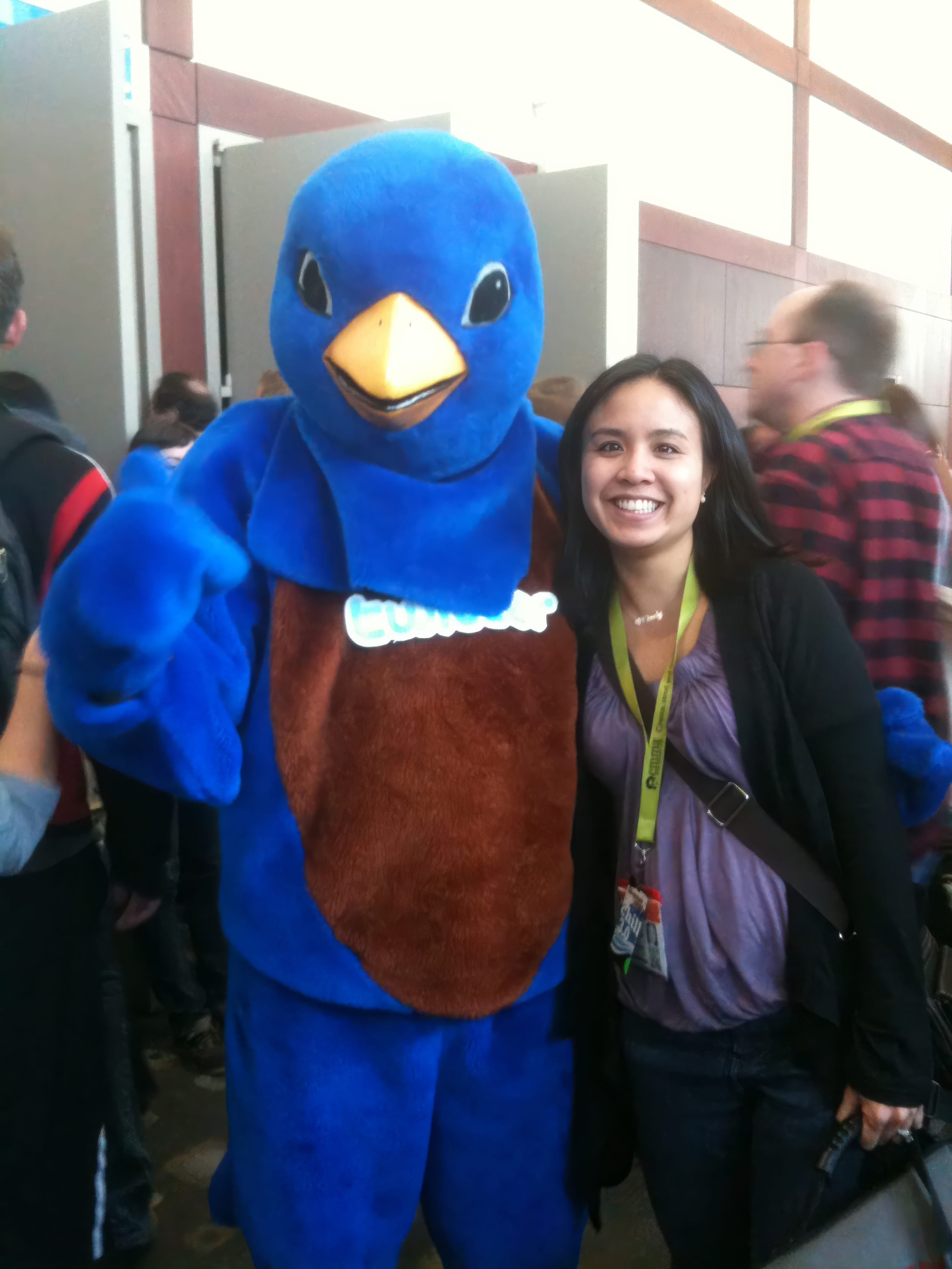
What built RED VELVET was not South by Southwest alone, though Austin’s gravitational pull mattered, but people—old bosses, university contacts, relationships formed long before they were needed—because careers, Cindy believes, are accumulations of memory, shaped by how people remember you when you didn’t yet need anything.
As the company matured, she narrowed her focus, first to corporate work, then to experiential, then to festivals, sponsorships, and activations, treating niche not as limitation but as clarity, and when RED VELVET began running smoothly without her constant presence, she noticed something unexpected: boredom, not burnout, but the restlessness that arrives when systems start to work and curiosity remains.
That restlessness led her to Strong Events, a decades-old fabrication and rental business she had not been seeking but immediately understood, where due diligence became her summer, EBITDA replaced aesthetics as the first filter, and the difference between consulting and fabrication became unmistakable, because fabrication is steel, logistics, depreciation, and margin, and nothing about it is abstract.
Cindy likes real.
When she attends an event now, she begins with wonder and ends with math, instinctively asking who paid for it, who underwrote it, and whether the model holds, able to estimate costs across Austin, New York, Houston, Dallas, and beyond without effort, and when something doesn’t add up, she doesn’t admire it, she worries about it.
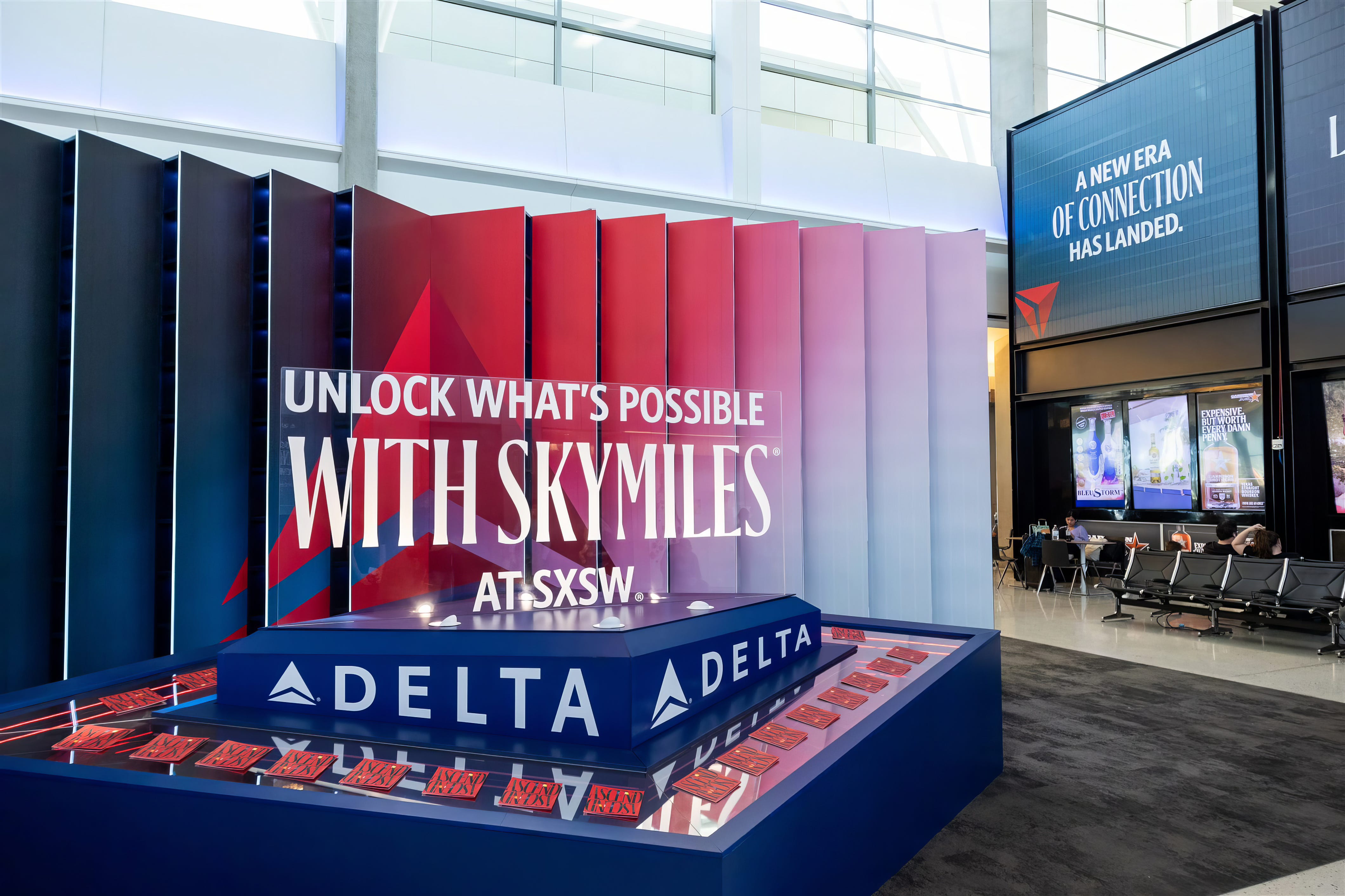
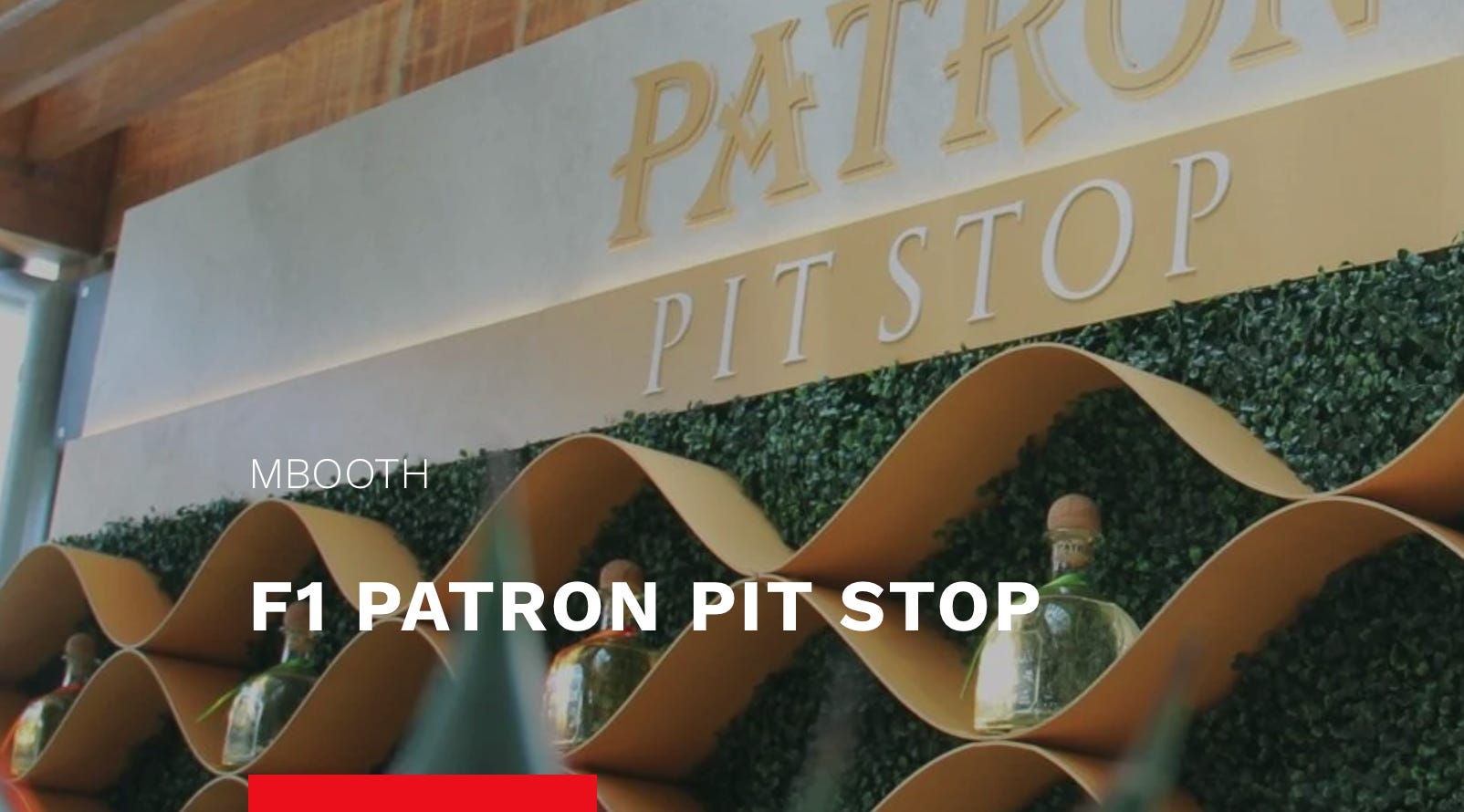
What makes a festival like South by Southwest uniquely unforgiving is that it isn’t a single event so much as a temporary city layered onto a real one, a dense cultural cocktail of brands, artists, activists, residents, tourists, and institutions all sharing the same streets at once, each arriving with different expectations and different tolerances. In moments like this, context isn’t just logistical, it’s cultural, because a misjudged activation doesn’t simply fall flat, it collides—with local sentiment, with political mood, with audience fatigue, with a city increasingly sensitive to being treated as a backdrop rather than a participant. What once read as bold can now feel tone-deaf, what once felt celebratory can quickly feel extractive, and the margin for error has narrowed as scrutiny has intensified. Designing for SXSW now requires not just creativity and scale, but restraint, timing, and an intuitive understanding of when to show up loudly and when to step back, a kind of judgment that can’t be imported overnight and rarely survives distance.
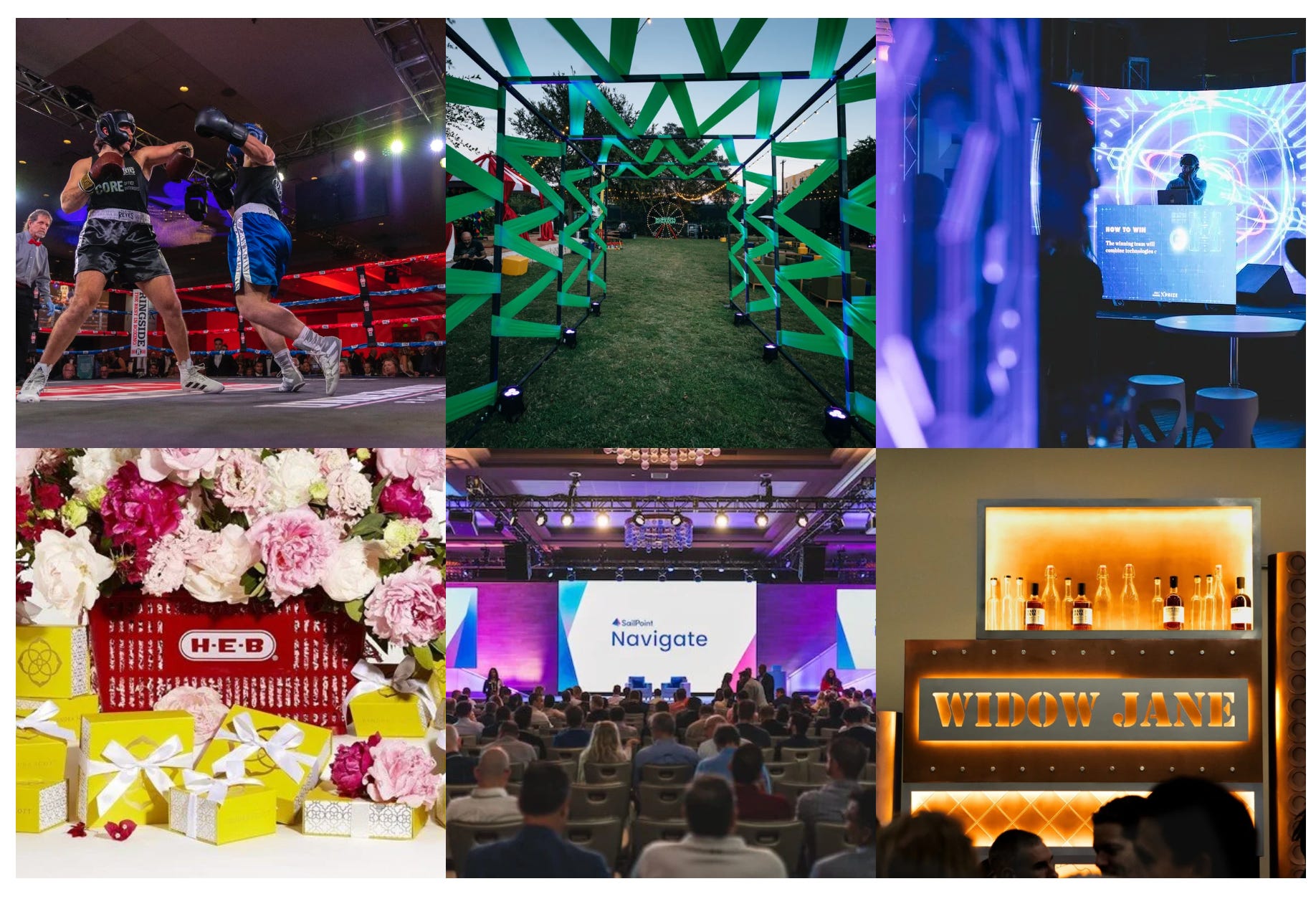
There are forms of experiential work that tolerate distance well enough—controlled product activations, repeatable national rollouts designed to behave predictably across markets—but festivals, city takeovers, and cultural piggybacks exist in open systems, intersecting with municipal politics, neighborhood tolerance, labor realities, audience behavior, and memory, conditions that do not scale cleanly and demand judgment earned on the ground.
That is where Cindy’s advantage becomes decisive.
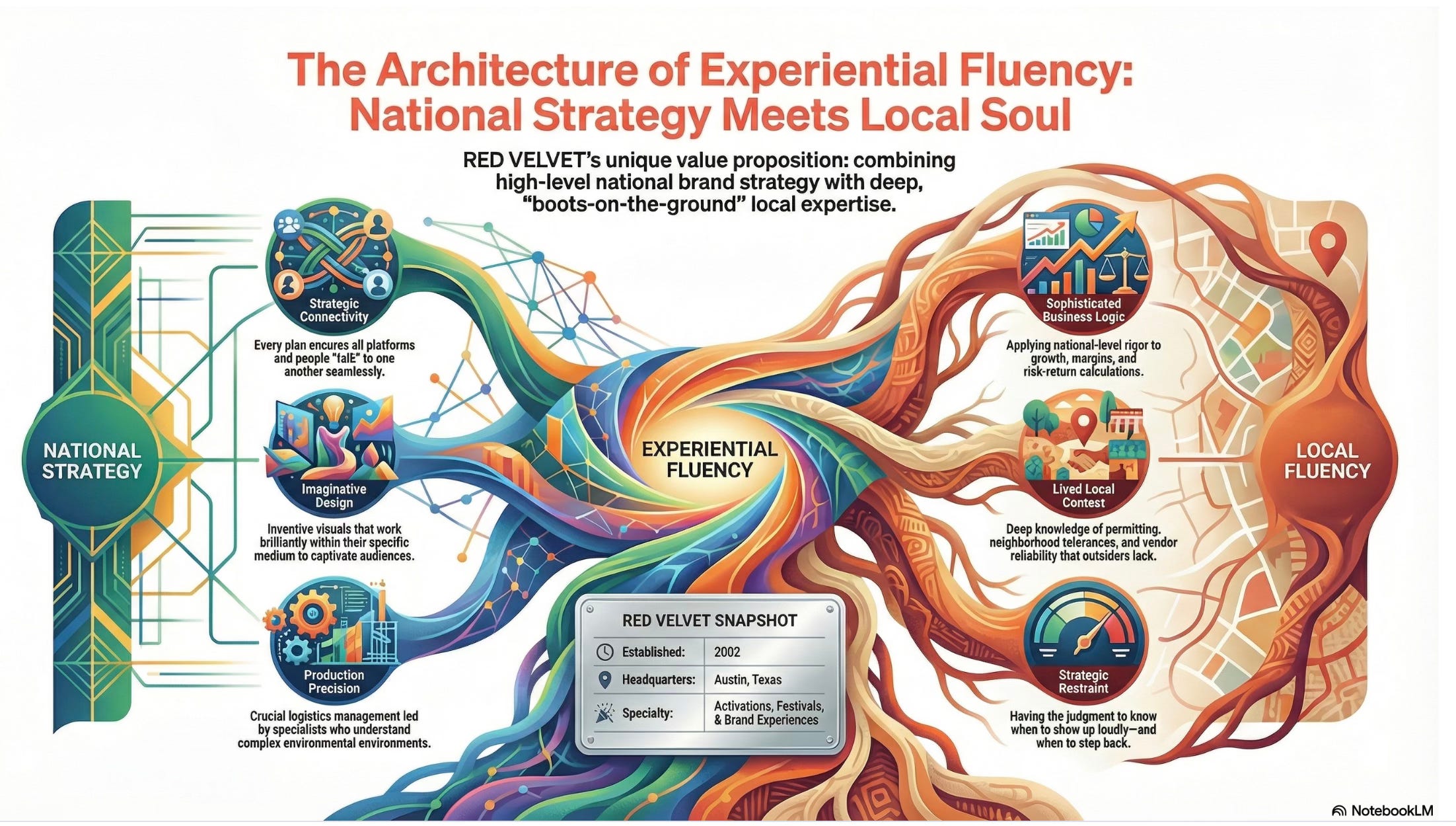
She speaks the same business language as national agencies—growth, margin, risk, return—but adds something they cannot replicate from a distance: lived context, the accumulated knowledge of which parking lots quietly quintuple their rates, which neighborhoods tolerate noise, which ideas won’t survive permitting, which vendors deliver under pressure, and which “great ideas” fail simply because they were designed somewhere else.
Local, in this sense, is not smaller. It is sharper.
For years, experiential work rewarded scale over fluency, with national teams flying in, decks growing shinier, and local context treated as an afterthought, but that era is ending, because Austin is not an interchangeable stage, and Cindy knows where its limits are, when to tell a client not to do something, and how to do so in a way that ensures she’s still invited back.
This is the new authority in experiential work, rooted not in spectacle but in accuracy, not everywhere but here.
Cindy believes the next wave will be less about flash and more about proof, about knowing that something actually happened, that what you experienced was not manufactured on a screen or using AI, and when younger team members tell her they want their phones taken away, told when to turn them off, relieved of the obligation to perform themselves in real time, she understands exactly what they mean.
The pendulum is swinging back toward presence.
At the end of the conversation, when asked what theme she would choose if she were designing prom today, Cindy doesn’t say futuristic or immersive, but imagines something closer to the Rat Pack, with rolled-up sleeves, jeans and Converse dressed up just enough, phones locked away for an hour, the room allowed to be the room, the night permitted to be real.
She never stopped being the girl on the prom committee, still scanning the room, still doing the math, still making sure the staircase holds, still asking whether the idea will survive the night.