
What the Miami Boat Show Is Really Selling
Not Just Yachts — A Billion-Dollar Marketplace and the Future of Event Power
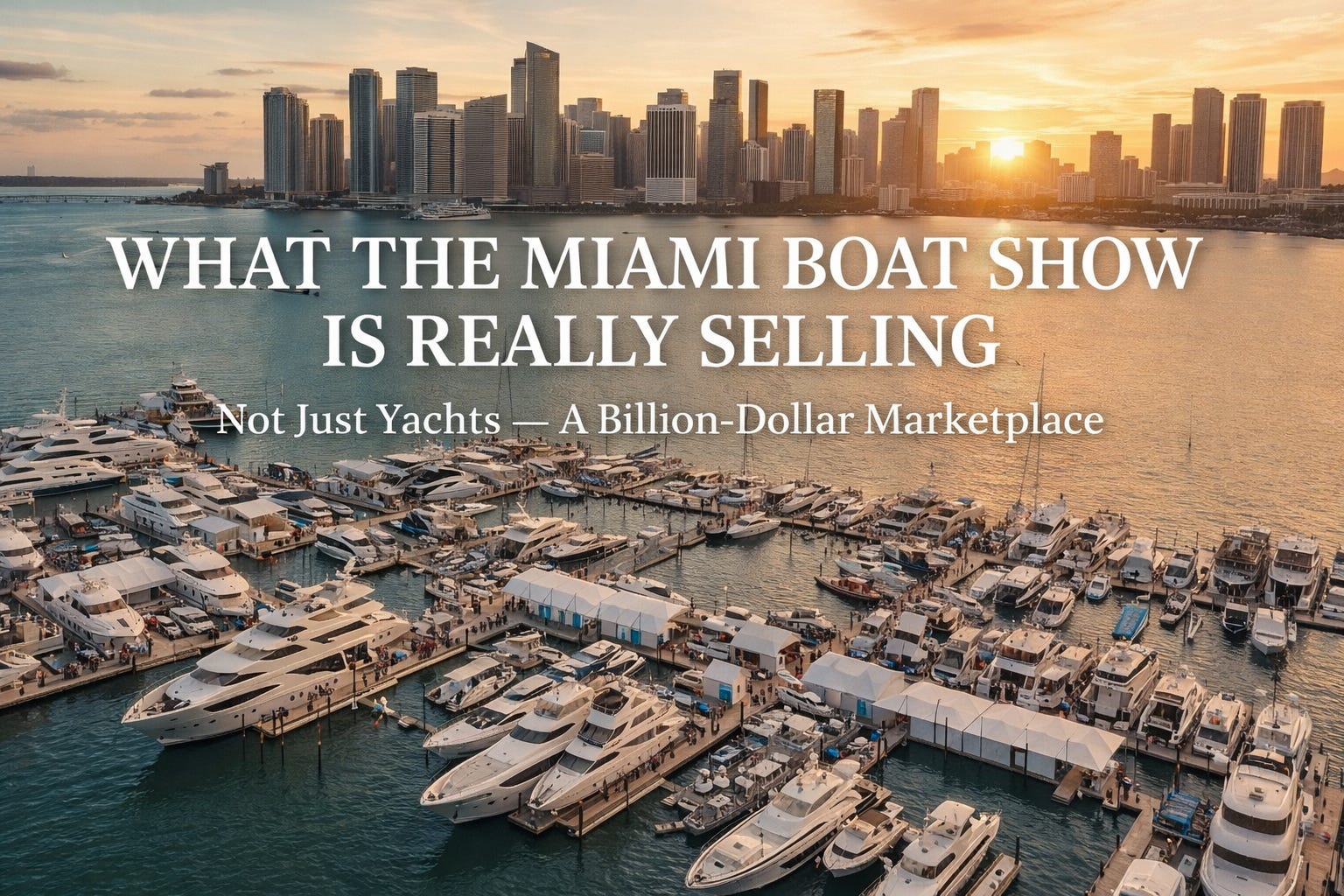
The first thing you notice at the Miami International Boat Show is not the size of the yachts but the assurance with which the entire enterprise unfolds. Across the broad, sun-struck expanse of Biscayne Bay, a temporary marine city assembles itself each February, floating docks joined with quiet engineering confidence, gangways aligned as though drafted in a naval architect’s ledger, tenders slipping between vessels like discreet ferries shuttling negotiators between floating embassies. Hulls reflect the light in orderly procession, masts sketch geometry against the skyline, and for a handful of days Miami seems to extend its shoreline outward, converting open water into disciplined commercial intent.
From a distance, the scene carries the sheen of indulgence, but proximity reveals something far more structural: an industrial system disguised as lifestyle spectacle.
Publicly cited economic impact studies have placed the show’s regional effect somewhere between the high hundreds of millions and north of a billion dollars annually, depending on the methodology and the year in question, yet the precise decimal is less instructive than the pattern. Tens of thousands of attendees circulate between the Miami Beach Convention Center and the waterfront marinas, while nearly a thousand exhibitors — boat builders, marine electronics firms, engine manufacturers, brokerage houses, insurers, finance teams, luxury partners — construct what amounts to a floating capital of the global marine industry.
The numbers are formidable, but the true mechanics of the show unfold beneath them.
A serious attendee — whether broker, supplier, executive, or buyer — can easily inject several thousand dollars into the local economy over three days once hotel rooms cresting four hundred dollars a night, client dinners that edge into four figures, flights, drivers, hospitality suites, and the choreography of business networking are accounted for. Multiplied across forty or fifty thousand visitors, the hospitality flow alone approaches nine figures before a single yacht changes hands, a velocity that many municipalities would treat as an economic windfall in its own right.
Exhibitors operate on a still larger scale. Transporting a vessel retailing for fifteen or twenty million dollars is not merely a matter of scheduling freight but of orchestrating cranes, marine logistics, dock engineering, insurance riders expanded to cover assets worth more than commercial towers, shore power systems, crew accommodations, and layered security protocols that balance access with discretion. A serious exhibitor’s local spend routinely climbs into the hundreds of thousands long before the first prospective buyer steps aboard, and when several hundred of those operations unfold simultaneously, the marina begins to resemble a compressed supply chain rather than a festival
.The glamour, unmistakably, rests on blue-collar muscle.
Long before the first handshake seals a negotiation, dock builders, marine electricians, riggers, customs brokers, transportation coordinators, security supervisors, and hospitality crews have spent weeks constructing what amounts to a temporary industrial district. Floating platforms are anchored with structural discipline; power grids hum with municipal reliability; foreign-flagged vessels clear regulatory checkpoints with a speed that would impress any port authority. For five concentrated days, a workforce rivaling that of a small town sustains a floating economy whose margins depend on precision rather than theatrics.
When the apex transaction finally occurs — a yacht retailing for twenty-five million dollars changing hands — it signals not a momentary indulgence but the activation of an operating ecosystem whose annual budget may exceed two or three million dollars once crew salaries, marina fees, fuel, insurance, refits, and management contracts are factored in. That single sale reverberates outward through shipyards in Europe, provisioning firms in South Florida, captains and crew housing in Fort Lauderdale, insurance carriers in London, and refit facilities that will service the vessel for years. Multiplied across dozens of serious negotiations unfolding quietly throughout the week, the oft-cited billion-dollar impact figure begins to feel less promotional than structural.
For the operator, the week generates margin; for the city, it produces velocity; for the industry, it reinforces momentum.
Placed within Miami’s broader civic theater, the show’s scale becomes even more legible. In December, Art Basel Miami Beach transforms the city into a global gallery, with publicly cited economic impact figures often landing in the half-billion-dollar range, its currency measured in cultural capital and international prestige. In May, the Miami Grand Prix broadcasts speed and spectacle to a global audience. Art, water, velocity — three industries, three emotional registers, each reshaping Miami in its own way. Where Basel compresses aesthetic influence and F1 compresses broadcast attention, the Boat Show compresses supply chains, anchoring Miami’s identity not merely as a destination but as a marine capital.
The architecture of the marine calendar underscores the point. Eight months after Miami dismantles its floating city, thirty miles north the Fort Lauderdale International Boat Show convenes the same industry in a different register, one defined less by launch energy and more by brokerage gravity, crew networks, shipyards, and refit facilities. What once appeared to be rivalry has matured into structural alignment. In 2017, Informa Markets acquired the company behind the Fort Lauderdale show and, through that transaction, the Miami Yacht Show, while the long-standing Miami International Boat Show — historically owned by the National Marine Manufacturers Association under the Discover Boating banner — entered into partnership rather than surrendering ownership. The association retained stewardship and industry trust; the global operator supplied capital, operational discipline, and portfolio scale. The result was not annihilation but bracketing: February ignites aspiration and product launches in Miami; October consolidates brokerage and institutional follow-through in Fort Lauderdale.
This is not horizontal domination in the software sense, and it was never meant to be. As Marco Giberti has argued, events function as ecosystems rather than platforms, compounding trust through ritual and repetition rather than scaling through abstraction. When an operator aligns itself with gatherings of this magnitude, it inherits sponsor memory, exhibitor loyalty, municipal cooperation, and decades of accumulated credibility. In a vertical industry such as marine, repetition is not redundancy but compounding, and stability at the top of the canopy allows specialization to thrive beneath it — sustainability forums, crew recruitment platforms, marine technology showcases, advisory gatherings timed to buyer presence.
All of this unfolds in a city that is itself in motion. Miami’s recent surge in capital inflows, wealth migration, marina expansion, and global repositioning has redrawn its economic map, and the Boat Show benefits from that ascent even as it accelerates it. The renovated Miami Beach Convention Center, reimagined in a $600-million overhaul completed in 2018, ensures the city can host gatherings at this scale without ceding ground to competitors, while the waterfront remains the irreplaceable stage.
As cranes lower the final vessels into water and the floating city begins its careful dismantling, the spectacle dissolves back into open bay, yet the calendar persists, anchoring a vertical ecosystem that understands precisely when and where its trust must gather. For its ability to compress industrial velocity, civic coordination, global capital, and seasonal ritual into one disciplined moment on Biscayne Bay, the Discover Boating Miami International Boat Show earns a Platinum Gathering designation from GatheringPoint.News. Where Cannes Lions commands cultural capital and Engage! exemplifies relational trust at luxury scale, Miami represents industrial ecosystem power — a gathering that shapes supply chains, stabilizes governance, and reinforces a city’s ascent without ever losing sight of the water that makes it possible.
Editor’s Note: The Platinum Gathering designation is reserved for events that demonstrate structural influence, economic gravity, and ecosystem stewardship at the highest level of the global convening industry. It is not awarded for spectacle alone, nor for attendance volume, nor for aesthetic flourish. It recognizes gatherings that shape markets, concentrate capital, activate labor ecosystems, and alter the civic and commercial landscape in which they operate.
The Discover Boating Miami International Boat Show earns this distinction for its ability to transform Miami into a functioning economic engine while anchoring a vertical marine ecosystem that compounds trust, timing, and industrial velocity across seasons and cities. It is not merely a large show. It is a structurally consequential one.
— David Adler
Curator in Chief, GatheringPoint.News


