
The New Era of Events Is Not So New
From private clubs to YPO to PTTOW, how gatherings have quietly become part of who we are
I remember hearing about PTTOW when it first started, about fifteen years ago, and not thinking much of it. It sounded like a slogan more than a structure, the kind of thing that might flare up for a year or two and then disappear, and it didn’t seem to belong in the same conversation as trade shows or association meetings or anything I had spent a career building. It didn’t fit into any category I recognized, and more importantly it didn’t seem to want to, so I let it pass.
What changed was not a launch or a headline but the way it kept resurfacing over time. I would run into people who had been, and the way they described it didn’t sound like the language of events. They didn’t talk about speakers or programming. They talked about who they met, what it felt like to be there, and why they kept going back. After a while, that repetition stopped feeling incidental because I had heard the same tone in other places, just never as clearly concentrated.
You begin to notice it in places that don’t look organized at all. A dog park will sort itself within minutes, with people arriving at roughly the same time, forming loose clusters, moving between conversations or lingering at the edges until they understand how to enter. Over time, the same faces return often enough that familiarity builds without introduction, and what appears informal begins to behave like a structure that doesn’t need to be named in order to function.
That behavior is older than anything we call an event. Long before conferences or clubs or networks, people gathered in circles because they had to, creating a shared field where everyone could see and hear each other. From that condition, patterns emerged that required no explanation. Some people spoke, some listened, some moved between groups, and newcomers learned the rhythm before they participated. Anthropologists have described this as cohesion formed through repeated proximity, and sociologists have shown how identity forms through group belonging rather than individual activity. Shared experience accelerates that process, especially when it involves some degree of uncertainty or vulnerability, because the relationship shifts before it is articulated.
The Hidden Layer That is Driving Effective Gatherings
A video that every event organizer understands but is hard to articulate
For most of the last century, that structure lived in buildings. The Union Club set an early model, but it was not open to everyone. In 1891, J. P. Morgan and his peers created the Metropolitan Club as a response, building a room that would operate on their terms and quickly became one of the most concentrated centers of financial and social power in New York. The Bohemian Club began as a gathering of writers and artists before evolving into something far more influential, while the Harmonie Club formed because Jewish elites were excluded elsewhere. Country clubs extended the same logic into leisure, creating environments where repetition produced familiarity and familiarity produced trust.
At a certain point, the room becomes important enough that people try to describe it. In Washington, directories like the Social Register and what insiders referred to as the Green Book mapped who belonged and how the system worked. In another context entirely, The Negro Motorist Green Book mapped where Black travelers could safely gather in a country that denied them access elsewhere. The stakes were different, but the underlying behavior was the same. When the room is not available, people do not abandon the need. They identify or build another one.
Before people could gather at scale, they had to know who else existed. Trade publications quietly built that layer, mapping industries in a way that made them legible. You could open a magazine and understand who mattered, what was emerging, and where you fit. By the time people entered the room, its outline already existed.
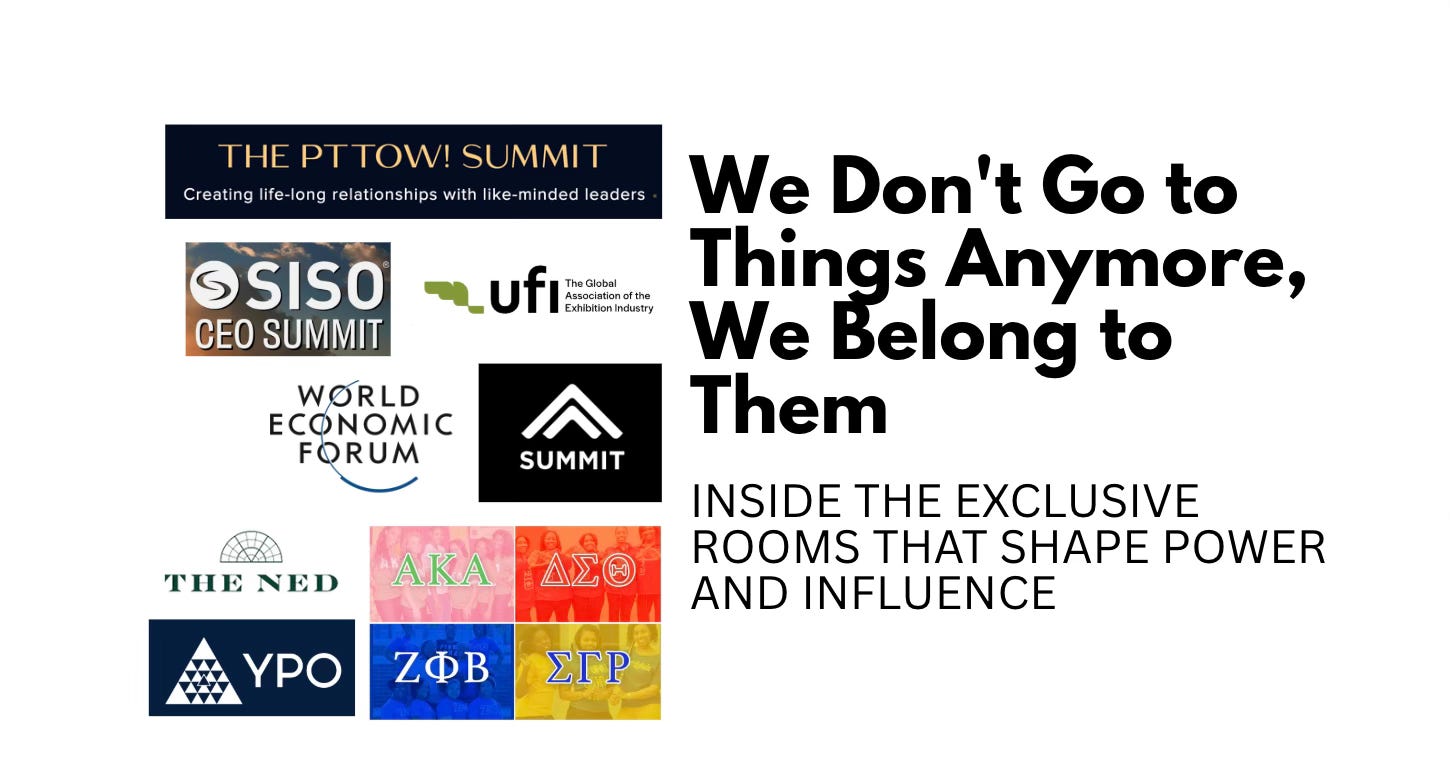
Inside the event industry, this structure has always been present, even if it has not been named directly. The visible layer is the trade show or conference, the measurable part. The real work happens in the layer beneath it, in the conversations that extend beyond the agenda and the relationships that carry forward. Organizations like the Society of Independent Show Organizers convene the operators who run markets, while the confex model acknowledges that the interaction between participants is the actual product.
Once you stop treating this as an event format, it appears across domains. In entrepreneurship, networks like Young Presidents’ Organization operate as long-term peer structures where leaders meet in small, confidential groups over years. In creative industries, environments like Soho House and The Ned create membership systems that move with their participants. On campuses, fraternities and societies extend influence long after graduation, while organizations like Alpha Phi Alpha and Delta Sigma Theta function as lifelong networks of identity, support, and leadership.
You hear the effect most clearly in how people talk about these rooms once they’ve spent enough time inside them. My brother Jonathan, now nearing seventy, refers to his YPO group as something constant, not because of any individual meeting but because the same people have been present across decades of decisions and change. Over time, that continuity becomes part of how he thinks, and it shows up in how he describes himself.
Terrence O’Dwyer’s path runs through both sides of this system. He co-founded LSX, the Life Science Executive Network, a platform that connects biotech executives, pharmaceutical companies, and investors through structured one-to-one meetings designed to facilitate deals, and ultimately sold it to Informa. Alongside that, he began bringing together media founders he had been meeting individually. What became the Media Entrepreneur Network, now operated by the advisory firm Collingwood, grew through repetition rather than design, with the same people returning often enough that the room began to hold.
When I spoke with Roman Tsunder, he described the same mechanism from a different angle. “I didn’t really know what industry I was in,” he said. His criticism was direct. “Most events just sucked.” What he built through PTTOW operates less like a conference and more like a membership system, with multiple touchpoints throughout the year designed so people return and recognize each other over time. He begins with shared experience rather than formal exchange, creating conditions where people meet before they present themselves.At a certain point, you begin to see that what feels natural is anything but accidental.
The room is composed with intent. Not in the obvious way of agendas or speaker lineups, but in the balance of who is present. The center of gravity is held by operators, the people who control budgets, partnerships, and decisions, the ones who can turn a conversation into something tangible without leaving the room. Around them move the connectors, individuals who carry relationships across industries and translate one world into another. Then come the cultural figures, whose presence extends the relevance of the room beyond business, giving it a kind of external voltage. And finally, there are the thinkers, the scientists and futurists who elevate the conversation just enough to make it feel consequential.
It is not a guest list. It is a system calibrated to produce interaction.
Once you recognize that balance, it becomes clear why these environments feel different. You are not just meeting people. You are stepping into a structure designed to accelerate recognition, trust, and, eventually, action.
There is a long tradition behind that instinct. The late Esther Coopersmith understood it in the way she introduced people at her table, shaping the room before it began. Dolley Madison understood it at a different scale, using gatherings to bring individuals into proximity under conditions that favored conversation. Without that layer, proximity does not turn into connection.
At the far end of this progression, Summit Series has explored what happens when everything outside the room is removed, placing participants together in immersive environments where interaction repeats in a compressed window of time. Attempts to extend that model into physical spaces suggest a broader ambition to stabilize the room itself.
What makes these rooms work so well also creates their tension. Over time, familiarity tightens, the same people return, and what once felt expansive can begin to feel efficient. From the inside, it still feels like clarity. From the outside, it can look like something else. The strongest versions of these gatherings work against that tendency, introducing new perspectives without breaking the continuity that gives the room its value.
After a while, you stop thinking about these things as events.
The label stops being useful.
What stays with you instead is the feeling of walking into a place where you don’t have to introduce yourself the long way, where people already have context, where the conversation doesn’t begin with explanation. Most gatherings still ask you to start over every time. These rooms don’t. They pick up where they left off, and over time that continuity does something subtle. It changes how you listen, how you decide, and what you carry with you when you leave.
You don’t notice it while you’re inside it.
You notice it later, somewhere else, when you realize you’re still in the room.


