


Professional conferences strive to create an atmosphere of energy and engagement, but recent shifts in social and psychological dynamics are changing how attendees actually feel. Today’s events don’t leave people with the same inspired buzz they once did. Instead, many attendees walk away feeling cautious, tense, or like they had to put on a performance. Maya Angelou famously noted that people remember how you made them feel more than what you said or did – and right now, a lot of events simply feel different. Organizers are noticing that the excitement and camaraderie that used to fill convention halls has been replaced by an undercurrent of unease.
The Thanksgiving Uncle vs. The Sanctimonious Attendee
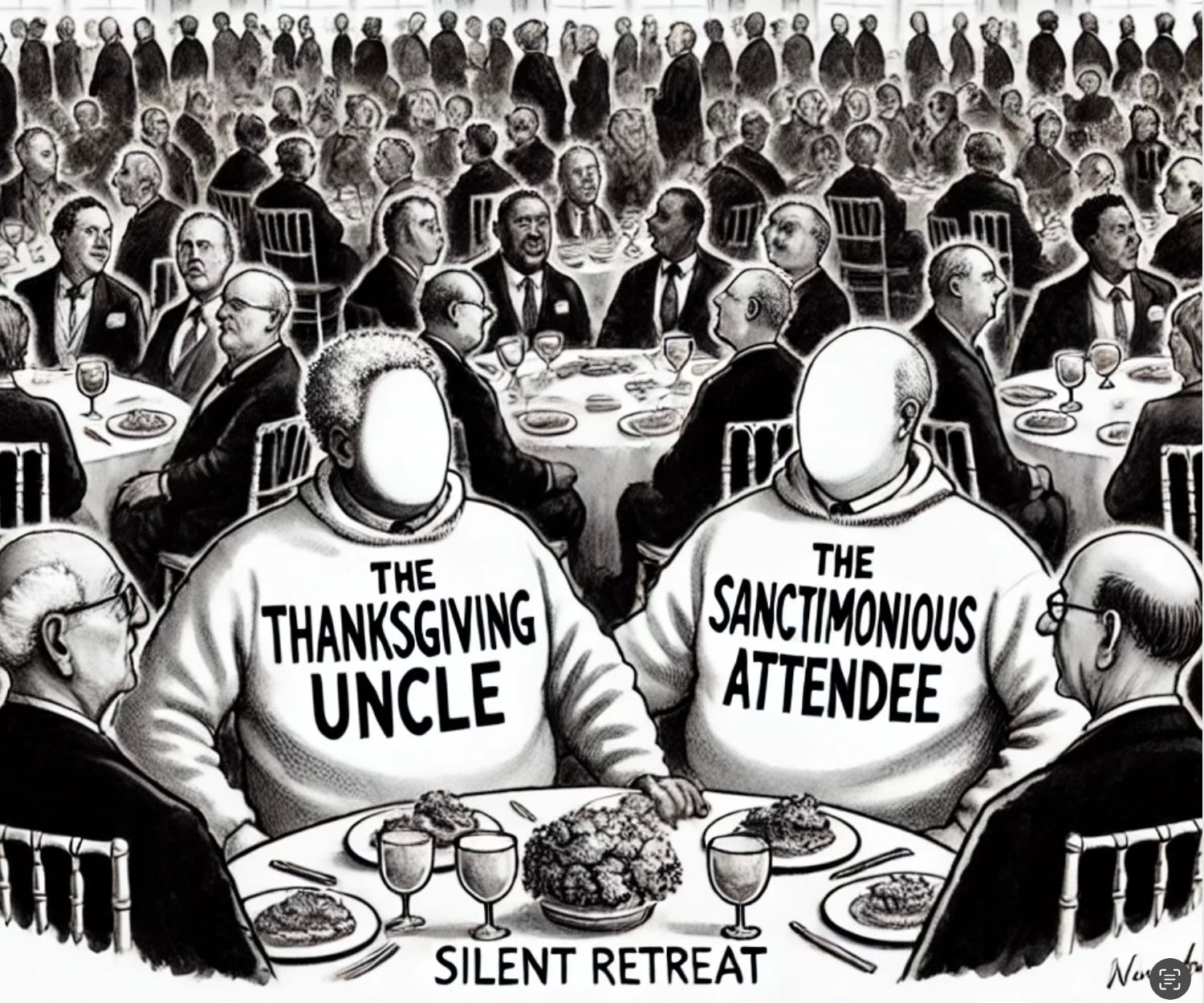
A speaker dominating the discussion, oblivious to dissenting views, exemplifies the “Thanksgiving Uncle” persona at events. One character now familiar at conferences is the Thanksgiving Uncle – the person who assumes everyone in the room agrees with their worldview. Much like that relative at a holiday dinner who launches into a one-sided rant, this attendee or speaker delivers monologues instead of inviting discussion. They speak at the audience, confident that their opinions are universal truths. Any attempt to interject or offer a different perspective is steamrolled by another anecdote or argument supporting their same point.
On the flip side is the Sanctimonious Attendee, who takes an opposite stance but has a similar chilling effect on conversation. This is the person who responds to ideas with an air of moral superiority – “I can’t believe anyone would think that way,” they might say, with a pointed glare. They may believe they’re championing what’s right, but the way they express it comes off as judgmental preaching. Instead of fostering dialogue, the Sanctimonious Attendee’s responses make others feel that any misstep will be pounced on and shamed.
Though they sit on opposite ends of the ideological spectrum, the Thanksgiving Uncle and the Sanctimonious Attendee end up doing the same damage. Both create an environment where others either nod along politely or simply shut down. In sessions and networking chats dominated by these two archetypes, genuine exchange grinds to a halt. People stop engaging – no one wants to ask a question or share their thoughts for fear of sparking a lecture or a moral rebuke.
The Silent Retreat at Events
Instead of lively debates, many conference sessions now face awkward silence as attendees withdraw from potential conflict. Increasingly, events are marked not by heated arguments or open disputes, but by a quiet withdrawal of participants. For example, during a panel Q&A, the room might fall silent even when the moderator asks for questions – everyone glances around, unsure if it’s “safe” to speak up. At networking mixers, conversations stay superficial; the moment a topic veers into disagreement territory, people either change the subject or simply drift away to refresh their drink. Even at VIP dinners where big ideas should flow freely, attendees often stick to polite small talk. A guest who might privately disagree with a speaker’s assertion will just smile and say nothing, rather than risk a public disagreement over the steak course.
The result is a kind of silent retreat in the middle of crowded events. It’s not that fiery debates are breaking out – it’s that meaningful debates aren’t happening at all. In past years, a controversial keynote might spark animated discussions in the hallways afterward. Now, it’s more likely to produce awkward side glances and hush conversations. The absence of any pushback or probing questions can feel as unsettling as an outright argument. Organizers need to realize the biggest problem isn’t open confrontation; it’s attendees disengaging entirely. When professionals come together but behave like strangers avoiding taboo topics, the whole point of an event – organic discussion, networking, learning – evaporates.
The Neuroscience of Smugness, Silence, and Anger
Why are people reacting this way? The answer lies partly in our brains. Humans respond to social conflict in much the same way we respond to physical danger: with a fight-or-flight instinct. When someone feels threatened by an opinion or afraid of social judgment, their brain’s alarm bells go off. Some people enter a “fight” mode – their body floods with adrenaline, and they double down on their viewpoint with rigid certainty. This is the smugness you see when a person becomes more performative and unyielding under pressure. Others take the “flight” route – they mentally and behaviorally check out. Neuroscience research confirms that those who perceive a greater social threat will often disengage entirely from the situation ([Brain's fight and flight responses to social threat | ScienceDaily](https://www.sciencedaily.com/releases/2017/06/170626131753.htm#:~:text=Summary%3A%20A%20new%20study%20explores,Share)). In a conference setting, that might mean tuning out of the discussion, avoiding the microphone, or even leaving the room to escape the tension.
Emotion plays a key role here, especially anger. While anger can energize a person to speak up, it does so at a cost: it makes them more confident, but not more thoughtful. Studies have found that angry individuals feel extremely certain of their position – sometimes more certain than people who are calm – even when their confidence is based on misinformation or misremembered facts ([A new study has found being angry increases your vulnerability to misinformation](https://www.psypost.org/a-new-study-has-found-being-angry-increases-your-vulnerability-to-misinformation/#:~:text=The%20researchers%20also%20found%20that,was%20associated%20with%20increased%20accuracy)). In one experiment, participants made angry were far more confident in the accuracy of their memories, even as their actual accuracy dropped ([A new study has found being angry increases your vulnerability to misinformation](https://www.psypost.org/a-new-study-has-found-being-angry-increases-your-vulnerability-to-misinformation/#:~:text=The%20researchers%20also%20found%20that,was%20associated%20with%20increased%20accuracy)). In the context of an event, if a discussion topic hits a nerve, a handful of angry voices might dominate with great conviction (even if they’re off-base), while everyone else either gets angry on the opposite side or opts to say nothing at all. This neuroscience of conflict explains the toxic loop of modern events: perceived social threat triggers fight-or-flight; fight leads to smug, performative monologues, flight leads to silence – and neither state is conducive to genuine dialogue.
The Unspoken Fear: When Events No Longer Feel “Safe
Beneath all these behaviors is an unspoken fear. Attendees today worry that events are not psychologically or even physically safe spaces to engage openly. Psychological safety – the confidence that you won’t be humiliated or ostracized for speaking up – is tenuous. Many professionals privately admit they’re afraid of saying something “wrong” in a workshop or asking an unpopular question on a public stage. In an era of social-media scrutiny, a single comment can be recorded, posted, and misunderstood by thousands not in the room. The fear of reputational damage or social backlash is very real. No one wants to become the Twitter (or LinkedIn) cautionary tale of the week because they voiced an opinion that others pounced on. So, people play it safe and keep their thoughts to themselves.
There are also undercurrents of concern about physical safety in contentious situations. While rare, we’ve seen instances of heated confrontations at public events. Organizers now quietly take precautions: security staff are on standby, bag checks at entrances are more common, and some topics come with trigger warnings or requests for decorum. Attendees likely won’t hear an organizer say, “We’re afraid conflict could erupt,” but behind the scenes many events have contingency plans for disruptions. Even diversity, equity, and inclusion (DEI) sessions – which aim to foster understanding – are handled delicately. Organizers remain committed to DEI goals, but they’re extremely careful in how those conversations are structured. They might hand-pick moderators known for neutrality, frame panel titles in less provocative ways, or circulate ground rules beforehand, all in an effort to avoid potential blowback from any side. The net effect is an environment that is cautiously choreographed to avoid backlash. Everyone is relieved when an event ends without incident – but that relief comes at the cost of frank, spontaneous exchange.
A Warning for Event Organizers
The trajectory of professional events is troubling, and it serves as a warning: the real risk now isn’t just an awkward atmosphere – it’s the collapse of the very reasons we hold events in the first place. Conferences, trade shows, and industry meetups exist to spark ideas, build connections, and challenge thinking. All of that is undermined if attendees are disengaging. An event where people don’t freely interact might as well have been an online video stream or a recorded lecture. Without organic conversations and the occasional tough question, networking dries up, learning stagnates, and innovation is stifled.
Who is responsible for fixing this? Everyone involved in an event – organizers, speakers, and attendees alike – has a role to play in making conferences feel open and constructive again. Organizers, however, are in a unique position to lead the charge by setting the tone and structure that can either make or break the environment. It’s time for proactive steps to course-correct and create spaces where genuine dialogue can thrive. Here are a few actionable measures event organizers can take now to start reversing the trend:
- Train speakers and moderators for productive dialogue: Invest in training keynote speakers, panelists, and session moderators on how to handle difficult conversations. They should learn techniques to invite audience participation (like explicitly asking for differing viewpoints), to gently interrupt and balance an overly dominant voice, and to defuse tension with empathy or humor. By setting expectations with speakers beforehand – “We want discussion, not just lectures” – organizers can prevent the Thanksgiving Uncle or Sanctimonious Attendee dynamics from taking over the stage.
- Design networking formats that prevent shutdowns: Rethink networking sessions and roundtables to encourage mixing and open conversation. For instance, use smaller break-out groups with a facilitator or topic cards that prompt constructive dialogue. Structured formats like “world café” discussions or Q&A platforms that allow anonymous questions can give more hesitant attendees a safe way to speak up. The key is to create situations where no single person can dominate and where participants feel invited to share their perspectives without fear.
- Foster a psychologically safe environment: Establish and communicate ground rules that make it clear the event is a forum for respectful exchange. This might include a brief opening statement about valuing diverse viewpoints and a zero-tolerance policy for personal attacks. Encourage speakers and attendees to approach disagreements with curiosity (“That’s an interesting point, can you elaborate?”) rather than hostility. Additionally, organizers can provide channels for feedback or questions (like event apps or drop-boxes for questions) that let quieter voices be heard. When people see that differing opinions are handled thoughtfully and not met with ridicule, it builds trust that the venue is psychologically safe.
- Address security concerns without stifling the atmosphere: Ensure there are measures in place to handle extreme situations – like trained security or clearly identified staff who can step in if discussions truly get out of hand – but keep these precautions low-key. Attendees shouldn’t feel like they’re at an airport checkpoint or under surveillance; they should simply have a subtle assurance that the event staff “has their back” if a conflict arises. For example, moderators can be coached on how to calmly pause a session and intervene if someone crosses a line. By quietly having protocols (for everything from escorting a disruptive person out, to mediating if needed), organizers can maintain an open and inviting atmosphere where people feel secure enough to speak, knowing there’s a safety net.
Ultimately, the goal is to reclaim the original spirit of conferences – those dynamic, invigorating experiences where ideas flow freely and you leave feeling inspired. To get there, event organizers must be vigilant and intentional in combating the creeping disengagement. This is not about silencing the Thanksgiving Uncles or shaming the Sanctimonious Attendees into submission; it’s about guiding them and everyone else toward healthier interactions. Speakers can be charismatic and inclusive. Attendees can be passionate without being combative. But it won’t happen by accident – it requires design and leadership.
Consider this article a wake-up call and a plea: if we don’t address the cautious, tense, performative mood pervading our professional events, we risk turning conferences into sterile, unremarkable gatherings that people attend out of obligation rather than enthusiasm. The good news is that by taking purposeful steps, we can change course. Event organizers, with support from speakers and attendees, can cultivate environments where disagreement doesn’t equal danger, and where feeling “safe” doesn’t mean staying silent. The next time we gather in a ballroom or convention center, let’s make sure it’s a place where everyone – from the boldest voice to the quietest attendee – feels they can genuinely engage. The future of our industry’s events depends on our ability to make people feel comfortable not only applauding in agreement, but also respectfully saying, “I see it differently – let’s talk.”