
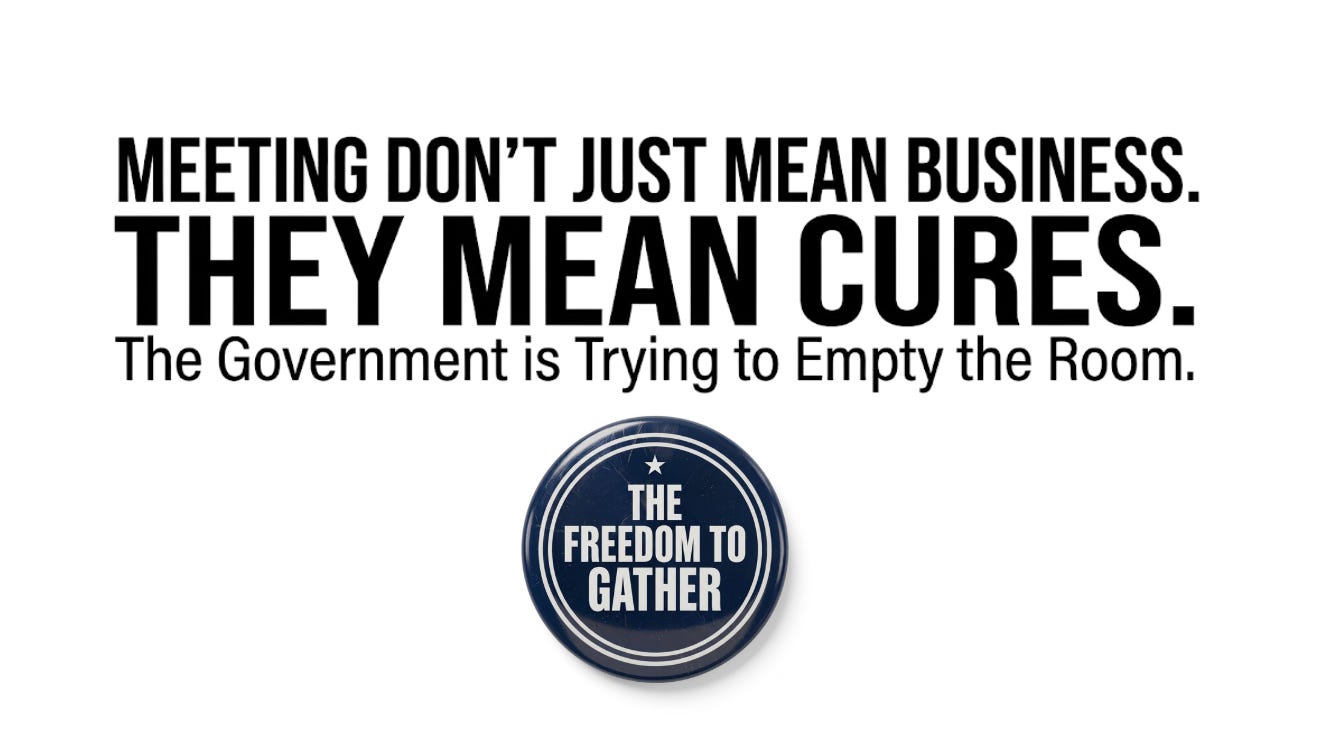
Warning: The Room Where Discovery Could Die- A Look at the Critical Role and Threat to Scientific and Medical Meetings Now
What happens when the funders and the scientists can no longer be in the same room.
EDITOR’S NOTE: The freedom to gather — to put scientists, researchers, and funders in the same room — is under direct federal threat. The comment deadline for OMB-2026-0034 is tonight at 11:59 p.m. Eastern. Go to regulations.gov/docket/OMB-2026-0034 and make your voice heard before midnight.
The same administration that launched a billion-dollar initiative to make America the world leader in AI-driven scientific discovery has proposed a regulation that would bar the scientists doing that science from attending the conferences where discovery happens. It calls the initiative the Genesis Mission. It calls the regulation a reform of federal grant management. One of them is true.
July 13 is when we find out which one the government believes.
The regulation is called OMB-2026-0034. Co-signed by 40 federal agencies simultaneously, including the Department of Energy that runs the Genesis Mission’s 17 national laboratories and the National Science Foundation that funds the basic research driving American science, it proposes to prohibit federal grant recipients from attending conferences unless attendance was written into the original terms of their award. Not amended in later. Not approved after an abstract is accepted. Written in at the beginning, before the researcher knows which conference they will present at, before the abstract has been submitted, before the science itself has produced the finding that warrants a presentation. As of July 11, two days before the comment deadline, 107,555 people had filed formal objections on the federal docket. The American Association for Cancer Research called the proposal reckless. The American Physical Society called it an existential threat to U.S. science. The American Astronomical Society led a coalition of more than 50 scientific societies in opposition. ASAE, the American Society of Association Executives, which represents more than 7,400 organizations whose members run the medical and scientific meetings most directly in the crosshairs, is reviewing the rule and plans to submit comments before the deadline. The Exhibitions and Conferences Alliance, led by President and CEO Tommy Goodwin, filed a nine-page formal opposition on June 17, calling on OMB Director Russell Vought to withdraw both provisions in full. Michelle Mason, President and CEO of ASAE, put it plainly: "The associations that ASAE serves in the scientific and medical community don't just run meetings. They run the rooms where the next treatment, the next collaboration, the next grant relationship begins. A regulation that bars federally funded scientists from those rooms is not a grant management reform. It is a disruption to the core mission of every scientific society in America."
Most of the events industry has not noticed. That is the first problem. The second is larger.
The comment period closes tonight at midnight. As of July 11, 107,555 (almost 300,000 from the document below) people had filed objections, most of them scientists, researchers, university administrators, and scientific societies. A biology professor at Ball State described the rule as making it nearly impossible to plan long-term experiments and sustain support for trainees. An AGU board member filed a comment that named the conference provision directly: “Scientific communication, whether through professional meetings or peer-reviewed publications, is the only way to share scientific findings. An individual working alone, with no route to sharing their work, does no good to society. Ideas thrive when they are shared, tested and amended, all of which happens through publications and presentations. Restricting this avenue damages our nation and leaves us unable to compete.” Senator Susan Collins, a Republican, asked OMB Director Vought to extend the comment period by 90 days. FASEB representing more than 100,000 researchers across the biological and biomedical sciences, filed formal comments. AGU President Brandon Jones wrote that the rule restructures the foundational rules of U.S. science funding to serve political priorities rather than the public good. A small minority of comments support the rule on waste and fraud grounds. The events industry’s voice in the record is almost entirely absent. The comment portal closes at 11:59 p.m. Eastern tonight at regulations.gov, docket OMB-2026-0034.
The proposed rule is not a standalone conference policy. It is one provision inside a sweeping 400-page ideological reorganization of federal grantmaking whose preamble explicitly frames it as a response to what it calls a “woke policy agenda” from 2021 to 2024. The conference attendance restriction travels with a second provision, Section 200.340, that proposes to give political appointees discretion to terminate active grants if the award is deemed “no longer in the Federal Government’s interest.” A researcher whose grant is terminated midstream cannot attend the conference where she was presenting the work that grant was funding, because that conference was not written into the original award terms. The two provisions are not separate. They work together. And they take effect October 1, 2026, binding every federal agency simultaneously, with the force of law.
Gail Mutnik and I went to college together. We were both active in student government, which is where you learn, if you learn it anywhere, that the agenda is not the meeting. The meeting is what happens between the agenda items, in the arguments that break out before the vote, at the table where someone says something they would never have said in the formal session. Gail learned this at twenty. She spent the next fifty years applying it to rooms full of scientists trying to solve diseases, which turns out to be the same skill at a different scale and with considerably higher stakes.
I called her recently because I had a feeling that the world she had spent her career inside was being threatened in ways the broader events industry had not yet noticed or named. I was right.
What the Rooms Are Actually For
Scientific meetings, of which medical meetings are the largest and most thoroughly documented category, are not conferences in the sense the broader events industry uses that word. They are not content delivery mechanisms. They are not networking opportunities with keynotes attached. They are gatherings of people who are each carrying pieces of problems that have not yet been solved, assembled in the same physical space under enough structured pressure that the pieces have a chance of finding each other. The output is not a takeaway or a badge scan or a lead. The output is, sometimes, a cure.
Gail understood this from the inside before she could have articulated it from the outside. Six months out of college, a woman at the American Society of Public Administration spotted something in her. “You’re really detail-oriented,” the woman said, “and you know the field. I have an opening in my meetings department. I’d like to train you. But you have to promise me two years.” Gail was twenty-two. She said yes. Her mentor sent her to school at ASAE, the American Society of Association Executives. She joined MPI, helped start the DC chapter, and learned the rest from the people around her because there was no formal education for this yet. No George Washington program. No George Mason program. No CMP credential. Her hotel salesperson taught her. Her general service contractor taught her. A mentor in Atlanta named Jeff Millen taught her an enormous amount. She calls herself a journeyman, and she means it as a precise description rather than a modest one. There is a small group of people in medical and scientific meetings who are genuinely innovative, she told me, who can take their meetings to a different level because their budgets and imagination allow it. Then there are people like her, who take what the innovators do, apply it within their constraints, and manage their meetings with enough discipline that the science inside them can do what it came to do.
What both groups share is a clear-eyed understanding of what a scientific meeting is for. “The real value,” Gail told me, “is not necessarily the dots on the board, the equation and the formula. The real value is talking to the researcher. How did you come up with this idea? What was the problem you were trying to solve? Now what? You’ve done this research, now what’s the next step?” She monitors virtual sessions for ASH, the American Society of Hematology, every December as a logistics facilitator, making sure slides are visible and AV is working. What she keeps seeing is something the platform cannot manufacture. “I can’t tell you how many times when the panel finished speaking, somebody will say to the panelist, ‘Okay, so now you’ve done this. What’s your next step? I have some ideas. Can we talk after the session?’ That doesn’t happen virtually. That only happens in the room.”
The science behind that observation is now substantial and specific. Researchers who share a physical building are 33 percent more likely to form new collaborations than those who do not. Put them on the same floor and that number rises to 57 percent. A study published in Nature in 2023 found that remote research teams, for all their access to global knowledge, are systematically less likely to produce breakthroughs, because breakthroughs require integration: two minds in the same space, reading each other’s faces, building on a thought before it disappears. Duke University researchers studying the human brain at the moment of discovery found that when insight strikes, the hippocampus fires, neural circuits reorganize, and the strength of the epiphany nearly doubles the likelihood that the person acts on what they suddenly understood. The machine can give a researcher every piece of the puzzle. It cannot give them the moment the pieces resolve into a picture. That moment is biological. It requires a prepared mind, an unexpected encounter, and something that surprises it.
Medical and scientific meetings are the machine that manufactures those surprises, at scale, on purpose.
The Landscape and Its Margins
ASCO, the American Society of Clinical Oncology, drew 45,300 participants in 2024, with 14,400 from outside the United States. RSNA, the Radiological Society of North America, is what Gail called the big behemoth of the device world, where the imaging machines take up so much exhibit hall space that the meeting can only realistically be held in Chicago or Orlando. “They could meet in Vegas,” she told me, “but Vegas doesn’t like that scientific and medical meetings are usually scheduled for the weekends and conflict with consumer demand.” ASH brings over 30,000 clinicians and researchers to its annual meeting in December, taking over all of downtown San Diego when it meets there, spilling into the ballpark. The American Heart Association draws nearly 13,000 professionals from more than 100 countries in person, with two million more participating virtually. These are not simply large events. They are, in the specific context of what proximity does to scientific knowledge, large experiments in what happens when you compress the right minds into the same space for four days and give them enough unstructured time to surprise each other.
What once made this landscape categorically different from the broader events industry was a strict church-and-state framework: science on one side, commerce on the other, an accreditation wall between them. CME credits, the continuing medical education that physicians, nurses, lab technicians, and researchers need to maintain their credentials, cannot be earned at a commercially tainted event. That wall has shaped everything about how medical and scientific meetings are designed and sold. The reception dinner Beckman Coulter hosted at the ADLM meeting was, in Gail’s telling, the get invitation of the conference year. If you got invited to the Beckman Coulter reception, you were somebody. The commercial side of the ecosystem honoring the scientific side, at a safe and regulated distance.
But the wall is becoming a door. Ken Holsinger, SVP Industry Research and Insight at Freeman and one of the most rigorous analysts of the scientific meeting market, says the data is now clear. CME claims have been dropping for several years but accelerated steeply post-pandemic when numerous alternative options became available. “It’s not affecting their attendance,” Holsinger says. “Their numbers are stable and for many, are up.” The implication is significant. Physicians and researchers are not coming for credits anymore. They are coming because the room is where the science moves. And Holsinger’s research shows that 83 percent of attendees across the meetings landscape, including scientific meetings, say they would prefer to get their learning from subject matter experts including industry sponsors, if there is transparency. The church-and-state model was built for a world where the primary reason to attend was CME accreditation. That world is gone. What replaced it is something more elemental and more powerful: people coming because they cannot get what they need anywhere else.
The financial architecture underneath all of it is what makes the current threat so dangerous. When Gail ran the meetings department at AACC, now rebranded as ADLM, the Association for Diagnostics and Laboratory Medicine, her meetings budget was 65 percent of the association’s entire operating budget and 100 percent of its profit. “I can’t tell you how many times the controller would come into my office and say, ‘If we don’t make budget, or we don’t exceed budget, I’m going to have to let people go.’” She is not describing a contribution to revenue. She is describing the engine that keeps the association alive, which means the engine that keeps the scientific community the association serves in business. A 10 percent attendance drop is not a rounding error at those margins. It is an existential event. This dependence on the revenue from annual scientific meetings is not unusual.
The federal government constituency inside these meetings is not the majority. Gail estimated it at 10 to 12 percent, depending on the association. But she named its specific function. “If you want a grant from the government, which many people need to do their research, if the NIH people aren’t at the meeting, you can’t get to know them. You can’t make your pitch. Even before you make your pitch on paper, even before you apply for the grant, if I know you, you might be looking more favorably on my application because you know who I am.” The NIH program officer who attends the ASH meeting every December is not just an attendee. She is the connective tissue between the science being presented and the money that funds the next round of it. Remove her from the room and you do not lose 10 percent of attendance. You break the chain.
How the Unraveling Began
On January 22, 2025, employees at the National Institutes of Health were informed that all travel, foreign and domestic, had been suspended immediately and indefinitely. Researchers were told they would need official permission to attend conferences even if they covered their own expenses. The ban was communicated verbally, by managers, without written policy guidance. A senior NIH scientist described to Science magazine the group of early-career researchers who had been scheduled to present at a conference the following week, presentations now impossible. “I have never seen this level of confusion and concern in people that are extremely dedicated to their mission.”
The Biophysical Society held its annual meeting in February 2025. Twenty-nine speakers canceled. Sessions designed to help researchers navigate grant applications from NSF and NIH were dropped entirely because the NIH scientists who were supposed to run them could not come. The ban was formally reversed on April 10, 2025. The damage did not reverse with it. The approval requirement remained. The uncertainty remained. The institutional memory of what had happened shaped every travel decision made in the months that followed.
What the January ban did informally, OMB-2026-0034 would do in permanent federal regulation. The proposed rule is co-signed by 40 federal agencies, including the Department of Energy, which runs the 17 national laboratories at the center of the Genesis Mission, and the National Science Foundation, which funds the basic scientific research that drives the meetings the rule would restrict. It goes further than the travel ban did. The American Physical Society noted that under the proposed rule, professional society membership costs would also require prior written approval and would be banned entirely if the organization is deemed to engage in issue advocacy. Every major scientific society has advocacy arms. The New York Times, Scientific American, the New England Journal of Medicine, the Atlantic, the Financial Times, and STAT News have all reported on the rule in the past month. The broader events industry has produced almost nothing.
The Contradiction at the Heart of It
On November 24, 2025, President Trump signed an executive order launching what his administration called the Genesis Mission, describing it as this generation’s Manhattan Project. The stated goal was to double U.S. scientific productivity in ten years using artificial intelligence. The order directed the Department of Energy to unite 17 national laboratories, 40,000 scientists and engineers, and the nation’s most powerful supercomputers into a single integrated platform for AI-driven discovery. Google DeepMind signed a memorandum of understanding with DOE. NVIDIA partnered as a private-sector collaborator. $293 million in federal funding was announced in March 2026 to support what the administration called 26 national science and technology challenges. In May, the White House Chief Technology Officer told an audience at the Special Competitive Studies Project’s AI Expo that agentic AI, autonomous systems capable of executing tasks with minimal human oversight, would have a profound impact on scientific research.
The rhetoric of American scientific dominance has been consistent and loud. The problem is not the ambition. The problem is what the administration is doing simultaneously to the human infrastructure that gives AI something to work with.
AlphaFold is perhaps the most celebrated AI achievement in the life sciences of the past decade. It predicted the three-dimensional structure of two hundred million proteins, a task that would have taken human researchers centuries using conventional methods. The system is genuinely revolutionary. But AlphaFold was built by a team at DeepMind that spent years in dialogue with the structural biology community, presenting at conferences, absorbing feedback from researchers who had devoted careers to specific protein families, iterating on findings that emerged from the kind of cross-disciplinary collision that happens when the right scientists are in the same room. The AI did not produce the breakthrough in isolation. It produced it in partnership with a global scientific community that had been convening, arguing, and building on each other’s work for decades in exactly the kinds of meetings that OMB-2026-0034 would make structurally inaccessible to federally funded researchers. Remove the community and you do not get a faster version of discovery. You get a very powerful tool with no one left who knows how to ask it the right questions.
The neuroscience is specific here. When insight strikes the human brain, the hippocampus fires. Neural circuits reorganize. The stronger the epiphany, the deeper the memory, the greater the commitment to pursue what just crystallized. That moment cannot be programmed. It cannot be scheduled. It cannot be produced by a closed-loop AI experimentation platform or a national supercomputing cluster, regardless of how much compute is available. It requires a prepared mind encountering something unexpected. And the most reliable machine ever built for manufacturing those encounters is a well-designed scientific meeting where 30,000 researchers have been put in the same city for four days with enough unstructured time to collide with each other.
The Genesis Mission is betting that AI can accelerate scientific discovery. The science of human cognition says that bet only pays off if the scientists doing the discovering are still in the same rooms together, still presenting their findings to each other, still having the hallway argument that produces the idea neither of them would have had alone. The administration launched a billion-dollar initiative to speed up science and simultaneously proposed a regulation, co-signed by the very agency running that initiative, that would bar the scientists doing that science from attending the conferences where the human half of the acceleration happens. That is not a policy tension. It is a self-defeating contradiction written into federal regulation, with an October 1 implementation date.
The Regulation Nobody in Events Is Discussing
Section 200.432, as proposed, would replace a workable framework with what the ECA called an unworkable prior-approval requirement. The current rule already requires that conference attendance be necessary and reasonable for successful performance under a federal award. The new rule would require that attendance be expressly approved by the federal agency and written into the original award terms before any conference cost is allowable. A researcher may not know whether an abstract will be accepted until months or even years after the award terms are finalized. A project team may learn about a relevant technical convening after the award begins. Under the proposed rule, none of those circumstances would constitute a basis for allowable conference attendance unless the specific conference had been named at the time the grant was signed.
The equity consequence compounds the damage. Larger and better-funded institutions will still attend, drawing on unrestricted funds that do not touch the federal award. Smaller organizations, early-career researchers, rural institutions, minority-serving institutions, and community colleges will not. The AACR noted that the proposed changes may adversely affect patient accrual to cancer clinical trials, since patients may be less likely to enroll if ongoing support for trials is uncertain. A separate analysis published in Scientific American found the rule could kill 5,000 active clinical trials. Cancer research requires years of sustained investment. Permitting political appointees to discontinue a grant or clinical trial after it has already begun destabilizes research programs that patients are relying on for their survival.
The second provision, Section 200.219, reaches into venue management decisions involving access to facilities, security, crowd management, insurance, and fees, applying federal grant conditions to operational decisions that require local knowledge and professional judgment. Its political backstory is specific: OMB designed it to stop public universities from charging higher security fees for conservative speakers. Its practical scope is anything but specific. It would apply to any public entity receiving federal funds, covering events on their property regardless of whether those events are federally funded. A venue facing a potential grant-compliance complaint may hesitate before implementing safety measures that are genuinely warranted. Decisions requiring trained professionals who understand the specific facility and the specific event should not be made by federal grant administrators applying unclear national standards after the fact.
Together the two provisions represent something the broader events industry has not absorbed. This is not a medical and scientific meetings problem. It is a federal grant problem that affects every organization whose conference attendance is funded by a federal award in any field. University research programs. Workforce development meetings. Public health conferences. Engineering and technology societies. All of them send grant recipients to conferences. All of them face the same prior-approval requirement if Section 200.432 passes as written. October 1 is when it has the force of law.
Three Centuries of Rooms
The medical and scientific meeting as an institution is nearly three hundred years old. In 1731, a Scottish surgeon named Alexander Monro Primus gathered physicians in Edinburgh, not to lecture them but to argue with each other. He called it the Society for the Improvement of Medical Knowledge. They met regularly, presented cases, disputed findings, and published what they decided. It became the first peer-reviewed medical journal in Britain. From those rooms, across two generations of argument, came the students who built North American medical education, the men who proved the germ theory of infection, the physicians who identified diseases that now carry their names. The form of the meeting has changed almost beyond recognition. The underlying logic has not moved.
The most analog technology in all of scientific meetings is the poster session, and it is also where the most important science happens. At ASH in December, researchers physically carry their posters from around the world. Holsinger describes watching them board planes carrying what looks like a fishing pole tube, protecting it like state secrets, because it is their life’s work on a board. He tells the story of a young researcher from Kenya, coming to San Diego to present her sickle cell research, nearly in tears when the airline tried to check her poster because there was no room in coach. He brought it to first class with him and connected with her on the show floor. At that same meeting last year, researchers found what may be a pathway to the cure for sickle cell disease. It did not happen in a session room. It happened in the hall.
The ASH poster hall at peak hours has logged thousands of people simultaneously. Numerous large meetings turn down millions of dollars in exhibitor floor revenue every year to protect the space the poster hall requires, because their leadership understands that the poster hall is not ancillary to the meeting. It is the meeting. Several groups have built digital poster platforms to test whether the format could move online. But they can only handle roughly a hundred posters before they become unnavigable. ASH runs numerous rotations of physical posters across four days. The math tells you everything. Some things do not scale digitally because their value is in the physical density, the serendipity of two researchers stopping at adjacent boards and discovering that their separate work is one problem. “Everything you describe about the magic of serendipity,” Holsinger told me, “that’s where it happens.”
The researcher who cannot attend because her grant does not include this conference in the original award terms will not find that collision in an app.
What Gail has understood, across five decades of building those rooms, is that the science is only half of what happens inside them. The other half is the social architecture of discovery. The poster session that puts two researchers in front of the same board. The exhibit floor dinner that introduces a lab director to the diagnostics company that has the tool she has been searching for. The gap between sessions where someone says “wait, what did you just say?” and the conversation that follows changes the direction of a research program. “You can’t replace looking somebody in the eye and saying, ‘I challenge your assumption, and here’s why I challenge your assumption,’” she told me. “Or, ‘I agree with your assumption, but did you think about blank?’ That doesn’t happen virtually. That only happens in the room.”
The attendees who come to these meetings are not there for goosebumps in the sense the broader events world uses that word. They are not there for CME credits anymore either. Mostly they come for what Gail described more precisely: to be seen and see, to present their science if they want to be taken seriously, to show they are serious about their work if they are young and want to rise. They are unforgiving of anything that gets between them and that purpose. “If you do something as an organizer that is ridiculous, if you have a balloon arch in the exhibit hall,” she said, the image visibly impatient in the telling, “they look at you and they’re like, ‘What the hell was that? Don’t impede my progress into the hall by making me walk through a balloon arch.’ Where in other meetings, that kind of frills is accepted and expected.” They are dealing with life and death. The urgency in those rooms is not metaphorical, and it does not tolerate decoration.
The Industry That Forgot Where It Came From
PCMA, the Professional Convention Management Association, was originally founded in significant part to serve the medical and scientific meeting community. It drifted. A group of scientific and medical meeting professionals, several of them past PCMA presidents, eventually went to the CEO and said there was nothing at PCMA for the scientific meeting planner at any level, and that the organization could not continue to ignore a category it had been built to serve. They were given a one-day track that they had to staff themselves. “It was like, ‘Yeah, okay, fine, we’ll give it to you,’” Gail said, “because two of the people who went to him are past presidents of PCMA. So he couldn’t ignore it.” In his most recent quarterly report, the CEO wrote several paragraphs about needing to return to the organization’s scientific meeting roots. It took past presidents walking into the office to make him write those paragraphs.
ASAE, the organization where Gail received her first formal training and where she has spent her career, represents more than 7,400 organizations whose combined membership runs the full spectrum of medical and scientific meetings. Through its Power of A advocacy platform, ASAE has been tracking the rule and preparing to file formal comments before the July 13 deadline. What that filing says, and how forcefully it says it, will be one measure of whether the association management world has finally understood what is at stake in the rooms its members have been building for three centuries.
On the exhibition and events side, Tommy Goodwin, President and CEO of the Exhibitions and Conferences Alliance, has been the most visible industry voice in the formal regulatory process. The ECA, whose members include the organizers, exhibitors, suppliers, venues, and small businesses that build and operate the rooms where scientific meetings happen, filed nine pages of documented legal opposition to OMB Director Russell Vought on June 17. The letter was precise, specific, and unambiguous: withdraw both provisions in full. Goodwin’s organization represents an industry that employs 2.6 million Americans and drives more than $400 billion in domestic spending annually. That is the industry whose rooms are directly in the crosshairs, and it is the industry that has been most conspicuously absent from the broader public mobilization the scientific community has mounted.
The broader industry has been producing gatherings for decades without asking what the one category of meeting with a scientifically documented proof of value actually knows. The research is not obscure. It is published, peer-reviewed, and available to anyone who looks. Scientific meetings produce collaborations, grant applications, clinical trial partnerships, and treatments that would not exist otherwise. The hallway conversation is not a side effect of the conference. The poster session is not a relic waiting to be digitized. They are the mechanisms of discovery. Gail Mutnik has spent her career designing the conditions that make those conversations possible, managing the logistics that support the science, putting the right 21,000 people in the same building for five days, and staying out of the way when the collisions she designed begin to happen.
What Comes Next
“I don’t want to say we’re in a crisis today,” Gail told me near the end of our conversation. “But we’re certainly heading in that direction. And depending upon how much more HHS does or doesn’t allow, we could be in a crisis. Especially for a smaller association.” NIH cutting back on grants and travel. Hospitals closing. Research programs dependent on federal funding finding the funding gone, and unable to replace it with pharmaceutical money because the compliance rules prevent it. “If your shop only runs on federal grants,” she said, “there’s no reason for you to come if the feds can’t be there.”
What has happened in the 45 days since OMB published the proposed rule is, by the standards of federal rulemaking, extraordinary. The AACR mobilized 66,000 members with a formal call to action. The American Physical Society joined more than two dozen scientific organizations in calling the rule an existential threat. The American Astronomical Society(https://aas.org) led a coalition of more than 50 scientific societies in a letter to Congress. The New England Journal of Medicine published an opinion piece. STAT ran one from a researcher with 40 years in the field who described this as the worst threat to science he had ever seen. The Atlantic, the Financial Times, Nature, and the New York Times have all weighed in. Scientific American reported that an independent analysis found the rule could kill 5,000 active clinical trials. As of July 11, 107,555 public comments had been filed on the federal docket.
Under the Administrative Procedure Act, OMB is legally required to respond to every significant comment before finalizing the rule. A large volume of substantive, specific, individually written comments builds a record courts can review if the rule is challenged legally, forces OMB to defend each provision individually, and signals to Congress that the rule is contested enough to warrant a legislative response. The administration has indicated it intends to finalize the rule with an October 1 effective date. Legal challenges are expected regardless. The comment record determines how strong those challenges are.
The events industry’s voice in that record, as of this writing, is thin. Tommy Goodwin and the Exhibitions and Conferences Alliance filed their nine pages of opposition on June 17. ASAE is preparing to file through its Power of A advocacy platform before midnight tonight. Beyond those two organizations, the broader gathering world, the one that builds and operates the rooms where the science happens, is still largely watching from the outside.
That may be the most important data point in this story.
The Genesis Mission wants to double American scientific productivity in a decade using AI. That goal requires a scientific community that is still intact, still connected, still meeting in the same rooms, still having the collisions that give the AI something meaningful to accelerate. You cannot run a billion-dollar machine-driven discovery program if you have defunded and isolated the human scientists who feed it. The two policies cannot coexist. One of them will determine whether the other succeeds.
The rooms Alexander Monro Primus built in Edinburgh in 1731 survived two centuries of confident predictions that the meeting was no longer necessary. They survived because the people who understood what happened inside them refused to let the argument for their value go unmade.
Gail Mutnik and I both learned something about rooms in student government. What she learned was the same thing Monro Primus learned in 1731, and the same thing Ken Holsinger has spent a decade watching happen on the floors of the world’s largest scientific gatherings: the agenda is not the meeting. The meeting is what happens when the right people are in the room together, with enough time to find each other, and nothing in the way.
July 13 is the next moment when that argument needs to be made.
Take Action Through the ECA Advocacy Network
The Exhibitions and Conferences Alliance has made it simple to submit a formal comment before tonight’s midnight deadline. Visit the ECA Advocacy Network Action Center, select “Stop harmful OMB grant proposal,” enter your contact information, tailor the letter to your organization and role in the industry, and click Submit. That is all it takes. The comment period closes at 11:59 p.m. Eastern tonight.
Comments on OMB-2026-0034 can be submitted at regulations.gov, docket OMB-2026-0034, through July 13 at 11:59 p.m. ET. OMB named contacts for the rulemaking are Andrew Reisig and Joel Savary at MBX.OMB.Grants@OMB.eop.gov. GatheringPoint has requested comment.


