


LISTEN TO THE SONG WHILE READING- WE FIX THE ROOM
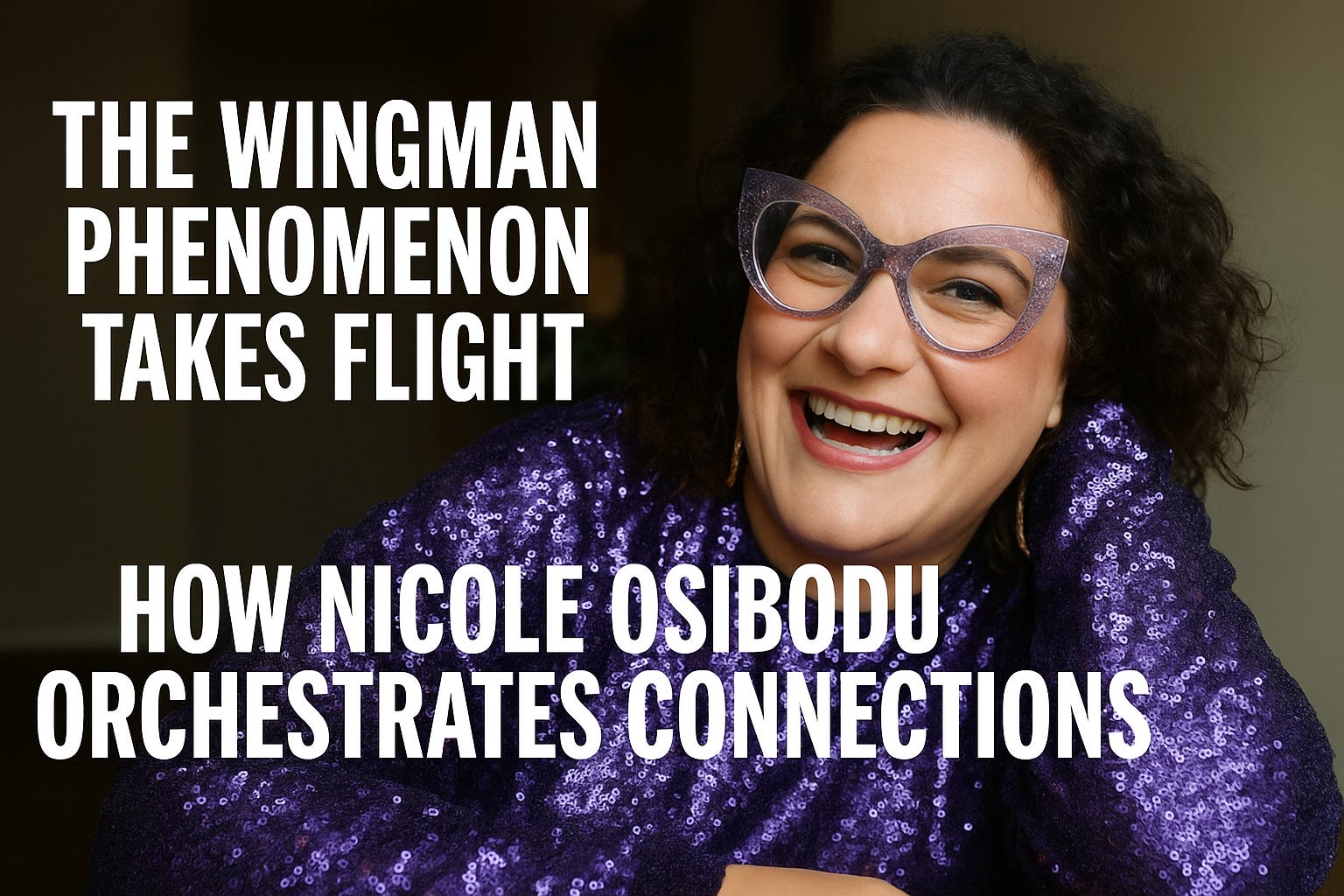
At a time when guests arrive at events more connected and more emotionally disconnected than ever before, Nicole walks into a room not to network, but to orchestrate. She scans the social weather like a storm chaser. She sees the frozen guests, the cliqued-up circles, the dead zones. And then she fixes it. Not with tech. With movement. With mischief. With mastery.
She’s not a speaker. She’s not even on the run of show. She is, instead, what the modern gathering desperately needs: the Wingwoman. A trained orchestrator of human chemistry. The one who sees the gaps, the scroll fatigue, the hovering-by-the-ficus panic—and fixes it in heels.
They used to teach you how to walk into a room.
Not just how to glide across parquet floors in kitten heels, but how to introduce yourself without stammering, how to leave a conversation without ghosting, how to wield a canapé like a calling card. Charm school wasn’t about charm—it was about power. And it was always women who carried that power in their posture, their invitation lists, their quietly sharpened instincts.
Emily Post knew this. So did Amy Vanderbilt.
And if you’ve ever studied protocol—real protocol, the kind practiced at the U.S. State Department—you understand that it isn’t just about formality. It’s behavior design. It’s how people are subtly guided to feel seen, safe, and aligned. From who walks in first to who exits last, from where to place a glass to when to open a conversation—protocol teaches us how to behave in public without being told.
What Nicole Osibodu is building echoes this tradition—not in title, but in effect. Her Wingman Protocol isn’t about hierarchy. It’s about hospitality as fluency. It’s the reintroduction of soft power into our rooms, but this time for everyone, not just heads of state. They didn’t invent manners—they codified them. In drawing rooms and dining salons, in the private clubs of Palm Beach and the boarding schools of Connecticut, they offered training in the choreography of civility. Where to stand. When to speak. What to do with your hands.
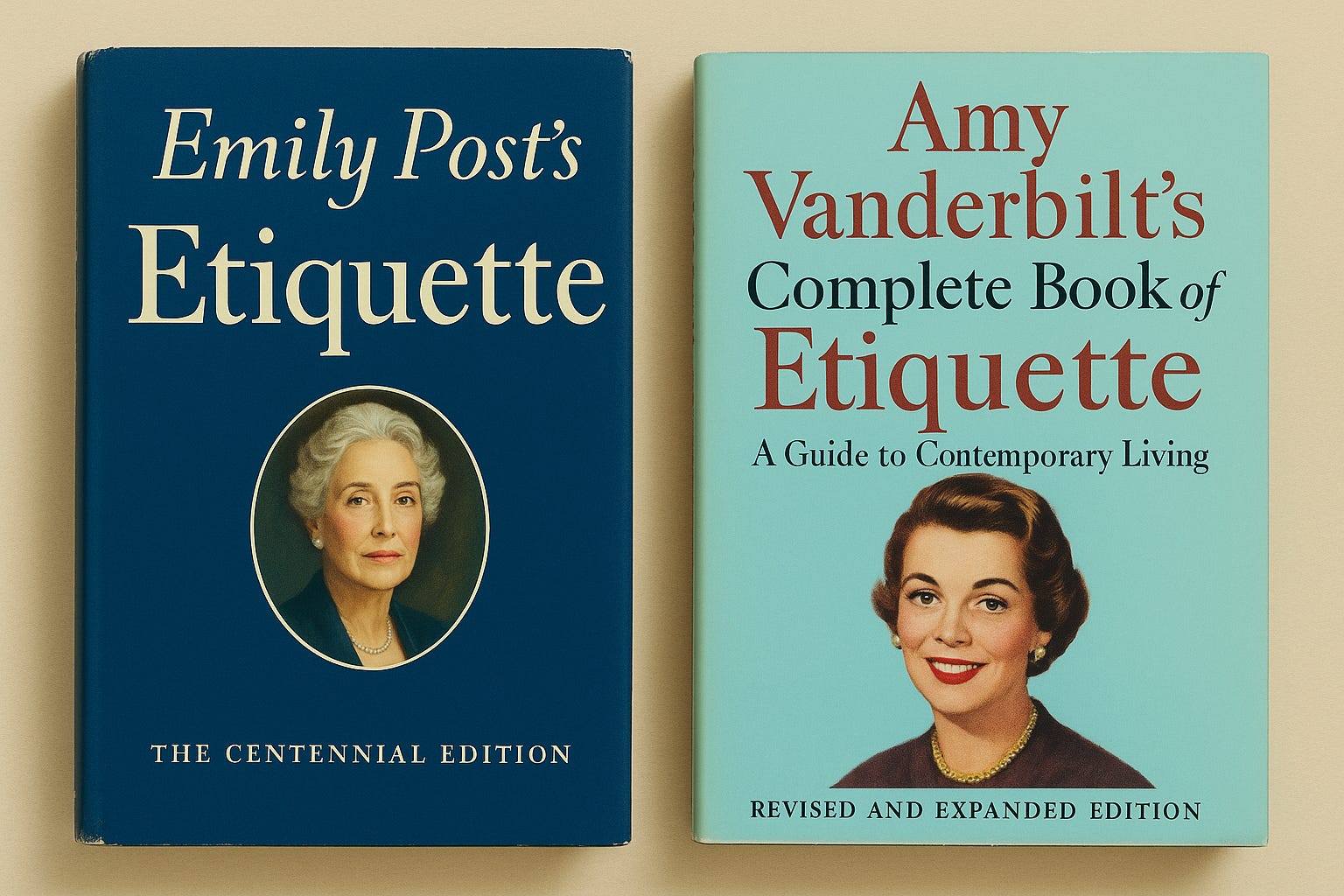
Emily Post, born into New York high society, wrote her seminal Etiquette in Society, in Business, in Politics, and at Homein 1922—not as a gatekeeper, but as a democratizer of social knowledge. Her golden rule? Make others feel at ease. Never point with a finger, avoid money talk at dinner, and if you’re unsure what to say—say something kind. She taught Americans that etiquette wasn’t about superiority. It was about sensitivity.
Amy Vanderbilt arrived three decades later, all efficiency and edge. Her Complete Book of Etiquette became the Eisenhower-era instruction manual for corporate courtesy. Never smoke while walking. Hostesses greet every guest personally. Conversation should remain light—never confessional. Vanderbilt didn’t just tell you how to behave—she told you how to ascend.
Their books weren’t about snobbery—they were manuals for belonging. They gave people a path into rooms that had long been closed. Their rules were rituals. Their tone was authoritative but democratic. Their influence? Immense.
Then, suddenly, we stopped.
Charm school didn’t die overnight. It faded—like the scent of talcum powder and gin—under the fluorescent lights of modern life.
First came feminism. As women rightly demanded power over polish, anything that resembled performative femininity—posture drills, thank-you notes, pouring tea without spilling—was cast off as regressive.
Then came class anxiety. Charm school had always flirted with elitism. It offered access, but only to those already close to the gates. As America tilted toward hoodies and casual Fridays, grace started to look like privilege.
Next came the cult of authenticity. The late 20th century prized rawness over refinement. Polish was suspect. Unscripted became a badge of honor. And charm school? Too curated. Too fake. And in America, nothing dies faster than what’s seen as fake.
Finally, technology rewired the rehearsal. Screens replaced sitting rooms. Digital life reduced face-to-face reps. We stopped learning how to talk, read a room, or recover from awkwardness. The social muscles atrophied. Etiquette didn’t just go out of style. It disappeared. Until we noticed what it took with it.
Because now… The dinner parties are back. The mixers are back. The summits, galas, trade shows, brand launches, think-ins, and tables-for-eight are all back.
And suddenly, the absence of that training feels seismic. People don’t know how to exit a conversation. How to read a room. How to hold space without holding court.
Charm school didn’t fail. It just wasn’t replaced.
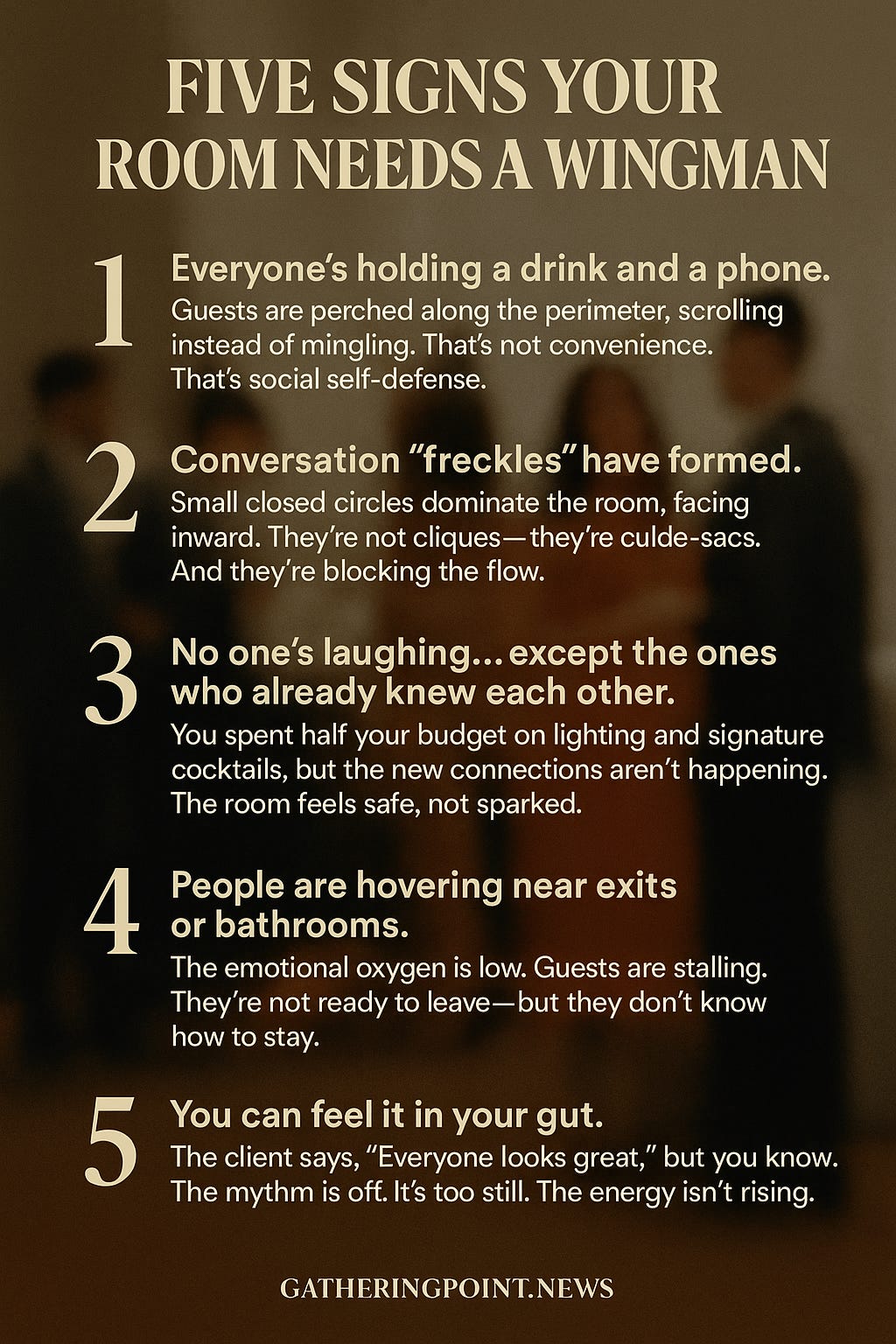
So when a young guest arrives at a networking event or an opening night reception, what unfolds isn’t a lack of interest. It’s a neurological stress response. Fight, flight, or scroll. That’s the new posture.
The bar becomes a shield. The phone becomes armor. The exit sign becomes a fantasy.
Nicole Osibodu has seen this happen too many times to count. “It’s not that people don’t want to connect,” she says. “It’s that they’re not equipped to. And we’ve given them no map, no host, no safety net.”
So she built one. It’s called the Wingman Protocol.
Nicole isn’t resurrecting charm school. She’s reimagining it. She’s replacing place settings with presence. Instead of posture lessons, she’s training emotional radar. Her solution is human: actual people trained to move through events like social paramedics—reading rooms, spotting isolation, and making introductions with surgical precision.
A Wingman doesn’t make speeches. A Wingman doesn’t work the mic. A Wingman makes the room work better.
They notice the person hovering by the wall. They rescue the guest stuck in a draining conversation. They widen the circle. They ask the right question. And they know when to leave. It’s not performance—it’s pattern recognition. It’s social fluency, turned into a role.
So what does that actually look like? Nicole teaches her Wingmen to fix the silent problems no one wants to talk about. The ones you don’t see on the run-of-show. She trains them to sense disconnection, not just observe it—and to intervene with subtlety, not spectacle.
Picture this: A cocktail hour. Loud music. A bar forming the gravitational center of the room. You’ve got your early arrivers—junior staffers clinging to their drinks, nervously checking their phones. You've got executives breezing in late, flanked by handlers or trailing assistants, never alone. Freckles of conversation form—tight circles facing inward, unconsciously closed to new people. And in between it all, people pretending to scroll, frozen in place, unsure how to begin.
Nicole’s Wingmen move through this like emotional EMTs. They notice who’s stuck. Who’s performing. Who’s pretending to be okay. Then they take action.
They break up freckled cliques and gently open space. They introduce newcomers with purpose: “Hey, this is Jamie—first time here. You two have to talk.” And then they vanish. They don’t hover. They don’t pitch. They don’t interrupt. They create momentum and exit before the spotlight hits.
They might delay letting in early arrivals to prevent awkward clustering. They pace arrivals so that energy syncs instead of jars. They coach guests in real time on how to enter a group without derailing it. They use small cues—a laugh, a tap, a shared compliment—to create social permission where it didn’t exist a second ago.
They also help people escape. The guest caught in a marathon monologue? The Wingman gives them a graceful out: “I promised myself I’d talk to three new people tonight.” Or they create a diversion: “Hey, I need your help over here with someone who just arrived.”
Even the hors d’oeuvres are weaponized with intent. Nicole trains hosts to design food that moves—literally. One bite, two chews. Tray-passed, not plated. Each nibble is a conversational spark, a chance to meet, shift, or laugh.
Nicole’s Wingman Protocol addresses the unsaid: people don’t know how to connect, and most rooms are built for logistics—not for courage. Her solution? Teach courage. Model presence. Design for warmth.
When a Wingman is present, the event’s emotional weather changes. The room feels warmer. Safer. Quicker to connect. A guest who might have hovered awkwardly in silence now finds themselves in conversation within the first three minutes. A once-frozen circle of executives now includes a first-time attendee laughing in sync. People stay longer, talk deeper, and follow up faster.
The Wingman doesn’t just move people around. They change how the room feels. And that, in turn, changes what the room does.

Club Ichi, the partnership-powered platform Nicole co-founded, now trains and deploys Wingmen at events where the guest experience has stakes—where connection isn’t fluff, it’s the point. From cocktail hours to closed-door summits, Wingmen are not emcees. They are infrastructure. They are the vibe’s invisible scaffolding.
And it’s working. In rooms where Wingmen operate, conversations happen faster. People stay longer. Guests self-report higher satisfaction, stronger follow-up, and even higher deal-flow. That’s not a nice-to-have. That’s ROI.
This isn’t a nostalgia act. It’s a cultural correction.
Because we didn’t just lose etiquette—we lost rehearsal. We lost rituals. And we lost the middlemen—the quiet, intuitive people who helped us belong before we even realized we needed to.
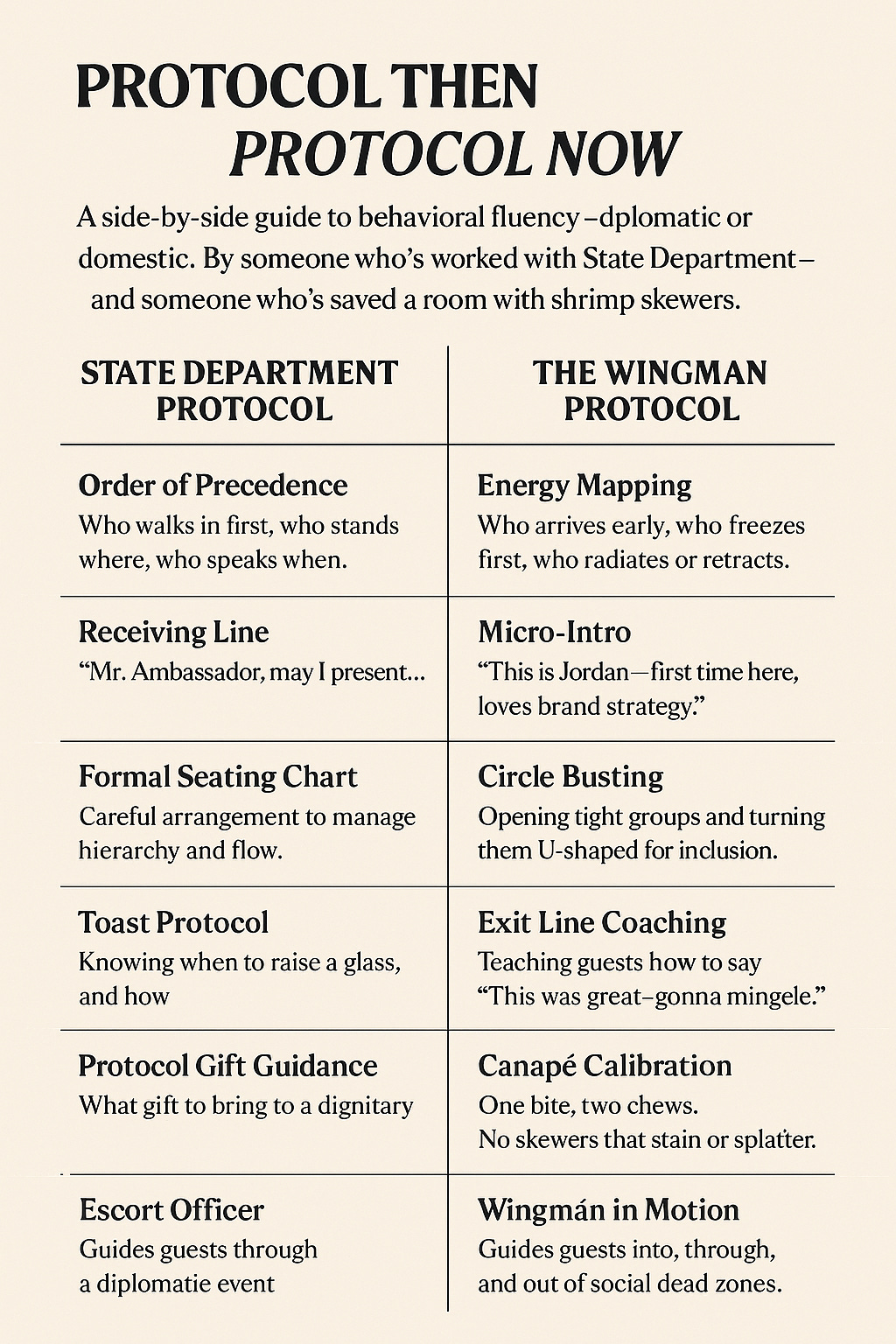
The Wingman Protocol isn’t a throwback. It’s a reengineered etiquette for the attention economy. And it’s giving event designers, planners, and hosts a tool they didn’t know they were missing: people who know how to make other people feel like they belong.
In the end, it was never about the gloves. It was about the grace.
And in a world still re-learning how to look each other in the eye, that grace may be the most valuable RSVP of all.