


Editor’s Note
I need to declare an interest before you read a word of this profile, and the interest is love. I have been producing and attending events at the Javits Center for a quarter of a century. I know its loading docks and its lousy old coffee and its river light in late afternoon, and I know what the building means to this industry in a way that no market study can capture, because I was there in November of 2001. Two months after the towers came down, when nobody knew whether anyone would ever again voluntarily walk into a large room full of strangers in New York City, we held a BizBash event at Javits. It became something none of us had planned: the first reunion of the events industry after the tragedy. People who staged galas and conventions and street festivals for a living, people whose entire profession is predicated on the belief that human beings are better off in the same room, came through those doors and found each other alive, and hugged, and cried, and then, because this is who we are, started planning again. I have never forgotten what that building held that day. A convention center is a warehouse for optimism, and Javits proved it when optimism was the scarcest commodity in America. That is why the question of who runs Javits has never been just a personnel matter. Those six blocks on the Hudson are the citadel of the American gathering economy, the place where New York’s multiplier effect turns a trade show into a world event, and the room where our industry goes to find out what it believes. So when the building named its first female chief executive, a woman who started her career answering a convention center switchboard, I wanted to do more than report the milestone. I wanted you to see her. That is what the Wisdom Bank is for. I should add one more disclosure: I have known Joyce Leveston since her Washington years, and I like her enormously. After you read this, you will understand why that is less a bias than a universal condition.
D.A.
Joyce’s Story: San Diego, early 1990s. The convention center has a new chief executive, and the staff has been gathered for a town hall to meet her. Somewhere in the crowd is a telephone operator that almost nobody in the room could name, a young woman from Cincinnati who has just been told, in the most withering terms, that she has no future here. The head of sales, a big-time hire out of New Orleans and Baltimore, had looked at her across his desk days earlier and asked why she thought she could possibly work for him. She had never been crushed like that before. So when the microphone opens for questions, she stands up with two job offers from hotels in her pocket and absolutely nothing to lose, and she addresses the new CEO of the San Diego Convention Center Corporation in front of everyone.
“Everything about you seems amazing,” she says. “But I wish you the best of luck here, because I don’t think these people are ready for you. They couldn’t even see me in sales. I answer all their phones. I know all their business. But they didn’t understand that I offer value.”
Then she sits down and waits to be fired.
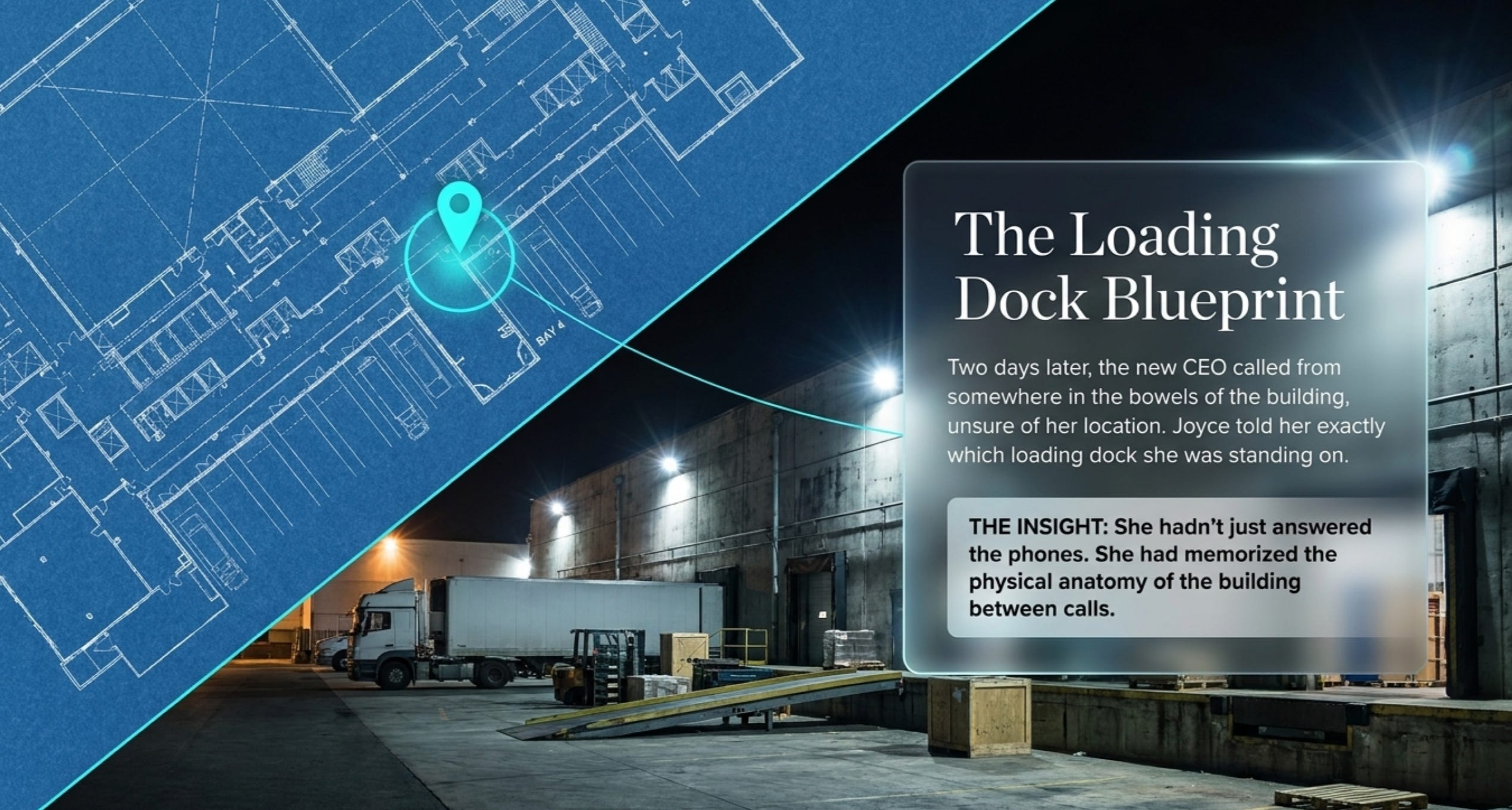
Two days later, the switchboard rings. The voice on the line says, “This is Carol Wallace.” The new CEO is calling from somewhere in the bowels of the building, a loading dock, and she isn’t sure which one. The telephone operator tells her exactly which dock she is standing on, and when Wallace asks how she could possibly know that, the answer comes back without hesitation: “I know every phone number in the building.”
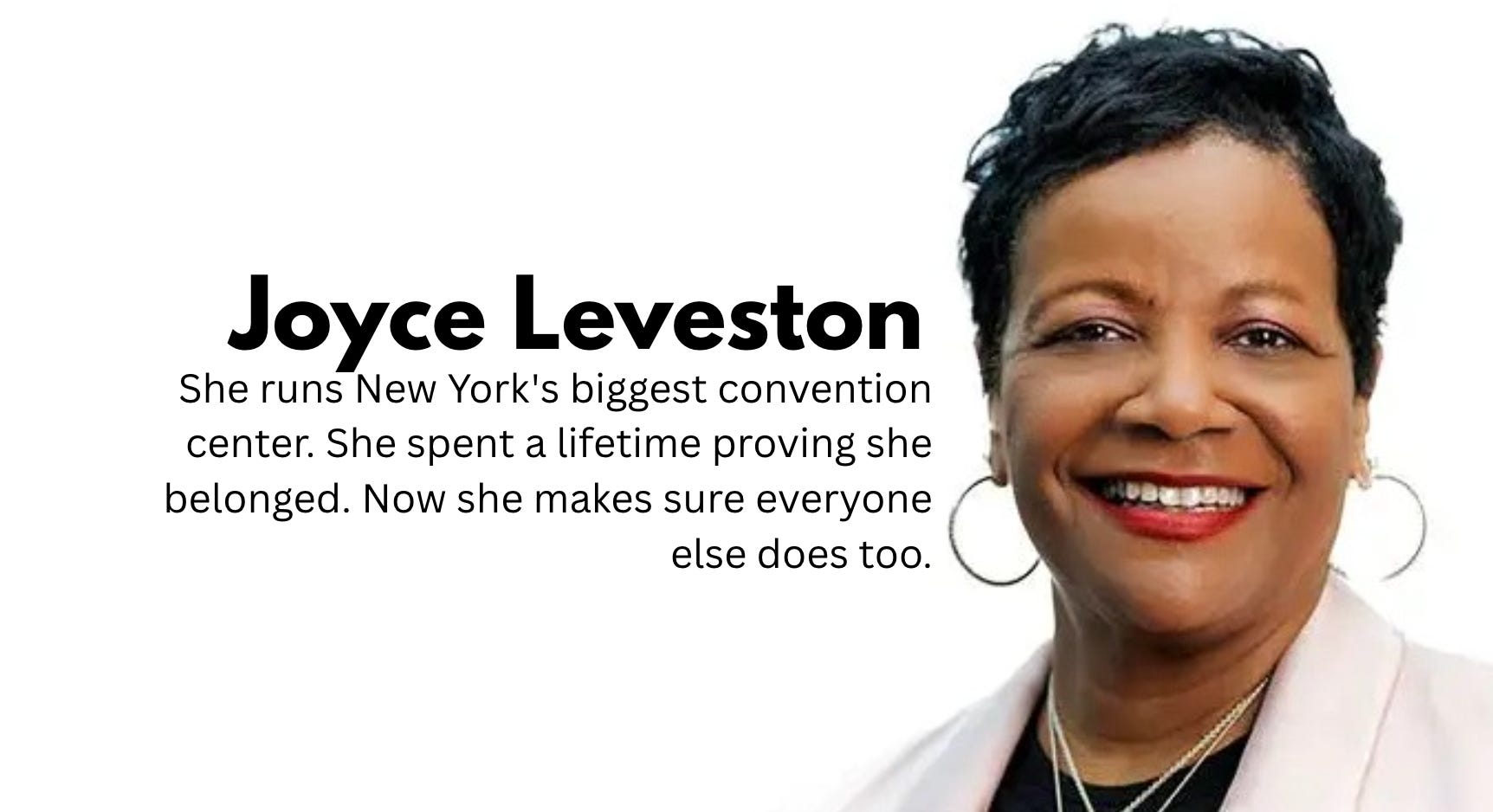
That sentence is the key to everything that happened next, and to most of what has happened in the American convention industry since. The operator’s name was Joyce Watson then. Today she is Joyce Leveston, president and CEO of the Jacob K. Javits Convention Center, the first woman to run the six-block colossus on Manhattan’s West Side, and the woman who now, in a very real sense, answers the phone for the entire gathering economy of New York. She got there the same way she knew the dock number. She has spent her whole life memorizing the building, whichever building it happened to be, and making sure that anyone who called got connected.
I have known Joyce since her Washington years, when she ran convention services at what everyone still called the DC Convention Center, and I can report what everyone who meets her reports. When she looks at you, you are briefly the only person in the world. Bill Clinton is said to have the same wiring. It is not a technique. Spend an hour with her, as I recently did over video, me at my desk and Joyce at hers above the Hudson, and you understand that the attention is the entire operating system, installed early and never once powered down. The woman can make you feel like the only person in the room through a laptop screen, which may be the most rigorous test of the gift ever devised.
The kitchen table
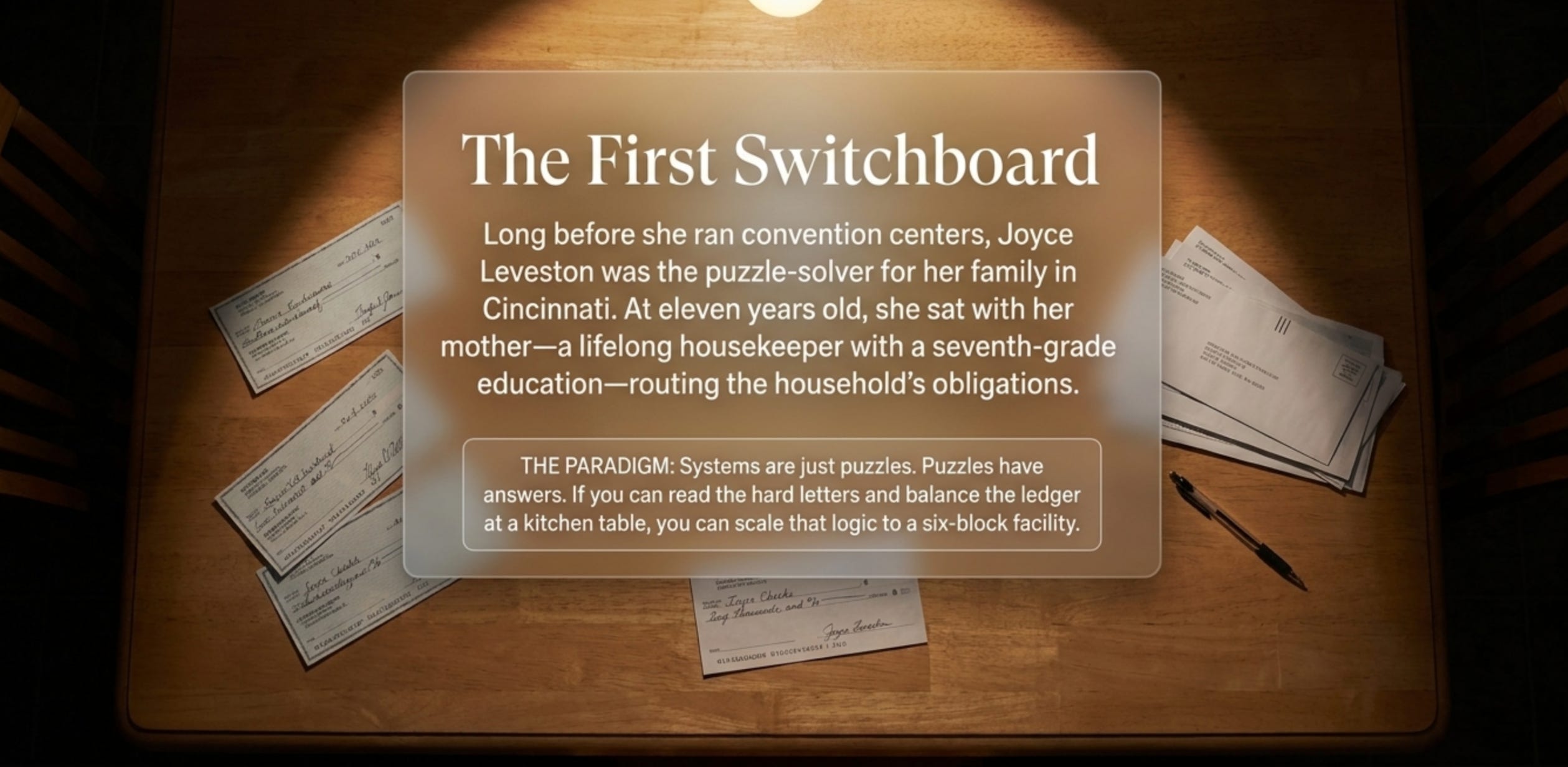
Start in Cincinnati, at a kitchen table in an apartment complex full of kids who all went to the same school. Joyce’s mother had a seventh-grade education and worked in housekeeping and janitorial her whole life. Money was a monthly puzzle, and the family’s designated puzzle-solver, from about the sixth grade on, was Joyce. Her mother would lay the bills out on the table and Joyce would write the checks, and together they would decide which bills got paid that month and which ones could wait. When anything official and confusing arrived in the mail, the call went out through the apartment: Joyce, come in here and read this. Tell me what it’s saying.
She was, in other words, the family switchboard before she was anyone else’s. A child who routes a household’s obligations at eleven grows up with a particular self-understanding, which is that systems are just puzzles and puzzles have answers, and it explains why, decades later, being told she had no value landed like a physical blow. It also explains the sash.
When Joyce ran for class president in junior high, her sister made her a beauty-pageant sash in the school colors, gold and burgundy, with MISS PRESIDENT across it, and Joyce papered every apartment door in the complex with flyers until, by her own admission, the neighbors were sick of her. She won. She was also a cheerleader, a base who flipped and threw and caught flyers, and captain, naturally. She ran track, played in the music program, ushered at church, and sang in a mass youth choir called FIC, the Fellowship Interdenominational Choir, 105 kids drawn from four or five congregations and directed by a University of Cincinnati doctoral student named Donald Lawrence, who would go on to become one of the most decorated writers in gospel music. The choir got so popular it toured the Midwest. To this day, when Joyce runs into someone from that world and says she knew Donald Lawrence before anybody knew Donald Lawrence, they don’t believe her until he lights up and asks, you were in FIC?
And there was the drill team, which was not a hobby. It was one of the top drill teams in the country, the kind whose yearbook photo required a foldout page, the kind that marched the school hallways on Friday mornings while students pressed themselves against the lockers. The team was good enough to be invited to New York, where a teenage Joyce from Cincinnati marched in the Macy’s Thanksgiving Day Parade. Hold that image. We will need it later.
Who is this Joyce?
The convention business found her by way of the United States Navy. A young Navy wife in San Diego, she helped plan military wives’ trips out of the USO, which happened to sit next door to an enormous construction site. For two years she watched the San Diego Convention Center rise out of the ground, those great white buttresses spreading like sails, and she decided, with the certainty of someone who once papered an apartment complex in flyers, that she was going to work there. Her only prior reference for a convention center was the city-run hall in Cincinnati where her mother took the kids for the community’s Easter Bunny party. It didn’t matter. “They gonna need people,” she reasoned. “I wanna work there.” She informed her financial aid advisor at UC San Diego that it was the advisor’s job to get her an interview, and she kept informing her until it worked. She thought she was being a nuisance. It was tenacity, and it paid.
The gift was already documented, if anyone had been checking references. Working her way through school at a private ambulance company’s billing office, she had noticed that claims to CHAMPUS, the military’s insurance program, kept going unpaid, so she got on the phone for an hour, extracted the entire byzantine process from a helpful clerk on the other end, and wrote it up as a standard operating procedure. Checks the company had written off began arriving in the mail, each one traceable to her initials, until the owner walked into the office and asked the question that has trailed her ever since: who is this Joyce? He turned out to be a UC San Diego alumnus who sat on the alumni board, and he arranged for an endowment to cover the rest of her tuition. She was 22. The pattern of her life was already complete: learn the system, write it down, and someone powerful will eventually ask who you are.
The blueprint
Carol Wallace asked. When the CEO’s appointment was first announced, the press release ran without a photograph, and Joyce, reading it at the switchboard, studied the biography and announced to the office, “That’s a Black woman.” Her coworkers told her she didn’t know what she was talking about. Three days later the photo came out, and they came to find her. You were right, they said. Joyce had never seen a Black woman in charge of anything, and now one was going to be in charge of everything, and the sight of it rearranged her sense of what was available.
So the loading dock summons, when it came, terrified her. Assuming she was fired for the town hall stunt, she packed everything she kept at work, the books, the shoes, the homework she did between calls because she had no computer at home, and hauled two overstuffed bags out to the dock, where Wallace took one look at the luggage and chuckled. What she said instead was that it had been brave to stand up, that she had been heard, and that while Joyce wanted sales, Wallace thought she had something better in mind. She was going to create an event coordinator position, and she wanted Joyce to apply. Six months, she promised, and if it didn’t work out, “I know people, and I will help you get into sales, here or somewhere else.”
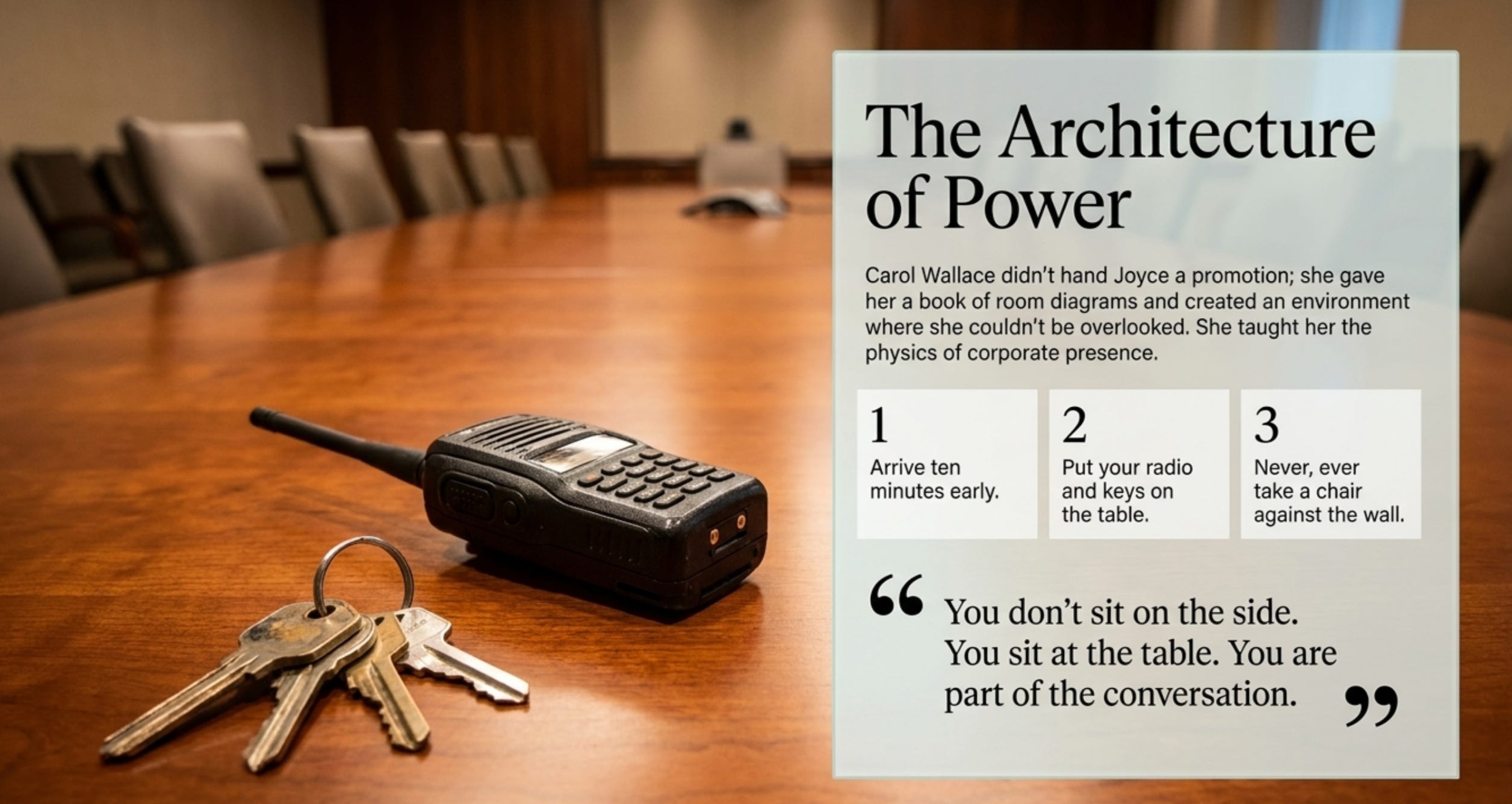
What followed was a master class in how power develops people when it actually means it. Wallace never handed her the job. She posted it, told Joyce to apply, gave her a book of every possible room diagram, theater, classroom, chevron, and then removed herself from the interview panel so the hire would be beyond question. Joyce did the rest, calling the head engineer and asking him to meet her on her break so he could teach her how the building’s lights worked, preparing for an interview for a job that did not officially exist yet. She got it, of course. And for the next decade and a half, Wallace made one thing structurally impossible at the San Diego Convention Center: overlooking Joyce. She did not have to win every promotion, but she would be in the running for all of them. Wallace taught her to arrive at meetings ten minutes early, to put her radio and her keys down on the conference table, and never, ever to take a chair along the wall. “You don’t sit on the side,” she told the young woman who had spent her life sitting on the side. “You sit at the table. You are part of the conversation.”
Joyce calls it grooming she didn’t know was happening, and to this day she has never made a career move without calling Carol Wallace first. Not one. But Wallace was the second teacher. The first was Tom Liegler, the general manager who originally hired her, a man who managed by walking the building and who would plant a piece of trash beside a trash can just to watch who picked it up and who radioed housekeeping. When Joyce told him she intended to become director of event services one day, he gave her the sentence she has carried through six cities: “If you’re gonna be the director, you have to see things that nobody else sees.”
Years later, her own event teams would beg her not to enter a ballroom too early. Don’t go up yet, Miss Joyce, we know you gonna find something. She would go up anyway, walk the banquet tables, and discreetly bump each one with her hip. If a floating candle toppled, she’d say only, “The fire marshal’s gonna have a problem,” and walk off, leaving the team to rebuild the centerpieces and, more to the point, to learn. She never told them the hip check was deliberate. Liegler would have approved.
Moments like this
By the time she reached Washington, running convention services at the building now called the Walter E. Washington Convention Center, the philosophy had matured into something like a doctrine of the invisible workforce. In lunchrooms, when word spread about whose show was loading in, workers would stand up mid-meal, saying they had to go check their bathrooms, because we can’t let Miss Joyce down. When a friend reported this to her, Joyce’s first reaction was worry. “Does that mean I’m too hard on them?” No, came the answer. It meant they respected her enough to want to be at their best, because she was the manager who showed up at the 7 a.m. lineups to thank them and tell them what was coming. After big shows, she had the managers put on aprons and cook breakfast for the crews, or truck in barbecue from a local spot and serve it themselves. You take such good care of us, the gesture said, so today we serve you.
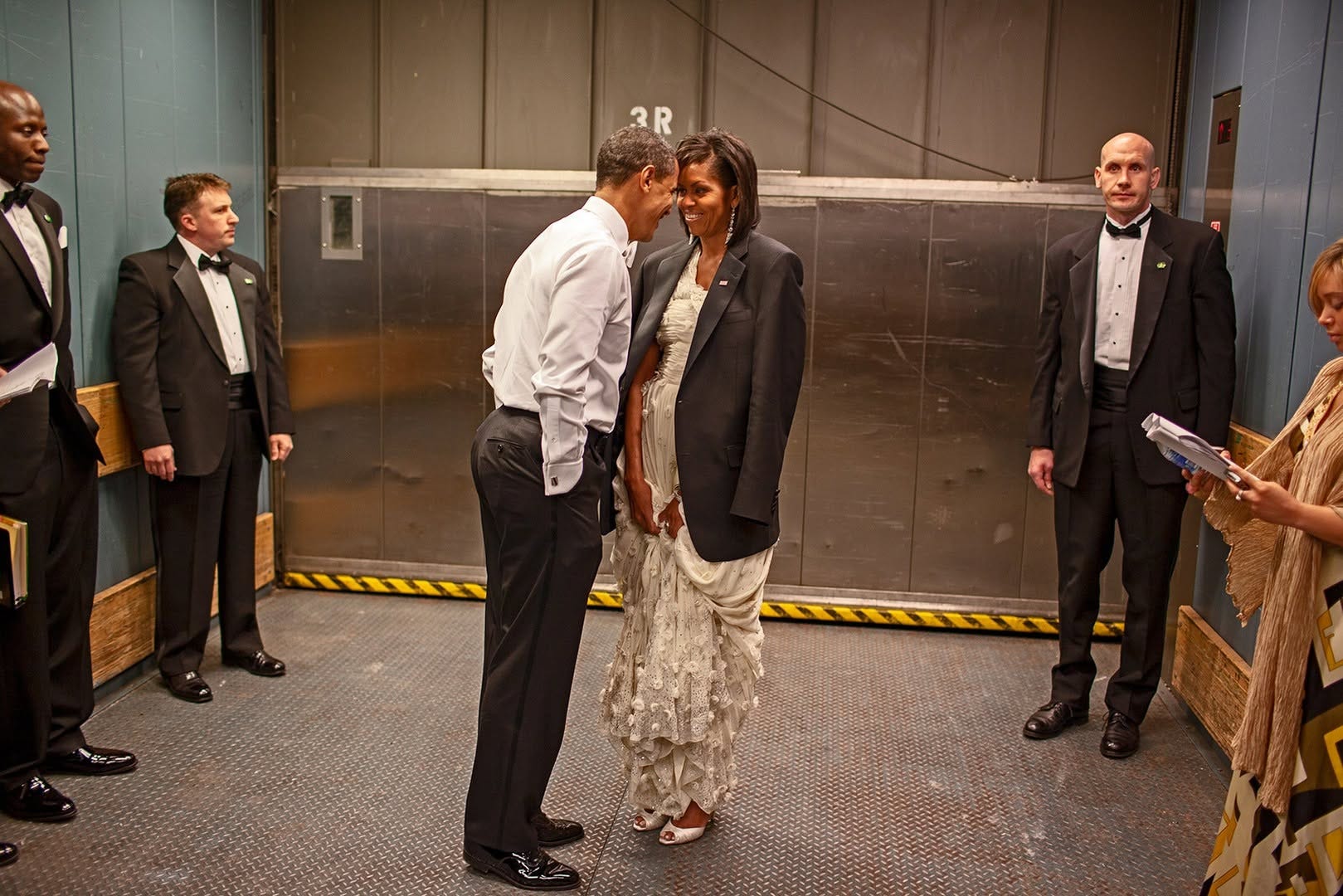
Washington also gave her the photograph. On the night of an inaugural ball, Michelle and Barack Obama were caught in a quiet moment in the convention center’s freight elevator, his tuxedo jacket draped over her white gown, the two of them leaning toward each other while the Secret Service agents in the frame politely looked away. The image traveled the world. Joyce turned it into an onboarding ritual, showing it to every new hire at the DC building, from telephone operators to the traffic marshals out on L Street, and telling them: whatever job you do, you do it because of moments like this. You never know when history is going to be made here, and you are part of it. People who believe that stay overnight when the power fails. They come in through blizzards to move a show out. She watched them do it.
The building had its own cast. I still remember doing a double-take at a staffer named Abel who so resembled the sitting president that visitors regularly froze mid-sentence. Whenever Joyce approached him with a request, he would answer before she finished: “Yes is the answer. What is the question?” She has been trying to institutionalize that sentence ever since.
Her path to the top of the DC building involved a comedy of missed connections that has become industry legend in her telling. Greg O’Dell, the chief executive who would remake the organization into Events DC, spent months calling a rising Miami operator named Joyce Watson whom everyone kept telling him to hire, and Joyce spent those same months dodging his calls, convinced he had discovered that she’d been quietly scouting a show that was considering leaving his building for hers. When a mutual friend finally walked her up to O’Dell and his general manager at an industry convention in New Orleans and made the introduction, the two men looked at each other, then at her, and O’Dell delivered the greeting she still laughs about: “Oh, so you just don’t call people back?” He hired her anyway. She calls him her brother now, one of the few people she has ever met with her own particular wattage, the ability to make whoever he’s facing feel like the only person in the room, though as she points out, he is six foot seven and she is five feet flat, so they arrive at the effect from different altitudes.
The aura and the elevation
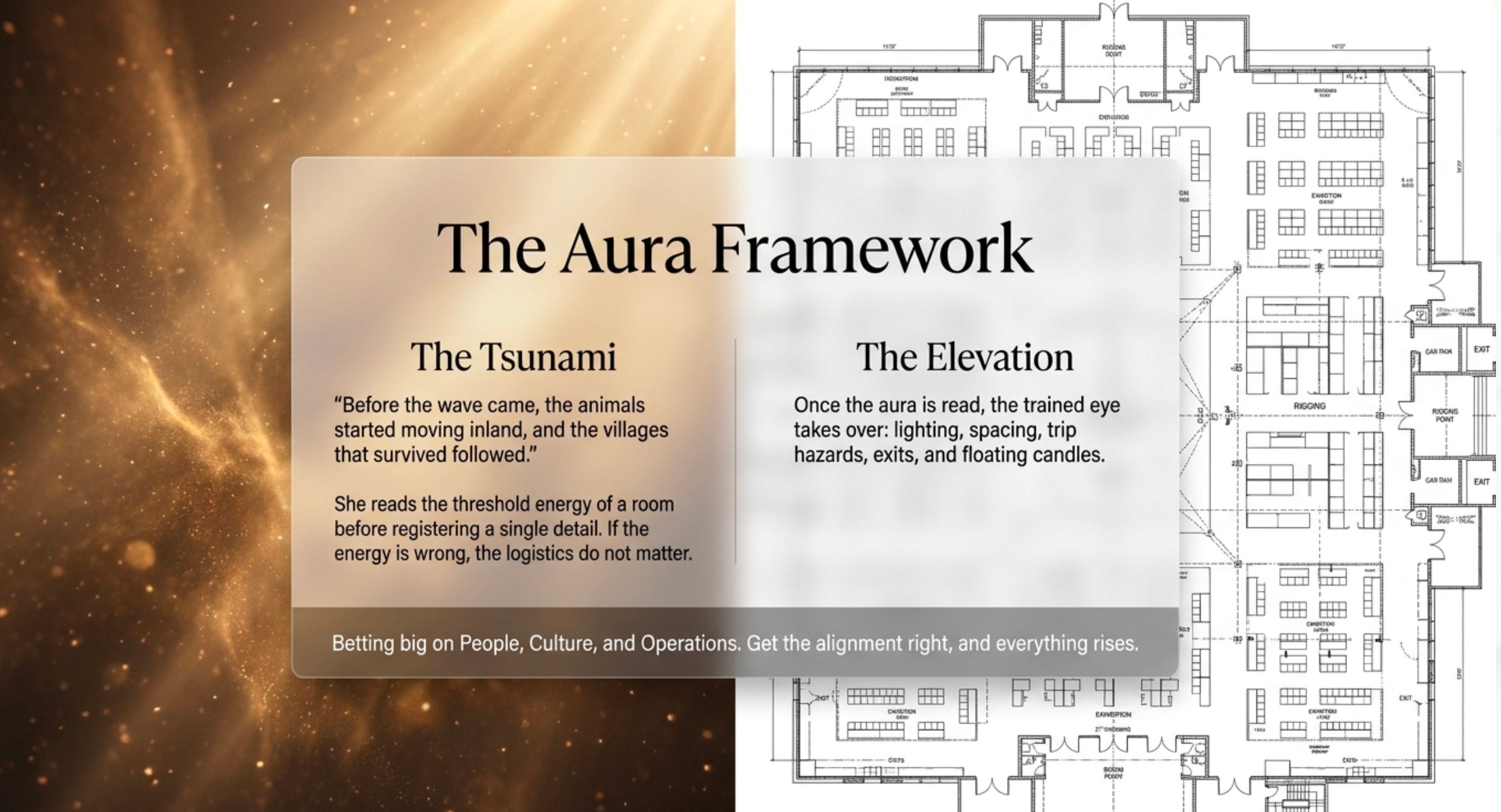
Ask Joyce how she reads a room, and she will not give you a metric. She will tell you about the tsunami. Before the wave came, she says, the animals started moving inland, and the villages that survived were the ones that watched the animals and followed. That is how she describes what she feels at the threshold of any gathering: an aura, an energy that registers before a single logistical detail does. She has walked out of her own boss’s office moments after walking in, telling him the energy in the room was wrong and the meeting could wait, only to learn he had just come from letting someone go. Then, and only then, does the trained eye take over, the lighting, the spacing, the trip hazards, the exits, the floating candles waiting for her hip.
At Javits, where she officially took the helm in March 2025 as the first woman to run the building in its four decades, the doctrine now operates at industrial scale. The timing carries its own charge. Javits turns forty this year, and the woman who will stand up to lead the building's own commemoration of four decades is the same woman who spent her own four decades proving, one loading dock and one switchboard at a time, that she belonged at the table at all. The institution's anniversary and her arrival are now permanently the same story.In her first months she held one-on-one meetings with every director in the organization, roughly three dozen of them, an hour each, and in every session she wanted one thing beyond the org chart: something personal. “I wanted to understand who I’m working with,” she says. “It’s not about titles.” Her word for this year is elevation, and her formula for it is characteristically un-mystical for a woman who believes in auras: “I’m betting big on people, I’m betting big on culture, and I’m betting big on operations.” Get those three in alignment, she says, and everything else rises. She is emphatic about where she ranks in the system: “I’m not bigger than Javits.” Nothing, she tells her team, is bigger than the nucleus unit, a lesson she traces directly to the cheerleading pyramid, where a base never, under any circumstances, lets her flyer fall.
The gospel-choir kid also still believes the highest thing you can do for another person is inspire them, a line she heard in church as a girl and never put down. Carol pulled her up, she likes to say, but she is pulling fifteen people through the door behind her. It’s going to be crowded in the room when she gets finished.
There is a cost column in this ledger, and she does not hide it. Her mother and sister back in Ohio are both seriously ill, and Joyce, who has spent a lifetime being the one the family calls in to read the hard letters, regularly steps away from the most demanding job in the industry to go be that person again. “Sometimes you gotta just step off,” she told me, “so you can make sure you show up for the people that always show up for you.” The girl at the kitchen table is still on duty.
The menu
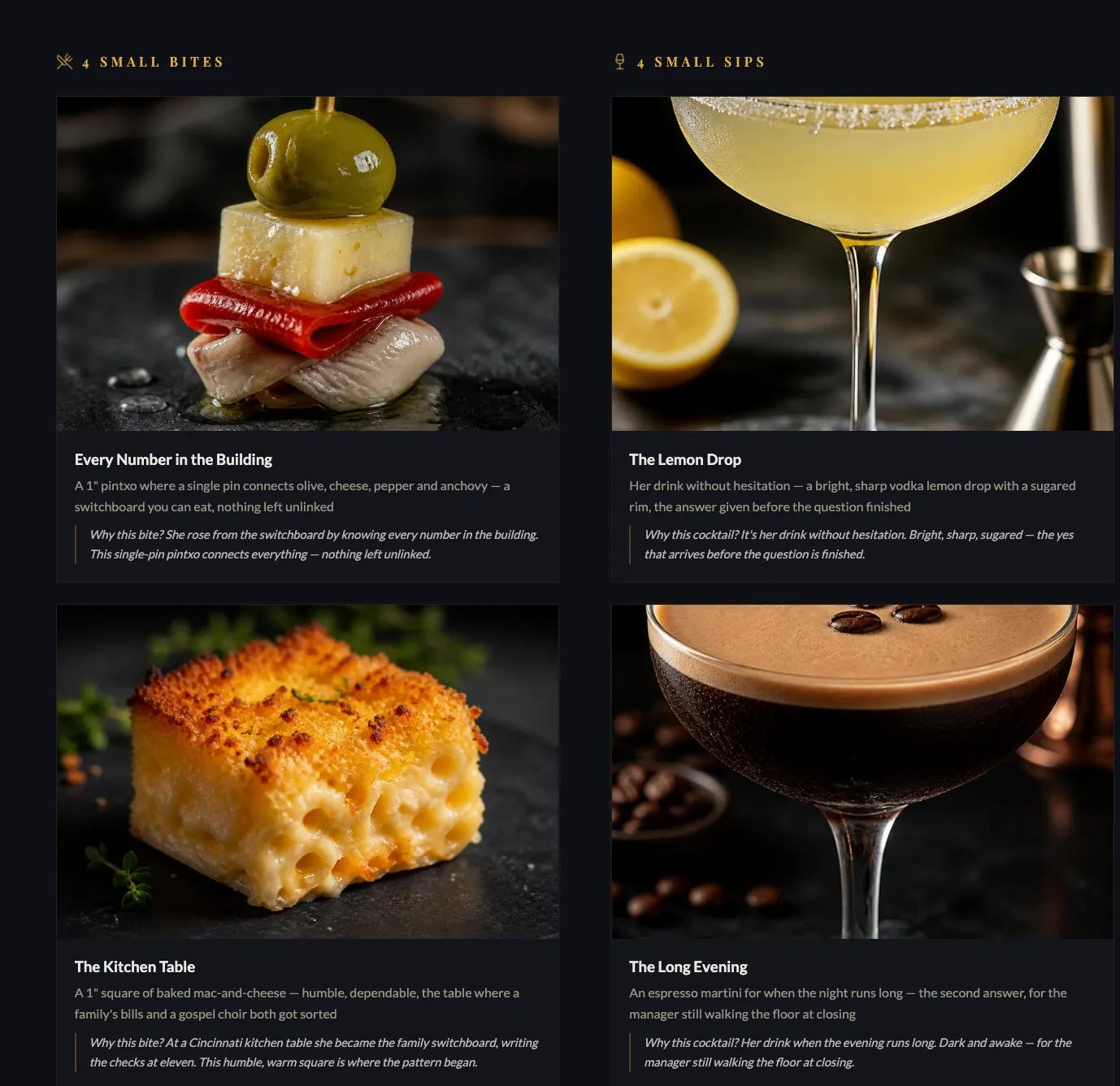
Because a profile at GatheringPoint comes with an edible companion, I asked her the two questions we ask everyone. Her drink, without hesitation: a lemon drop martini, or an espresso martini if the evening runs long. Her hors d’oeuvre took a moment. She floated calamari, then crudité, then something with cheese on it, at which point a member of her team cut in with the correct answer: Joyce, you’re a full charcuterie board. She surrendered instantly and completely. “I love it. I’m all of that. Almost anything with cheese and olives. I’m a big olives girl.” People who know her, she added, already know; they steer her toward the cheese table without asking. The full edible profile, the menu of appetizers and drinks that depict her, follows this piece, but the shorthand is now on the record. She is abundance, variety, and something for everyone, arranged with more care than it lets on.
Near the end of our conversation she mentioned, offhandedly, that she recently dropped into a full split, at sixty-something, with three hip surgeries behind her, while her daughter, a former competition cheerleader who shares her mother’s exact birthday of December 16th, looked on in horror and begged her never to do it again. “I just was checking,” Joyce said, “to see if I still had it.”
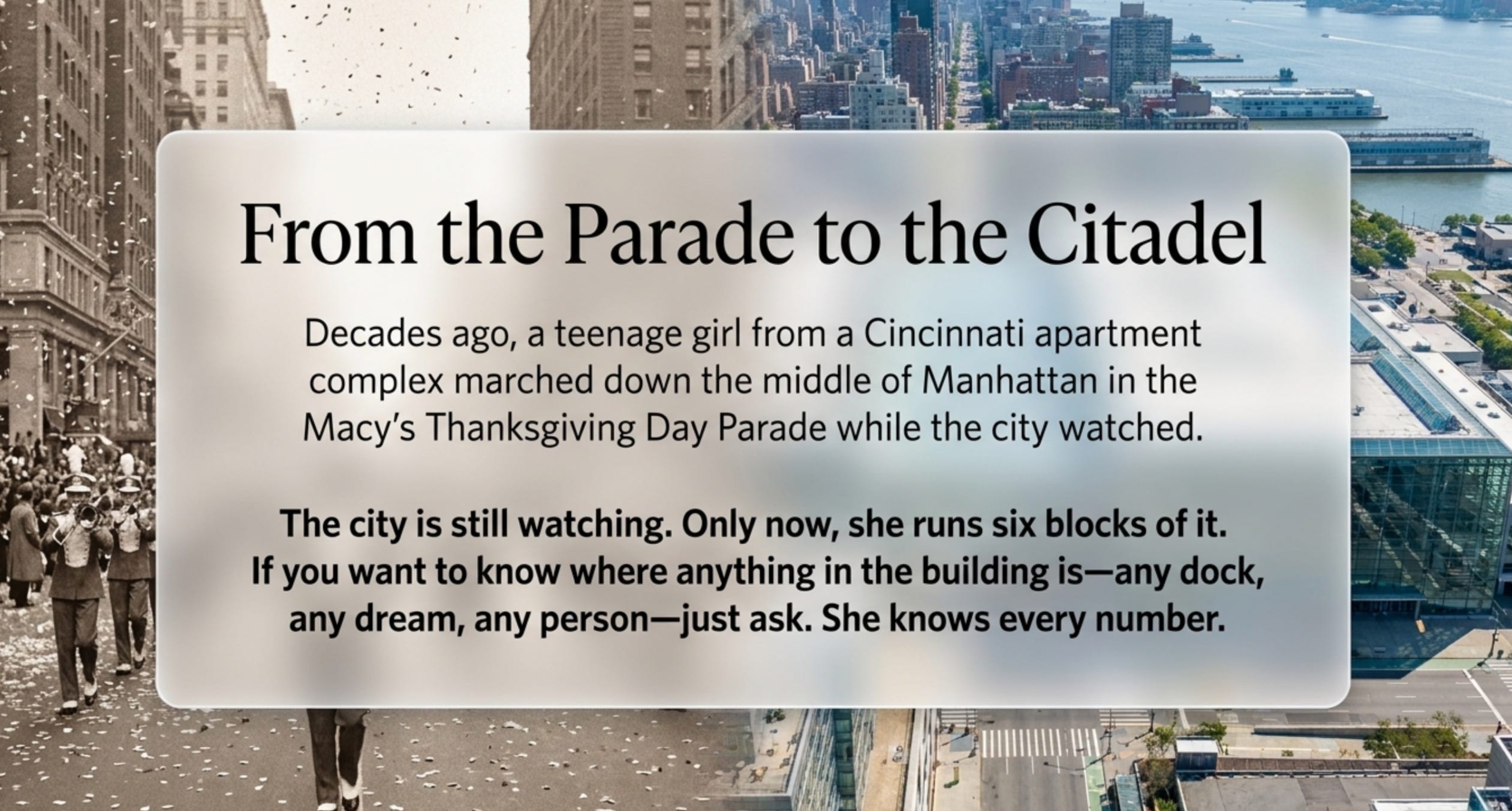
She still has it. And here the image from Cincinnati comes back around, the way the best ones do. Somewhere in a yearbook with a foldout page is a photograph of a drill team so good it was summoned to New York, and in its ranks a girl from an apartment complex marching down the middle of Manhattan on Thanksgiving morning while the city watched. The city is still watching. Only now the girl runs six blocks of it, from the switchboard all the way up, and if you want to know where anything in the building is, any dock, any dream, any person, you can just ask. She knows every number.
The Wisdom Bank is GatheringPoint’s ongoing archive of the gathering economy’s master practitioners, in their own words. The edible profile of Joyce Leveston, including the full menu, appears as a companion piece.
Edible Profile of Joyce Levenston

Every Wisdom Bank profile closes the same way: not with a summary, but with what the subject actually left behind. Here is what Joyce deposited.
Deposit 1: Learn every number in the building before anyone asks you to.
Nobody told Joyce to memorize the building’s phone extensions or loading dock numbers. She did it anyway, and it was the reason a new CEO trusted her with a job that didn’t exist yet.
Deposit 2: Say the true thing, even if you think it costs you everything.
She stood up at a town hall with two other job offers in her pocket and told the incoming CEO the staff wasn’t ready for her. She expected to be fired. She was heard instead.
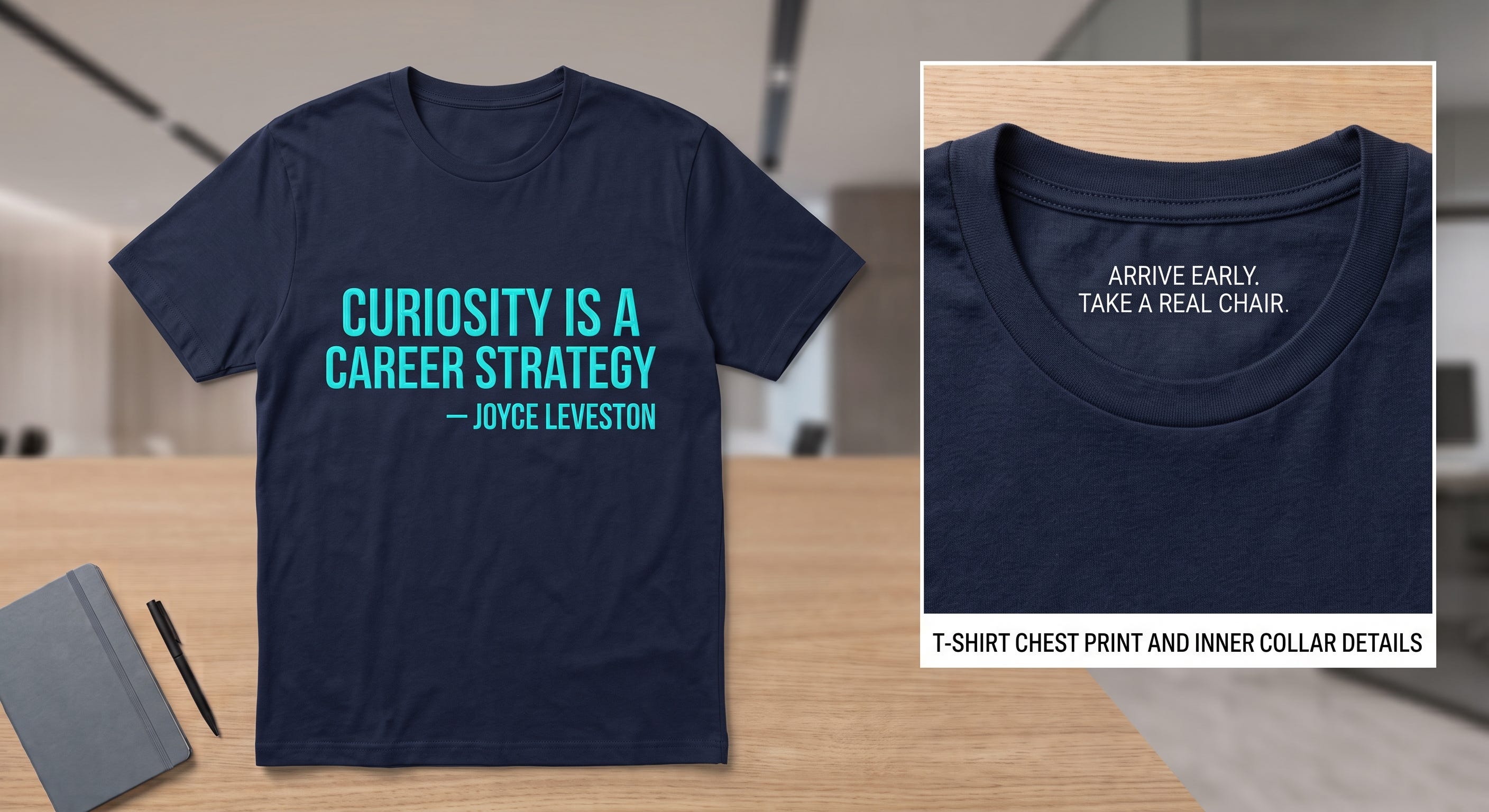
Deposit 3: You don’t sit on the side. You sit at the table.
Carol Wallace’s literal instruction, arrive early, put your things down, take a real chair, became the whole architecture of how Joyce has carried herself in every room since.
Deposit 4: If you want the title, learn to see what nobody else sees.
Tom Liegler’s line to a young event coordinator who said she wanted to run the department one day. It is still the standard she holds her own teams to.
Deposit 5: Somebody has to see you before you can rise, so be the person who sees others.
Wallace never handed Joyce a job. She made sure Joyce was always in the running for one. Joyce now runs the same play for the fifteen people she is actively pulling through the door behind her.
Deposit 6: Take care of the crew, and the crew will take care of the show.
Breakfast cooked by managers in aprons after a big load-out. Barbecue served by the people who usually give the orders. The doctrine of the invisible workforce, made visible on purpose.
Deposit 7: Know who you’re working with, not just their title.
Her first months at Javits, she spent an hour with every director individually, not to review the org chart, but to find out who each person actually is.
Deposit 8: Curiosity is a career strategy, not a personality quirk.
She spent an unpaid hour on the phone once, untangling a broken insurance claims process nobody asked her to fix. That instinct, chase the answer nobody assigned you, is the throughline of everything that followed.
Deposit 9: A room full of strangers is proof that people showed up anyway.
Two months after the towers fell, a hall much like the one she runs today held the events industry’s first reunion. Nobody knew if anyone would come. They came anyway. That is what a gathering is actually for.
Deposit 10: Inspire people. It is the highest thing you can do for another person.
A line she heard in church as a girl and has never put down. Carol pulled her up. She is pulling fifteen people through the door behind her.


Edible Profile of. Joyce Leveston


The Joyce Leveston Story in a Song- Absolutely in LOVE!!!
Thank you for profiling Joyce! When I saw this, my first and still thought: was she invited by US Travel Association to the confab in the Oval Office last week? If so, was she unable to attend? If not, why not? She IS our industry! She represents us. Now let’s follow the leads of others and raise others up.