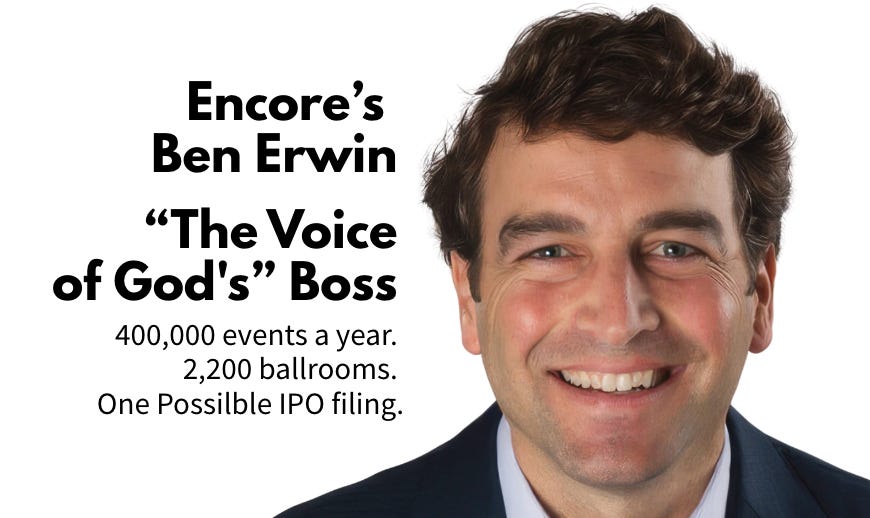
The first thing you notice is that he is standing in the aisle. Not walking it with a handler, not passing through on the way to a partner meeting, but standing inside the booth at his own company’s trade show stand, talking to whoever comes up. It is disorienting enough that the question forms before you can stop it: is he the CEO? Ben Erwin runs Encore, which employs thirteen thousand people, works out of 2,200 hotels and venues across twenty-three countries, produced 400,000 events[CM1] last year, booked 3.4 billion dollars of revenue, and has a filing sitting at the Securities and Exchange Commission proposing to list on the New York Stock Exchange under the ticker ECR. If you have attended a conference around the world in the past decade, there is a strong chance his people ran the room, and you never learned the company’s name. And there he is, in the aisle.

Asked about it, he does not reach for a line about servant leadership. “It’s the only place I’d want to be,” he says, and then makes the case in operational terms, which is the more revealing answer. “You can in the matter of an afternoon get a lot of intelligence, hear a lot of things, and candidly get closer to your business than I can standing where I am right now.” Where he is right now is the Chicago office. He describes it later, without prompting, as the one place his business does not happen. “Our business comes to life in 2,200 places. My office building here in Chicago is not one of them.”
Consider what he is declining. Somewhere in that same building, at that same hour, a person sits in a booth at the back of a ballroom and speaks into a microphone, and two thousand adults stop talking and take their seats. This industry gave that job a name of its own. Voice of God. Not announcer, not host. God. The voice comes from nowhere, has no body, cannot be argued with, and is obeyed. Encore staffs that role hundreds of thousands of times a year, which makes Ben Erwin, in the most literal organizational sense available, the Voice of God’s boss.
And he is out in the aisle handing someone a business card.
What this business is
It helps to know what he inherited, because almost nobody outside the industry does.
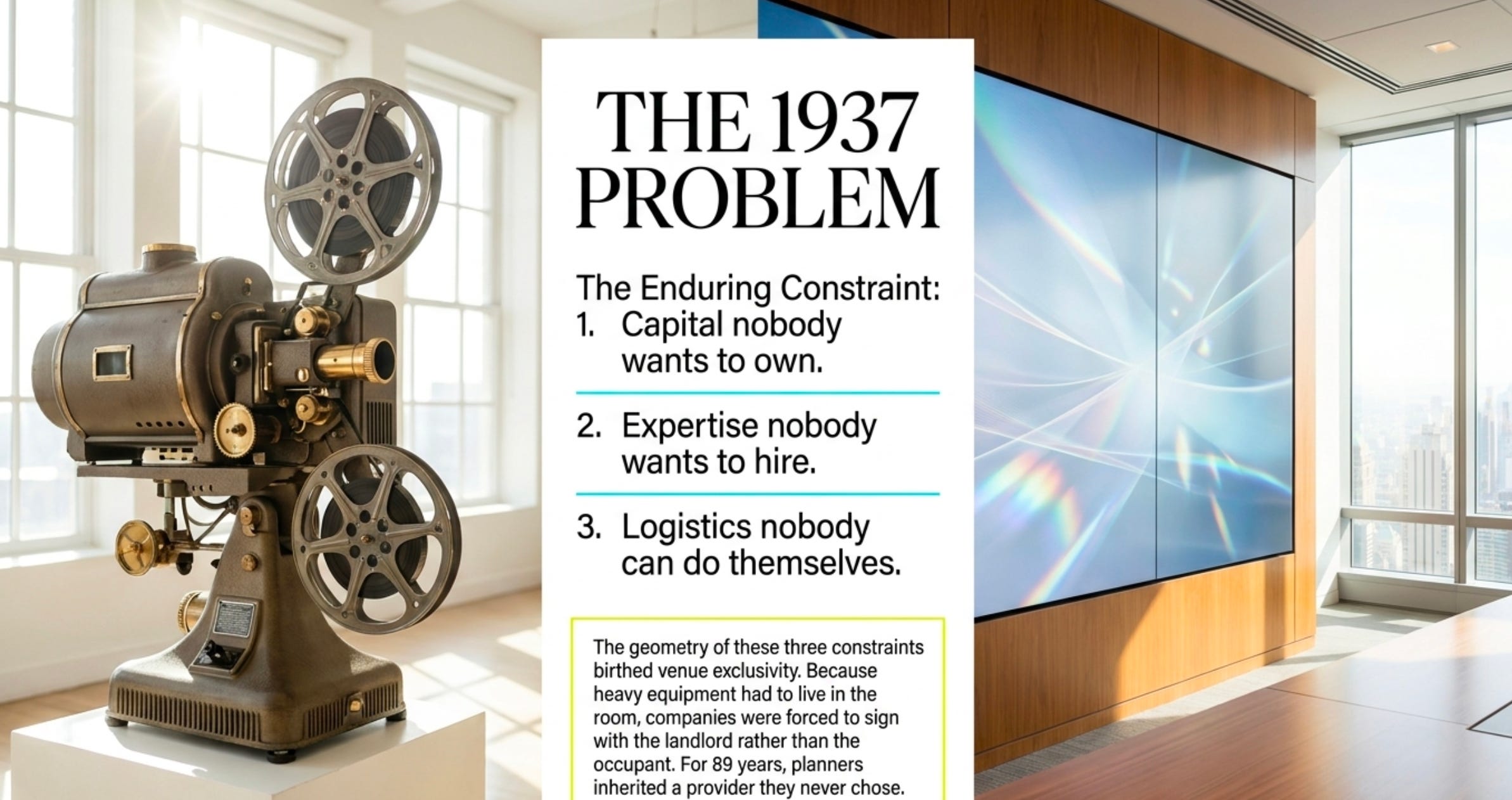
The business starts in 1937 with a problem that has never really changed. A projector was expensive, heavy, and temperamental. A company that wanted to show a film for two hours could not justify buying one and could not thread one if it did. So a man named P. Ray Swank began renting the machine and the person who could operate it and delivering both into a room on a specific afternoon. Three things sold together: capital nobody wants to own, expertise nobody wants to hire, and logistics nobody can do themselves that today is part of the hidden formula that helps to create the magic.
That is still the business in 2026. The boxes are larger. Nobody’s marketing department owns an LED wall or a line array, nobody’s meeting planner can patch a console, and they need both for two days in a ballroom in Orlando.
The geometry of that problem determined everything that followed. The equipment must be in the room, and the room belongs to the hotel. Which means the most efficient way to run this business has always been to sign an agreement with whoever owns the room rather than with whoever is holding the meeting. That is where venue exclusivity comes from. It is not a private equity invention. It is the logical endpoint of a 1937 constraint.,
Scale arrived in stages, and mostly during downturns. Kelso & Company, a private equity firm, bought PSAV Presentation Services in 2007, one year before the financial crisis and the collapse in corporate meetings that followed it. Group business did not fully recover until 2014. A sponsor that cannot sell an asset buys instead, and in 2012 Kelso merged the company with Swank, its only real national peer and sold it to Goldman Sachs in 2013. Blackstone bought PSAV in 2018 and spent the next two years acquiring, including Hargrove in Washington and, in 2019, a company called Encore Event Technologies purchased from Freeman. In January 2021 the whole portfolio took that name and it has been strategically applauded.
Which brings the story to the part that is still moving. In late 2025 the company acquired Eclipse, a UK-based event production company, and then FIRST, an agency of more than eight hundred people, roughly three quarters of whom work inside client offices rather than at venues. Four months later the S-1 went to the SEC, proposing a New York listing under the ticker ECR. The filing shows 2025 revenue of 3.4 billion dollars, long-term debt of 2.3 billion, and one number that describes the shape of the market better than any of the others: revenue per event up nearly 88 percent since 2019, while the total number of events has declined potentially due to market trends where customers are investing in more immersive events and technologies that enable them, rather than a comparable increase in event pricing.
Fewer, but larger more complex events. That is the industry Erwin is taking public, and it is a different industry from the one that rented projectors.
What Encore has become, in plain terms, is a new type of connective infrastructure . Not a vendor in the ordinary sense, because a vendor is something you select. This is closer to the plumbing of the meetings economy: a standing layer of people and equipment installed inside 2,200 buildings, which activates whenever anyone in those buildings decides to gather. The planner does not choose it. She encounters it, the way she encounters the loading dock and the ceiling height. Nobody built it on purpose. It accumulated, one hotel agreement at a time, over eighty-nine years, until the only company that could serve a national customer across every property was the one that had signed with every property.
Infrastructure of that kind has a characteristic dynamic, and it is the one the industry complains about. Its counterparty is the landlord, not the occupant. Its revenue is transactional, event by event, room by room. Its relationship with the person holding the meeting begins when she walks through the door and ends when the trucks leave. Ninety years of arriving after every decision that mattered.
The whole of Erwin’s strategy is an attempt to reverse that polarity. The word he uses is closeness, and what he means by it is structural rather than sentimental.
That is the whole man, and it is worth understanding how a finance executive with no events background arrived at it.
The accident he has learned to narrate
Ask Erwin how a Wake Forest economics graduate ended up running the largest event production company in the world and he immediately disowns the tidy version. “I’ve gotten good at telling a story of how it all makes sense,” he says. “But I think my parents are probably better judges. And they would say it’s a little bit of an accident and a little bit of being open to opportunities that present themselves.”
What he does claim is a decision he made at twenty-two, and it is more specific than most origin stories. He turned away from investment banking and management consulting, the two default destinations for someone with his transcript, on the grounds that both were the wrong kind of room. “It felt outside of business. And I wanted to be in a business.” Then the line that explains everything after it: “I wanted to be in the middle of the fight. And you don’t get that seat by being outside it.”
So, the man in the booth is not performing humility. He is doing the only version of the job he ever wanted, which is the version conducted in the middle of the fight rather than adjacent to it. The finance credential got him the seat. It was never the point of the seat.
His college years read the same way once you know what to look for. Greek life, student government, club sports, a standing role in and around the Wake Forest athletics department without ever playing a varsity sport. He describes himself in that period, accurately, as “an organizer of people.” And before any of it, there was a smaller and more demanding room. He is the oldest of four boys in a family where his parents held high expectations for all of them. “That was my first crew,” he says. “How do you get all of those personalities to do what was expected of us?”
He has a word for what he was learning, and he uses it constantly inside Encore. Followership. Asked to define it, he locates it entirely outside the org chart. “It’s all the credibility that comes from soft skills. It comes from storytelling. It comes from authenticity. It comes from trust. It comes from building something people believe in that’s bigger than themselves.” Leadership, in his account, is not conferred by title. It is the observable fact of whether anyone is behind you.
The year the business went dark
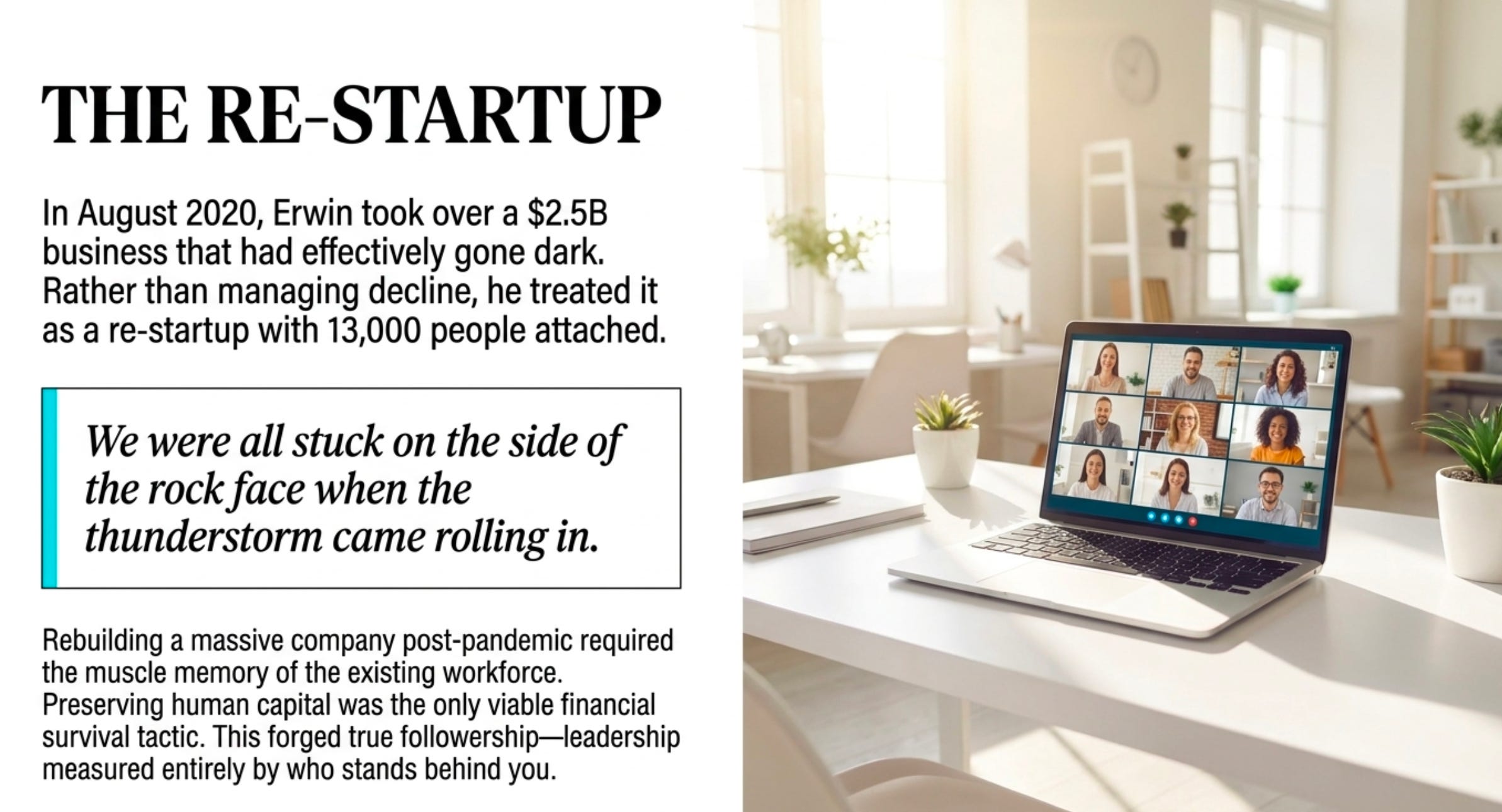
He became chief executive in August 2020. Encore, then still trading as PSAV, had been a two and a half billion-dollar business before the pandemic. By the time he took the job, monthly revenue was running in the single millions.
“It was brutal,” he says. “Can I be CEO for the first time in a business that’s effectively dark?” He describes the period in three registers at once, and does not try to reconcile them: scary, heartbreaking, stressful. Then he adds a fourth that most executives would leave out of an on-the-record conversation. Liberating.
His reasoning is unsentimental. “I think it would have been harder to be a CEO of a successful business at a successful time, because you would have felt a bit more paralyzed by changing things. Where there would be this fear of, just don’t screw anything up. It’s all just working.” Instead, he found himself running something closer to a pre-revenue startup that happened to have thirteen thousand people attached to it, and he named the condition rather than hiding it. He called the next chapter a restartup, and told the company that its advantages, the talent and the experience and the accumulated craft, were intact while everything else was newly negotiable.
He set out four priorities. Three were conventional business strategy. The fourth was that Encore should be a place everyone wanted to work, an academy company for the industry, and he is direct about why that was the one that mattered. The company was asking people to stay on roughly half their take-home pay, in an industry that had become the rare thing both political parties agreed on. Face to face did not make sense. Las Vegas went dark. Hotel staff were improvising ways to lock ballroom doors that had never had locks.
“Our teams are sitting not together. We’re sitting at home. Our place of work is shuttered,” he says. The retention argument he made was not financial, because there was no financial argument to make. It was that there would be a company on the other side and they would want to have been part of it.
The metaphor he reaches for is a rock face. “We were all stuck on the side of the rock face when the thunderstorm came rolling in. We had to figure out what to do. And as scary and daunting as that moment is, when you get to the other side, you have a fundamentally different relationship with everybody that you just went through that with.” Then the operational payoff, which is the part a finance executive would notice first: “to regrow, you needed that muscle memory.”
He is describing his own workforce as an asset that could not be rebuilt from scratch, and a shared ordeal as the mechanism that preserved it. It is the same insight the events industry sells to its clients every day, applied inward under conditions where it was the only currency available.
Turning the infrastructure around
The strategy he can describe, IPO restrictions notwithstanding, is an attempt to make that installed layer work in the other direction. Thirteen thousand people, 2,200 venues, twenty-three countries, thousands of daily encounters with organizations trying to convene somebody. Historically all that value flowed toward the building. His proposition is that it should flow toward the customer instead, and that the building benefits anyway when it does.
He puts it as an obligation rather than a pitch. If he has the talent, and he is already standing in the places a customer is most likely to meet, then he ought to be able to give that customer more, in his phrasing, “leveraging the experience we’ve had together to earn your trust.” And if that happens, the venue partner still wins, because the customer walks through their front door knowing what to expect. It is a coherent argument. It also requires a company whose entire commercial history runs through the landlord to start behaving as though the occupant were the client, which is a harder cultural task than an acquisition.
Three things have to change for it to work, and Encore is visibly attempting all three.
The first is memory. Infrastructure does not remember anyone. His answer is that the teams should arrive already knowing what this customer wanted last time, in a different city, in a different building. He describes a system where an experience travels with a client across the network rather than restarting at every property. That is the difference between plumbing and a relationship, and it is entirely a data problem. Asked where the untapped value in the business is, he answers instantly, with a line his team has clearly heard before. “If Encore only knew what Encore knew.” Four hundred and fifty thousand events a year is the largest observational dataset in live events by a wide margin, and he calls the work of using it early to improve personalization.
The second is position. This is what FIRST is for. “In the case of FIRST,” he says, “it’s extending into their buildings.” The agency employs more than eight hundred people, roughly three quarters of them working inside client offices rather than at venues, which means they are present when an event is still an idea, before the city, the venue, or the format has been chosen. A company that has spent eighty-nine years arriving after every consequential decision has bought a seat in the room where those decisions are made. It is the single most significant thing Encore has done in a decade, and it is not about audiovisual at all.
The third is the calendar. The infrastructure was built for the tentpole, the large annual gathering that fills a ballroom and justifies the trucks. But the filing shows event count declining while spend per event climbs, which means the middle of the market is thinning. The volume is migrating to smaller, more frequent meetings that never touch a hotel and are therefore invisible to a venue network. You cannot serve those from a ballroom. You can only serve them from inside the client’s building, with someone on staff who knows they are happening.
He does not claim the field to himself. Told that the old rivalry with Swank has no modern equivalent, he pushes back. “While I sleep well, I don’t sleep perfectly.” He names production houses and agencies coming at the same customers from a different angle, notes that the barriers to entry are low, and calls the industry incredibly fragmented. What he claims is not dominance but consistency, sold to a customer base he describes as “overworked, taxed, and in greater demand inside their businesses than they’ve ever been,” in a market where freelance labor means an organizer often does not know who will actually turn up to run the show.
Whether any of it survives contact with a quarterly earnings call is the open question of the next three years. A public company carrying 2.3 billion dollars of debt has an obvious short path to revenue, and it runs straight back through the ballroom.
The AV tech is the star
The most animated he gets is not about strategy. It is about the person in the ballroom.
Encore runs a large voice-of-the-customer program, and the finding that delights him is that most respondents use it to name an individual employee. His customers, unprompted, want to tell him about a specific human being.
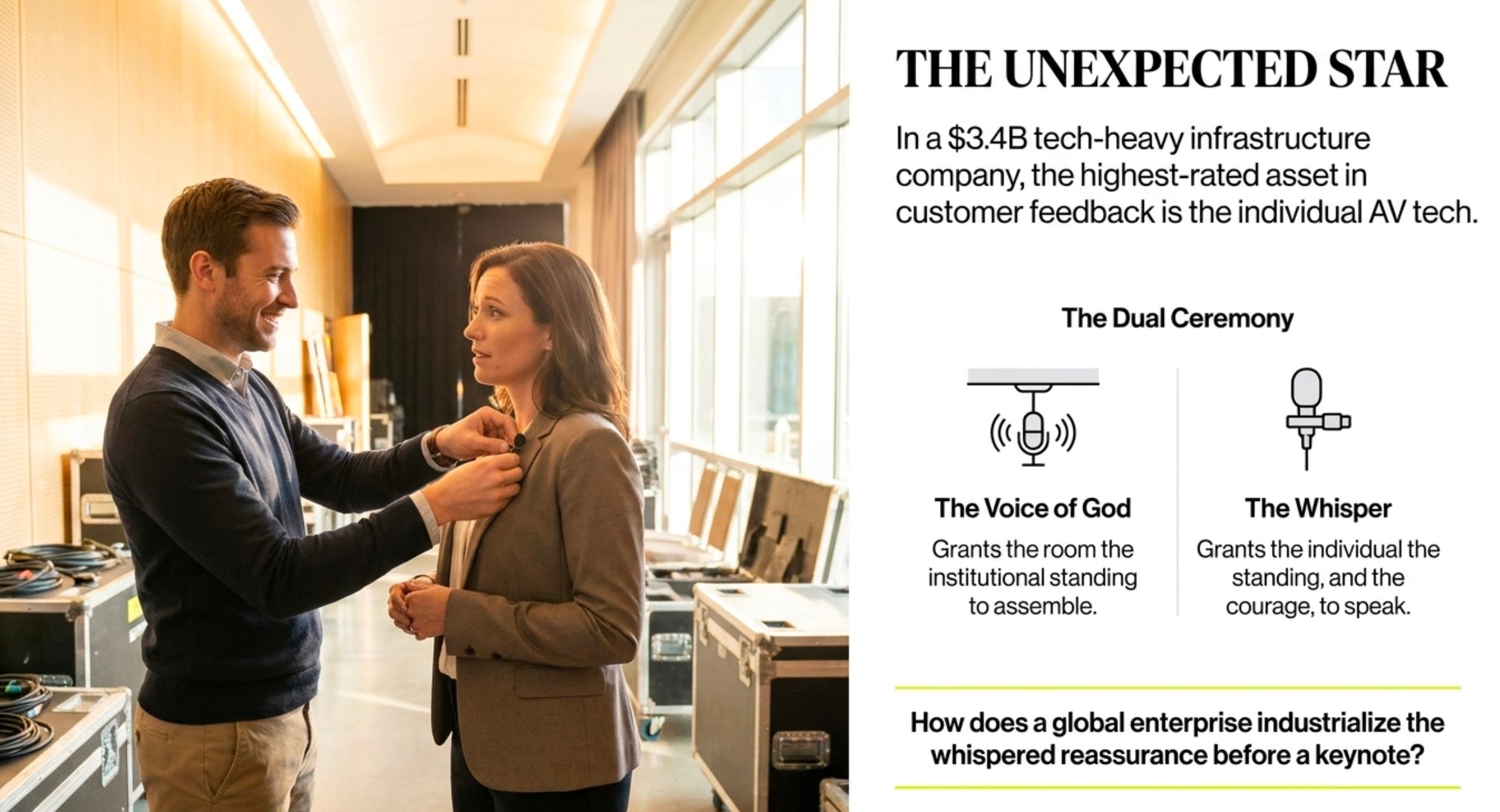
“It is an AV tech miking them up when they’re nervous,” he says. “It’s the last person they see before they walk on stage. It’s a producer that helped them create kind of the vision that they had in their head but didn’t know how to get it put to life in the ballroom. And it is, that’s our star. That’s our celebrity.”
Consider what that moment is. Everything else about the day was planned months ago and printed in a run of show. The mic check was not. A stranger threads a wire under a speaker’s jacket, stands closer to her than anyone has all day, feels that her hands are shaking, and improvises a sentence. Some version of: you’re going to be great. He does not know whether that is true. It works anyway.
She already had the slot. Her name was already on the screen. What she did not have was permission to walk out and be looked at, and permission cannot come from the meeting planner or the chief marketing officer, because they want something from her. It must come from someone with no stake in the outcome. That is the second unnamed office on this floor, alongside the voice in the ceiling: one grants the room the standing to assemble, the other grants the individual the standing to speak. We have built an entire industry on top of two ceremonies, and we file both under production.
There is a real ambition buried in that. The company hires out of hospitality schools and theater programs into a structured leadership program, and Erwin talks about human capital as the thing he most wants to discuss internally. The unresolved part is that the star system he admires belongs to the individual, while the consistency he is selling belongs to the network. His stated answer is that the experience should travel: the next Encore team, in the next venue, should already know what worked. Whether a company can industrialize the whispered reassurance before a keynote is the interesting problem, and it is not solved.
Rehearsal
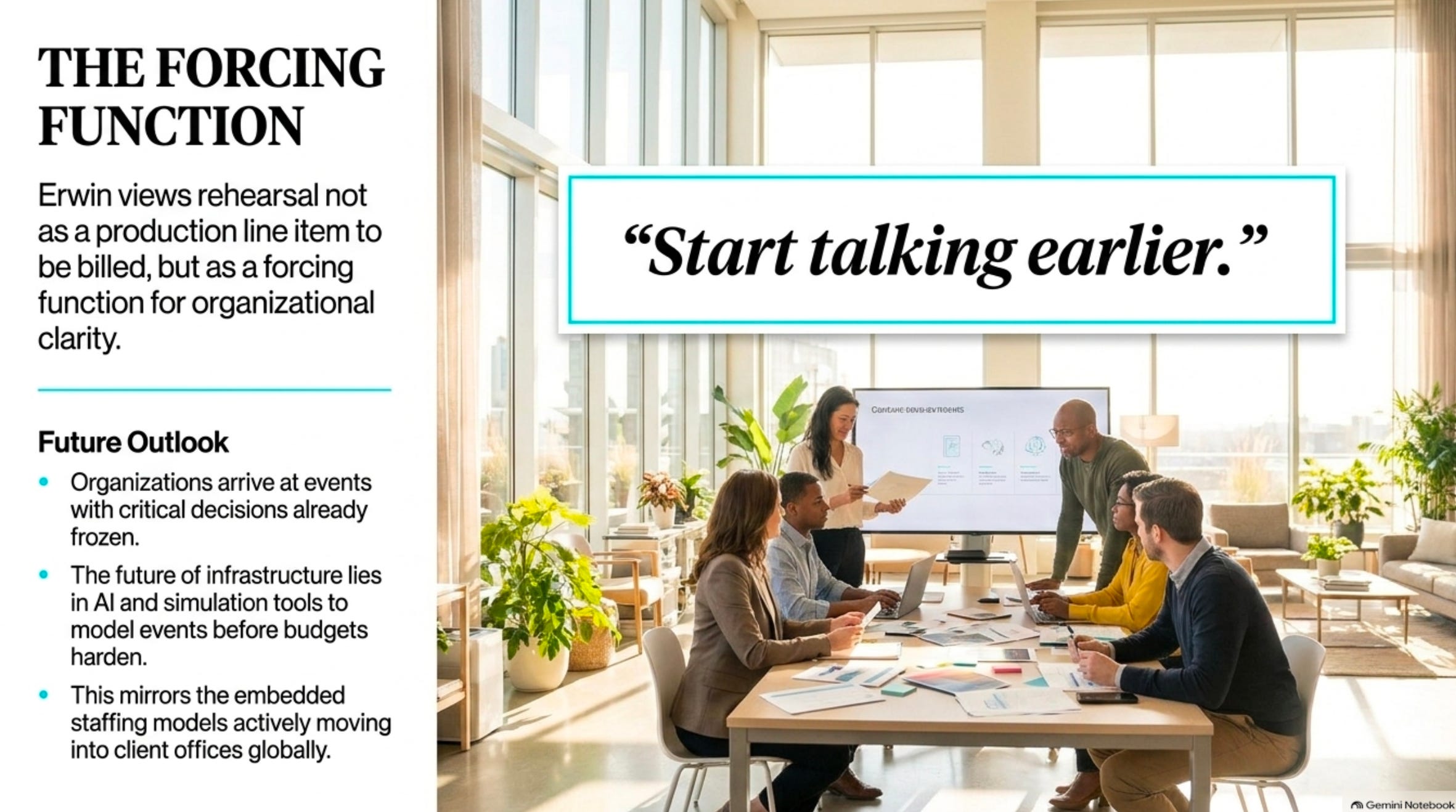
Late in the conversation the subject turns to rehearsal halls, and to the observation that most organizations arrive at their event with the important decisions already frozen. Erwin does not hedge.
“You’re pointing on rehearsal is spot on,” he says. “You’re investing in all of this time and money and resource to get people together, and too often people underinvest in how they can have the biggest impact.” Then the thing that makes it more than agreement. “I also think it forces a whole bunch of conversations around what are we actually trying to do.” He reports that the single most common piece of advice his customer and operations teams give is the least technical one available: start talking earlier.
He is describing rehearsal as a forcing function for clarity rather than a production line item, which is the correct diagnosis and a slightly awkward one for a company that bills rooms by the hour. He points toward technology and AI as ways to give a client a sense of what is possible much earlier, before the budget hardens.
Told that a family-owned German agency called Vok Dams has independently arrived at the same embedded staffing model that FIRST practices and built a simulation tool to model events before production decisions are locked, he is interested and unguarded: he has not heard of them. Two companies with nothing structurally in common, one an eighty-nine-year-old American rollup preparing to list, the other an independent agency in Wuppertal, moving toward the same answer from opposite directions. That is not a coincidence about either company. It is a signal about the market both are standing in.
He ends nearly every conversation the same way, according to him and, he suspects, according to anyone who works for him. Before hanging up he asks what he can do for you. He did it at the end of this one.
He talks about growth carefully, in the manner of someone with lawyers, but the thing he wants to grow is not only the company. “There’s an opportunity not just to grow Encore, but to grow the importance of our industry,” he says, and then makes a claim about the people in it: they are strategically important, and they have not been given their due.
Asked what his fraternity brothers would make of all this; he does not perform modesty or confidence. “Half of them would be not surprised and half of them would be shocked. And I’d let you decide who we’re closer to me.”
The oldest of four boys, running his first crew, would recognize the man in the aisle. The bankers he declined to become at twenty-two would not.
Everything else in this business speaks from somewhere you cannot see. The voice in the ceiling. The contract the planner inherits with the ballroom and never signed. The provider chosen by somebody else, in a room she was not in. Erwin has spent twenty-five years choosing the opposite, on the stated grounds that a tower is only a window on a fight. He employs God. He would rather be interrupted.
GatheringPoint covers the people who build the gatherings. Subscribe at GatheringPoint.news.
Ten things worth keeping from an hour with the man who runs the infrastructure under 400,000 events a year.
1. A window is a view of somebody else’s fight.
At twenty-two he turned down investment banking and consulting on the grounds that both were adjacent to business rather than inside it. His phrasing was that he wanted to be in the middle of the fight, and that you do not get that seat from outside it. Every job he has taken since has been a version of the same choice. The lesson is not that towers are bad. It is that proximity is a skill, it decays when unused, and you cannot acquire it later at a higher title.
2. Watch where the leaders stand.
He was twenty-four when the energy company he worked for came apart, and what he took from it was spatial rather than ethical. The people who built the thing were never anywhere near the actual business. That observation has governed a twenty-five-year career. When you are trying to read an organization, do not read the org chart. Look at where the senior people physically are on an ordinary Tuesday.
3. Leadership is measured in followership.
It is his word and he uses it constantly inside the company. Not authority, not title, not span of control. Whether anyone is behind you, which is an observable fact rather than a claim. He locates the whole of it in things that do not appear in a job description: credibility, storytelling, trust, and building something people believe in that is bigger than any individual in the room.
4. Your first crew is smaller than you think.
Oldest of four boys in a house with high expectations. He describes that as his first management job and means it seriously: how do you get four separate personalities to do what is expected of all of you. Most people’s leadership instincts were formed long before their first direct report, in a room with no title in it.
5. A crisis allows you time to change things.
He took the chair in August 2020 with the business effectively dark, and his read on it is counterintuitive and worth stealing. It would have been harder, he says, to become chief executive of a company that was working, because the instinct in that seat is not to break what is running. Catastrophe removed the fear of changing things. If you are waiting for a calm moment to remake something, you will wait forever, and the calm moment would not have let you anyway.
6. When you have nothing to offer, offer the truth and stay in the room.
What he had in 2020 was half pay and a promise. What he did was tell people exactly that, describe where they were going, and then show up every morning. Eleven thousand of them stayed. The mechanism was not incentive. It was presence plus honesty, sustained over a period long enough to be believed.
7. Shared ordeal is an asset, and it is the one you cannot buy.
His metaphor is a crew caught on a rock face when the weather turns. You would never choose it. But when it is over you have a relationship with those people that cannot be manufactured, and he was explicit that the muscle memory of the people who stayed was the thing that let the company regrow. Organizations that went through something together in 2020 are still spending that capital. Organizations that scattered are still paying to rebuild it.
8. End every conversation the same way.
He closes nearly every meeting, one-on-one, and call by asking what he can do for you. He is aware that his team finds it funny. He also traces how the meaning of the question changes across a career: early on it means solving somebody’s small problem, mid-career it signals that you are not only in it for yourself, and from the top it sets the terms of what a leadership job is actually for. A habit performed ten thousand times becomes a culture.
9. The person who grants permission is not the person who benefits from it.
Ask him who the star of his company is and he names the technician who mics up a nervous speaker ninety seconds before showtime. Consider why that works. The meeting planner and the chief marketing officer both want something from that speaker, which is precisely why neither can give her what she needs. The stranger with the wire wants nothing. That is what makes the reassurance usable, and it is a structural fact rather than a sentimental one.
10. Ask the question earlier.
The single most common piece of advice his customer and operations teams give is the least technical available: start talking sooner. He extends this into strategy. Putting people inside client organizations means asking what are you trying to accomplish while the answer can still change the plan, rather than at the mic when nothing is left to move. Most of what looks like an execution problem in this business is a conversation that happened too late.
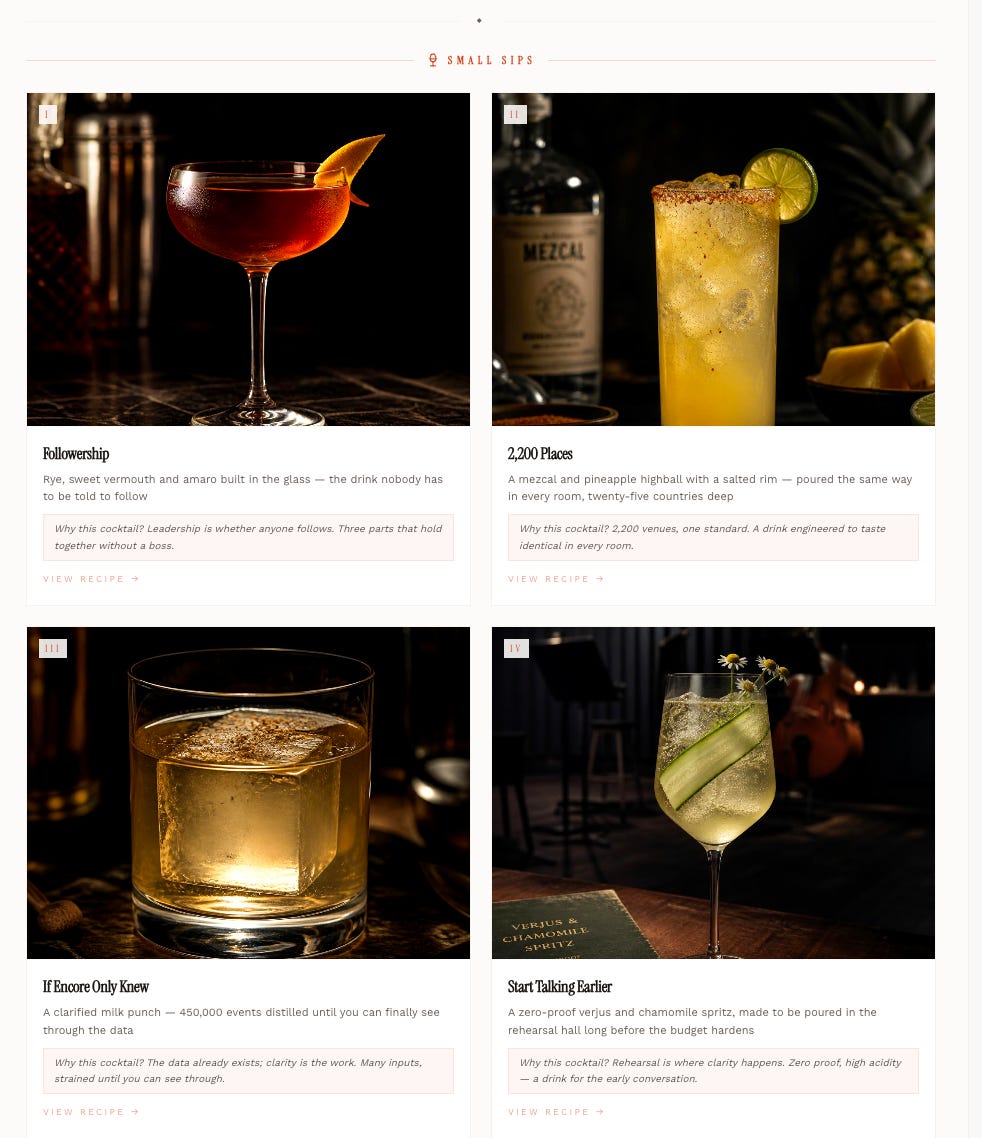
Ben Erwin: Four bites inspired by the CEO who took over the largest event production company in the world the year the lights went out — and never left the floor
Edible portraits designed to capture who they are in a single taste.
Click for interactive version: https://smallbitearchitecture.lovable.app/people/ben-erwin


The Artifact. Every GatheringPoint interview leaves one object behind. The thing worth keeping, made into something you could actually wear.