


Twelve percent. That’s the share of Gen Z professionals who said, in a 2025 survey of conference attendees by GoGather, that they actually want to hear a keynote speech from a leader. Fifty-three percent wanted hands-on demonstrations and live simulations instead. Another quarter wanted a workshop or a breakout. In the same survey, 61.4 percent said they disengage entirely from a session the moment it stops feeling relevant to them, phone out, attention gone, whatever the person on stage is still saying.
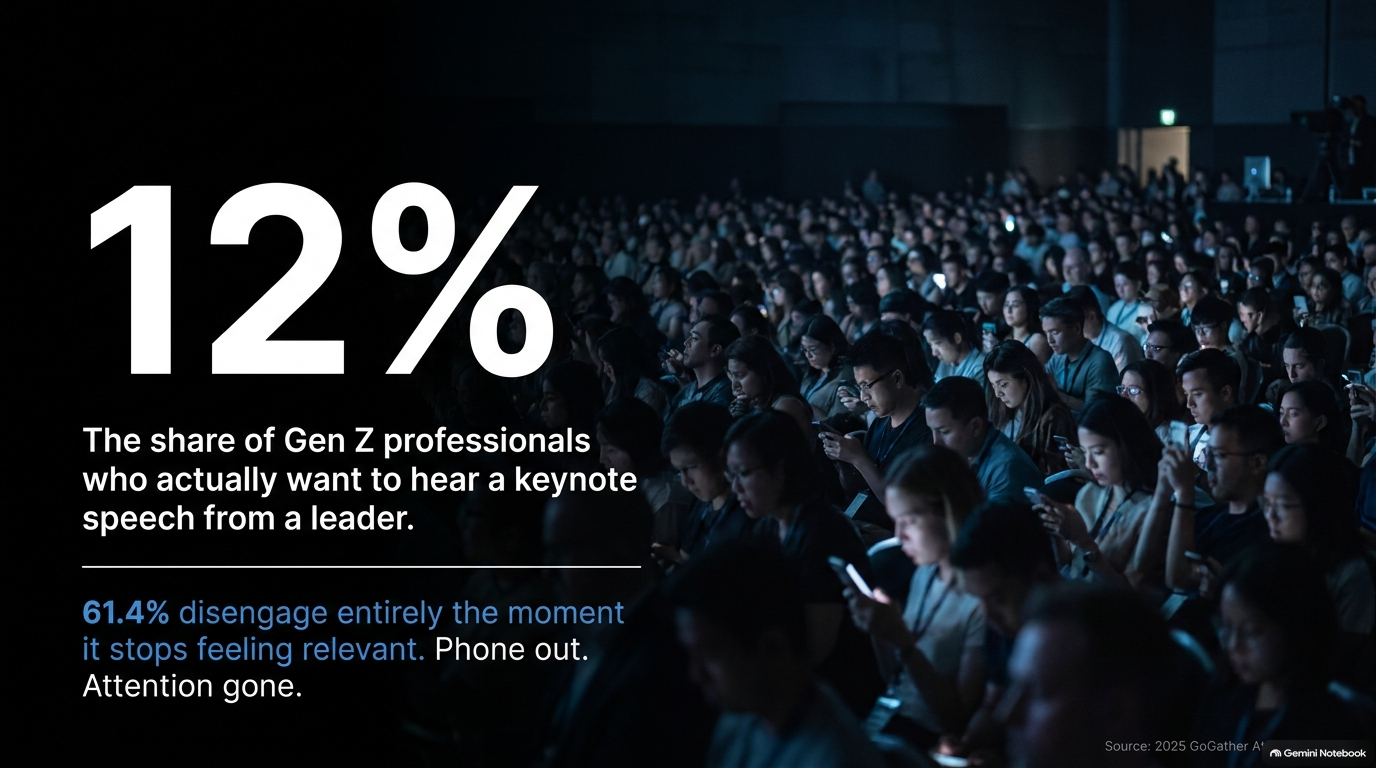
That is not a generational quirk. It’s a preview. Gen Z is simply the first cohort of attendees who grew up with every keynote ever given already sitting on their phone, one search away, free, and they have responded accordingly: the stage isn’t where they expect to learn anything. A new white paper landing this week from GatheringArchitecture.com, the framework and format-research site I founded after BizBash, argues that everyone older than Gen Z is quietly arriving at the same conclusion, just more slowly and with more money already sunk into the old model. “Speaker Industrial Complex: The 2026 Report” runs to sixteen sections and an interactive audit tool, and its real argument is that three different people in the same room, the organizer who booked the speaker, the speaker themselves, and the attendee sitting in row twelve, are all quietly having a different reaction to the same booking, and the industry selling the speaker has only ever built a pitch for one of them.
For the organizer: what you’re actually buying
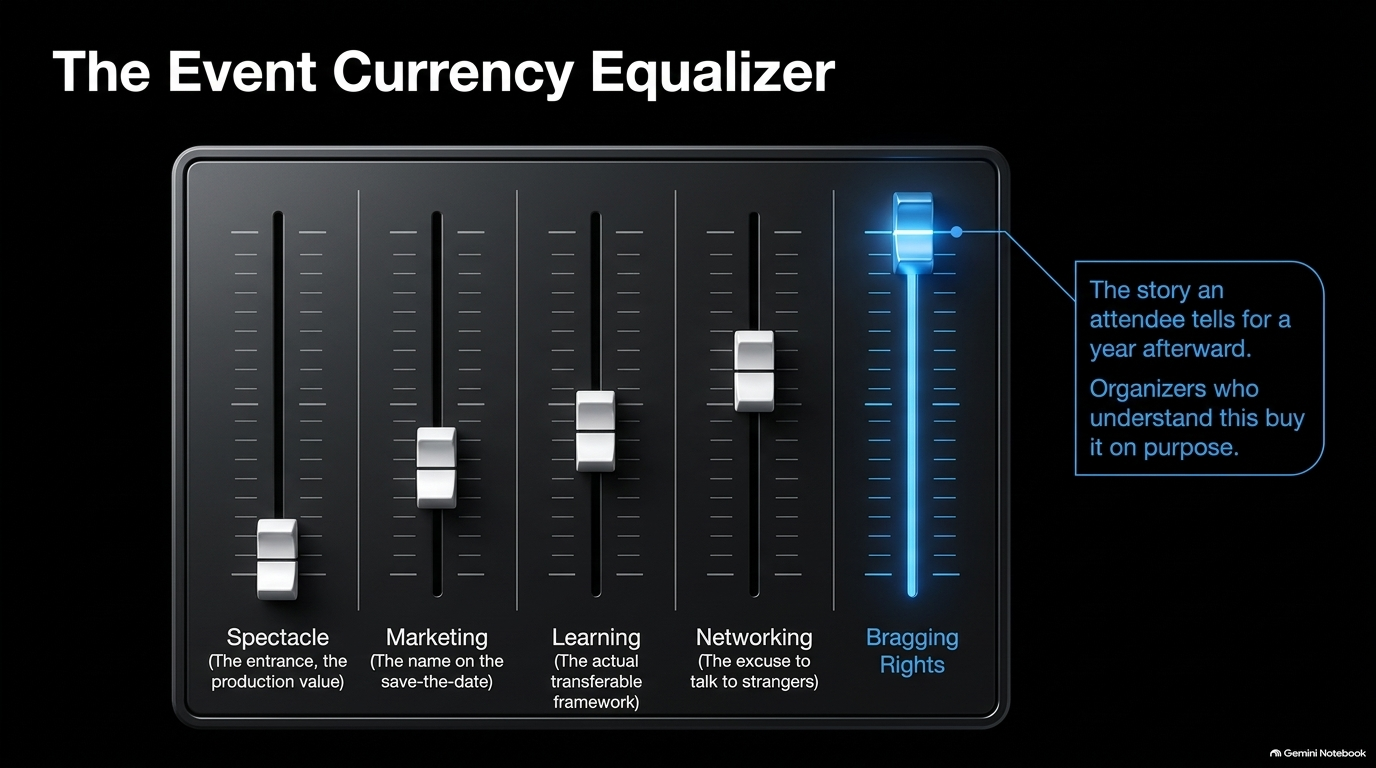
Ask an event organizer why they’re paying $40,000 for a keynote and you’ll get an answer about content. Watch what they actually do with the booking and you’ll see something else. I spent two decades watching that gap up close, clients telling me they wanted “thought leadership” and then spending the entire budget review on whether the name would move registration. The report’s central device is what it calls the four currencies: spectacle, marketing, learning, and networking, the four different things a speaking slot can be bought to deliver, usually confused for one another in the buying decision and rarely all delivered by the same person on the same night.
Spectacle is the entrance, the production value, the thing that makes an opening plenary feel like an event rather than a meeting. Marketing is the name on the save-the-date email that gets a registration clicked. Learning is the actual transferable skill or framework a session leaves behind. Networking is the excuse the room needed to stand in a hallway and talk to strangers. A marquee booking, the report argues, is superb at the first two currencies and, per that Gen Z data, closer to worthless every year at the third, which is a finding organizers already know in their gut and rarely say out loud, because saying it out loud means admitting the budget line didn’t buy what it looked like it bought. I said it out loud plenty of times over the years and watched it land badly in board meetings, because nobody wants to be the one who tells the committee the keynote was a marketing line item, not an education one.
There’s a fifth thing hiding inside spectacle that the report insists on giving its own name: bragging rights. The story an attendee tells for a year afterward, the “I was in the room when,” is a real commercial output, not a soft consolation prize for a keynote that didn’t teach anyone anything. Organizers who understand this buy it on purpose. Organizers who don’t buy it by accident and then wonder why the survey scores came back mixed. The report also walks through who’s actually making these calls: four distinct organizer types, from the association running on member dues to the brand-as-publisher treating its conference as a marketing channel, plus a fifth player, the outside agency that conceived the whole event and has its own incentives baked into every recommendation it makes. Knowing which one you are, the report argues, should come before you know which currency you’re buying.
One more gap the report doesn’t let organizers off the hook for: the format itself. You can book the right speaker for the right currency and still waste the slot by defaulting to a panel with a moderator and twenty minutes of Q&A, which is still what most rooms default to even though most organizers will privately tell you it’s the weakest structure they’ve got. I built a library of more than 150 session formats on GatheringArchitecture for exactly this, organized by the outcome you’re actually trying to produce, a decision, an alignment, new thinking, not by novelty. And once you’ve picked the structure, you still need someone who can hold it; a directory of more than 140 verified convenors and facilitators, rated on a four-level scale from convenor to steward, is the companion piece. Both are free to browse.
The layer nobody’s pricing yet: AI, real-time data, and a stack no one’s consolidated
Underneath everything above, and I think it’s the single most underappreciated finding in the whole report, a completely different layer of this business is being rebuilt in real time, by AI and by a scattered handful of platforms nobody’s consolidated yet.
Planners are starting to just ask an AI assistant who to book instead of googling a list of names, and that’s not a speaking-industry trend, it’s happening to search generally: something like 68 percent of Google searches now end without a click at all, and Google’s own AI Mode has been measured as high as 93 percent zero-click. Point that at speaker discovery and the math is brutal for anyone not already inside whatever ChatGPT or Claude or Perplexity surfaces when someone asks “who should I hire to talk about burnout.” A cottage industry of “AI visibility audit” consultants has sprung up around exactly this gap, and I’d treat their own scary statistics the way the report treats every self-interested “Top 25” list, skeptically, but the underlying mechanism is real: a handful of AI labs are quietly becoming the new arbiter of who gets recommended, with zero transparency about why.
That’s all still an AI helping an organizer decide who to book. A separate, more disruptive version is an AI helping the attendee decide whether to show up at all, screening the agenda and the speaker list and either recommending against the trip or just registering you, without you personally reading a bio or watching a sizzle reel. I can’t prove that’s happening yet at scale, but if it does, every persuasive thing this industry has built, the one-sheet, the demo reel, the bureau’s marketing copy, was built for a human deciding whether to spend a day of their life in a room, not for a machine making that call on the human’s behalf.
A related shift gets mischaracterized every time I hear it discussed: is this happening because speakers hate their agents? I don’t think so, there’s no survey showing that’s a widespread sentiment. What’s actually happening is the market dynamic this report keeps landing on: content got commoditized, a speaker with a following now has distribution a bureau’s Rolodex can’t beat, and below roughly $20,000 to $25,000 a fee, where the bulk of working speakers actually sit, the commission math just doesn’t clear for anybody, no bad actors required. The funnel runs through a LinkedIn clip instead of a one-sheet, a booking form instead of a booking desk, a QR-code survey instead of a bureau’s word for it. Worth flagging for any organizer who thinks “self-serve marketplace” means commission-free: Talkadot charges a subscription plus a 20 to 30 percent platform fee, bureau math with a nicer interface, while SpeakerHub runs flat-subscription with no cut at all. Two products wearing the same marketing.
There’s a whole layer most coverage misses because it’s about who represents the buyer, not the speaker. Bob Strange has run The Closer Speakers’ Consultancy out of the UK for three decades, sourcing speakers directly for corporate clients, not bureaus. Scurati, built by ex-bureau veteran Dogan Altindag, sells the same buyer-loyal pitch with an AI-assisted disclosed-commission shortlist, past clients including Audi, BMW, and Mercedes-Benz. PR firms and ad agencies do a rougher version daily, sourcing from bureaus on a client’s behalf and billing a coordination fee the client never sees itemized. And for the record, since I’d assumed otherwise: Freeman’s move here isn’t a human consultant, it’s a 2025 software partnership with Sessionboard running the whole content pipeline for organizers. Given the October kickback reporting on undisclosed bureau markups, a buyer-loyal, fee-disclosed layer isn’t a curiosity, it’s what a market with a trust problem produces on its own.
There’s a mirror-image tool for the speaker’s side of the same equation. Adam Parry’s SpeakerStacks, launched at SXSW London 2025, fixes the fact that an organizer legally can’t hand a speaker the room’s attendee list, so a speaker can give the talk of their career and walk off with nothing but the check. “Most event organisers can’t legally hand over attendee data, and that’s a huge missed opportunity for business speakers,” Parry told Conference News. His fix, a QR code, a consent-based landing page, an ROI report, now plugs into Lineup Ninja and Sessionboard. Everybody in this business measures the fee. Almost nobody measures what either side got back for it.
The quiet part about all of this: the content and speaker-tech layer is still wild west, SpeakerStacks, Talkadot, Sessionboard, the buyer-side curators above, each solving one piece of a fragmented stack with no dominant player and nothing talking to anything else. I think that’s an opportunity, not a knock, since the bureaus certainly aren’t building the connective tissue themselves.
Since people are going to ask: is there tech that lets a speaker see the room’s reaction in real time and adjust on the fly? The sensing half is real. Zenus does camera-based facial and sentiment analysis, already running at IMEX Frankfurt, IMEX America, and PCMA’s Convening Leaders. One meeting used it to notice women under 40 weren’t represented on its speaker roster, fixed the lineup, and watched engagement rise. But that data goes to organizers and sponsors after the fact, not to the person on stage while they’re still talking. Piping it back to the speaker in real time is still science fiction, and I looked hard enough to say that with confidence. My own bet, and it’s mine, not a product anyone’s announced: closing that loop, a live signal of how the room is receiving you while you can still act on it, would be worth more to a speaker’s career than any bureau relationship. The sensing technology exists. Somebody just has to point it at the stage instead of the sponsor booth.
There’s a bigger shift buried in that same technology: it’s making the whole program as important to analyze as any one speaker. Zenus’s own example wasn’t about whether one keynote landed, it was about which topics across a full agenda created excitement, a program-level finding. Once you have that data, the real question stops being “was this speaker good” and becomes “did the day’s actual mix match what we sold this event as,” and the report’s audit tool for that goes from a planning estimate to an actual measurement. I’ve been doing versions of this analysis myself, and it surfaces two things worth naming. One: event strategist Elizabeth Lumley has already said the quiet part, sponsors pay for access to job titles, not “interesting speakers,” so a lot of what gets billed as Learning is Marketing wearing a content costume, and real session-level data finally makes that gap visible instead of assumed. Two: Swapcard already runs AI-personalized recommendations across 4,000-plus conferences, matching people to sessions by role and interest; the next step, close now, is an agent that tells you what’s missing from the agenda for you specifically, which only works once it’s reasoning over the whole program’s shape, not one speaker at a time.
For the speaker: no ranking, and a shrinking lane
For the working speaker, the report’s most uncomfortable finding might be the simplest: there is no credible, independent ranking of who’s good at this job. Business has Thinkers50, film has the Academy, books have the Booker. Professional speaking has a scroll of “Top 25 Speakers of 2026” listicles, and the report checked, and nearly every one of them was published by a bureau or a platform with a financial interest in the names on the list. I’ve read enough of these lists over the years, on behalf of clients trying to do real due diligence, to have stopped trusting any of them on sight, and it turns out that instinct was correct. The absence of anything like an honest arbiter isn’t a footnote. It’s the finding.
There’s a small, durable lane inside this business the report insists on naming properly: the full-time act. Donna Brazile and Karl Rove, marketed jointly by the Harry Walker Agency as strategists from opposite ends of the aisle, are the one actually working the circuit right now, with two confirmed joint appearances in 2024. James Carville and Mary Matalin invented this format, and I’ve known them since the Washington Dossier days, but my own reporting for this piece found Matalin canceled a scheduled joint appearance at Chautauqua Institution in June 2025 and Carville, 81, disclosed hernia surgery in mid-2026, while the bureaus still list them together at the same fee. Whether that’s a couple still touring or a listing that’s outlived the tour, I genuinely don’t know. Harry Walker sells the identical format with Brazile paired against Michael Steele, the former RNC chair, which tells you the pairing matters more than the specific person. Newt Gingrich runs the same circuit solo, six figures a night, over a decade in. None of them ever held elected office. Unlike Clinton, Bush, or Blair, whose fees the report tracks in a dated, sourced table, speaking was never their second act. For a quarter century, it’s been the only act.
The harder news for the ordinary working speaker, the one without a cable-news chair behind them, is what’s happening underneath all of this. The report’s argument is that content alone, the framework, the three-step model, the TED-style idea, no longer justifies a fee the way it did even five years ago, because that content is one search away from free. What’s scarce now is the ability to run a live room, read it, and adapt in real time, which is a facilitation skill, not a stage skill, and most professional speakers were never trained in it and most bureaus have no way to sell it.
Who actually represents these people, and the strange bedfellows in between
One thing the report tracks that I don’t think anyone outside this industry appreciates: the agency behind a booking tells you more than the fee does. The Harry Walker Agency, now owned by Endeavor/WME, exclusively represents both Barack Obama and Bill Clinton, the cleanest, most documented representation deal in this market. Trump’s own circuit has no comparable arrangement: his 2023 financial disclosure showed a between-terms speaking income (2021 to 2025) that the report calculates as comparably lucrative to the Clintons’ own peak, run entirely without a clean agency relationship like theirs, his adult children booking instead through open marketplace bureaus. He’s back in office now through January 2029, so what he charges next is speculation, not a finding. The full breakdown, disclosure figures and all, is in the report.
The real strange bedfellows story, and a better one than any bureau double-act, is George H.W. Bush and Bill Clinton, who ran against each other in the ugliest terms in 1992 and then were recruited by George W. Bush in 2005 to co-chair tsunami relief fundraising, raising over $10 million in what NBC News described as Bush calling Clinton “brother” onstage. They did it again for Katrina, and George W. Bush and Clinton later co-founded the Presidential Leadership Scholars program together. No fee was ever paid for that stage. It’s a real civic friendship between two men who beat each other, a different, better story than “opposite sides of the aisle for hire,” which is what Carville and Matalin actually are.
And since we’re on the subject of people who used to be somebody: Rudy Giuliani’s net worth has collapsed from a peak in the tens of millions to a fraction of that, a bankruptcy filing and a $148 million defamation judgment behind him, disbarred, with Cameo and book royalties standing in for the $270,000-a-speech bureau fee he once commanded. That’s notoriety finding a cheaper channel once the legitimate one shuts down. Running the other direction, toward reconciliation: Michael Cohen, Trump’s former fixer turned star witness against him, had Trump on his own podcast in August 2026, both men saying afterward they’d “forgiven” each other. That’s the parasocial currency doing exactly what I described above: an audience that already feels it knows the relationship can resurrect a career the legal record alone should have ended.
For the attendee: the room is the whole point
Go back to that 12 percent. It isn’t that Gen Z has a shorter attention span. It’s that the scarce commodity at a live gathering was never the content, it was always the room itself, a specific configuration of people arguing about a specific problem on a specific afternoon, and that cannot be downloaded, replayed, or generated. The report leans on Dunbar’s number and basic cognitive-load research to argue a plenary hall of 3,000 has never been where learning actually happens. It happens in the breakout, the roundtable, the hallway conversation the breakout was designed to cause, and all three live or die on the person running them, not the person headlining them.
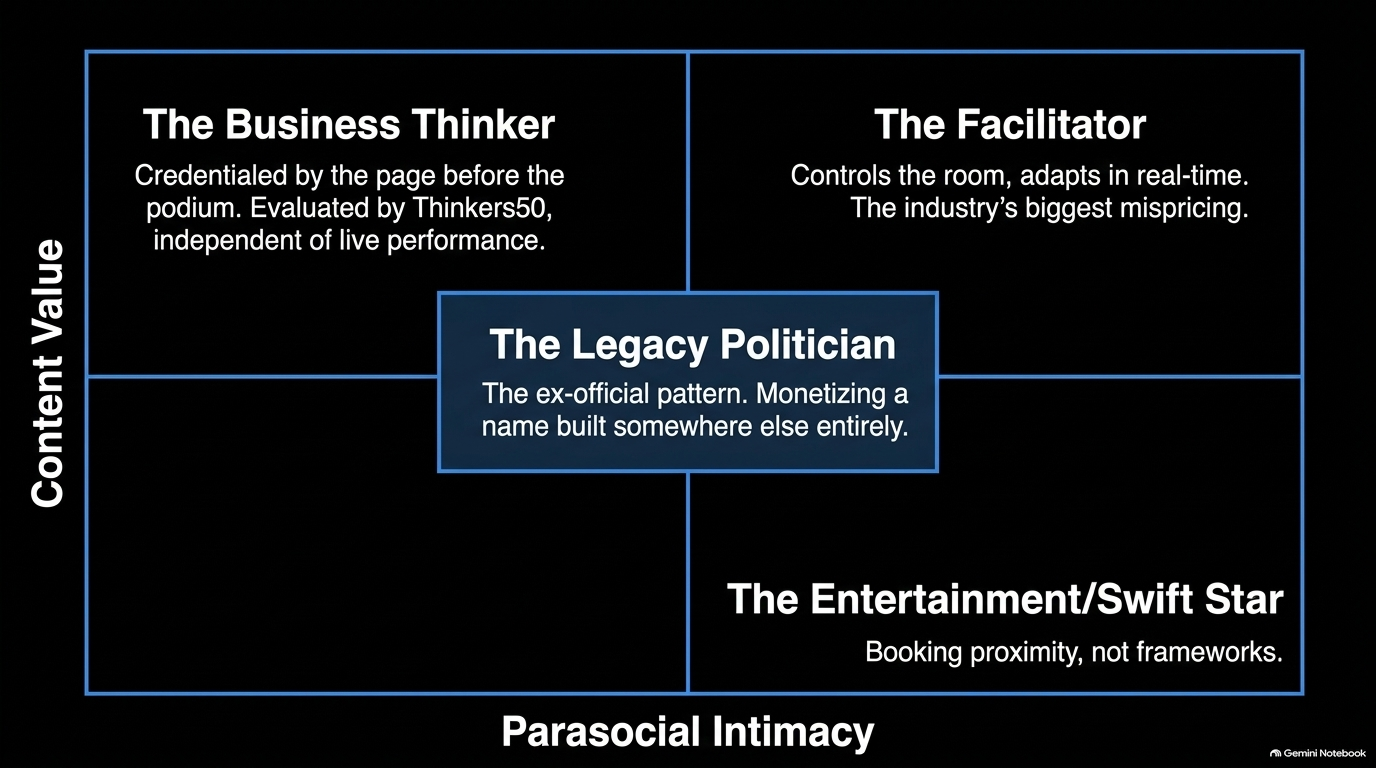
That person is a facilitator, and the report treats the fact that facilitation has no fee scale, no bureau infrastructure, and no bragging-rights value remotely close to a keynote’s as the industry’s most obvious blind spot. Speakers have Harry Walker, Washington Speakers Bureau, APB, and a private-equity ownership map the report walks through in detail. Facilitators, doing arguably more of the actual teaching that happens at any given conference, have nothing comparable. I think that gap is the single biggest mispricing in this entire industry, and the report’s bet is that it closes, and closes fast, precisely because AI has made the free-content half of the speaker’s value proposition worthless while making a skilled live facilitator more valuable, not less.
The currency nobody in the bureau world names: parasocial
Here’s the fifth thing driving bookings that the report insists on naming properly, because I think it explains more of this business than the four official currencies combined, and it doesn’t require the speaker to be impressive at all. It requires the audience to feel, correctly or not, that they already know this person. Psychologists Donald Horton and R. Richard Wohl coined the term “parasocial” back in 1956, watching early television audiences fall for on-screen personalities they’d never met. I think it’s the whole explanation for why Taylor Swift can command seven figures for a single corporate date while a Nobel laureate can’t clear five, and it’s the honest answer to a question I keep getting asked: why do consumer conventions built entirely around reality television and comic-book franchises keep outgrowing the business events I spent a career building.
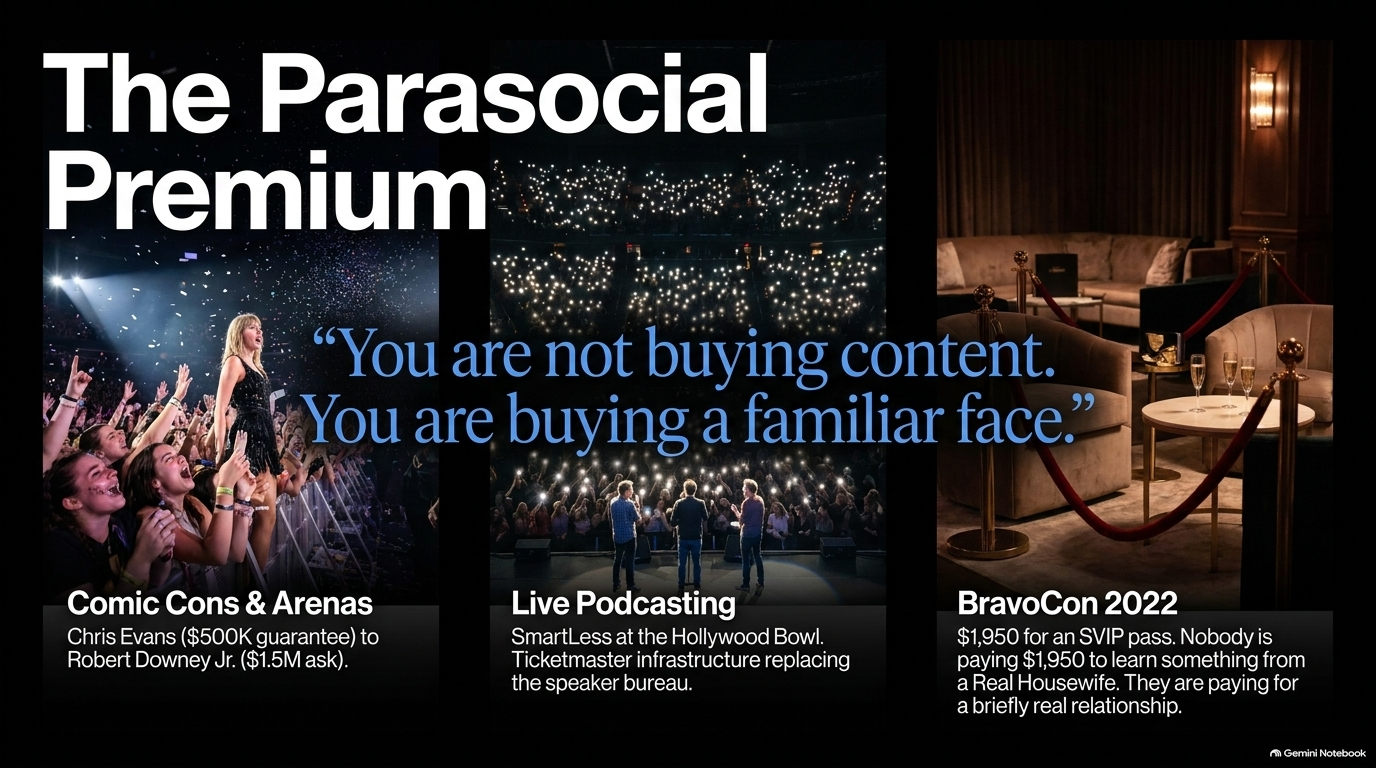
BravoCon is the cleanest example: fans paid up to $1,950 for a top SVIP tier at the 2022 event, buying meet-and-greet access to Bravo personalities, not learning anything from a Real Housewife. Comic conventions run the identical math higher up, with reported weekend guarantees putting Robert Downey Jr. as high as $1.5 million. Taylor Swift is the same mechanism at the top of the market, and it’s why the report’s entertainment-tier fees run past $1 million a date: a corporate booker is paying for proximity to someone millions of people feel they already know, not an hour of songs.
Live podcasting is the newest version of the same instinct, and it’s starting to compete with the keynote circuit for the same money. “SmartLess” took its format to the Hollywood Bowl; Alex Cooper’s “Call Her Daddy” ran a sold-out arena tour. Both booked through Ticketmaster and Live Nation, concert infrastructure, not a bureau, because a podcast host offers hours of accumulated audio intimacy no forty-minute keynote can match.
I’ll go a step further than the report does, because this is my read, not a proven finding: parasocial dynamics explain more of Donald Trump’s political durability than his policy positions do. A University at Buffalo study found voters who’d watched “The Apprentice” felt they genuinely knew him, a feeling that predicted their 2016 vote and made them discount negative coverage. The mechanism isn’t partisan, researchers have described a similar “My friend AOC” bond on the left, it’s just more powerful than most of us want to admit.
The same logic is reaching places that would have been unthinkable a decade ago: OnlyFans now sends its executives to legitimate business conferences, its CFO argued at TNW Amsterdam in 2024 that the platform is a creator marketplace, not an adult site, while adult performers already run their own speaking circuit at XBIZ and AVN on the same fee logic as BravoCon.
For an organizer, the takeaway is simple: this currency doesn’t correlate with the report’s other four. A reality personality or podcast host can be worthless for learning and still sell out the room, because nobody’s buying content or status. They’re buying a familiar face, the right tool for some events and exactly the wrong one for a room that needs people to learn something.
Nobody wants to talk about the actual controversy
Here’s the part of this business that never makes it into a bureau’s pitch deck, and it’s become the most consequential thing happening in the room right now: the country the speaking business sells into is polarizing faster than the business has adjusted for, and organizers no longer agree on who counts as a safe booking.
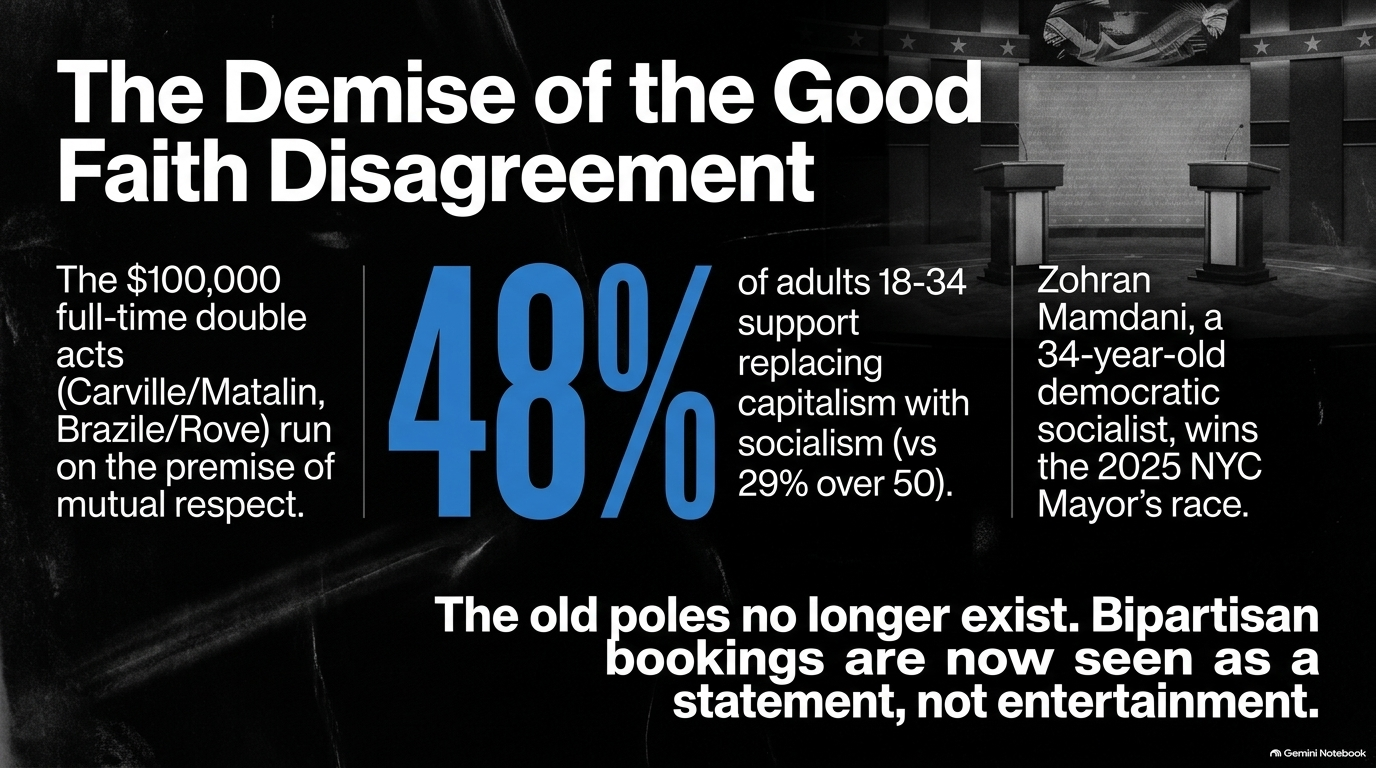
Start with the generational gap. An ongoing national survey by icitizen found 48 percent of adults 18 to 34 said they’d support replacing capitalism with socialism, against 29 percent of adults 50 and older, an opt-in poll worth taking loosely on the exact number but not on the direction (Latin Times). That gap stopped being theoretical in November 2025, when Zohran Mamdani, a 34-year-old democratic socialist backed by Bernie Sanders and Alexandria Ocasio-Cortez, won the New York City mayor’s race on an affordability platform carried by young and progressive voters (CBS News). That’s not a campus theory anymore. That’s the mayor of the largest city in the country.
Gaza is the fastest-moving trigger on top of that, and it’s not staying on campuses even though campuses are where it’s best documented. Rutgers dropped a biotech CEO from its 2026 commencement after students objected to his posts on Gaza. Georgetown Law’s speaker withdrew after a student petition over his views on Israel. Utah Valley pulled a commencement speaker after backlash tied to a post about Charlie Kirk’s killing on that same campus. South Carolina State canceled its lieutenant governor over her politics, citing safety concerns (Inside Higher Ed). A PR professional quoted in that reporting said it plainly: critics now surface a disqualifying statement “within minutes, hours, days” of an announcement, not weeks. I’ve watched that speed happen in real time on bookings I had nothing to do with, and it is genuinely faster than most comms teams are built to respond to.
Here’s the uncomfortable connection back to Brazile and Rove, and the format Carville and Matalin invented. Their whole act depends on a room believing two recognizable sides can disagree in good faith and both walk away respected. That premise gets harder to sell every year a meaningful share of the youngest people in the audience stop seeing the two major parties as the real poles at all. I don’t think the bipartisan double-act disappears. I think it gets harder to book without someone in the room deciding it’s a statement rather than entertainment.
So is everybody just scared? Mostly, yes, and I don’t think that’s cowardice so much as arithmetic. A controversy hits spectacle and bragging rights, the two currencies a board or a membership actually sees, and never touches learning at all. Nobody gets credit for the provocative booking that goes fine. Everybody remembers the one that doesn’t. What the corporate and association world does instead of a public disinvitation is quieter and less dramatic: a morality clause negotiated before the contract is signed, not improvised during a crisis. A bureau source I’ve seen quoted described pulling an offer from a celebrity caught on camera in an ugly, abusive confrontation, and getting the agent to back off the signed deal only after documenting the exposure in writing. Her advice was the whole lesson: don’t wait until you’re in the middle of it to have the clause.
There’s a second threat sitting next to that one, and it’s not the same problem wearing a different hat, so I want to be precise about the difference. A morality clause defends against a booking that turns into a liability before the event happens. It does nothing for a group that shows up to an event that’s already fully contracted and running, and takes the stage, the hashtag, and the news cycle in real time. I wrote about exactly this collision back in November, in “Inside the Protest That Stole Your Event,” and Climate Defiance is still the clearest case study going. They’re not limiting themselves to podiums with politicians on them: their record includes disrupting Occidental Petroleum’s CEO mid-remarks at the New York Times’ Climate Forward summit, an event that ended up going virtual after ten arrests, though the footage was already circulating before the room had even cleared; a three-story “Oil $$$ Out of the DNC” banner at the DNC’s winter meeting; and confronting EPA administrator Lee Zeldin in the Hamptons during wildfire haze, chanting “What will you tell your children when the Hamptons are underwater?” That’s not improvised outrage. Michael Greenberg, the group’s founder, told me his read on a room comes straight from his stand-up background: “You sense energy. You break tension. Protesting isn’t that different, it’s a live audience, and you’re trying to change how they feel.” His team runs like a startup war room, dedicated Slack channels for visuals, rapid response, legal, a decentralized plan where only a handful of people know the full sequence, videographers trained, in his words, to “hold frame, upload fast, beat the official feed.” That’s a deliberate, rehearsed operation running its own script against your program’s script, on your stage, on your night. No morality clause touches that.
What’s grown up to meet it is its own quiet industry, and it deserves its own paragraph because most organizers have never heard of it. Crisis firms, Brunswick, Edelman, APCO, Hill+Knowlton, Sitrick, Teneo, Rokk Solutions, FTI, SKDK, BerlinRosen, The Messina Group, Kekst CNC, are now getting called in before a stage is built, not after something happens on it, drafting disruption scenario trees for programs that haven’t run yet. David Fuscus, who runs Xenophon Strategies and built the predictive platform Précis AI, put it to me in the plainest possible terms: “There are two kinds of companies. Those that have had a crisis. And those that will. Speed is everything.” When his team found three protestors hiding in a supply closet at one event, his instinct ran the opposite direction from instinct: “Security wanted to arrest them. I told them: give them sandwiches. Walk them out. Don’t feed their narrative with a perp walk.” For the highest-exposure sectors, oil, pharma, defense, the playbook goes further than a well-briefed moderator: mapping the room for likely flashpoints in advance, live sentiment spotters reading the emotional temperature of the crowd in real time, lighting and music cues built to de-escalate without anyone visibly confronting anyone, high-risk content quietly siloed into invite-only breakouts, pre-written response content ready to flood social the instant something happens, even a celebrity appearance or product reveal timed deliberately to overshadow a protest’s window. A few firms have gone as far as hiring former protestors to help design against their own old tactics. This is not theoretical. It’s the same production discipline this whole report keeps circling back to, aimed at the newest thing an event now has to manage: whether the room stays your story, or becomes someone else’s.
What’s inside the full report
The four currencies every event is actually buying, and why most organizers can only name one of them
Four organizer types, and the outside strategist who isn’t the organizer at all
A dated, sourced table of what former presidents, prime ministers, and first ladies have actually been reported to charge, Clinton to Blair to Palin
The new, unaccountable ranking system nobody’s talking about: how AI assistants are becoming the arbiter of who gets recommended, with zero transparency into why, and the stranger next step, an AI agent deciding on the attendee’s behalf whether to show up at all
The buyer-side layer nobody maps: independent consultants, AI-assisted curation shops, and the agencies quietly sourcing speakers on a client’s behalf
Real-time audience-reaction tech: what’s actually real (Zenus), what’s still science fiction, and the case for pointing it at the stage instead of the sponsor booth
The bipartisan double-act: Carville and Matalin, Brazile and Rove, Gingrich, and why they’re the industry’s actual full-time speakers
Who represents whom: Harry Walker’s exclusive hold on Obama and Clinton, Trump’s looser circuit, and the real story behind the Bush-Clinton “strange bedfellows” friendship
The honest Giuliani story, and Michael Cohen’s stranger one
The parasocial currency: BravoCon’s meet-and-greet pricing, Taylor Swift’s fee logic, live podcasting, and why a theory about Trump belongs in a report about event booking
The politics underneath the booking: Gaza-driven disinvitations, the generational shift toward socialism, and why the old bipartisan center is narrowing
Defensive planning for the disruption era: inside Climate Defiance’s playbook, and the crisis-firm industry built to counter it
The entertainment tier: what it costs to book a touring act instead of a keynote, and why those fees are up 30 to 40 percent since 2020
The bureau ecosystem, the boutiques that work commission deals with the big houses, and how private equity quietly bought the top of the market
Why there’s no Booker Prize for public speaking, and what that absence actually means for organizers doing due diligence
The decade GOATs, argued rather than ranked, 1990s to now
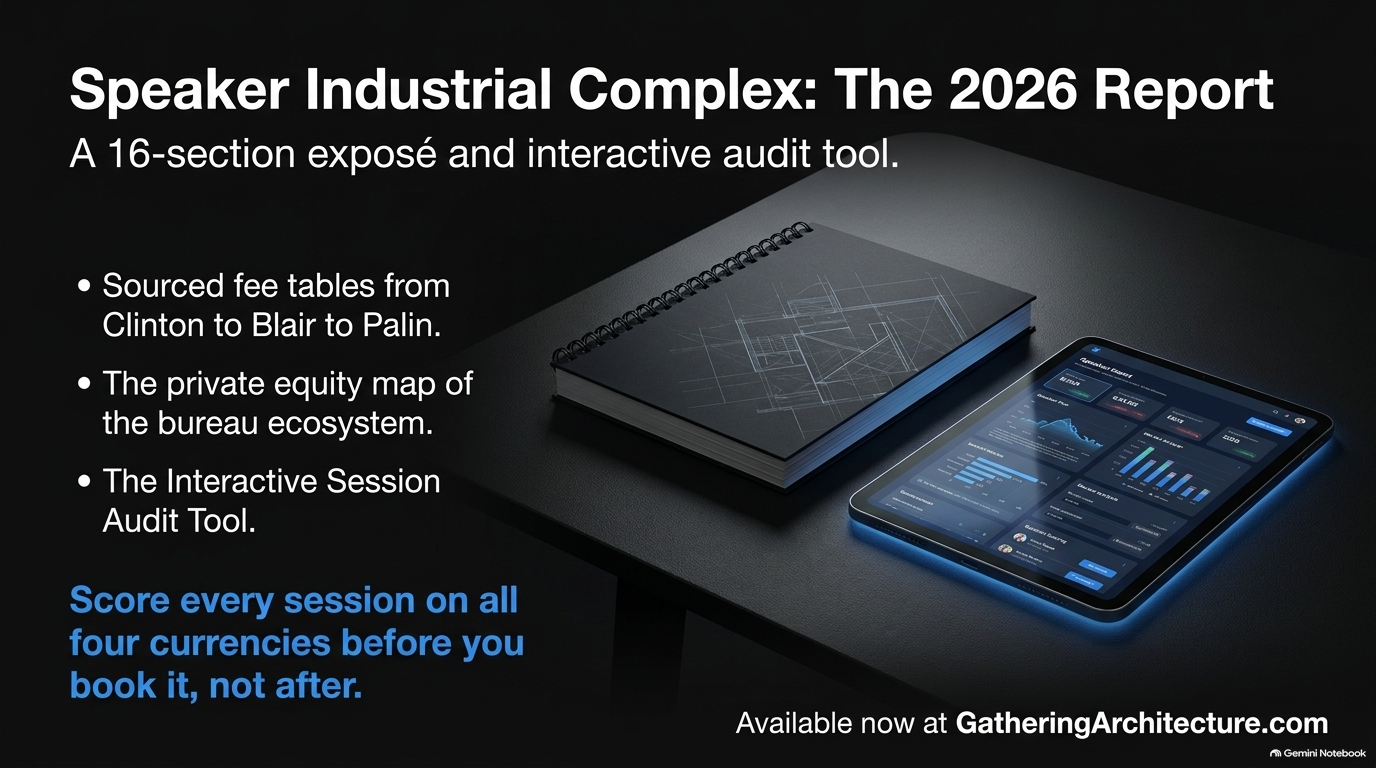
A working audit tool: score any session on all four currencies before you book it, not after
The taste of it, market by market
Run the full-time-speaker question across politics, business thinking, motivational speaking, entertainment, and sports, and the same pattern holds everywhere with a different cast: a small, durable lane of people for whom speaking was always the whole job (Brazile and Rove, Tony Robbins, Brené Brown), sitting next to a much larger population for whom it’s a second act grafted onto a career that ended somewhere else (the ex-president tier, retired athletes). The full-time-speaker category turns out to be rare enough, in every one of these markets, that you could name most of its members off the top of your head. The report walks all five markets decade by decade, plus its own editorial read of who defined the job in each one, the “decade GOATs,” from Robbins and Ziglar in the ‘90s through the TED-talk era to whatever’s being written right now. That’s a full report’s worth of detail I’m not going to try to compress into a paragraph here; read it at GatheringArchitecture.com.
The bet
None of this means the keynote disappears. Spectacle and bragging rights aren’t going anywhere, and a marquee name will keep selling tickets to a general session for exactly the reasons it always has. What the report is actually betting on, and what I’m putting my own name behind by publishing it, is a reallocation: less money assuming a famous face on a mainstage solves every problem a gathering has, more money finding its way to the people running the rooms where the actual work happens, the organizers who name what they’re buying before they buy it and who put the morality clause in the contract before they need it, the speakers who learn to run a room instead of just perform in one, and the attendees, Gen Z first, everyone else close behind, who’ve been telling us for years that the hallway was the good part. GatheringArchitecture is calling that shift now, in public, with an audit tool attached, so that in two years there’s a receipt for having said it first.
“Speaker Industrial Complex: The 2026 Report” is available now at GatheringArchitecture.com.