
The Seventy-Five Minutes After the Shot
Saturday at the Hilton, read from the event production side.
Every event organizer in America who watched the footage from the Washington Hilton on Saturday night did the same private inventory in their head. Where would I have been standing. Whose voice would I have been hearing in my ear. What would I have done with the next ninety seconds. The answer most of us came back with, if we were honest, was that we have spent careers building the muscle for nights that go right and almost no muscle at all for the night that ends with a federal officer at the back of house saying nobody touches the gear. That is the night we should have been training for. After Saturday, it is the night we have to.
What happened, for the record, is that at 8:36 P.M. a man armed with a shotgun, a handgun, and multiple knives reached the Secret Service magnetometer line at the entrance to the International Ballroom — the checkpoint dinner attendees had cleared on the way in — and charged it as agents were breaking it down for the night, exchanging fire with the agents intercepting him. A uniformed officer was struck and saved by his ballistic vest, then released from the hospital later that night. Inside the room, more than two thousand people in black tie went under their tables while the President, the Vice President, the Speaker of the House, the HHS Secretary, and a long table of cabinet officials were pulled off the dais by their details. The security around the dinner had been described that day, by former FBI deputy director and CNN commentator, Andrew McCabe, as almost on the level of a national security event. By Sunday morning the headlines belonged to the politics. The story for the people who actually build these rooms is something else.
The Reflex
The most important sentence spoken about Saturday night from an event pro perspective was not delivered from the dais. It was delivered on cable television, while the Hilton was still being processed as a federal crime scene, by McCabe. There is no chance, McCabe said. No circumstances under which you advise the host of that event, or the President and his team, to do anything other than send everyone home. The place is frozen. It is a crime scene. The show does not go on.
That sentence belongs in every show caller’s binder, taped to the inside cover, read again before every load-in. The reflex of the showrunner, of the producer, of the person whose entire professional identity is built around the show going on, is almost always wrong in the first two minutes after a violent disruption inside a credentialed gathering. The reflex says keep the room. Salvage the night. Finish the program. McCabe’s rule is the corrective. The moment a weapon is discharged inside or adjacent to your perimeter, the event is over. The venue is no longer a venue. It is evidence. The decision to end the program is not yours at all; it has already been made by the building.
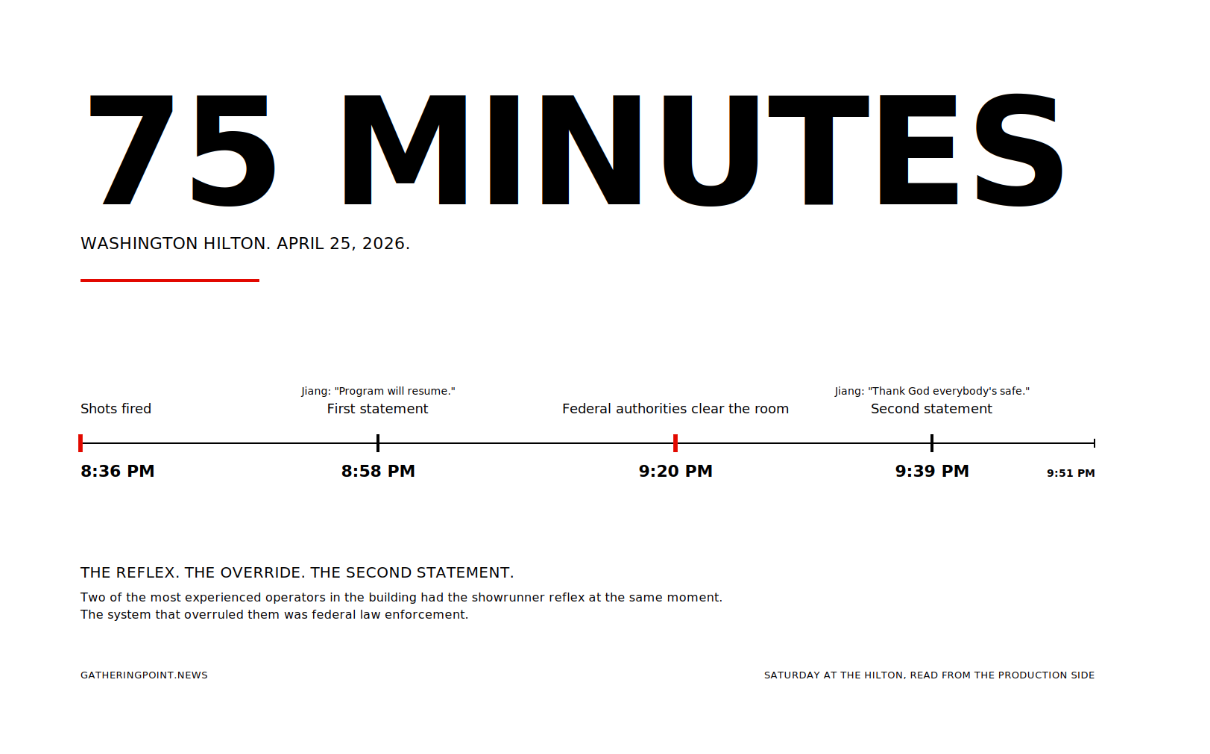
Saturday gave us the case study for how universal the reflex is and how hard the rule is to apply in real time. Twenty-four minutes after the shots, around 8:58, Weijia Jiang — the senior White House correspondent for CBS News and the elected president of the White House Correspondents’ Association, which produces the dinner — returned to the podium and told the room the program would resume momentarily. We don’t have all the details, she said, but we’ll have them shortly. Half an hour later, Trump posted on Truth Social that he had “recommended that we ‘LET THE SHOW GO ON,’” though he would defer to law enforcement. He told reporters at the White House later that he had wanted very much to continue, that he didn’t want sick people and thugs to change the fabric of American life, that the dinner would be rescheduled within thirty days. Two of the most experienced operators in the building on Saturday night had the showrunner reflex at the same moment. The system that overruled them was federal law enforcement, which by 9:20 had begun clearing the ballroom over the host’s stated intention to resume.
At 9:39, an hour and three minutes after the shots, Jiang returned to the dais. Per Variety, she came up with tears in her eyes. Law enforcement, she said, had requested that we leave the premises consistent with protocol, and we will do that. Trump wanted to emphasize that nobody was hurt. He had wanted to do this tonight, but security protocol had to be followed. And then, finally, the line that the world will remember: journalism is a public service, because when there is an emergency, we run to the crisis, not away from it. On a night when we are thinking about freedoms and the First Amendment, we must also think about how fragile they are. Thank God everybody’s safe. We will do this again.
The reading the industry should take from this is not that Jiang failed and then recovered. The reading is that nobody nails the moment the first time, almost nobody, and that the discipline isn’t in being the rare person who does. It’s in having a system, internal or external, that catches the wrong call and forces the right one before it is too late to correct. The single most powerful figure in the room had the showrunner reflex. The most carefully prepared host of the night had the showrunner reflex. The corrective came from the only people in the building who weren’t part of the production: federal law enforcement. The lesson for the rest of us, working without a federal apparatus to stop us from making the wrong call, is that the discipline of overriding the reflex has to live somewhere in the organization before it is needed. Usually that somewhere is one specific person, calling the night, with the radio in their hand, whose job it is to know McCabe’s rule cold and to apply it whether or not the talent agrees. If your operation does not know who that person is, you do not have a plan. You have a wish.
The Second Statement
The remarkable thing about Jiang’s 9:39 statement is not that it was eloquent, though it was, or that she delivered it through tears, though she did. The remarkable thing is that it was her second pass. The first pass, twenty-four minutes after the shots, had said the program would resume. She had to walk that back, in front of the same room, on a live broadcast, with the cameras up. Anyone who has ever been at a microphone on a difficult night knows what that costs.
There is a craft lesson buried in the gap between her two statements, and it goes deeper than the showrunner reflex. The 8:58 statement was procedural. We don’t have details, the program will resume, please be patient. It told the room what was going to happen next. It did not tell the room she had heard what had just happened to it. The 9:39 statement did. Thank God everybody’s safe. Same speaker, same room, ninety seconds, completely different acknowledgment of what the people listening had just been through. Every announcement in a crisis has two layers, the operational and the empathetic. The most experienced operators tend to nail the operational and miss the empathetic, because under pressure, with adrenaline still moving, the human in the microphone defaults to procedure and forgets that the people in front of them just had a thing happen. The discipline is to acknowledge the thing first and run the procedure second. Almost nobody does on the first pass. Jiang did on her second, with tears in her eyes.
The public-facing host of any major gathering has roughly ninety seconds to set the emotional register for everything that follows. Jiang’s first were the wrong ones. Her second were the ones the industry will study. That a CEO of a major event company can read this paragraph and not be able to name the person in their own organization who would have the second-statement instinct is the curriculum problem this work has been carrying for a decade. Saturday is what makes it urgent. Most of us would not even have the chance for a second statement; the room would already be gone.
The Seams You Signed
The single most operationally consequential fact to emerge from Saturday is one the political coverage will mostly miss. The attacker was a guest at the Hilton. He had a room. His key card got him into the building, into the elevators, into every corridor that mattered. By the time he reached the magnetometer line at the entrance to the International Ballroom, he had not been challenged once. The dinner’s screening was at the ballroom door. The screening for everything between his room and that door was, as it is on every Saturday, a key card. The Associated Press has now reported what the industry has known and quietly accepted for years: the Washington Hilton remains operational as a hotel during the dinner, with the credentialed event’s screening and security positioned at the ballroom itself rather than at any point earlier in the building.
If you have ever signed a venue contract for a flagship hospitality property, you know this seam, even if your contract did not name it. The licensed-premises section defines what you are renting, which is the ballroom and usually a designated prefunction area. By implication, everything else in the building is the hotel’s, under the hotel’s standard operating posture, which for most flagship properties means a key card and not much more. The seam is the architecture of every major hotel-anchored gathering in America: the convention hotel during a software keynote, the resort property during a tech week, the historic ballroom during an awards weekend, the conference hotel during a political summit. The screening is at the credentialed event’s door. The bar adjacent to the checkpoint is not. The hallway from the spa to the loading dock is not. We have all signed this seam. Most of us have never asked what is on the other side of it.
There is a second seam, less obvious and possibly more troubling, that emerged from the surveillance footage Trump released on Saturday night. The video shows the attacker running past officers who were disassembling the metal detectors. The Secret Service line is that this is standard procedure: once the principals are seated and the room is closed, the magnetometer line is no longer needed, and it comes down. The director called it proof that the multilayered protection works. That is one defensible reading. The other is that the screening apparatus contracts inward toward the principals at the moment when, by definition, anyone still trying to come through is the threat. Look at your own run of show. The breakdown of the magnetometer line is on it somewhere, probably in small print, probably scheduled to the minute. Has anyone in your operation ever asked what it means. Whether the threat profile of late arrivals is meaningfully different from the threat profile of the seated room. Whether the venue’s security partner has thought about it the same way you have, or thought about it at all. On Saturday night the answer at the Hilton was that the apparatus came down on schedule, and a man with a shotgun was charging the line twelve seconds later. Go look at your own next major load-in and ask the question.
The case for treating the seams as structural, rather than as an operational lapse the Hilton can be blamed for, has hardened in the past twenty-four hours. McCabe was right that the security around the dinner was at near national-security level. CBS has now reported that the attacker purchased the shotgun in August 2025, owned a handgun since 2023, and traveled by train from Los Angeles to Chicago to Washington, avoiding airport screening, in what law enforcement is calling a planned attack he did not intend to survive. This was not an opportunist who stumbled into an open door. This was someone who studied the architecture for at least eight months and exploited it deliberately. The seams the industry has been quietly content to leave unaddressed have now been mapped, in operational detail, by a person willing to die using them.
The People You Walk Out With
The night you walk out, you do not actually walk out. You are responsible for the AV crew that has been on site since Friday and now cannot touch the patch bay. The caterer with several hundred plated entrees in the wells. The florists whose centerpieces are now logged as evidence. The transportation company with idling cars on Connecticut Avenue. The production team that has been building the stage since Friday morning and is now standing in the back of house with no instructions. None of them are going to break down their gear on Sunday. None of them are going to break down their gear on Monday. The Hilton ballroom is a federal crime scene, and federal crime scenes do not release equipment until the investigators are finished with them.
Most vendor contracts treat force majeure as a binary. The event happens or it does not. They do not contemplate the middle case, which is the one that played out: the event happened, the vendors performed, the venue was then seized with capital equipment held inside for an indeterminate period. If you are the organizer in this scenario, you are not just dealing with your own load-out. You are dealing with fourteen AV people who have flights, childcare, and gear sitting in a room they cannot enter. You are the person they call. Every senior organizer should be on the phone with contracts counsel on Monday morning. The cost of the gap will eventually be paid by someone. Better that it is identified before the next time, and not after.
Monday
The honest version of what happened Saturday is that the system worked, twice. The Secret Service intercepted a determined attacker before he reached the ballroom. A vest stopped a round. The principals were evacuated cleanly. And then, when the host and the President both wanted to keep going, federal law enforcement made the McCabe call for them and cleared the building. The attacker will be arraigned Monday in federal court on charges of using a firearm during a crime of violence and assault on a federal officer with a dangerous weapon, with additional charges expected. CBS has reported, citing two sources, that he told investigators he wanted to shoot Trump administration officials, a claim that should be treated as preliminary until the affidavit is unsealed.
By any operational measure, this is the best-case version of a worst-case scenario. The danger now is the reflex, again, to read that as reassurance and move on. Read it instead as the inflection point that closes a chapter of American event security in which the quiet assumption was that the perimeter held. The perimeter did not hold on Saturday. A man got through. He was stopped by one officer’s vest and a few seconds of training, and the next time the gap is exposed, the officer may not be as fortunate.
What should be on every organizer’s Monday agenda is not the active-shooter drill. The Secret Service does not need event-industry advice on checkpoints, and most major venues already game out shooter scenarios with varying degrees of seriousness. What needs to go on the agenda is the seam audit. Where, in your next twelve months of confirmed bookings, does the credentialed perimeter end and the open hotel or campus begin. When does your screening apparatus come down, and who has thought about the threat profile of a late arrival. Who, contractually, is responsible for the corridor in between. Who in your organization has the discipline to override the showrunner reflex when the talent wants to keep going, and when you yourself want to keep going. Who has the second-statement instinct if they have to use it tonight. And who in your operation has ever sat through a forced simulation of the seventy-five minutes after the shot, when the protectees are gone, the venue is frozen, the broadcast is dark, the crew is stranded, and the host has ninety seconds to set the tone for everything that follows. That is the room most of us have never been in. After the Hilton, every one of us should be.
The Thirty-Day Problem
Trump announced from the White House that the dinner would be rescheduled within thirty days. That is a political statement, not an operational one. The rescheduled date will be set by the FBI’s release timeline for the ballroom and the gear inside it, not by the President’s preference. And the rescheduled dinner, whenever it happens, will run on top of a contract stack that was not written for what just happened.
A black-tie dinner of more than two thousand attendees in a flagship Washington ballroom is a multi-million-dollar production. Almost all of it was performed Saturday night. Some of it cannot be performed twice. Some of it cannot be touched until federal investigators release the room. The rescheduled night will require a fresh build under the same vendor relationships. The contracts that govern all of it treat force majeure as a binary, the event happens or it does not. The middle case the WHCA just lived through is not in the standard language.
Who pays for the redo is the question every event CFO in the industry should be working through this week, even if their next major night is months away. The likely answer for the WHCA is a combination of insurance recovery, venue and vendor accommodation, and a meaningful net cost the association absorbs. The likely answer for the rest of the industry is that contracts written next quarter look different from contracts written last quarter. The line item nobody had a name for on Saturday afternoon will have one by Monday morning.
Editor's note. David Adler is the founder of BizBash, Founder of Washington Dossier Magazine and Curator in Chief of GatheringPoint.news. He has been covering the White House Correspondents' Dinner for over 40 years. GatheringPoint covers the people who build the gatherings. Subscribe at GatheringPoint.news.


Timeline analysis and interesting read David. Thank you for sharing your pertinent insights.
David, amazing analysis! You absolutely covered everything and we are in for a new event planning since now...!
I have had the honor and privilege to do so many events with all US Presidents (and the same several times) since Reagan! We, as hotel Catering Galas specialists, that I claim I am, do not have much to say as Secret Service and WH police control everything on our property day and evening of the event. Which I have no issue with, just more costly and more planning but the exposure of having POTUS is everything for a hotel!
Sharing with my Hotel Team. THANK YOU!