
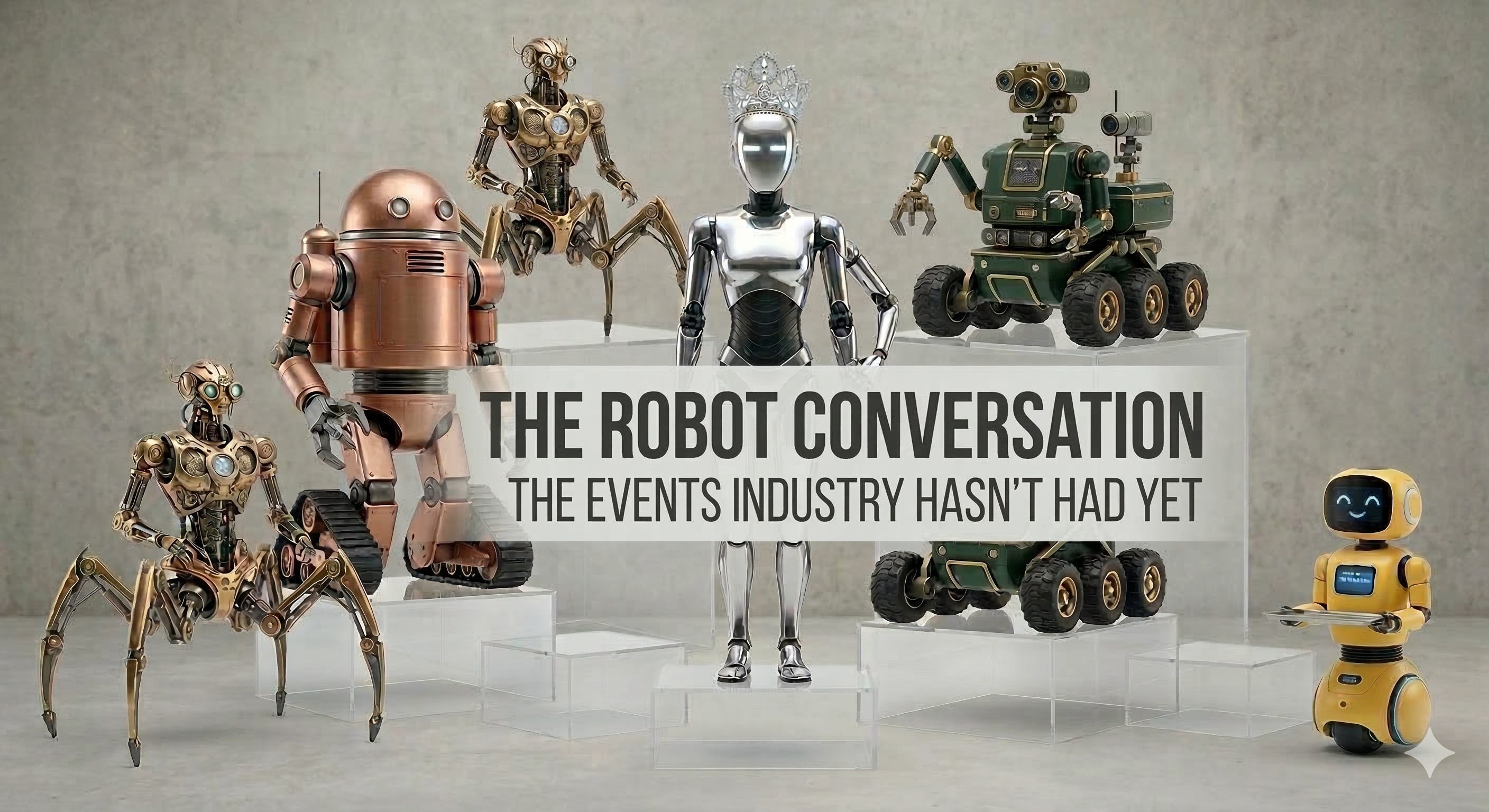
The Robot Conversation the Events Industry Hasn’t Had Yet
A dispatch from two gatherings
The conversation at the CEO Summit of the Society of Independent Show Organizers sounded exactly the way the exhibitions business has always sounded when the people who run marketplaces gather to compare notes.
Square footage still dominates the conversation. How much carpet can a show sell? How much does it cost to produce it? What happens when buyers increasingly arrive already informed by digital research or artificial intelligence tools that compare suppliers before anyone boards a plane to attend a trade show?
Around the table were organizers whose companies operate in the same ecosystem as the global exhibition giants—firms like Informa, RX Global, Emerald Holding, Clarion Events, and Easyfairs.
These companies collectively operate the marketplaces where entire industries conduct their annual commerce—from healthcare technology to construction equipment, hospitality services to advanced manufacturing.
The tone in the room was pragmatic and slightly reflective. For decades the exhibition industry has measured success with a simple ruler: carpet. Net square feet sold. Booth count. Attendance. The exhibition floor functioned as both marketplace and metric.
Between sessions I opened a Substack post written by futurist entrepreneur Peter H. Diamandis describing the second day of his AI Agent Abundance Summit.
The gathering had nothing to do with conferences or trade shows.
The founders and investors there were discussing humanoid robots. What was striking in Diamandis’s notes was the tone of urgency. The founders speaking there were not describing a distant technological horizon. They were describing machines already moving out of laboratories and into workplaces. Several suggested that the shift from demonstrations to real deployment could begin within the next few years. The implication running through the discussion was simple: the robotics future is not decades away. It is arriving now—and faster than many industries expect.
The summit itself sits inside Diamandis’s broader Abundance community. At the center is Abundance360, an invitation-only membership group that brings together entrepreneurs, venture investors, and technology founders several times a year to discuss what Diamandis calls “exponential technologies.” Membership is intentionally selective and historically priced around $25,000 a year, drawing CEOs, founders, and investors who want early signals about emerging industries. The meetings function less like traditional conferences than private briefings from the technological frontier—rooms where artificial intelligence, robotics, biotech, and space ventures are discussed before they become visible to the wider economy.
Sitting in the SISO room, listening to exhibition leaders debate square footage and AI-driven buyer discovery, the contrast between the two gatherings was hard to miss. One room was talking about how marketplaces evolve. The other was talking about machines that may soon reshape how physical work gets done.
The Companies Behind the Conversation
The robotics conversation at the AI Agent Abundance Summit was not theoretical. The founders presenting there represent companies already building machines intended for real environments.
One of the most visible is Agility Robotics, whose robot Digit has been designed for logistics environments. The machine walks on two legs, lifts packages weighing roughly thirty to fifty pounds, and has already been tested inside warehouse operations connected to Amazon. The company is building manufacturing capacity in Oregon that aims to produce thousands of robots each year, suggesting the transition from laboratory prototypes to commercial deployment is already underway.
Another company discussed at the summit was 1X Technologies, which is developing a humanoid robot called Neo designed specifically to operate around people. Unlike traditional industrial machines powered by high-speed motors, Neo relies on tendon-like systems inspired by human muscles. The engineering goal is safety: reducing the mechanical force inside the robot’s joints so it can operate in environments where humans move unpredictably.
A third firm drawing attention was Clone Robotics, which is experimenting with machines built around synthetic muscle fibers and skeletal structures designed to replicate the mechanics of the human body. Their long-term ambition is precision—robots capable of performing tasks that require delicate physical control.
The companies represent very different approaches to the same challenge, which is why Diamandis described the current robotics moment as something closer to a Cambrian explosion than a single race toward one dominant design.
Different robots are emerging for different environments.
And that is where the conversation begins to intersect with the gatherings industry.
Because once you begin looking at conferences and trade shows through that lens, you realize those environments already contain many of the conditions robotics engineers are designing for.
Yet reading those notes from the vantage point of someone who spends a life around gatherings produced an unexpected thought experiment.
What happens if you run the robotics conversation through the event organizer’s lens?
The answer turns out to be larger than expected, because the environments robotics engineers keep describing look remarkably similar to the backstage operations of large events.
Why Gatherings Look Like Robot Environments
Anyone who has spent time behind the scenes of a large gathering understands how physical the business actually is.
A major conference inside a venue such as the Las Vegas Convention Center behaves less like a meeting and more like a temporary logistics network. Freight arrives in waves during trade show load-in. Crates move across acres of concrete floors. Booth structures rise overnight while lighting trusses are hoisted above cavernous halls. Catering teams push carts through service corridors that most attendees never see. Overnight crews clean and reset entire buildings so that the next morning’s sessions begin as if the previous day never happened.
To the audience the event feels seamless.
Behind the curtain it resembles a warehouse crossed with a theater production.
That description happens to match the environments robotics engineers repeatedly say their machines will enter first: large indoor spaces, predictable pathways, repetitive physical work, and tightly choreographed operations.
Factories fit that description.
So do convention centers.
The Safety Question
One of the most interesting discussions in the robotics world right now is not about movement but about stopping.
Traditional industrial robots rely on motors spinning at extremely high speeds. Those motors store enormous kinetic energy, which is why factory robots operate behind protective cages.
Humanoid robots designed to work around people cannot rely on that model.
Several companies are experimenting with tendon-based systems that behave more like human muscles. Instead of rigid mechanical joints powered by high-speed motors, the robot’s limbs respond softly to resistance.
If the machine encounters an obstacle—or a person—it stops.
That engineering shift matters enormously for gatherings. Factories can isolate machines. Conferences cannot.
The Hidden Infrastructure of Events
Once you begin mapping robotics onto the events ecosystem, the list of possible roles expands quickly.
Freight robots could move crates and booth components during trade-show load-ins. Autonomous cleaning systems could operate overnight across millions of square feet of convention center floor space. Robots inside conference hotels could transport luggage, deliver room service trays, and move banquet supplies between kitchens and ballrooms.
Security robots could patrol corridors and exterior perimeters after hours. Inspection robots could monitor lighting rigs and infrastructure inside venues that must operate flawlessly during high-profile events.
None of these roles require robots that look particularly human.
They simply require machines capable of navigating large indoor environments while performing repetitive tasks.
The Business Model That Makes It Possible
Perhaps the most important insight from the robotics world has nothing to do with the machines themselves.
It has to do with how they will be deployed.
Most robotics companies are not planning to sell robots outright. Instead they are building what the technology industry calls Robot-as-a-Service.
Under this model the robotics company owns the machines, maintains them, updates their software, and charges customers a subscription fee.
For event professionals this structure feels immediately familiar.
The gatherings industry already runs on temporary infrastructure. Lighting rigs are rented. Audio systems are rented. Staging, furniture, and temporary kitchens appear for a few days and disappear when the show closes.
Robots could easily become another vendor category in that ecosystem.
Meet the Robots Likely to Show Up at Your Next Event
The robotics discussion becomes much more tangible once you look at the machines that already exist. Several categories of robots are already operating in environments that closely resemble conferences, exhibitions, hotels, and venues. If robotics begins entering the events ecosystem over the next few years, it will likely arrive through machines that look very much like these.
Digit — The Freight Mover
Digit is a two-legged robot designed for logistics work. The machine weighs roughly 200 pounds and repeatedly lifts packages weighing about 35–50 pounds. Its unusual backward-bending legs allow it to crouch beneath shelving systems while retrieving containers. Digit has already been tested in logistics environments connected to Amazon.
If robots begin appearing in the events industry, machines like Digit will likely enter through the loading dock. Trade shows require enormous volumes of freight movement during load-in and teardown, and autonomous logistics robots could eventually transport booth materials, staging components, and equipment across convention halls that currently require human crews to walk miles pushing carts.
Servi — The Hospitality Runner
Built by Bear Robotics
Servi robots already operate in restaurants and hotels around the world, transporting food, dishes, and supplies between kitchens and dining areas. The machines can carry multiple trays at once and navigate crowded indoor environments.
At conferences and large conventions, similar robots could quietly handle the logistics of catering operations. Banquet service at major events involves thousands of repetitive trips between kitchens and ballrooms. Robots moving trays, beverages, and supplies through service corridors would allow hospitality staff to focus more on guest interaction rather than transport.
K5 — The Security Patrol Robot
Built by Knightscope
The K5 patrol robot monitors corporate campuses, office parks, and public facilities. Equipped with cameras and sensors, the robot continuously patrols areas that would normally require human guards.
Large gathering environments—convention centers, stadiums, festival grounds—are enormous spaces that require constant monitoring. Security robots like K5 could patrol corridors, loading docks, and exterior areas overnight while human teams supervise operations remotely.
The Future Event Worker
Built by Figure AI
This photo represents the new generation of humanoid robots designed to perform general-purpose physical work in environments built for humans. These machines are being developed to lift objects, move equipment, and assist with tasks traditionally handled by people.
Within the events ecosystem, humanoid robots could eventually support exhibit setup, move equipment during show resets, assist with logistics in large venues, or function as concierge assistants guiding attendees through complex buildings.
The Robotic Bartender — Where Spectacle Meets Hospitality
Robotic bartenders are already appearing in hospitality environments such as hotels, cruise ships, and technology conferences. Systems like Makr Shakr use robotic arms programmed to mix cocktails and prepare drinks with precise measurements.
At events these machines often appear first as experiential attractions—part demonstration, part entertainment. They attract crowds and provide a glimpse of how automation may gradually enter hospitality operations.
The novelty may be the hook, but the deeper implication is operational. Once robots can reliably prepare drinks or simple food orders, similar systems could eventually assist with beverage service during large receptions and high-volume hospitality events.
Why Events May Introduce the Public to Robots
Factories and warehouses are hidden environments. Homes are private environments. Events occupy a different category entirely. Conferences, exhibitions, and festivals are public environments where industries demonstrate what comes next.
For decades gatherings have introduced audiences to new technologies—from early personal computers to virtual reality. If the robotics industry unfolds along the trajectory many founders are predicting, conferences and exhibitions may once again serve as the stage where society encounters the future in real time.
Only this time, the robots will not just appear in keynote demos.
They will be working quietly in the infrastructure that makes gatherings possible.


