
The Reunion Instinct
Why Jennifer Collins Builds Rooms That Change People
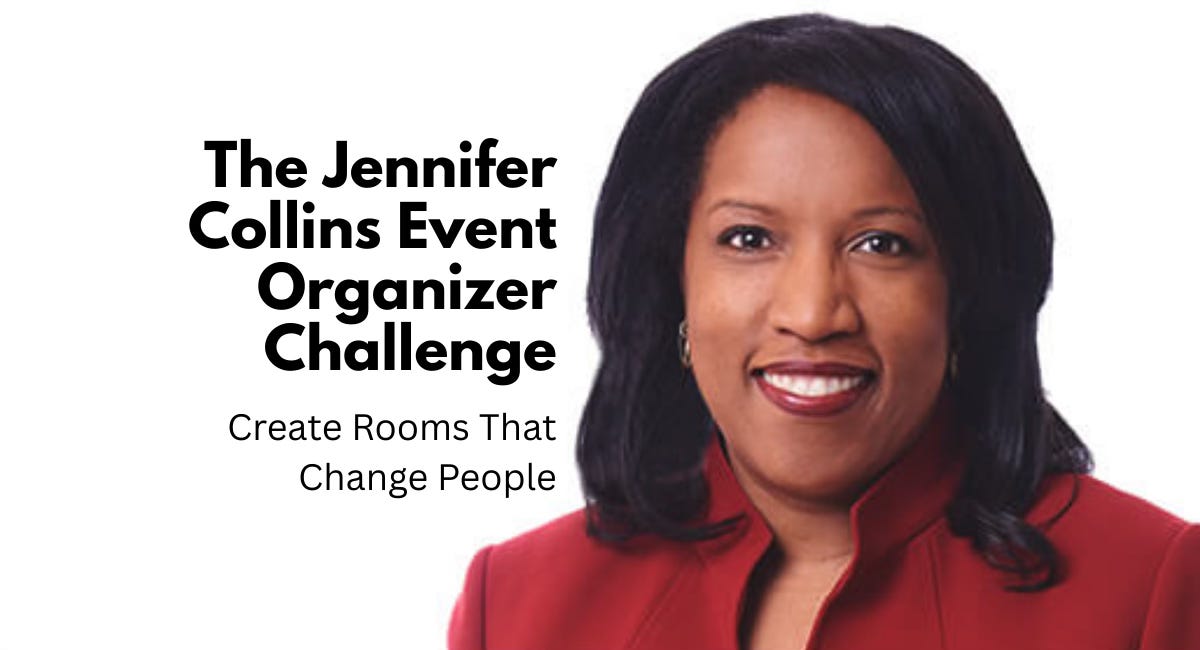
Jennifer Collins does not position herself as a futurist, a disruptor, or a visionary. She runs an events firm called JDC Events. She manages contracts. She produces conferences and summits for corporate clients, public-sector agencies, and specialized communities. On paper, her résumé resembles that of many seasoned operators in the meetings industry.
What distinguishes her is not scale. It is orientation.
When Collins talks about her work, she does not begin with logistics or production value. She talks about what happens to a person inside a room. She talks about the subtle shift that occurs when someone leaves a gathering knowing something about themselves that they did not know before they arrived.
That distinction feels increasingly relevant.
The events industry is recalibrating. Corporate gatherings are expanding again. Government budgets are shifting under political realignment. First responders remain under strain. Institutions across sectors describe a crisis of fragmentation. In that environment, Collins has been returning to a deceptively simple premise: the most consequential gatherings operate less like productions and more like reunions.
To understand why she believes that, you have to begin with her family.
On her mother’s side, the family was large, southern, and deeply rooted. Her grandmother was one of ten siblings. Atlanta served as the family’s axis point, even after migration north to Connecticut. The reunions were not occasional social events; they were structural. People traveled intentionally. Stories were retold. Small awards were given. Music filled rooms without rehearsal. Children were introduced to relatives whose names carried weight.
Collins grew up playing classical piano, and at those reunions she was expected to contribute. Around her, family members sang hymns layered in harmony. Recipes circulated without documentation. Narratives of resilience were passed down not as mythology but as inheritance.
What she absorbed in those rooms was not sentimentality. It was reinforcement.
People left knowing who they belonged to.
When asked what first motivated her to write her book, she did not reference professional ambition. She described that sensation. “It was the result,” she said. “How it bonded. How it showed people coming together. The immense feeling of love, of connection, of engagement that came from it.”
That language would later shape her philosophy of events.
Her entrepreneurial instinct emerged early, though in a different setting. As a child born in Boston after her family’s relocation, she launched a neighborhood car wash. She created a menu of services and attached specific prices. If a customer wanted tires wiped, that was one fee. If they wanted spokes cleaned, that was another. When someone complained that something was not dry enough, she redid it. If expectations were unclear, she clarified them.
She was not thinking in terms of customer experience design. She was learning to define value and respond without defensiveness.
Entrepreneurship was not abstract in her family. Grandparents owned a cleaners and landscaping business. An uncle operated a florist shop. Another relative worked independently. Her father held executive leadership at Stop & Shop and also spent weekends assisting his friend’s electrical business. No one framed this as founder culture. It was simply the visible fact that building something of your own was possible.
The bridge between instinct and professional conviction formed at American University, where Collins became student chair of the Public Relations Student Society of America. In that role, she was responsible for producing a Mid-Atlantic summit that would bring communications students from multiple states together.
The undertaking felt ambitious and uncertain. Speakers had to be recruited. Sponsors persuaded. Classmates rallied. There is a particular exposure in leading peers; authority is not inherited but negotiated. She remembers wondering whether the summit might overextend the organization.
When the day arrived, students filtered onto campus, some driving hours for what was technically a student conference. Early sessions were cautious. Then something shifted. Questions sharpened. Hallway conversations intensified. Students who had arrived tentatively began debating career paths and strategy with urgency. Speakers lingered beyond their allotted time. Connections were made in real time.
The room tipped.
It was not the catering or the printed program that mattered. It was the collision. Students recognized themselves in one another. They saw possibility reflected back at them.
Collins left that summit understanding something she would spend the rest of her career refining: a room, properly structured, can alter a life’s direction.
That moment was hers.
Professor Richard Stack, who taught public relations and once mapped the birth of his son as a narrative arc for his students, recognized it as well. He invited Collins back to speak in his classes every semester after graduation. She returned for more than twenty years. He encouraged her repeatedly to write a book, not because she executed events but because she understood what they do to people.
Two weeks after she committed fully to her company, September 11 reshaped the country. She boarded a nearly empty flight to Arkansas for an incentive program meeting. The airport was subdued. The plane sparse. The contract was later canceled; celebration felt misaligned with national grief.
Rather than retreat, she pivoted.
One of her early growth chapters involved producing international cocoa science symposia for Mars Incorporated in partnership with University of California, Davis. The objective was to position cacao research around heart-health benefits and differentiate a global brand within a competitive marketplace. She traveled to Ghana and observed how convening scientists and executives could reshape narrative authority.
The lesson was not about product. It was about structure.
When the right stakeholders are convened under the right framing, perception changes.
Government contracts followed, including work connected to FirstNet, the communications network developed after 9/11 to ensure first responders could communicate across frequencies, and advisory committees for national emergency medical services. These were rooms dense with policy and operational consequence. The stakes were tangible.
Then COVID recalibrated everything again. Watching first responders strain under relentless pressure — and having first responders in her own family — she launched Equipped, a year-round platform designed to provide tools and innovation to that community. The initiative evolved through partnerships, including with Lexipol.
Last year introduced another inflection point. A change in administration led to the termination of several government contracts that had become meaningful revenue lines. The effect was immediate. Programs were paused. Budgets were reforecast. Rooms she had helped architect were no longer authorized to convene.
Her response was not rhetorical. It was structural.
She reassessed revenue mix. Strengthened private-sector partnerships. Leaned further into proprietary platforms like Equipped. Examined exposure to any single sector. Diversification became active discipline rather than strategic theory.
Listening to her describe this recalibration, the continuity is unmistakable. The same instinct that once led her to define tiers at a neighborhood car wash now guides revenue architecture. When expectations shift, clarify them. When value changes, redefine it. When something fails to meet standards, adjust and continue.
The rooms evolve. The resolve does not.
More recently, Collins spent six weeks traveling across Europe, Africa, and Asia, speaking with tour operators and local leaders about migration, racial tension, economic strain, and political polarization. The geography varied. The concerns were familiar.
Her observation was simple: fragmentation is widespread.
And fragmentation, in her view, is not addressed digitally. It is addressed physically.
She does not romanticize convening. She has managed too many budgets and watched too many agendas unravel to indulge abstraction. But she believes that when people occupy the same space, listening becomes possible in ways it does not online. Context re-enters the conversation.
This is where her reunion instinct resurfaces most clearly.
A family reunion is not designed around spectacle. It is built around recognition. Stories are retold because repetition stabilizes identity. Awards are given because contribution deserves reinforcement. Music binds memory. Ritual sustains continuity.
Collins approaches corporate strategy sessions, scientific symposia, and government advisory meetings with the same underlying question: what will someone walk away with? What understanding will shift? What connection will endure beyond the program?
There are moments — in classrooms, in summits, in policy meetings — when a person hears something that reorders their sense of what is possible. Collins experienced that as a student at a PRSSA summit. She has been building rooms capable of producing that moment ever since.
In an industry that often measures success by scale and spectacle, Jennifer Collins measures it by the quiet recalibration that happens when someone leaves a room changed.
It is not dramatic.
It is durable.
And in this moment, it may be the most consequential work the events industry can do.


