


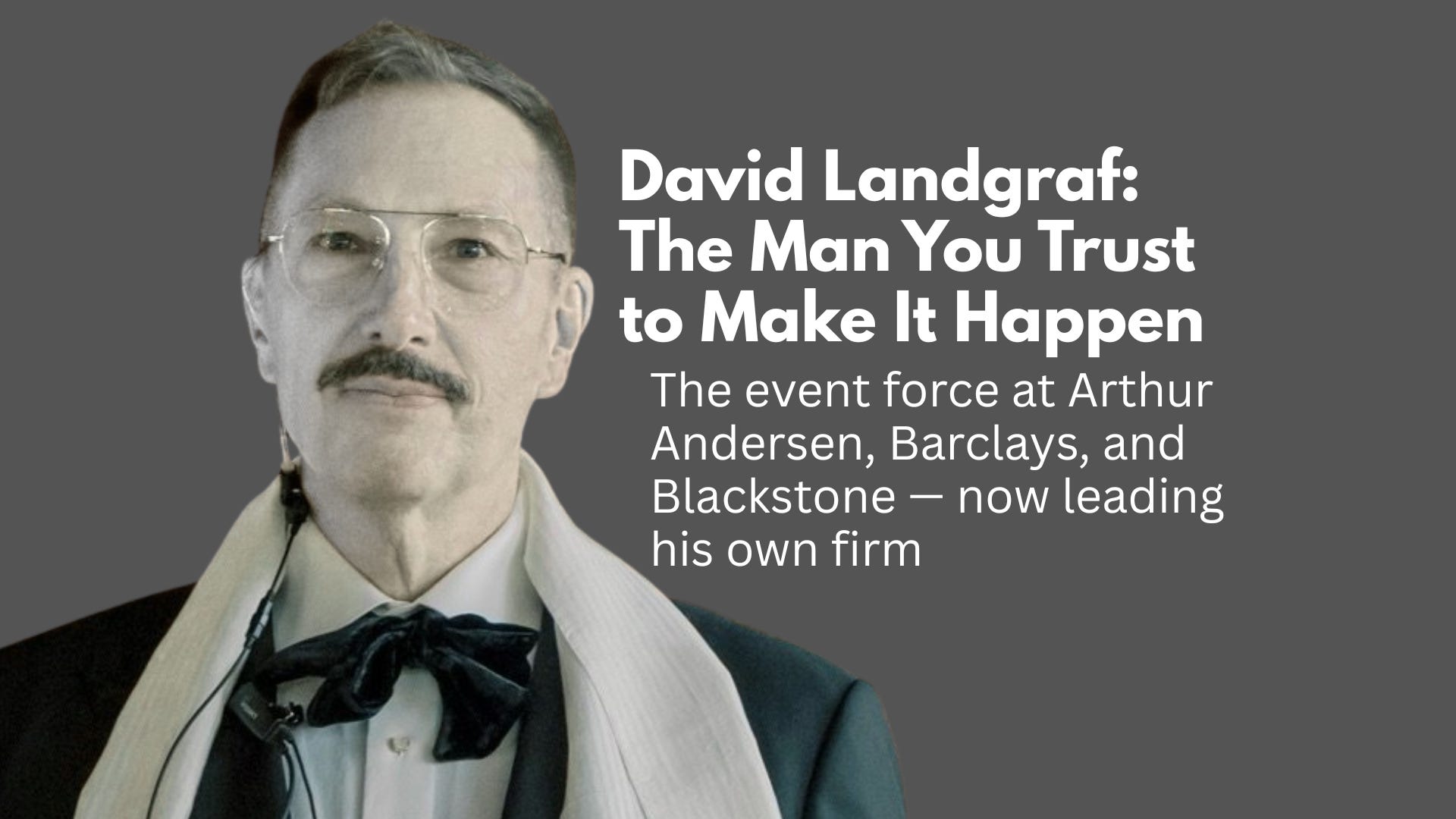
A GatheringPoint Note: Before we begin this story about David Landgraf, it’s worth remembering something about the profession he represents. Whether the title reads wedding planner, exhibition organizer, conference producer, concert promoter, or corporate event strategist, the underlying craft is remarkably similar. These are the people who design the conditions where human beings gather — and where decisions, relationships, and commitments are made in real time. Over time the tools matter less than the judgment. The best event architects build that judgment room by room, year after year, learning how atmosphere shapes perception, how narrative moves a crowd, and how gatherings can advance culture, capital, or purpose. David Landgraf happens to have developed that judgment inside some of the most powerful institutions in the financial world. Which is why this story begins not in a boardroom, but in a ballroom where Manhattan briefly felt like the Amazon rainforest.
The fog arrived first. The fog did not arrive dramatically.
It crept. Guests stepping into Jazz at Lincoln Center that January evening felt it first along the floor — a slow drift of haze that softened the edges of the room and slowed their steps almost involuntarily. Suspended lights hung overhead at irregular heights, their beams cutting through the mist like flashlights searching through rainforest canopy at night.
For a moment Manhattan disappeared. The skyline beyond the windows dissolved into shadow. Conversations softened. Phones lifted instinctively, the reflexive signal that something unexpected is happening.
At the back of the room stood David Landgraf, watching the entrance. He always watches the threshold moment. If the entry lands, the night has a spine. If it doesn’t, the rest of the evening becomes recovery. Ninety-eight percent of the people entering that room had never been to the Amazon rainforest.
For them it was a distant headline, a place they might recognize from documentaries or news footage but had never physically experienced. Landgraf’s task was to make that far away unknown place, and the distance disappear.
The Visual Story of the Junglekeepers New York Gala
The gala marked the founding benefit for Junglekeepers, the conservation organization led by explorer, filmmaker, author, and speaker, Paul Rosolie. The evening combined a book launch, immersive storytelling, and fundraising. On paper it resembled many nonprofit galas before it.
But Landgraf had instinct through experience and foresight, corrected the first unrealistic assumption. The organizers initially estimated seven hundred and fifty guests. It was January. It was the organization’s first major event. “No way,” he told them. “You’ll get two hundred, maybe three hundred.” It wasn’t pessimism. It was calibration.
That instinct — the ability to see a situation clearly before others do — has shaped Landgraf’s entire career.
Long before the fog and the rainforest lighting, David Landgraf was working inside the National Security Agency. At seventeen he entered a rigorous testing process that stretched over weeks: six rounds of eight-hour analytical exams designed to measure cognitive patterns and decision-making under pressure. Security screenings followed. Polygraph tests. Clearances. On July 20, 1982, he began work at the NSA. He remained there until February 1, 1991.
The environment was enormous — the largest computer systems operations center in the world — intercepting signals from the field and transmitting intelligence through complex networks where seconds mattered. When systems failed, people in the field could be affected immediately.
From that experience Landgraf carried away something he still refers to today: a permanent sense of urgency. Events, he would later discover, demand the same mindset. Venues and ballrooms are live systems and networks.
Lights, sound, timing, narrative, personalities, expectations — dozens of elements interacting simultaneously. When something breaks, it breaks publicly and maybe creating that domino effect.
But urgency was only half the story. Before the NSA there was a Christmas tree farm in Maryland. Landgraf’s parents bought the property when he was young. During the holidays families would drive in to cut their own trees, and Landgraf helped transform the arrival into something memorable — lanterns lining the driveway, hot chocolate and cider waiting at the entrance, the quiet sense that guests had stepped into a seasonal ritual rather than a retail transaction. He was thirteen.
Later he became his high school mascot, climbing into a lion costume to energize football games and pep rallies. He was also the lead singer in a small folk-rock band performing cover songs for school audiences — including Kiss’s “Beth,” which he can still sing from memory. Mascot. Singer. Intelligence analyst.
By the time Landgraf entered corporate life, the elements of his eventual profession were already present. After leaving the NSA he joined Arthur Andersen during a period when the firm was redefining its brand identity. Landgraf began helping design internal events that translated the firm’s message into live experience.
From Andersen he moved to Goldman Sachs, reshaping learning and orientation programs into immersive on-boarding environments rather than administrative meetings.
Later he joined Barclays Capital, beginning his work there on September 11, 2001 — a day that permanently changed how institutions thought about gatherings and vulnerability.
Then came Blackstone. Inside the private equity firm — one of the most powerful financial institutions in the world — Landgraf did something unusual: he built the company’s event division from the ground up.
It was not the first time. Three Fortune 100 institutions where Landgraf helped create formal event departments rather than simply producing events.
Inside Blackstone he structured investor meetings, Annual Meetings, leadership summits, recruiting events, summer outings, office openings, and global gatherings that required scalable systems. He moved the organization away from spreadsheet-driven processes toward enterprise event technology platforms.
He describes his role simply: visual corporate communications. Events, in his view, are where organizations physically express what they believe or want to change about themselves. That perspective now intersects with a much larger economic shift.
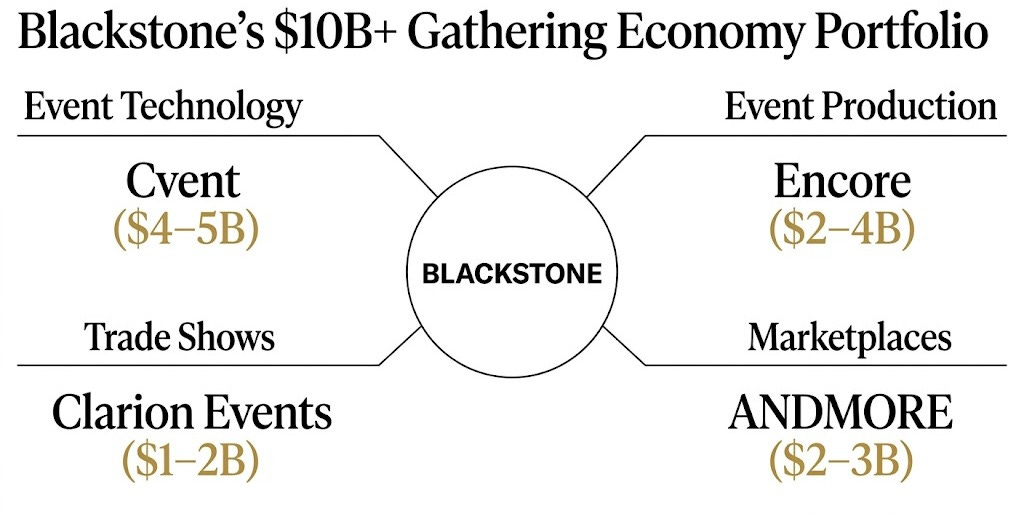
Over the past decade Blackstone has become one of the most influential investors touching the global event ecosystem, backing companies across production and event technology infrastructure. The Gathering Economy — conferences, festivals, corporate summits, nonprofit events — has become one of the fastest-growing sectors of the experience marketplace
No one claims that Landgraf caused that expansion. But the proximity is fascinating.
There is a concept in biology called osmosis — influence absorbed gradually through exposure. Spend enough time watching how gatherings shape trust, narrative, and relationships between leaders and investors, and it becomes difficult to dismiss the industry as decoration.
Landgraf spent years demonstrating that reality from inside the institution. Inside organizations, the event leader occupies a unique position. The title might say events, communications, marketing, or experience design. But the function is something deeper. They are connective tissue.
Every gathering touches multiple departments — marketing, HR, investor relations, legal, communications, finance. The event architect becomes the person who moves across those boundaries, linking divisions that rarely interact in daily operations. Over time they acquire a panoramic view of the institution.
They see which narratives resonate and which collapse. They observe how executives behave when speaking to investors, how employees respond to leadership messages, how relationships evolve when people share the same physical space. In a sense, the CEO delegates a portion of their agency to them.
Which is why a network like ELX — the Event Leaders Exchange exists.
ELX brings together the internal event strategists inside some of the world’s largest organizations. These professionals design the rooms where institutions explain themselves. They are, collectively, the quiet architects. And like many of them, Landgraf eventually entered the second phase of this profession.
After years inside large institutions, internal event leaders often step outside. Not because the work changes — because the knowledge they carry becomes valuable elsewhere. Years of observing how leaders behave under the lights, how investors respond to narrative, how atmosphere shapes perception give them something rare: strategic judgment.
Landgraf eventually founded Make It Happen Mgmt, an agency that designs gatherings for corporations, nonprofits, and private clients.
The name came from an internal joke. Inside Blackstone, when something complicated needed solving, colleagues would say, “Call Landgraf. He’ll make it happen.” The phrase stayed. nWhich brings us back to the rainforest.
The Junglekeepers gala unfolded according to Landgraf’s Four E’s philosophy: Excite. Empower. Educate. Entertain. Excite began with the fog rising above the rainforest.
Educate came through tightly controlled storytelling. Rosolie’s presentation was carefully structured — Landgraf believes audiences lose attention quickly. “You lose people after four minutes,” he says.
Empower came through the fundraising structure. Guests funded specific outcomes: boats, land plots, security stations protecting rainforest territory.
Entertain came through immersion rather than spectacle. Even the smallest decisions aligned with the mission. Landgraf refused printed menus. “If we’re protecting rainforests,” he asked, “why are we printing paper?” Instead each table featured a programmable digital kiosk displaying the program, menu, and auction interface throughout the evening. The culinary program echoed the region — Peruvian flavors, mole sauces, coconut, cacao.
Nothing contradicted the story. The event raised extraordinary funds for a first-year effort. Landgraf is already thinking about year two: showing donors exactly what their contributions accomplished — boats purchased, land protected — closing the loop between generosity and outcome.
Because that is how systems work. As the evening wound down, the fog thinned and Manhattan slowly returned. Guests drifted toward the exits. Landgraf took the same spot near the back of the room.
Not studying the décor. What he was doing — the way he has done for decades inside institutions — was absorbing the pattern.
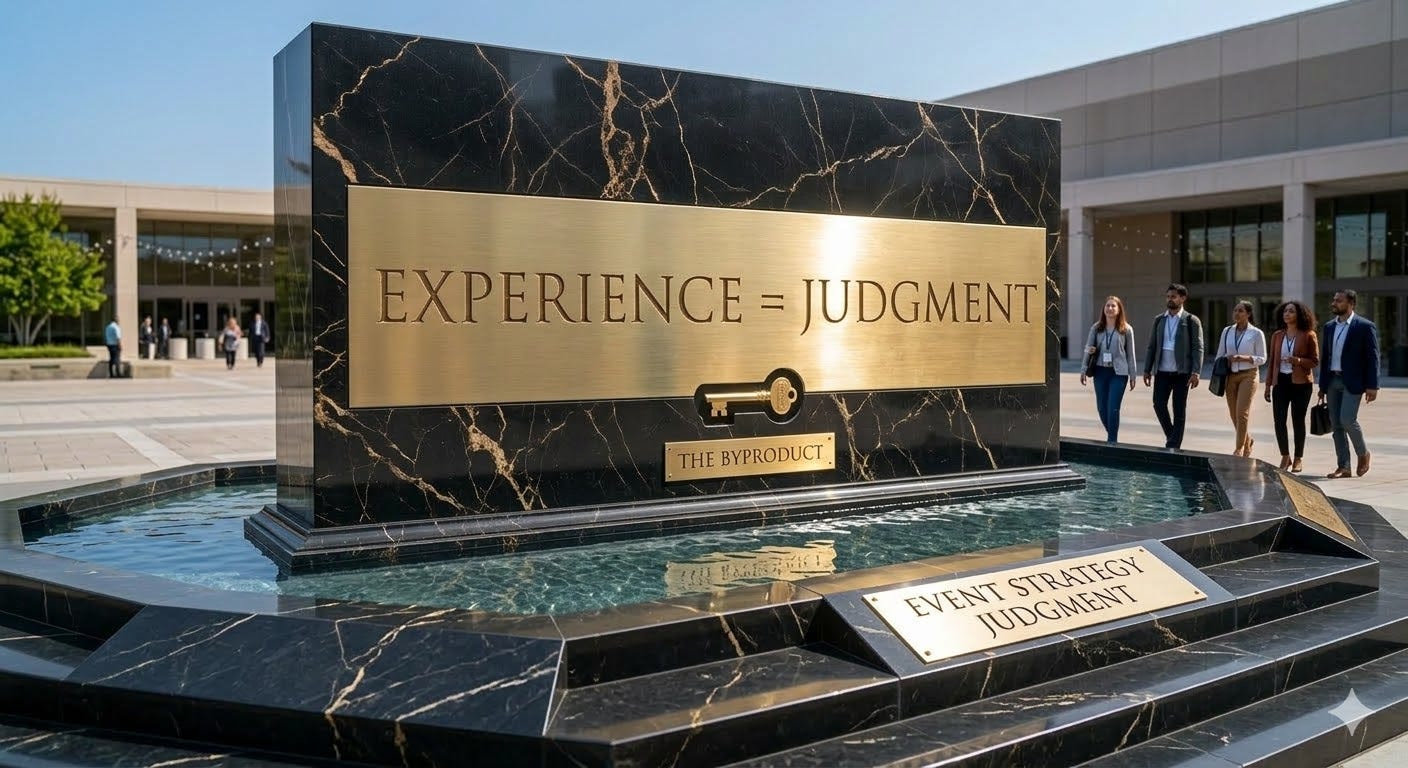
Years of watching gatherings unfold had given him something more valuable than production expertise. They had given him judgment.
The kind of judgment that allows someone to design a gathering deliberately — using the simple act of bringing people together to advance culture, capital, reputation, or purpose.
The fog that night was only the visible part of that craft. The deeper work was the strategic thinking behind it. And once you understand that, a gathering becomes something much more powerful than a party.
It becomes strategy in motion.
BONUS Edible Profile of David Landgraf

Every leader profiled on GatheringPoint.news receives bespoke small bites & cocktails — edible portraits designed to capture who they are in a single taste.
This is Small Bite Architecture: where food becomes storytelling, marketing, and belonging.