
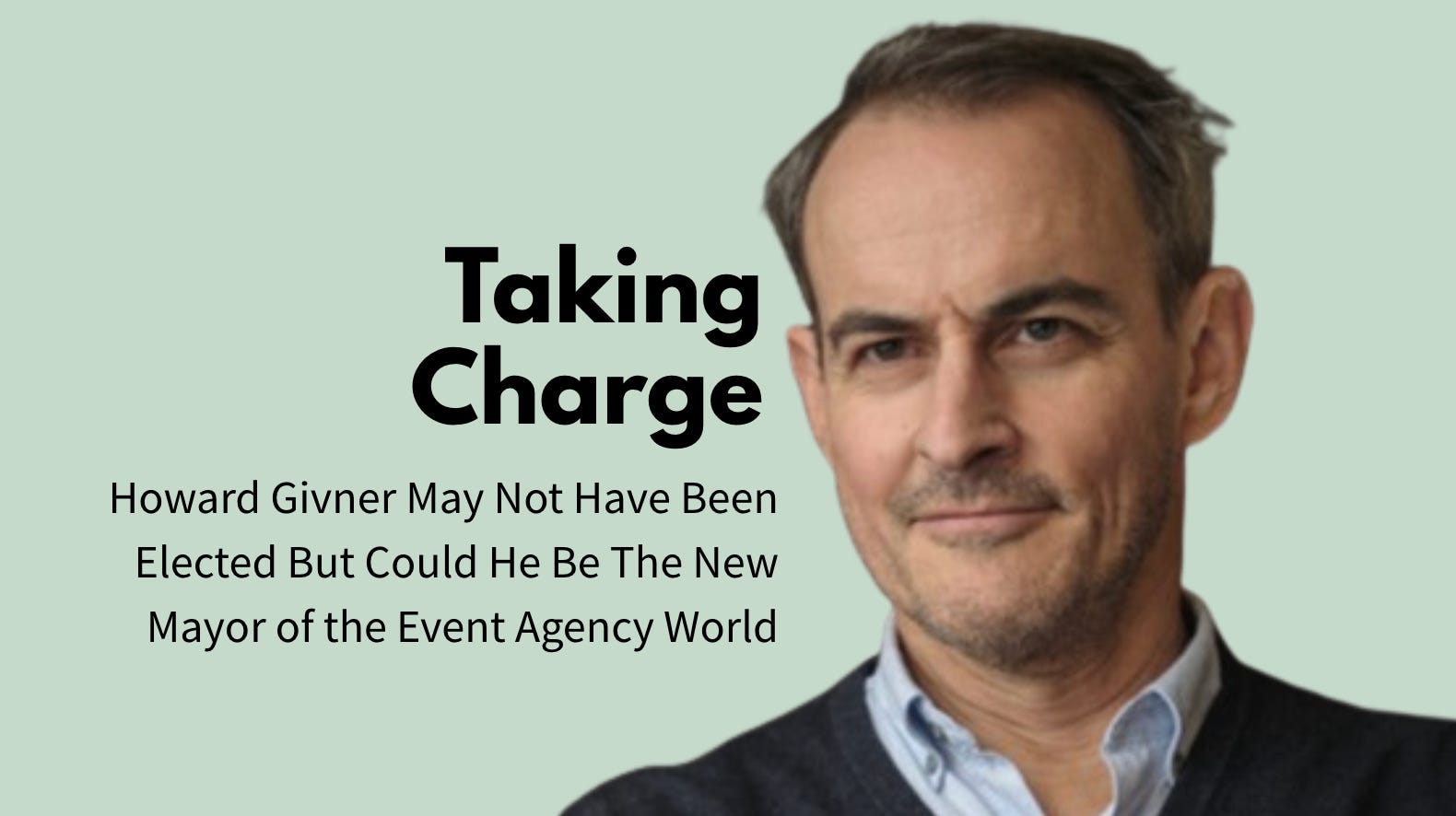
The New Mayor of the Event Agency World?
Howard Givner founded and sold two event companies, built a graduate school for the industry, and survived the cancer that nearly killed him. Now he runs the only room that matters.
Editor’s Note. Three forces have converged on the event agency business at the same moment, and the convergence is the story of the year. Brands have discovered that their live events are their Super Bowls, and the corporate budgets have followed. Private equity has arrived at scale in the exhibition and consumer event industry. And the digital channels the rest of the marketing economy was built on are collapsing under artificial intelligence, leaving the face-to-face room itself as the only channel the algorithm cannot reach and trust is still evident. The agencies who build those rooms are the picks and shovels of the next decade of corporate growth. But the deeper story is the double meaning of the word agency. The companies are one kind of agency. The human capacity to exercise judgment, to make the call, to keep the craft from being outsourced to the model — that is the other kind, and it is more important than ever. The machine can do the sourcing. It cannot do the gathering. This Howard Givner profile is the first installment of GatheringPoint’s commitment to covering the field with the seriousness it has earned.
David Adler · Curator in Chief · GatheringPoint.news
Six years ago, on a Tuesday in May of 2020, Howard Givner received the stem cell transplant that saved his life. The event industry he had spent 25 years building was, on that same Tuesday, effectively closed for business. Ballrooms were dark. Convention centers were field hospitals. Agencies were laying off the staff they had spent a decade training. The man who had founded and sold two event companies, served as chief executive of the American arm of a third through its sale to BCD Meetings and Events, and built the closest thing the meetings business had to a graduate school was lying in a hospital bed in New York wondering whether the industry, or he himself, would still be standing on the other side of the year. Both, as it turned out, would. “Knock on wood,” Givner says now, “all my scans are clear. I’m extremely grateful for having gone through that.”
The gratitude is not rhetorical. It is the operating system of everything that has happened since. The man who came out of that hospital is not the man who went in, and the events industry he has returned to is not the one he left. He calls the anniversary his Re-birthday, the term stem cell transplant survivors use for the day of the transplant that saved their life. He observes it. Two weeks before this conversation he marked the sixth one, and four days after that he stood on the top floor of NeueHouse Madison Square in New York and convened 98 chief executives of experiential, meetings, and incentive agencies for the inaugural Event Agency C-Suite Growth Summit, produced in partnership with micebook, the British events industry publication. Seventy-two percent of the room flew in from somewhere else. He admitted no vendors except sponsors, returned a meaningful sum of money to people who tried to slip in below the C-suite line, and opened the day by telling the room what he was personally struggling with. “This only works,” he told them, invoking the Chatham House Rule, “if everybody’s going to be open and share and be vulnerable.”
The man who built that room is the same man who began, a quarter-century earlier, as a club promoter in Manhattan, and the distance between those two figures is the whole story.
A promoter, a paisley fraternity party, and a salesperson who quit
The first thing to know about Howard Givner is that he did not set out to become the consigliere of an industry. He set out to throw a party. The party in question was a corporate event at a Manhattan nightclub in the late 1990s, and the only reason it landed in his lap was that the club’s event salesperson had quit a few weeks earlier and the owner, looking around at one in the morning for somebody who knew the room, settled on the young promoter who was already standing there. A caterer at the bar had mistaken Givner for staff and asked whether the space could hold a certain number of people for a corporate function. Givner took the man’s card, passed it to the club owner at the end of the night, and walked out with a commission and a small business in waiting. “That was sort of like the first foray out of promoting and doing more corporate events,” he says. “I booked that guy’s event, and he gave me more. And then other people started calling. It just went from being a promoter to having a business that didn’t rely on my own rolodex of friends and friends of friends.”
He called the company Paint the Town Red, after a theme party he had thrown as social chairman of his fraternity at the University of Pennsylvania. The fraternity was Tau Epsilon Phi. The theme, because it was the 1980s and paisley was still a thing, had originally been Paint the Town Paisley. The origin he can trace further back than that, to his mother, who threw what he calls “these really exotic parties” in the family house. The surprise party she staged for one of his father’s milestone birthdays had every guest waiting on the lawn in gilded-age parasols and hats. “He came home and it was like he stepped into a time warp,” Givner remembers. “They were all there and like, oh, hi, surprise.” The creative aspect of designing events appealed to him in some way he cannot quite articulate. The project nature of the work appealed to him more. He is, by his own admission, a man who gets bored easily, and the rhythm of an event business, the way a new client meeting reset the clock every quarter, suited him in a way that almost no other career structure would have.
There was no event agency world to walk into in those years. Givner remembers the distinction precisely. “We didn’t call them agencies,” he says of the businesses he was building alongside in the late nineties. “Event planning businesses. Event management companies. The market kind of said, no, this is really what you are. You guys are like marketing agencies or PR agencies. I think part of the growing up of the industry in general. It just was less defined as a clear-cut sector of the economy.” The renaming was not cosmetic. It was the first signal of an industry beginning to understand itself as a financial category rather than a service trade, and Givner happened to be standing on the right side of the door when the door opened.
He sold Paint the Town Red to Global Events Group in 2008 and ran North America for the parent company through the financial crisis that followed. He took the helm of the U.S. division of Grass Roots Meetings and Events as the chief executive of the American business and led the American unit through the parent company’s sale to BCD Meetings and Events in 2018. That chapter was operating experience inside somebody else’s transaction. The two transactions where he sat in the founder’s chair were the bookends. The agency he had built in his twenties. The institute he would build in his thirties and forties.
The institute, and the discovery that nobody had built a graduate school
The Event Leadership Institute began, as Givner tells it, from a frustration as old as the industry itself. Event planners in America had nowhere to go for serious professional development. The associations offered certifications. The trade shows offered breakouts. The vendors offered self-interested webinars. Nobody had built a Netflix-style library of on-demand video classes, taught by working practitioners, structured the way a serious continuing-education curriculum is structured, priced for individual professionals rather than for enterprise procurement departments. Givner built it. He launched the Event Leadership Institute in 2011 and ran it through the decade that followed. The library expanded into certifications, summits, white papers, and live programming. The instructor roster filled out with the people the industry actually wanted to learn from, working agency principals and venue executives and creative directors who had built the careers the next generation was trying to model.
What ELI did, more than any single certification program or video class, was give the events industry the thing every grown-up profession eventually requires, which is a place to think about itself. The reason it mattered is the reason any graduate school matters. The associations served their members. The trade shows served their exhibitors. The institute served the practitioner. There was, until ELI, no neutral ground on which an event professional could simply learn the craft from the people who had figured it out, in the format the practitioner actually had time for, at a price an individual could carry. The institute became the closest thing the meetings business had ever produced to a school, and the school had a faculty, a syllabus, and, eventually, a brand.
PCMA acquired the institute in January 2023. The association needed an education engine that could move at the speed of the industry. The institute needed the institutional capital and the distribution that an established trade body could provide. Givner came in as the association’s Senior Vice President of Knowledge and Innovation. He led the integration, he sat in the management meetings, he ran the product. And then he walked.
The walk is, in some ways, the most consequential decision of his career, because it freed him to do the work he is doing now. The institute had taught a generation of practitioners how to think about the craft. The next problem in the industry was no longer a teaching problem. It was a structural one. The capital had arrived. The deals had begun. The founders the institute had spent ten years educating were now sitting across desks from private equity sponsors, trying to figure out whether to sell, when to sell, and to whom. The man who had built the school they had attended was the natural person to walk them through the next chapter, and the natural person to build the room in which the next chapter would actually be discussed.
The room he built, and the man cancer made
The Event Agency C-Suite Growth Summit was, on paper, a one-day conference at a private club on East 25th Street. In practice it was something the event agency business has never had before. “We mixed together people who would say there are incentive agencies, and others would be, well, we’re more experiential, and others are more, well, we’re more meeting management,” Givner says. “But everyone’s dealing with a lot of the same issues. Whether you’re working in pharma or finance or tech, or you’re in one region or another region, people are dealing with a lot of the same things.”
That sentence is the entire thesis of his fourth act. The agency principals of the American events business have spent their careers in segregated silos, gathered by category at the conferences that serve their narrow trades. The luxury social planners gather at Engage. The trade show organizers gather at IMEX and IBTM. The meetings management houses live inside PCMA and MPI. The destination management firms have ADMEI. The production companies have LDI and InfoComm. What no one had built, until Givner built it with micebook as his production partner, was the room for the chief executives themselves, across categories, talking to each other under Chatham House Rule and the unspoken agreement that no one was there to sell to anyone else.
The way he built it is the part the story usually misses, and it is the part where the cancer chapter comes into the frame. A man who has been on a stem cell transplant ward does not have the patience for performance. He does not have the patience for the small social capital that ordinarily lubricates an industry gathering. He does not have the patience for the people in the room who are there to take rather than give. Givner returned a meaningful sum in ticket money to people who tried to attend below the C-suite line. He capped the room at strict equivalent. He admitted vendors only as sponsors. “There were one or two people who came to the June dinner last year who just listened and took and didn’t give,” he says. “They were not invited back.” He opened the day by telling the room what he was struggling with. He had 20 agency principals do the same. He spent the breaks making introductions across geographies. “If there’s a female owner of a mid-sized business from the Bay Area here,” he says, “I connect her to a female owner of a mid-sized business from Toronto. They don’t have any real mechanism to talk to each other, and to do so in a space where they don’t have to worry. There are no clients in the room. There are no prospects in the room. It’s a place where it’s sort of okay to come together. This was like a club almost.”
The club almost. That is the right phrase. The American event agency business has, for the first time in its history, a clubhouse, and Givner is the man at the door. The man at the door knows, in a way that the men and women inside the door cannot yet quite admit, that the time everyone has left to figure this out is finite. That is the gift cancer gives a man, when it does not kill him. It clarifies the calendar.
Why him, and not somebody else
There are perhaps 20 figures in the American event agency business who have the experience, the network, and the standing to have done what Howard Givner did in May at NeueHouse Madison Square. There are perhaps three who have the temperament. The question of why Givner is the one running the room, rather than one of the other 19, is the question the field has quietly answered without anyone asking it out loud.
The answer is biographical. He has been a founder, twice. He has been a buyer, advising more than a dozen agency principals through their acquisitions and sales. He has been an operator inside the parent company that bought him and inside the global meetings firm that ran him. He has been a teacher, building the only graduate-school-shaped institution the field has ever had, and he has been a seller, walking that institution into the arms of the trade body that needed it. He has sat at the M&A table from both sides and at the educator’s lectern from in front of it. There is no chair in the event agency business he has not occupied, and the field knows it. When a founder gets the first unsolicited LOI and needs somebody to walk through it with them, there is one phone call. When a number-two finally wants to ask whether the founder is ever going to share equity, there is one phone call. When a private equity sponsor wants to understand what they are actually buying, there is one phone call. It is the same phone.
The other piece of the answer is temperamental. Givner is the rare senior figure in this field who is not running a competing agency, not selling a competing platform, not staffing up a competing trade media operation, and not trying to position himself for the next acquisition. He sold both of his companies. He walked out of the association job. He is, structurally and by choice, the one person in the room with no conflicting interest. The chief executives who fly in to NeueHouse fly in because they know the man at the head of the table is not pitching them. He is not competing with them. He is not building a portfolio company that will eventually be sold to one of them or against one of them. The Chatham House Rule works because Givner himself has no commercial reason to break it, and the field can feel that. The mayor of the event agency world is the mayor precisely because he has nothing to sell and everything to broker. The civic frame is not metaphorical. It is the actual structure of his role.
And the field, having figured this out without anyone needing to say it, has begun arriving at his door with the problems that matter most.
The inventory of problems, and why they all rhyme
The actual problems on the table at the summit are the most accurate inventory of the state of the event agency business currently in circulation, and Givner walks through them with the calm of a man who has heard every version of every one of them in a private conversation in the last 12 months. Talent, which is to say everything. Agencies, he says, are McKinsey-shaped businesses. “We don’t have venues. We don’t have gear. I mean, I guess some do, but most of them, it’s really just intellectual capital. You’re like a McKinsey. Your assets walk out the door every day, so to speak.” The pipeline question, the development question, the retention question, and the equity question all run together. The number-twos at the great agencies have been waiting 15 years for an ownership conversation that never quite happened, and they are now reading about private equity acquisitions in the trade press and asking themselves whether they should still be loyal to the founder who is about to take the check.
Artificial intelligence, and specifically how to integrate it operationally rather than theoretically. “Melissa Van Dyke from The Creative Group did a really good presentation at the summit on the approach that her company took,” Givner says. “They created a tiger team and they looked at all these different AI products and they mapped the workflow and they figured out, what’s the best way for us to integrate this and socialize it.” The houses that solve that puzzle in the next 18 months will be meaningfully more valuable than the houses that do not.
Mergers and acquisitions, which is no longer a minority concern. “Five years ago it was a minority of companies looking at it,” Givner says. “Now everybody’s thinking about it.” The smarter shops are thinking about it as buyers, looking at acquisition as a faster path to growth than the organic option will ever deliver. “They’re like, we need to basically buy EBITDA,” he says, “and it’s that simple.” The harder problem, the one that gets less airtime in the trade press, is what happens after the deal closes. The integration is where one plus one becomes three, or where it quietly becomes one and a half. Most deal announcements read like the transaction is the achievement. The achievement is the work that begins the morning after the press release runs, and the agencies that have done the diligence on the cultural integration as carefully as they have done the diligence on the financial one are the agencies whose deals actually deliver the return.
The request-for-proposal process, and the growing sense among agency principals that brands are now sending RFPs to too many shops, giving too little time, and in the worst cases lifting the ideas of one agency to hand to another for execution. None of these problems are new. What is new is the room. And what is new about the room is the man who built it, and the chair he is sitting in.
Why private equity has finally arrived
The reason the clubhouse matters is that the deal flow it is mediating is the most significant financial story in the events industry. Givner moderated a panel at the summit with the principals of three of the firms that have most aggressively entered the space. Shamrock Capital, which owns Nth Degree. EagleTree Capital, which acquired Opus Agency. H.I.G. Capital, which entered the industry this year by buying and merging the destination management firms 360 Destination Group and CSI DMC into a single national platform. The men on stage, Givner has said publicly, were genuinely bullish on the industry in a way the room found almost startling. “They wake up and they love the industry,” he says. “They can invest in a plumbing supply business if that’s going to give them a good return. And they’re really optimistic about the space. A lot of people in the room found that optimism really infectious, because they’re struggling day to day. To see investors who don’t have that event DNA, it’s like, they really love this.”
The optimism is grounded in a set of theses Givner articulates more clearly than the sponsors themselves often do. Events, he argues, have become the rare marketing channel that has withstood the disruptions currently destroying media brands. Search has been cannibalized by artificial intelligence overviews. Email open rates are collapsing under the weight of AI summaries. Brands that built their growth engines on either channel are getting killed. Live events, by contrast, are what Givner calls “truth sanctuaries” and “algorithm-proof vehicles.” You are in the room. The algorithm cannot reach you. The trust, the spontaneity, the relationship-building, the face-to-face exchange, none of it can be replicated by the technology that is dismantling the rest of the marketing stack.
Then there is the structural thesis. The event agency business is, in Givner’s reading, still fragmented in roughly the way the American accounting profession was fragmented before the consolidation that produced the Big Eight, then the Big Six, then the Big Four. “I think there’s a feeling that’s sort of part of where our industry is headed to some extent,” he says. The capital arriving in the field is arriving with that consolidation in mind. The H.I.G. play with 360 and CSI was not a one-off. It was a template.
The deal sheet underneath all of this is real and current. EagleTree acquired Opus. Nth Degree acquired the experiential firm INVNT. MC and A took an investment in Imprint Events Group. Brands at Work acquired Chorus. Apollo Global Management announced its acquisition of Emerald and Questex to create one of North America’s largest combined business events and media platforms, the first credible attempt in a generation to fuse trade media and trade events under common ownership at meaningful scale. Encore Global, the production giant, acquired the meetings agency FIRST and its embedded-services model, and has filed to go public.
The Encore-FIRST deal is the one Givner spends the most time on, and it is the one most worth understanding. FIRST is, in his telling, really two businesses. “Eighty percent of their business is this embedded model where they’ve got bodies on the ground at Goldman and Google and Bank of America. Those companies outsource their meeting management. Venue sourcing, registration, a lot of the logistics. It’s very predictable. At the beginning of the year, they know what they’re going to do.” The remaining 20 percent is the creative shop, which scaled meaningfully after FIRST acquired Jeff Kalpak’s company some years back. What Encore was buying, in Givner’s reading, was less the creative side than the embedded model itself. “Encore looks at that as a corporate campus viewpoint,” he says. “They probably could refer business to FIRST as much, if not more, than FIRST refers business to Encore.” The combined entity is now positioning itself to go public on the back of a business model that arbitrages labor inside the largest corporate accounts in the country. There are, Givner notes, not many other firms attacking that specific niche. “That’s a tough space to get into. You’re really arbitraging the labor.”
The Vogue World thesis, and what the agencies are actually selling
If the financial story is consolidation, the cultural story is the discovery, by every adjacent industry, that events are the asset class the rest of the marketing economy has been quietly subsidizing for years. Givner reaches, more than once in our conversation, for the parallel that explains the most. “You look at Vogue. Vogue’s digital traffic is down,” he says. “But they create Vogue World, and the revenue doubles every year. People Inc., the former Dot Dash Meredith, did their first upfront for events in February. They brought media and brand marketers in to showcase their event portfolio.” The Conde Nast and People Inc. moves are not curiosities. They are the leading edge of a structural reweighting of how media companies make money. The text business is being eaten by the algorithm. The event business is not. Vogue World is, in any honest accounting of the contemporary Conde Nast balance sheet, the most important new product the company has launched in a decade.
Agencies sit, in Givner’s framing, at exactly the seam where this reweighting is happening. “It’s a little bit like agencies are viewed as the picks and shovels of the space right now,” he says. The phrase is the right one. When media companies decide to launch tentpole events, when brands decide to shift budget out of search and into experience, when corporations decide that the only marketing channel they cannot afford to lose is the one where their customers are physically in the room, the people who actually build the rooms are the agencies. The picks-and-shovels logic explains both why private equity is suddenly bullish on the category and why the multiples on agency businesses have begun to move.
There is, of course, a question lurking underneath the optimism, and Givner is too experienced not to know it is there. The event agency business is, in its bones, a relationship and a sensibility. The private equity model wants a scalable financial asset. The challenge, as he framed it from the summit floor, is to turn relationship-driven companies into scalable financial assets without losing what makes them work. The agencies that solve that puzzle will emerge from the next five years larger, better capitalized, and meaningfully more valuable. The agencies that do not will be the ones whose founder walked out with a check and whose clients quietly found somebody else to plan the next user conference.
The way the smart houses are hedging against that risk, Givner says, is by deliberately building multiple touch points into every client relationship. “There’s account person risk, and there’s owner-slash-salesperson risk,” he says. “The smarter agencies navigate multiple touch points for each client. One person manages the relationship, one person’s in charge of the event. The odds of both of those people leaving are lower than obviously one person.” It is the Mad Men model, in his telling, applied to the event agency business. The accounts director who keeps the relationship and the producer who delivers the work. When a deal closes and the new ownership calls the client list, the first question every client asks is, “Well, who’s going to be running my event now?” The houses that have answers survive the integration. The houses that do not, do not.
The Cuban doctrine, and the disruption coming for the back office
What does Givner tell the old-line agencies who are wondering how to stay fresh while the capital rearranges the field around them? He reaches for Mark Cuban. “Run your business like there’s somebody in a garage hustling to eat your lunch, because there is,” he says, paraphrasing a line Cuban once delivered on Shark Tank. “Constantly operate out of a slight sense of fear that there’s a more aggressive competitor coming for you. If you have that mentality, and you don’t take your repeat clients for granted, because that’s where you kind of get soft. A lot of times the more doting service and the more creative ideas are reserved for the new clients, for winning those new clients. And then once you have them, it’s tempting to take them for granted and be like, okay, well, they know us, they’re going to rebook us. We don’t have to go crazy. And you take a client for granted for too long, and the next thing you know, your event is out for RFP, and maybe you’re invited back, maybe you’re not.”
The garage hustler is not, in Givner’s reading, hypothetical. The disruption coming for the events industry over the next 18 months will land first in the back office. The sourcing side of the business, in his analysis, is ripe for replacement by software, and the replacement has already begun. The French firm Naboo raised 70 million dollars earlier this year to attack venue sourcing and procurement from the ground up. The armies of people who today do the work of checking availability, holding space, moving group blocks from one room to another, are about to discover that a meaningful portion of that work is being done by an algorithm. “That business today is run by armies of people,” Givner says. “Whether it’s the Helms Briscoes on the outside or other companies. A lot of that is matching availability and capacity and pricing for meetings and venues. Naboo is one of a handful of companies that have basically attacked that problem from the ground up through AI, not through labor.” The hordes of people whose careers were built on that work will not all survive the transition.
The disruption will be felt unevenly. The largest IMEXes and South by Southwests of the world, in Givner’s view, will continue to thrive, because the human urge to gather at scale is not going away. But within those rooms, the real value will accrue to the people who can find their five or six right people inside the larger 8,000. “If you go to IMEX and there’s 8,000 people there,” he says, “if you meet five or six of the right people for you, the ROI is great. The challenge is how do you find those five or six people? The matchmaking apps, they’re okay. They’ll get better. But if there’s somebody who can curate that and say, listen, I’m getting together with a group of people at IMEX who are newsletter thought leaders in the space, there’s going to be eight of us, and I’m pulling all the other David Adlers together, you’d be like, I’m definitely not going to miss that.”
The example was not, in fairness, chosen at random. Givner has, in his way, been pulling versions of that room together for 20 years.
The narrow and deep doctrine, and a man counting his calendar
The reason Howard Givner is the one running this room, rather than the one paying admission to it, is that the cancer chapter rearranged his sense of what is worth doing with the time he has. He does two or three things now, by his own count. The consulting practice through Heathcote Advisory Group, which advises owners and executives at event businesses, largely agencies but increasingly also event-technology firms and event owners trying to scale. The mergers and acquisitions work through Oaklins DeSilva and Phillips, which is the largest piece of the advisory practice. And, increasingly, the building of these narrow, deep, curated communities of which the C-Suite Growth Summit is the prototype.
“I have a very strong belief that this sort of narrow and deep approach provides incredible value,” he says. “It’s more work. It’s not going to be a ten-million-dollar event. But the people that are there, if you curate it right and the content is right and the people are right, you can really create a great experience for people.”
The narrow-and-deep doctrine is the operating philosophy of the next chapter, and it is the doctrine of a man who has learned, in the most direct way available, that time is the only resource that does not refill. The summits will not scale into the largest revenue events on the calendar. The mass-market trade press will continue to cover the bigger shows. What Givner is building instead is the room where the consequential conversations actually happen, and the standing to be the man who calls those conversations into existence. “There’s that innate need,” he says, “and I think that’s not always going to drive the largest profits or revenue. But people will pay a lot more to be in a really, really curated room. When you’re at the bottom of your own funnel.”
The bottom of your own funnel. That is the phrase that will travel out of this conversation and into the next one, because every chief executive in the room at NeueHouse knew exactly what he meant. They have spent careers running the wider funnel, the trade show booth, the prospecting list, the brand awareness play. What they have not had, until now, is the room where they are themselves the prospects, where the conversation is for them rather than from them, where the man at the door has lived every chair in the room and has the standing to ask the questions nobody else can ask.
A man, a clubhouse, a generation
The American event agency business is, right now, in the middle of the most significant financial repositioning in its history. The capital is here. The deals are getting done. The founders are aging. The integrations are succeeding or failing on the strength of decisions being made in conference rooms the trade press will never see. The next five years will determine who owns this industry, and what shape it takes on the other side of the consolidation.
The man who will be in the room for every meaningful conversation is the same man who walked into a Manhattan nightclub 30 years ago because the salesperson had quit, who built a graduate school for an industry that had never had one, who founded and sold two companies of his own, the agency in his twenties and the institute in the decades that followed, and ran the American arm of a third through the parent company’s sale to one of the largest meetings firms in the world. He lay in a stem cell transplant ward at the exact moment his industry shut down and decided, when his scans came back clear, that the next chapter would be the one that mattered most. He did not plan to become the mayor of the event agency world. But somebody had to be, and Howard Givner, six years out from his Re-birthday, the club promoter from Penn who took a commission one night because the door was open, is the one who turned out to be standing there when the door opened again.
The door is wide open now. The people inside the room are the ones who run the field. And the man at the door, calendar finite and clear-eyed about it, is the one taking down their names.
Your Assets Walk Out the Door Every Day
The event agency business is a McKinsey-shaped business. You do not own venues. You do not own gear. You own intellectual capital, and intellectual capital has feet. The houses that forget this are the houses that wake up one morning and discover their best three people have started their own shop down the block.
The Garage Hustler Is Real
Run your business as if there is someone in a garage right now figuring out how to eat your lunch. Because there is. The agencies that operate out of a permanent, slight sense of competitive paranoia are the agencies that stay sharp. The agencies that get comfortable get replaced.
The Danger Is the Repeat Client
Agencies reserve their best creative and their most attentive service for the new accounts they are trying to win. The accounts they already have are where the soft spots open up. Take a repeat client for granted long enough and the next thing you see is the RFP, and maybe you are invited back and maybe you are not.
Build Two Touch Points Into Every Client
Account person risk and owner-salesperson risk are the two failure modes that quietly kill agencies. The Mad Men model is the answer. One person carries the relationship. One person carries the work. The odds of both walking out the door at the same time are meaningfully lower than the odds of either one. The first question every client asks after a deal closes is, who will be running my event now. Make sure you have two answers.
Events Are Truth Sanctuaries
Search has been cannibalized by artificial intelligence overviews. Email open rates are collapsing under AI summaries. The brands that built their growth engines on either channel are getting killed. Live events are the algorithm-proof vehicles that remain. You are in the room. The algorithm cannot reach you. That is the entire investment thesis.
Buy EBITDA When You Can
Organic growth is hard. Acquisition is faster. The smart agencies are now thinking about mergers and acquisitions as an instrument of growth, not as a one-time exit. The hard part is not the deal. The hard part is the integration, and the heavy lifting begins the morning after the press release runs.
The Heavy Lifting Comes After the Announcement
Every acquisition press release reads like the deal is the achievement. The deal is the easy part. The achievement is making one plus one equal three, and most acquired companies fail at that math because nobody ever wrote the integration plan. The agencies that win the next five years will be the agencies that take integration as seriously as they take diligence.
Curate the Room Ruthlessly
The value of a curated room is the people who are not in it as much as the people who are. Vendors out, except as sponsors. Listeners who take and do not give get one invitation. Return the money to the people who do not belong. The strict line at the door is the product. If you blur the line, you do not have a room. You have a trade show floor.
Narrow and Deep Beats Broad and Shallow
It is more work. It will never be a ten-million-dollar event. But the people you bring together inside a curated room will pay more, return more often, and tell more of their peers about it than any volume play will ever generate. You are at the bottom of your own funnel, and so are they. The bottom of the funnel is where the real money lives.
Time Clarifies the Calendar
A man on a stem cell transplant ward does not have the patience for performance. He does not have the patience for the people in the room who are there to take rather than give. The gift cancer gives you, when it does not kill you, is the clarity to spend the next chapter on the work that actually matters. Six years out from rebirth day, the calendar is finite, and the only question worth asking is which conversations are worth being in.
Why I Do Songs. Every Wisdom Bank piece comes with an original song because a song carries an argument differently than prose does. Prose persuades the reader. A song moves through them. A chorus settles into the back of the head and stays there long after the article has been closed and the laptop has been shut. The Greeks knew this. The Burgundian troubadours knew this. The civil rights movement knew this. The gathering economy needs its own canon of songs, because the field deserves to be remembered the way it actually feels — communal, in motion, sung in a room.
David Adler · Curator in Chief · GatheringPoint.news
An Edible Profile of Howard Givner
Why Small Bite Architecture. Personalization is the most overused word in the contemporary economy and the most undelivered promise. The algorithm personalizes by guessing. The brand personalizes by inserting your name in the subject line. None of it is personal. Real personalization is the act of one human being studying another closely enough to render them as something no other person could be rendered as. A portrait. A song. A dish. Small Bite Architecture renders each subject as four bites and four sips no other subject could receive, built from the specific facts of the specific life. The machine can imitate the prose. The machine can imitate the music. The machine cannot host the dinner.
David Adler · Curator in Chief · GatheringPoint.news


