


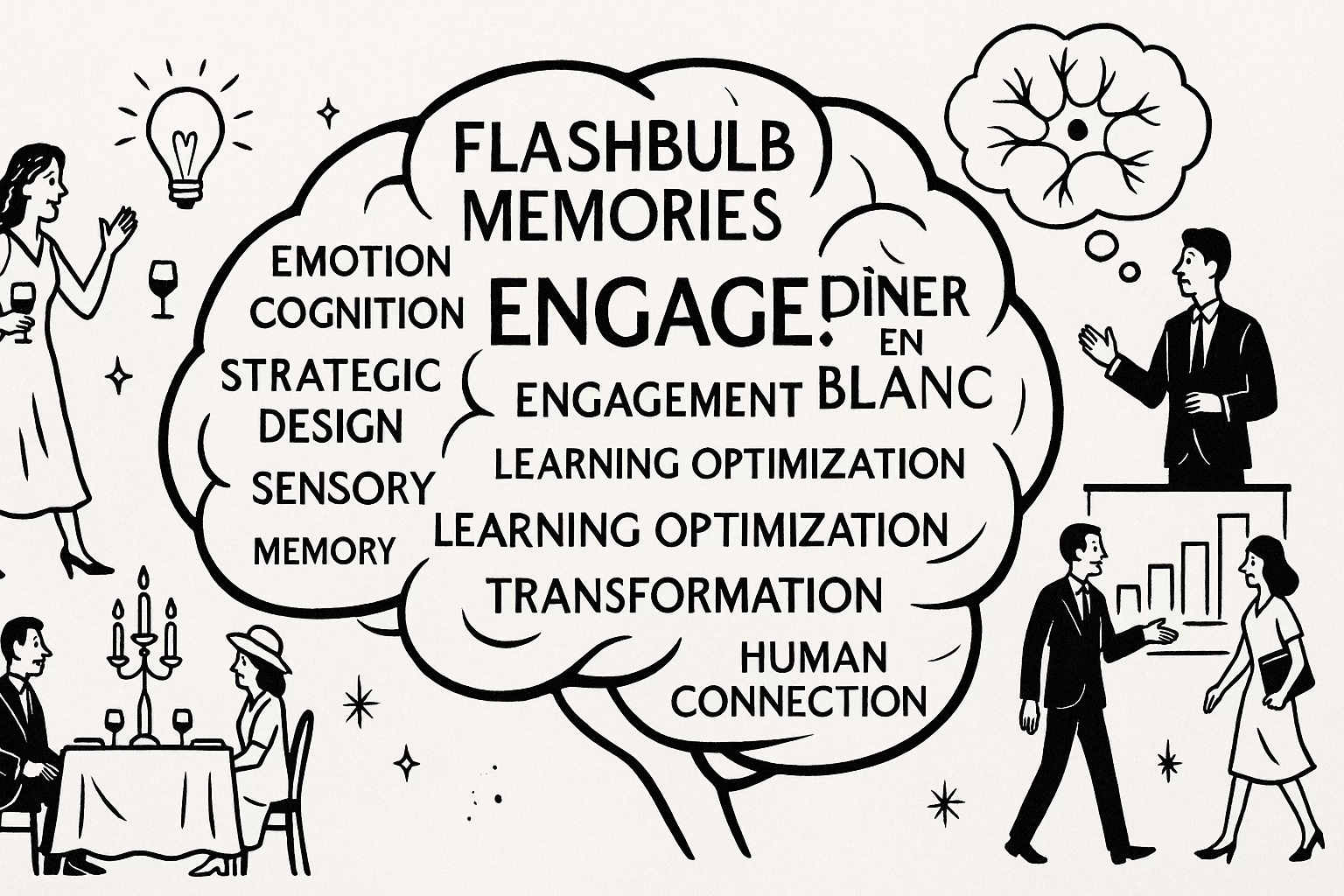
Welcome to Part 2 of my series on experience design. In Part 1, we explored how the most successful wedding designers evolve into comprehensive experience architects whose work spans corporate, cultural, and political realms. Now, we'll dive into the fascinating neuroscience behind why exceptional experiences are so powerful.
I'm not a neuroscientist or cognitive psychologist. My background is in journalism, entrepreneurism and collaboration with an emphasis on the gathering industries. However, recent explorations with AI research tools have opened my eyes to remarkable connections between what exceptional event designers do intuitively and what neuroscience is beginning to explain scientifically.
The Brain Science Behind Immersive Experiences
Mirror Neurons: Why Exceptional Experiences Feel So Powerful
For years, I've wondered why some events stick in our memories for decades while others fade almost immediately. What makes the difference? As part of my recent AI-assisted research explorations, I've discovered something fascinating: mirror neurons.
These specialized brain cells fire both when we perform an action and when we observe someone else performing it. They're why we wince when seeing someone get hurt, why our mood lifts when someone smiles at us, and why certain environments can instantly transform how we feel.
The top event designers who create the Engage! Summit experience demonstrate this principle in action. Attendees don't just see the dramatic floral displays and lighting—they feel them. Breathing patterns change, posture shifts, and these transformations happen collectively, creating a cascade effect of shared emotion. This is mirror neurons responding not just to the environment but to others experiencing the environment.
Neurological Amplification Loops in Group Settings
The same principle applies to personalized content and group entertainment experiences. When someone beside you gasps at a performer's exceptional skill, laughs at a comedic moment, or is moved to tears by a poignant performance, your mirror neurons activate in response—not just to the performance itself, but to the emotional responses of those around you.
This creates what is called a "neurological amplification loop." The performer's action activates your mirror neurons, causing an emotional response. Simultaneously, you observe emotional responses in fellow audience members, triggering additional mirror neuron activation that intensifies your own emotional state. As this happens throughout the audience, it creates a heightened state of shared emotion that can transform a good performance into a transcendent experience.
Top event designers understand this principle intuitively. When Bryan Rafanelli, the uber experience designer, arranges for a surprise performance at a political fundraiser or Bronson van Wyck, the bon vivant event designer, the coordinates a theatrical element at a gala, they're not simply providing entertainment—they're leveraging our brain's capacity for emotional contagion to create a unified experience among attendees.
The Loyalty-Building Power of Designed Experiences
Case Study: The Engage! Summit Phenomenon
Two events consistently demonstrate extraordinary power to create loyalty and demand: Engage! Luxury Wedding Summit and Dîner en Blanc.
Engage! summits, created by Kathryn Arce and Rebecca Grinnals, have become what many consider the gold standard of industry events. What makes them remarkable is the meticulous attention to every sensory aspect—from the "gifting lounge" experience to themed and highly branded celebrations. Engage! consistently sells out within minutes despite significant investment from attendees. Participants report that they don't attend primarily for the education (though it's excellent)—they attend for how the experience makes them feel. This emotional state becomes almost addictive, bringing them back year after year.
Case Study: Dîner en Blanc's Viral Growth
Dîner en Blanc represents another fascinating global phenomenon of experience design. From its Paris origins in 1988, it has expanded to over 120 cities worldwide. In New York alone, it attracts more than 6,500 participants with a waiting list exceeding 80,000 people. The 30th anniversary Paris event drew over 17,000 guests, including 6,000 international visitors.
What makes this particularly remarkable is that participants must bring their own tables, chairs, food, and decorations—they're essentially co-creating the environment. The location remains secret until minutes before, creating intense anticipation. This uncertainty triggers a state of heightened anticipation and attention that dramatically enhances memory formation.
What continues to drive the remarkable growth of Dîner en Blanc is how new people are constantly discovering the experience so they are not relying on the "hot, hip, new thing" phenomenon that frequently burns out. It becomes deeply personalized for each new attendee, creating passionate evangelists who spread the word and constantly increase demand. It's a perfect example of how a well-designed experience self-perpetuates through the emotional responses it generates.
Creating Flashbulb Memories
First-time participants often describe these experiences as "life-changing" and "unforgettable." They're experiencing what scientists call a "flashbulb memory"—an emotionally charged moment that remains unusually clear in memory due to its distinctive neurochemical signature.
The Science of Experience: Why Design Matters in Business
The most sophisticated corporate leaders understand what my research has revealed: environmental design directly impacts human cognition, emotion, and behavior. Here's how strategic event design creates measurable business impacts:
Memory Enhancement
Information presented in distinctive, multi-sensory environments is stored more effectively in long-term memory. When event designers create unique sensory experiences, they're not just decorating—they're optimizing conditions for message retention. Research shows that environmental distinctiveness can increase information recall by up to 29% compared to generic settings.[1]
Emotional Engagement
Our brain's emotional center processes environmental cues before rational thought occurs.[2] Well-designed environments trigger positive emotional responses that become associated with the brand or message. These emotional connections drive decision-making far more powerfully than logical arguments alone.
Learning Optimization
Physical environments significantly impact learning outcomes. Strategic use of lighting, seating arrangements, color psychology, and sensory stimulation can increase information absorption by up to 40%.[3] When corporate training sessions incorporate these design principles, ROI increases dramatically.
Footnotes:
[1] Isarida, T., & Isarida, T. K. (2021). Environmental context-dependent memory. In Oxford Research Encyclopedia of Psychology. Oxford University Press. The researchers found that distinctive environmental contexts can improve memory recall by 25-29% compared to neutral environments.
[2] LeDoux, J. E., & Pine, D. S. (2016). Using neuroscience to help understand fear and anxiety: A two-system framework. American Journal of Psychiatry, 173(11), 1083-1093. This research demonstrates how the amygdala processes emotional stimuli approximately 40-120 milliseconds before the neocortex processes rational thought.
[3] Barrett, P., Davies, F., Zhang, Y., & Barrett, L. (2017). The holistic impact of classroom spaces on learning in specific subjects. Environment and Behavior, 49(4), 425-451. This study of learning environments found that classroom design factors could account for a 16-40% variation in academic progress, with lighting, temperature, air quality and layout all playing significant roles.
[4] Rizzolatti, G., & Craighero, L. (2004). The mirror-neuron system. Annual Review of Neuroscience, 27, 169-192. This foundational study explains how mirror neurons activate both when performing and observing actions, creating the neurological basis for empathy and shared experience.
[5] Hatfield, E., Cacioppo, J. T., & Rapson, R. L. (1993). Emotional contagion. Current Directions in Psychological Science, 2(3), 96-100. This research established how emotional states can transfer between individuals in group settings through unconscious mimicry.
[6] Konvalinka, I., Xygalatas, D., Bulbulia, J., Schjødt, U., Jegindø, E. M., Wallot, S., Van Orden, G., & Roepstorff, A. (2011). Synchronized arousal between performers and related spectators in a fire-walking ritual. Proceedings of the National Academy of Sciences, 108(20), 8514-8519. This study documented physiological synchronization between performers and audience members during emotionally intense experiences.
[7] Hasson, U., Ghazanfar, A. A., Galantucci, B., Garrod, S., & Keysers, C. (2012). Brain-to-brain coupling: A mechanism for creating and sharing a social world. Trends in Cognitive Sciences, 16(2), 114-121. This research explores how brains synchronize during shared experiences, creating collective emotional states.
[8] Brown, R., & Kulik, J. (1977). Flashbulb memories. Cognition, 5(1), 73-99. This classic study introduced the concept of flashbulb memories and explained their distinctive characteristics compared to normal memories.
Social Connection Facilitation
Well-designed event spaces create environments that foster specific types of interaction. By strategically arranging physical elements, designers can encourage collaboration, creativity, networking, or focused attention—whichever supports business objectives.
Understanding these principles explains why exceptional environmental design isn't a decorative expense—it's a strategic investment in neurological conditions that drive specific business outcomes.
Measuring What Matters: The Metrics of Experience
Advanced event designers are now implementing sophisticated measurement approaches to demonstrate the impacts of their work:
Dwell time analysis: Tracking how long attendees remain in different environmental zones to optimize engagement
Heat-mapping movement patterns: Understanding how design influences traffic flow and interactions
Sentiment analysis: Monitoring social media posts to gauge emotional responses
Post-event information retention: Measuring what participants remember at intervals following the event
Behavioral change tracking: Assessing how event experiences translate to measurable action after the event
One critical aspect that's often overlooked is the need for frictionless feedback systems. Tools like Jotto.me are revolutionizing how we gather insights not just from attendees, but from the hundreds of people who actually work on creating and executing the event. These are the people who truly know what's happening on the ground – from setup challenges to guest reactions that might not be captured in formal surveys. By making it easy for everyone from lighting technicians to catering staff to share observations, we get a 360-degree view of the experience that no executive summary could ever provide.
These metrics transform abstract design concepts into concrete business outcomes, allowing for continuous improvement and data-driven optimization of the experience design process.
The Memory-Emotion Connection Across Modalities
What's particularly fascinating about exceptional experience design is how it targets multiple memory systems simultaneously. Our brains process and store different types of information in distinct but interconnected memory systems:
Declarative memory stores facts and concepts
Episodic memory records personal experiences and their emotional context
Procedural memory retains skills and patterns
Sensory memory briefly preserves impressions from our senses
The best-designed experiences engage all these systems at once, creating redundant neural pathways to the same core messages or feelings. This multi-system engagement explains why well-designed experiences have such staying power in our memories.
Conclusion & Preview of Part 3
We've seen how the neuroscience of experience explains why exceptional environmental design creates such powerful impacts on human cognition, emotion, and behavior. This understanding transforms how we view the value of experience design—not as decorative expense but as strategic investment in optimizing conditions for human connection and transformation.
In Part 3 of this series, we'll look toward the future of experience design, exploring cross-disciplinary approaches, AI-powered tools like NotebookLM and Suno AI, and how the boundaries between different experience categories are dissolving to create a more unified understanding of transformational design.