
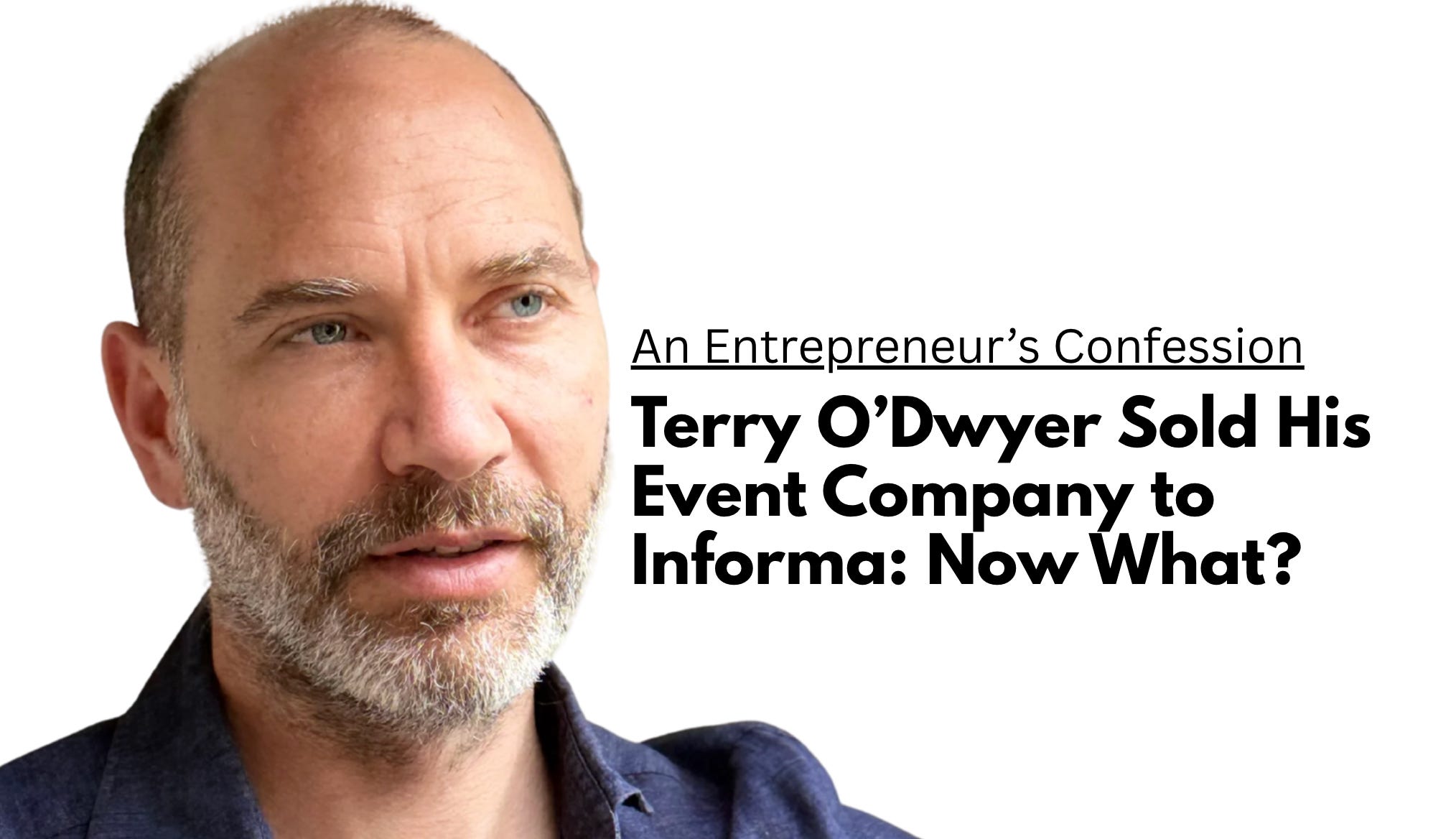
The Hardest Move a Founder Makes Isn’t the Exit. It’s What Comes After.
Terrence O’Dwyer on resisting the wrong next act and choosing the work that actually fits how he builds.
There is a peculiar quiet that follows a successful exit, a kind of silence that feels, at first, like a reward and then, not long after, like something closer to exposure. The machinery that once structured every day falls away, the calendar empties, and the external signals that once confirmed progress are replaced by something far less reliable. The question of what comes next is no longer answered by momentum. It is answered by judgment, and judgment, when it is no longer buffered by necessity, becomes an unusually demanding companion.
Terry O’Dwyer found himself in that space after the sale of LSX, the Life Science Executive Network, to Informa in 2023, a transaction that, from the outside, appeared to complete a clean and disciplined founder arc. LSX had been built with intention, scaled with care, and positioned as a platform where biotech executives, investors, and pharmaceutical dealmakers could meet in ways that produced actual outcomes rather than the vague promise of them. It was the kind of business that confirmed its value not in attendance numbers or atmosphere, but in the quiet accumulation of decisions that happened because the right people had been placed in proximity at the right moment.
https://collingwood.group/stories/collingwood-advises-on-the-sale-of-lsx-ltd-to-informa-plc/
What the transaction did not resolve was the more complicated matter of what to do with the freedom it created. It is tempting, at that stage, to reach for the next available narrative, to find something that feels like a natural extension of the first act or, better still, an elevation of it. O’Dwyer resisted that temptation long enough to notice it. Instead of moving quickly, he began to take the situation apart, not in the abstract language of opportunity, but in the more uncomfortable language of self-assessment.
He considered, in practical terms, the three paths available to him. Starting again from nothing would have satisfied the familiar founder instinct, the desire to construct something entirely one’s own. Acquiring a business offered a different appeal, the chance to impose order and direction on something that already existed but had not yet reached its potential. Joining an emerging venture would allow him to apply his energy without insisting on authorship from the outset. Each option carried its own logic, and for a period he leaned toward acquisition, drawn to a company in the mental health and wellbeing space that aligned with his personal interests and suggested a second act that would read as more explicitly meaningful.
It is here that the story might easily have taken a more predictable turn. The founder, having achieved commercial success, reinvents himself in a space that signals purpose, aligning personal conviction with professional effort in a way that feels both admirable and narratively satisfying. O’Dwyer came close enough to that path to recognize its appeal. What pulled him back was not doubt about the sector, but a more precise discomfort with his own motivation. The closer he looked, the clearer it became that he was responding to the way the decision would sound rather than the way the work would unfold. The business might have held emotional resonance, but it did not align with the pattern of how he actually operates when he is at his most effective. It would have been, in his own framing, an emotional investment, and one that risked substituting narrative coherence for operational truth.
He stepped away from it before it hardened into a commitment, a decision that, in retrospect, explains far more about his second act than any single company he might have chosen to build. What replaced that near-miss was not a sweeping reinvention, but a clearer articulation of something that had been present all along. He is not, at core, a founder driven by subject matter. What animates him is the act of construction itself, and more specifically, the construction of environments in which the right people come into alignment and something begins to move with purpose. Capital moves. Ideas advance. Decisions, which might otherwise take months, compress into moments.
The Terrance O’Dwyer Story in Song
Once that pattern is named, it becomes visible everywhere in his story. At Terrapinn, where he spent close to a decade, he learned the mechanics of B2B events in sectors that had little tolerance for abstraction. Oil, gas, transport, industries where a gathering functions as a working environment rather than a stage. The lesson was not subtle. A well-designed event is not an accessory to business. It is the business, assembled in time and space so that interactions can occur with unusual intensity.
LSX was a more refined expression of that idea, a platform built around curated access and structured interaction, where the emphasis fell not on programming for its own sake, but on facilitating exchanges that would not have occurred without the architecture surrounding them. Its success followed from that clarity.
The same instinct, stripped of any formal structure, can be seen much earlier. As a child, he found ways to create small systems of exchange, selling door to door, launching a school newspaper that circulated information among his classmates, discovering, without naming it, that value often emerges when something begins to move within a defined group. In high school, he moved across different environments, from drama to debate to sports to academics, less as a search for identity than as an immersion in different forms of group behavior. Each setting revealed a different rhythm of interaction, a different way in which attention, pressure, and influence organize themselves.
He now speaks about his self diagnosed and probably not scentifically accurate, ADHD with a candor that feels less like disclosure and more like explanation, a way of describing the speed and associative quality of his thinking alongside the structural discipline required to make that thinking useful over time. Ideas arrive quickly. Connections form easily. The instinct to begin is rarely in short supply. The challenge, which he understands clearly, lies in sustaining momentum through the less visible middle of execution. His solution has not been to reshape himself into something else, but to build around that reality, surrounding himself with people whose strengths lie in continuity, in follow-through, in the steady work of turning an initial spark into something durable.
Nowhere is that pattern more visible than in the founder community he created almost inadvertently while building LSX. A series of one-on-one conversations with other media and events founders gradually revealed a simple gap. These were people operating at similar levels, facing similar pressures, and yet they were not connected to one another in any meaningful way. The response was not strategic so much as instinctive. He brought them together.
What began as informal drinks evolved into regular lunches, and then into something more structured, though never fully formalized. The Media Entrepreneur Meetup became a space in which founders could exchange ideas with a degree of candor that is difficult to achieve in more public settings, testing assumptions, comparing experiences, and, at times, admitting uncertainty without the usual performance that accompanies it. The group grew because it addressed a real need, and during Covid, when isolation sharpened that need, it expanded further, becoming a global community supported by ongoing conversation, virtual gatherings, and shared resources.
At that stage, the opportunity to convert the network into a conventional business would have been obvious. Instead, O’Dwyer allowed it to evolve into something slightly different. The group found a more formal home within Collingwood, a firm operating at the intersection of advisory, growth strategy, and corporate finance for media and events businesses.
The arrangement made strategic sense, connecting the community more directly to capital, deal flow, and the kinds of decisions founders eventually face. What is more revealing is the boundary he maintained. He did not attempt to optimize the group into a product or extract immediate revenue from its existence. He preserved the conditions that had made it valuable in the first place, the openness of the exchanges, the relevance of the participants, and the sense that involvement was driven by necessity rather than transaction.
This instinct toward alignment, toward allowing things to become what they are best suited to be rather than forcing them into a predefined model, carries directly into his current work. Rather than starting from scratch or acquiring a business that did not fit his pattern, he chose to join and invest in a venture that operates in a space where his instincts remain relevant. Able, an AI for Business Leaders platform, is focused on the practical adoption of artificial intelligence within small and mid-sized media and events companies, translating a broad technological shift into something that can be used, tested, and integrated within real operating environments.
The surface has changed, but the underlying logic has not. It is still about identifying where movement is beginning, bringing the right people into proximity, and constructing a framework in which that movement can accelerate.
For founders considering their own second acts, the lesson here is not about the specific choices O’Dwyer made, but about the discipline behind them. Opportunity, after a successful exit, is rarely in short supply. The more difficult task is interpretation, the ability to distinguish between what feels compelling in the moment and what will sustain itself over time. It requires a willingness to step back from momentum, to question instincts without abandoning them, and to recognize that the next move does not need to be larger or louder, only more precisely aligned.
O’Dwyer could have built almost anything.
What he chose instead was to build in a way that fits how he actually works, a narrower, more exacting path that trades narrative appeal for something more durable, and, in the long run, far more useful.


