
Relationships Extend Life. Gathering Forges Relationships. The Events Industry Has Been in the Longevity Business All Along
Two governments have declared a public health emergency. Harvard spent 88 years proving the case. Neuroscience explains why people can’t do it alone. And Kara Swisher is about to put it on CNN.

The events industry’s most important product has no job title, no budget line, and no seat at the production table. It is the conscious act of giving people permission to talk to each other — of deliberately harnessing the serendipity that every gathering makes possible but almost none intentionally designs for. Conscious is the operative word. Because the industry does not do this well. It fills rooms, books speakers, manages logistics with extraordinary precision, and then leaves the most important thing — the actual human encounter — entirely to chance. Two strangers can stand fifteen feet apart at a conference designed for human connection and never once speak, because nobody in that room has been given the professional responsibility of closing that distance. Harvard spent 88 years proving that closing it is a matter of life and death. The US Surgeon General declared its absence a national emergency. Britain appointed a cabinet minister to address it. And the gathering economy — the $1.285 trillion industry that exists for exactly this purpose — has been delivering connection by accident rather than by design, without credit, without claim, and without nearly enough intention. That is the story. And it starts here.
AI Can't Replace the Oxytocin Moment
This clip delivers a sharp, memorable contrast between AI capability and irreplaceable human connection, with a vivid example that stands on its own. It's emotionally resonant and instantly frames why real-world interaction matters right now.
I have always believed you don’t judge an event by the number of people in the room. You judge it by the number of conversations created — real ones, the kind that continue after the badge comes off, the kind that become collaborations, friendships, and in ways that science is only now beginning to fully document, years added to the lives of everyone involved. That premise has guided everything I have thought about this industry for decades. It took Harvard 88 years to prove it, a US Surgeon General to declare it a national emergency, a British government to appoint a minister for it, and Kara Swisher launching a CNN series about living forever to make the rest of the world pay attention. The gathering economy didn’t need any of them to know it was true. But it needs all of them now to finally claim it.
The events industry has spent its entire professional life arguing its own value in the language of business — ROI, qualified leads, sales cycles shortened by a handshake. What it has never done is make the biological case. The most powerful longevity drug ever identified doesn’t require a prescription, a clinical trial, or a business class seat to Seoul. It requires other people. And this industry has been dispensing it, at scale, without credit, for as long as people have been putting chairs in rooms.
The Harvard Study of Adult Development has been running since 1938. It is the longest in-depth longitudinal study on human life ever conducted, and after nearly nine decades it has arrived at a conclusion simultaneously simple and staggering: good relationships lead to health and happiness. Not wealth. Not genetics. Not the blood-panel regimens Bryan Johnson submits to with the devotion of a medieval monk. Not income, professional success, intelligence, or fame — the quality of our relationships with partners, family, friends, and community is the single strongest predictor of longevity, physical health, and happiness across every social class and generation the study has ever tracked. Dr. Robert Waldinger, the study’s current director, has distilled nearly nine decades of data into three words that deserve to be carved above the entrance of every convention center in America: “Relationships, relationships, relationships.”
Strong relationships protect us from stress, strengthen immune systems, and promote faster recovery from illness. Loneliness and social isolation carry health risks comparable to smoking 15 cigarettes a day. Every trade show, every industry conference, every family reunion, every wedding where someone crosses three time zones to squeeze into a ballroom is, in the most literal clinical sense, a health intervention. This is not a motivational poster. This is the Harvard Study of Adult Development in its 88th year, and it is the scientific foundation on which the gathering economy should be planting its flag — loudly, permanently, and without apology.
But here is what the industry has never fully reckoned with: the science of why those conversations don’t happen on their own — why the medicine doesn’t dispense itself just because you’ve put a thousand people in the same room. This is where neuroscience stops being abstract and starts being operationally urgent for every event professional alive.
The Brain Chemistry Behind Trust and Connection
This clip is punchy and science-backed, delivering a compelling emotional hook about why human connection matters. It stands alone cleanly and frames a memorable, shareable insight that grabs attention fast.
The human brain is wired for connection in the deepest evolutionary sense, and simultaneously wired to be terrified of initiating it with strangers. The neuroscientist John Cacioppo argued that loneliness has evolved as an alarm signal to ensure we remain firmly embedded within our social cocoon — because humans, like all primates, survive in groups, and isolation is an existential threat the brain registers as physical danger. That alarm system is ancient and powerful. But so is its mirror: the threat-detection system that fires the moment we consider approaching someone we don’t know. Social rejection activates brain regions involved in distress, and researchers propose this sensitivity evolved because exclusion from the group was genuinely dangerous in ancestral environments. The brain hasn’t caught up to the fact that a networking conversation gone quiet won’t kill you. When silence falls between strangers, the amygdala — the brain’s fear center — can become hyperactive, triggering a fight-or-flight response, while the anterior cingulate cortex goes into overdrive searching frantically for the right thing to say.
In plain language: the same species that needs human connection more than almost anything else is neurologically predisposed to avoid initiating it with strangers. We are simultaneously dying of loneliness and too afraid to say hello. Research shows that people consistently think they are worse at social interaction than they actually are, that they believe compliments will seem weird when people love receiving them, and that they assume approaching a stranger will lead to rejection when in reality it almost never does. We miscalculate the social risk catastrophically and systematically, and we do it every time we walk into a room full of people we don’t yet know.
Which is precisely why conscious permission matters. Not as a soft concept, not as a hospitality nicety, but as a neurological intervention. When someone with authority — a facilitator, a host, a well-designed environment — removes the ambiguity that the amygdala reads as threat, the brain’s social circuitry can finally do what it has been trying to do all along. Neuroscience has linked human cooperation to oxytocin — a neuropeptide that promotes trust, reduces social anxiety, and facilitates the formation of interpersonal relationships. But oxytocin doesn’t flood the system from across a room. It requires a moment of genuine social contact to trigger — released even during minor social encounters, even with strangers, as long as the interaction is positive. The job of the conscientious facilitator is to create the conditions for that first moment. Everything else the body does itself.
This is the era in which that understanding has never been more urgent, or more endangered. We are living through a civilizational experiment in human disconnection. The smartphone completed what the suburb started — a systematic dismantling of the accidental encounters, the unplanned conversations, the spontaneous human friction that used to be unavoidable in daily life. Young people aged 15 to 24 are experiencing 70% less social interaction with friends than two decades ago, a collapse in human contact so steep it has no precedent in recorded social history. Artificial intelligence is now accelerating the isolation with a seductive logic: why sit in traffic to attend a meeting when the machine will summarize it for you? Why go to the conference when AI will extract the insights? The answer — the one Harvard and the neuroscience both insist on — is that the insights are not the point. The encounter is the point. The oxytocin is the point. The moment two people discover they are solving the same problem, standing in the same hallway, is the point. No summary captures it. No algorithm replicates it. And no virtual event has ever produced it.
Two governments have now said so in official language. Britain became the first country in the world to appoint a Minister for Loneliness in 2018, a direct legacy of Jo Cox, the Labour MP murdered in 2016 who had been focusing on the issue before her death. The ministry has now passed through five ministers. Over 3.9 million people in Britain report feeling lonely often or always — a figure that continues to rise — and 58% of UK adults now say they experience loneliness at least some of the time. In America, Surgeon General Vivek Murthy did something surgeon generals reserve for genuine emergencies and issued a formal advisory in 2023. He declared loneliness an epidemic, calling it a major public health risk for both individuals and society. Poor social connection, his report found, carries a 29% increased risk of heart disease, a 32% increased risk of stroke, and a 50% increased risk of developing dementia for older adults. The gathering economy — the largest organized infrastructure for human connection on the planet — has been almost entirely absent from both conversations. That is an institutional failure, and the industry has no one to blame but itself for not making the case.
Which is precisely the moment Kara Swisher walks in.
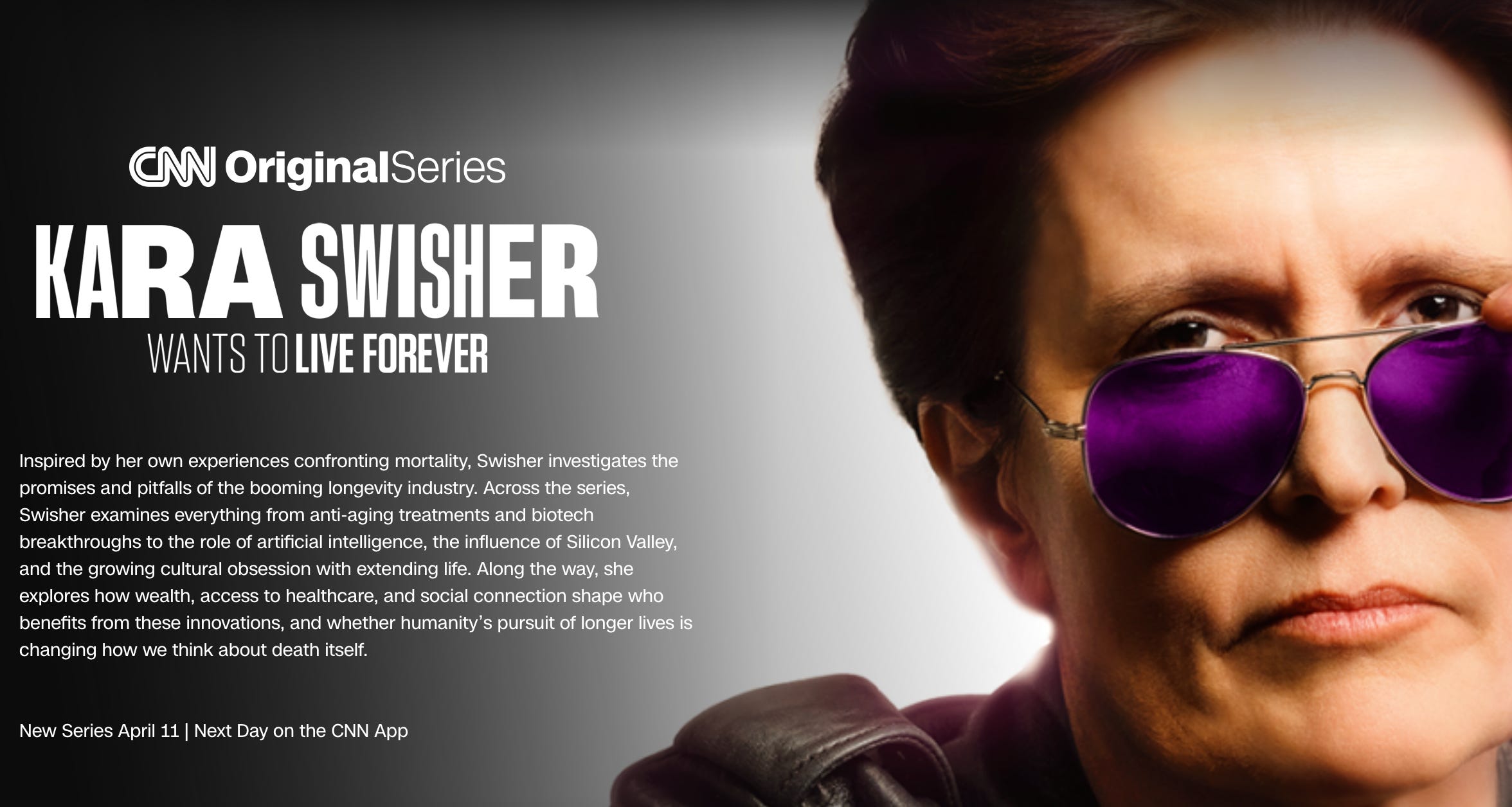
Fueled by the early death of her father and her own serious health scare, Swisher set out to investigate a longevity space she says has been held hostage by “rich tech bros, jacked dude influencers, nonsense sellers of useless supplements.” Her six-part CNN series, premiering April 11, takes her from concierge medical clinics to biotech labs and into South Korea, examining how wealth, access to healthcare, and social connection together determine who actually benefits from the longevity revolution. Sam Altman, Bryan Johnson, Jennifer Doudna, Scott Galloway — the guest list signals that this is not wellness television. It is a reckoning. And the variable that keeps surfacing — the one that resists every optimization scheme, that cannot be purchased at any price point, that no AI can manufacture — is human connection. The biotech crowd can sequence your genome, prescribe metformin, and monitor your VO2 max with Swiss-watch precision. It cannot produce the dinner with old friends, the hallway conversation at a conference that turns into a decade-long collaboration, the wedding toast that reminds a room full of people why they showed up. Those moments belong to the gathering economy. But only when someone in that gathering has made the conscious decision to create the conditions for them.
Conferences: The Accidental Health Intervention
This clip reframes conferences and trade shows as a surprising public-health force, creating a big, counterintuitive hook that grabs attention fast. It stands alone with clear stakes and an unexpected takeaway that invites curiosity.
Freeman — the 98-year-old events company that has put more people in rooms together than perhaps any organization in American history — has been building its own parallel case from inside the industry. Its 2025 Trust Report found that 95% of attendees trust brands more after participating in an in-person event, while 71% of brands saw a decline in reputation through other channels in 2024. Its most recent study found that 94% of working professionals say in-person events allow them to grow interpersonal skills, while 63% report increased confidence in business relationships after attending. Mapped against the Harvard findings and the neuroscience, those are not marketing statistics. They are measures of the precise biological conditions that keep people healthy and alive. And yet Freeman’s serendipity study — Unpacking XLNC: How to Architect Serendipity and Connect People in Meaningful Ways — delivered the finding that should unsettle every event professional in this industry: 96% of event organizers have no one specifically in charge of networking. The most important thing the industry produces has no owner, no job title, no seat at the production table. The industry is generating the medicine and leaving it on the floor.
The reason is neurological before it is organizational. Forty percent of attendees say networking feels awkward, and thirty percent admit they struggle to start conversations. The industry has mistaken that friction for a preference. It is not a preference. It is the amygdala doing its ancient job, scanning a room full of strangers and registering low-level threat. It is the precise moment that requires a professional to step in and consciously dissolve it — to give the room permission to be what it was assembled to be. The solution is not more programming, not smarter matchmaking software, though that helps at the margins. The solution is a human being whose specific professional skill is giving other people permission to talk to each other and guiding them toward the serendipitous encounters they came for but cannot engineer alone.
The facilitator. Not in the narrow workshop sense, but in the largest possible definition. The professional who understands that two strangers standing fifteen feet apart in silence may represent the most important conversation the entire gathering was convened to produce — and who knows how to close that distance without either person feeling managed. Part social scientist, part host, part dramaturg. Fluent in the dynamics of rooms. Trained in the neuroscience of first encounters. Conscious, always conscious, of the responsibility to guide attendees toward each other rather than leaving them to the mercy of their own amygdalae. Research estimates it takes roughly 200 hours of face-to-face contact over three months to turn a stranger into a good friend, but it takes approximately thirty seconds of the right kind of introduction to begin. The facilitator’s job is to supply those thirty seconds, deliberately and repeatedly, for every person in the room.
Waldinger has said that isolation sneaks up on people — that it is easy to get consumed by work and suddenly realize you haven’t seen a close friend in far too long. “So I try to pay more attention to my relationships than I used to,” he said — the most quietly subversive thing the director of an 88-year Harvard study has ever said publicly. His finding that loneliness kills — that it carries the same mortality weight as smoking or alcoholism, and that those who kept warm relationships lived longer while the loners often died earlier — has moved from academic literature into mainstream consciousness at the precise moment Swisher is pointing a camera at it, governments are legislating around it, and neuroscience is explaining the mechanism beneath it.
The gathering economy doesn’t need a new argument. It needs to claim the one that science, government, and its own research have already made — and it needs to build the professional discipline that delivers on it consciously rather than accidentally. The global events industry was valued at $1.285 trillion in 2024 and is on a trajectory toward $2 trillion by 2034 — which makes it one of the largest providers of human connection on the planet, operating at the precise intersection of public health, human longevity, and civilizational need. It built the solution to the loneliness epidemic before the epidemic had a name. It has been manufacturing the conditions for oxytocin release, trust formation, and life-extending relationships every single day, in every time zone, at every scale. It has simply never done it consciously enough.
The future superstars of this industry will not be measured by the size of the stages they command. They will be the professionals who master the conscious art of giving people permission to talk to each other — who treat the harnessing of serendipity not as a happy accident but as the primary deliverable of every gathering they touch. Britain appointed a minister for this. America’s top doctor declared a national emergency over it. Kara Swisher is chasing it on CNN. The gathering economy has been living it the whole time.
Time to do it on purpose.
The complete video and call to action


