
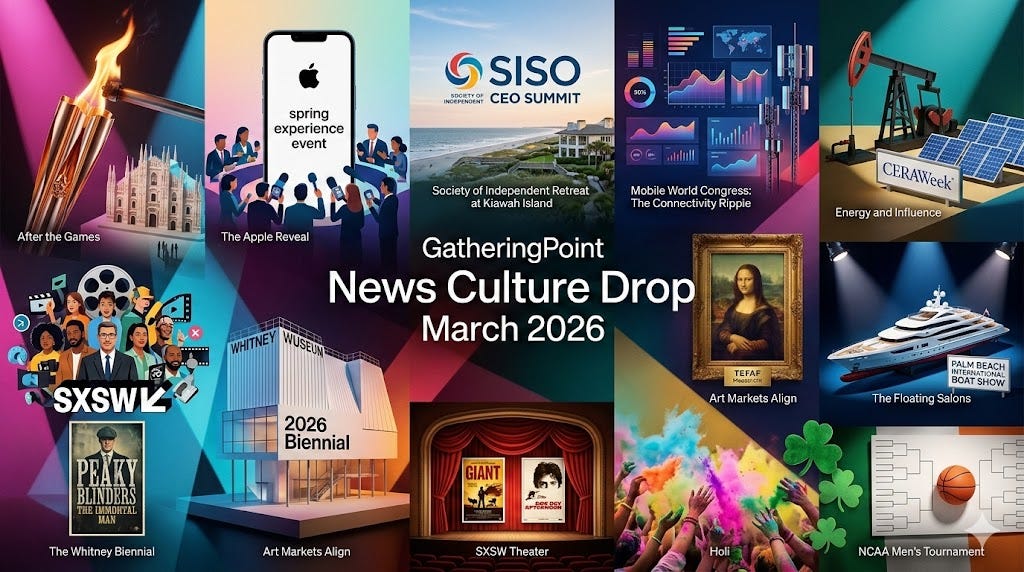
Editor’s Note: Most event organizers live head-down — timelines, budgets, speakers, sponsors. It’s easy to miss what the rest of the world is staging while you’re building your own room.
The Olympic flame in Milan and Cortina has barely cooled when March begins its quieter, more consequential work. The closing ceremony of the 2026 Winter Olympics delivered spectacle — symmetry, anthem, choreography — but March belongs to alignment. Stadiums empty. Suites fill. The applause fades and the decisions begin.
On March 4, Apple gathers press simultaneously in New York, London, and Shanghai for its publicly announced spring experience event. Apple does not casually assemble three global capitals. The choreography is precise, the narrative disciplined, the environment engineered for reveal. Whatever hardware or software takes the stage, the more important lesson is architectural: timing, secrecy, simultaneity, and confidence expressed through space.
Five days later, the exhibition world’s inner circle meets somewhere far quieter. From March 9 through March 11, the Society of Independent Show Organizers (SISO) convenes its CEO Summit at The Sanctuary on Kiawah Island. No booths. No exhibit floor. Just the executives who run some of the world’s most profitable independent trade shows discussing consolidation, AI integration, global expansion, and risk. If there is a nerve center for the exhibition economy in March, it is not a convention hall. It is this coastal retreat.
In the same early-March window, Paris becomes its own stage. From roughly March 2 through March 10, Paris Fashion Week transforms the city into a distributed theater of influence. The runway is only the headline; the real choreography unfolds in arrival lines, private showrooms, and late-night dinners where editors, buyers, luxury executives, and celebrities quietly recalibrate hierarchy. Fashion, like tech, understands sequencing. Who sees first. Who sits front row. Who is photographed entering. Narrative is not accidental in Paris — it is staged.
The reverberations of Mobile World Congress carry directly into early March conversations. Telecommunications giants, semiconductor strategists, AI infrastructure architects, and device manufacturers leave Barcelona and immediately begin translating face-to-face negotiations into global infrastructure shifts. Connectivity may feel invisible, but it is constructed in rooms like these.
In Houston, CERAWeek gathers energy ministers, oil executives, renewables innovators, and sovereign wealth funds. Panels provide language. Private dinners settle posture. Energy does not trend; it dictates. When these players share oxygen, the world’s grids and capital flows subtly realign.
Austin answers with friction rather than formality. South by Southwest (SXSW) stretches across the city in mid-March, merging tech, film, music, and venture capital into a restless organism. A founder leaves a keynote and wanders into a showcase. A filmmaker debates AI ethics with a chip designer. The city itself becomes a distributed venue. SXSW remains valuable because it tolerates collision.
New York reasserts institutional gravity. On March 8, the Whitney Museum of American Art opens its 2026 Biennial, an exhibition that reframes contemporary American art and quietly adjusts careers. Critics arrive sharpened. Collectors take measure. Artists find trajectories altered by proximity to certain walls. Across town, the Museum of Modern Art unfolds its spring slate throughout the month, including Peggy Weil: Core Memory (March 7), Frida and Diego: The Last Dream (March 21), and Naufus Ramírez-Figueroa (March 28). These galleries are not neutral containers; they are arguments made spatial.
Europe’s art market moves with studied sequencing. From March 14 through March 19, TEFAF Maastricht presents Old Masters and museum-grade works beneath lighting that communicates assurance rather than spectacle. Invitation days precede public entry, shaping tone before scale. At month’s end, from March 27 through March 29, Art Basel Hong Kong anchors Asia’s collector calendar, with preview days setting hierarchy before general access begins. Premium is not volume; it is order.
Wealth has its own March ritual. From March 25 through March 29, the Palm Beach International Boat Show lines Florida’s waterfront with superyachts that function as floating salons. Brokers close deals on polished decks. Buyers inspect hulls in person. Even in a digital economy, certain decisions require walking the perimeter.
The screen and the stage maintain their cadence. On March 6, Peaky Blinders: The Immortal Man reaches theaters, extending a global franchise into cinematic scale. Broadway contributes its own openings, with GIANT beginning previews March 11 and opening March 23, and Dog Day Afternoon opening March 30. In London’s West End, productions like Cabaret and Back to the Future continue their runs, anchoring Theatreland with durability rather than novelty.
Outside formal venues, March pulses with ritual. On March 3, Holi dissolves hierarchy in clouds of color. Mid-month, St. Patrick’s Day transforms cities into civic parades and economic engines. The NCAA Division I Men’s Basketball Tournament begins its annual takeover, converting offices and living rooms into decentralized arenas of suspense.
Across Orlando, Boston, and Chicago, fandom asserts its own architecture of belonging at MegaCon Orlando, PAX East, and C2E2. Cosplay is not ornament; it is allegiance enacted. Sponsors who integrate respectfully are rewarded with loyalty measured in years.
Across continents and sectors, the pattern is consistent. Technology reveals. Energy recalibrates. Exhibition leaders align. Art institutions assert. Wealth inspects. Theater tests. Fans gather. Ritual persists.
March does not rely on chandeliers. It fills the rooms where direction is set.


