
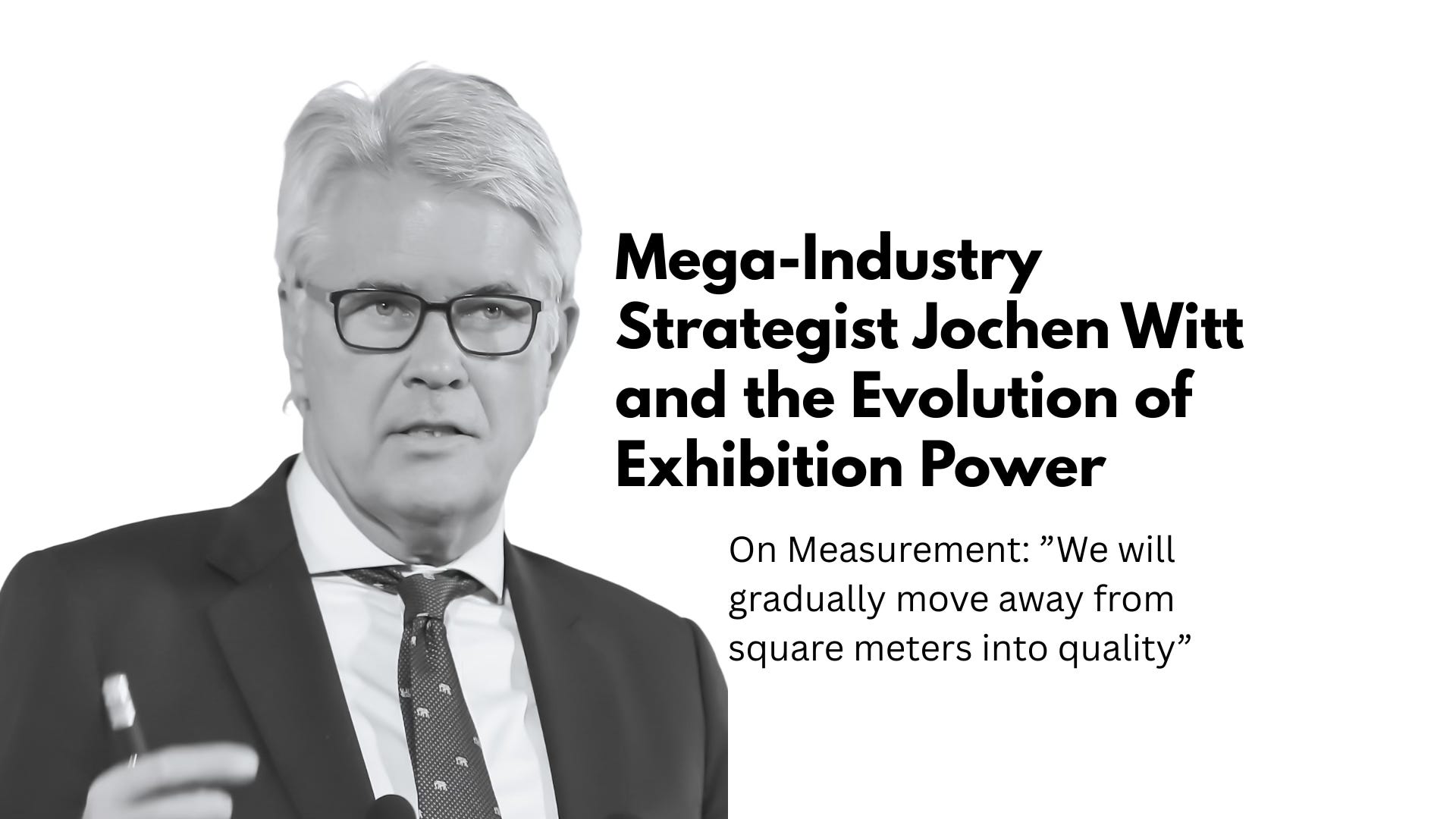
The Exhibition Industry Global Strategist Jochen Witt Opens Up About The Evolution of Exhibition Power
After decades defining how the world measures trade fairs, Witt argues the next era will be driven less by square meters and more by vertical density, regional power, and the quality of interaction.
Editor’s Note: When I spent 25 years at BizBash, my focus was firmly on cities like New York, LA, Chicago, Miami, DC, Las Vegas, Boston and Toronto—international was never top of mind. Then I met Kai Hattendorf, who ran UFI, the global association for trade show organizers. Kai recently joined jwc, and through him, I discovered Jochen Witt. Witt’s firm, jwc, is one of the most respected consultancies in the exhibition world, advising organizers, governments, and investors. Before that, Witt was the CEO of Koelnmesse—running one of Germany’s powerhouse trade fairs. These Messen are more than events—they’re economic engines for entire cities. It turns out, knowing the people who ran these halls is key to understanding the gathering economy. Through this article, you’ll meet Witt—and see why his vision matters.
Jochen Witt did not grow up in the exhibition industry. He did not inherit it, nor was he groomed in its rituals. He entered it through systems — and systems, for Witt, have always been more interesting than spectacle.
Before he ever presided over cavernous halls in Cologne, he defended Germany in the Caribbean with the Navy as he mockingly points out. He studied law. He financed his university years by selling at exhibitions, standing in front of rooms full of strangers and persuading them to buy something. That detail is not decorative. It is formative. Long before he measured square meters, he measured reactions. He learned how quickly a room shifts. He learned how tempo affects outcome.
He practiced bankruptcy and international tax law. He lived in Sri Lanka, Oman and Russia and lived in Sri Lanka, Oman and Russia and ran a potash mining company in Canada at a time when fertilizer was tied to the global politics of food. He oversaw European gas sales in a joint venture connected to Gazprom, navigating commercial terrain where geopolitics and economics refused to stay separate.
Then a headhunter called and asked whether he would consider becoming CEO of Koelnmesse.
To understand what that meant in the exhibition world, you have to understand what Koelnmesse represents.
Koelnmesse
Koelnmesse is not simply a venue operator. It is one of the institutional anchors of the German Messe tradition — a system that helped rebuild postwar Europe through trade fairs that functioned as industrial reset points. The German model was never just about marketing floorspace. It was about synchronizing industries. Entire sectors aligned product cycles, capital decisions, and strategic announcements to the calendar of Cologne, Hannover, Düsseldorf. If your industry mattered, you gathered under steel spans that conveyed permanence and authority.
The twentieth century believed in scale, and exhibitions mirrored that belief. Bigger halls signaled industrial seriousness. Biennial “lead events” dominated verticals. Governments invested in exhibition infrastructure as proof of economic stature. Square meters became shorthand for power.
Witt inherited that logic and helped rationalize it. He did not dismantle the cathedral. He strengthened its foundations. Yet decades later, as founder of jwc GmbH, he now speaks of evolution with the calm of someone who has watched a system mature.
This year, jwc introduced its first country-level multidimensional exhibition market ranking . The framework evaluates demand fundamentals, competitive openness, ecosystem maturity, venue capacity, and business conditions across nations. China and the United States lead overall. France edges ahead of Germany. The document runs nine hundred pages — comprehensive, comparative, strategic. Its very existence signals change. A decade ago, the industry did not measure itself this way.
To get a copy of the report link here.
In 2016, exhibition dominance was still largely equated with physical scale. Germany’s Messe system stood as monument. China’s growth rates made expansion feel inevitable. The United States assumed continental mass would secure its place. If you wanted to know who was winning, you counted square meters.
Today, Witt articulates something more complex. “We will gradually move away from square meters into quality,” he says .
He does not present this as rebellion. He presents it as progression.
The difficulty, he acknowledges, is that quality resists easy quantification. Scale is visible. Quality is relational. It lives in interaction density, in relevance, in how effectively proximity converts into durable economic relationships. The industry has learned to measure buildings. It has not yet fully learned to measure behavior.
The ranking reflects structural complexity. Markets excel for different reasons . Some are driven by demand. Others by competitive openness. Others by ecosystem maturity. No single variable dominates. Yet even this multidimensional framework feels transitional. It captures structure, but it only gestures toward what happens inside the halls.
Witt speaks about national tendencies without sentiment. The British internationalized early because they had to; their domestic market was small. Germany, comfortable in its industrial base, was slower. The United States, insulated by scale, was slower still. These are not criticisms. They are structural observations.
China complicates the picture. Witt has traveled there for forty-three years . He has witnessed transformation that challenges European pacing. He speaks of tempo. The Chinese attendee, he says, is faster — quicker to implement, quicker to act.
That difference in tempo alters economic physics. A hall filled with decisive participants produces different outcomes than one filled with hesitant observers. Conversations convert to commitments more quickly. Action follows encounter with less friction.
Markets do not move because halls are large; they move because people inside them act.
This emphasis on the attendee is telling. Rankings map nations. Buildings symbolize power. But the real variable is human behavior.
Government incentives add another layer of complexity. States deploy subsidies large enough to lure flagship events across borders. In other sectors, entire production industries have relocated chasing rebates. Witt has studied the dynamic and remains pragmatic. Most organizers prioritize market logic first . Incentives can accelerate a decision, but they rarely override structural demand — unless they are so large that declining them would be irrational.
Markets still anchor strategy.
The most revealing moment of the conversation comes when Witt is asked where he would invest a billion dollars in the exhibition industry. He does not cite the top-ranked country from his own report. He names Easyfairs .
For a former leader within Germany’s Messe system, that answer carries weight.
Easyfairs does not define itself by monumental “lead events.” It builds tightly defined vertical gatherings and replicates them regionally. It diversifies across sectors and geographies. It spreads risk. It favors density over monumentality.
Witt predicts exhibitions will become more regional and more vertical . Instead of singular global events dominating entire industries, sectors may organize around dense regional ecosystems in North America, Europe, Asia — eventually Africa. The future may reward repetition and familiarity over singular spectacle.
This logic extends beyond strategy into time. Witt describes what he calls the “impact gap” between major editions of flagship shows . Momentum fades between cycles. To bridge that gap, organizers increasingly deploy smaller, targeted gatherings — curated meetings, niche convenings, key-person dinners. The calendar becomes continuous rather than episodic. Density replaces periodic grandeur.
Architecture mirrors the shift. In Shenzhen, jwc helped shape a massive exhibition complex integrating halls with meeting and content spaces . What matters is not simply the total square footage but the configuration. Instead of relying on one enormous room, venues must incorporate multiple breakout spaces — fifty square meters, one hundred, one hundred and fifty — environments where smaller groups can cluster before reconnecting to larger flows.
He has seen new facilities built with a single dominant hall and little flexibility, and his reaction is blunt: “What did they build there?” .
Scale alone no longer guarantees relevance. Configuration becomes strategic.
As the conversation turns to AI and digital transformation, Witt remains composed. Artificial intelligence will strengthen exhibitions. It will not replace them . Digital systems optimize efficiency and probability. They rank, suggest, curate. But physical convergence preserves something distinct.
“Perception is reality,” he says . In a shared physical environment, perception anchors authenticity. In digital space, pathways are increasingly mediated. It becomes easier to follow suggested routes rather than initiate new ones.
In a hall, you decide which corridor to walk. You overhear rather than search. You engage someone you did not algorithmically select. That friction preserves agency.
Witt does not romanticize this distinction. He sees it as structural advantage.
Looking ahead to 2036, he imagines the full jwc research reports and the ranking evolving in format — digitized, globally accessible, layered with real-time data . But content-wise, he anticipates square meters declining in relative importance while new criteria rise. He acknowledges that the industry does not yet fully know how to measure those criteria.
That humility is instructive. If 2016 was defined by infrastructure dominance and 2026 by structural comparison, 2036 may hinge on how effectively markets convert proximity into durable networks.
The ranking maps geography. The next frontier may map interaction.
Witt’s path into the industry was unconventional, and perhaps that distance gives him clarity. He financed his education by selling on exhibition floors. He ran mines and gas portfolios before running halls. He entered the Messe world from the outside and translated it into strategic language.
The cathedral builders erected monuments. The next generation may build ecosystems. And somewhere between square meters and serendipity, Jochen Witt continues to refine how power in the exhibition industry is understood — not as acreage, but as density of interaction, tempo of execution, and resilience of networks.


