
The Editor Who Taught an Industry How to Listen
Michelle Russell has spent nearly two decades quietly shaping how the events world thinks—bringing emotional intelligence, behavioral science, and editorial rigor into the Gathering Economy. e
The Gatekeepers of the Gathering Economy- Meet the Editors: Michelle Russell of PCMA’s Convene
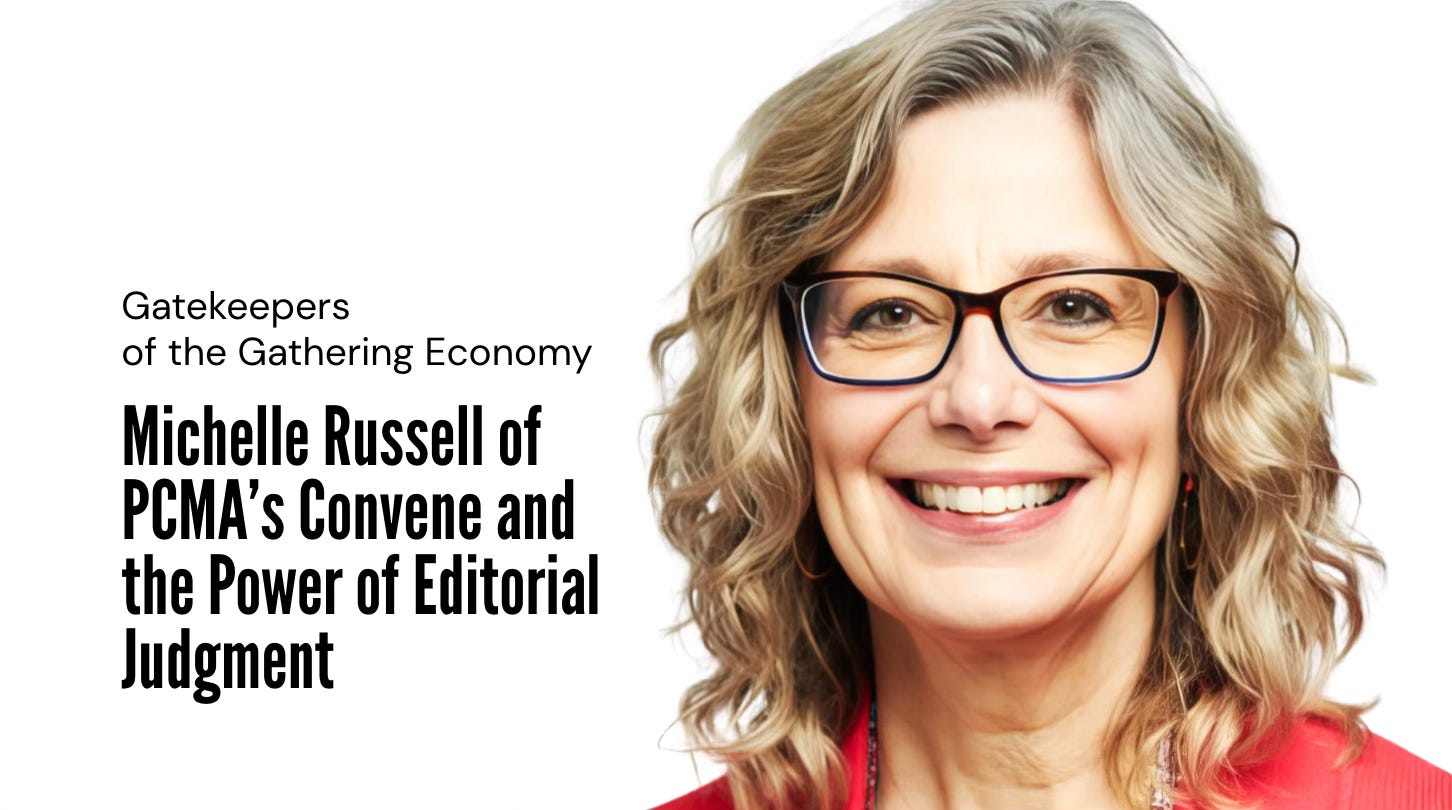
Editors Note: One of the most fertile—and least examined—territories in event coverage lives not on stages, show floors, or keynote screens, but inside the minds of the editors who decide what becomes visible, legible, and culturally consequential in what I’ve come to think of as the Gathering Economy: the vast, overlapping ecosystem of conferences, congresses, summits, festivals, salons, and live convenings that quietly shape how industries evolve, how communities cohere, and how ideas move through the world. Long before a concept hardens into a session title or a theme migrates onto an agenda, it passes through a smaller, more influential filter—the judgment of a handful of editorial gatekeepers who see everything, speak with everyone, and determine which conversations are ready to matter.
This story is the second in an ongoing GatheringPoint.News exploration of those gatekeepers. The first focused on the editor of Skift Meetings, Miguel Neves, whose clarity of thought and near-moral commitment to credibility revealed something essential: editors in this space are not passive observers but active shapers of how the industry understands itself. That realization led directly to Michelle Russell, because if there is a longer-serving, quieter, and more consistently influential editorial presence in the business-events world, it is hers.
This month marks 23 years that Michelle Russell will have been the editorial voice behind Convene, the magazine published by Professional Convention Management Association. During that time she has helped define not just what the industry talks about, but how it thinks about its own purpose. She does not do keynote conferences, cultivate a personal brand, or perform thought leadership. Instead, she has spent more doing the harder, less visible work of interpretation—deciding which ideas deserve oxygen, which deserve patience, and which need to be translated carefully so they land as insight rather than jargon. She supports a team of journalists who have inspired her to always be at the top of her game.
To understand why she reads the industry the way she does, you have to go back long before Convene, long before associations and agendas and editorial calendars, to a childhood shaped less by crowds than by curiosity. Russell describes herself, without irony, as a bookworm—the kind of child who got into trouble for reading instead of going outside to play, not because she disliked people, but because she was already fascinated by how other worlds worked, how other minds moved, how language could open doors that geography could not. Reading, for her, was not withdrawal; it was rehearsal. Even then, she remembers listening to the way people spoke and mentally rephrasing their sentences, instinctively testing how language could be sharpened, clarified, or made to say what it really meant.
That instinct carried her through her education and into her first professional chapter in publishing, where she worked as a nonfiction editor at Random House. It was there that she learned both the discipline and the burden of long-form storytelling—how to respect complexity without overwhelming the reader, how to serve the work rather than impose herself on it, and how editorial restraint can be as powerful as assertion. She also learned something essential about herself: she loved ideas deeply, yet preferred working in tighter frames. Books could feel overwhelming in their sprawl; magazines offered a different rigor—the chance to take one idea at a time and make it legible without flattening it.
When she arrived at Convene in her early forties, she did not come as an event professional but as an observer, and that turned out to be her advantage. What she saw immediately was an industry that spoke the language of logistics while practicing psychology, a field intensely focused on execution yet often unaware of the emotional, cultural, and behavioral forces it was orchestrating every time people gathered in a room. Planners talked about coffee counts and room blocks; Russell saw identity, belonging, friction, curiosity, and trust moving quietly beneath the surface.
Her own temperament sharpened that lens. Russell identifies as an introvert in an industry that often rewards extroversion, volume, and performance. She has never pretended to enjoy unstructured networking or crowded receptions designed around noise rather than conversation, and she has spoken candidly about how uncomfortable those environments can be—not just for her, but for many attendees who rarely say so out loud. That lived experience became editorial insight. Long before the industry began talking seriously about curated networking, facilitated dialogue, and psychological safety, Russell understood why those ideas mattered: she felt the misalignment personally.
Family experience deepened that understanding in ways that quietly but permanently shaped her worldview. She has spoken about her mother’s long battle with cancer and the role medical conferences played in extending her life—how knowledge shared in rooms far removed from the patient’s bedside translated into real-world outcomes. That experience cemented something fundamental for Russell: events are not abstractions. They are not just professional rituals or revenue engines. At their best, they are mechanisms through which knowledge moves, communities form, and lives change. Not every organizer makes that connection. Russell never forgot it.
To appreciate the scale of what she has been stewarding, it helps to understand the platform itself. Convene is not a niche blog or a lightweight member circular. It is one of the longest continuously published magazines in the business-events world, in circulation since the mid-1980s and reaching tens of thousands of readers globally through print and digital channels. It sits at the heart of PCMA, an association founded in 1956 that has grown into one of the most influential convening institutions in the world, with a global membership and a flagship annual gathering—Convening Leaders—that functions as a kind of constitutional convention for the profession.
PCMA is not, by nature, a media company; it is an educational and community organization. And yet housed within it is a magazine that has behaved, under Russell’s direction, like an independent cultural interpreter—close enough to the institution to understand its machinery, far enough from it to ask harder questions about meaning, purpose, and impact. That balance has never been simple. Russell has spoken candidly about the double-edged nature of working inside an association: the freedom to explore ideas deeply, paired with the ongoing need to explain why good editorial work requires time, resources, and a tolerance for ambiguity.
Over time, Russell wrote her way toward a point of view. If you trace her career only through titles, you miss the more revealing record, which lives in the editor’s letters, framing essays, and reflective columns where she allowed herself to ask the questions the industry was not yet ready to formalize. Early on, her writing carried the tone of a careful observer fascinated by a profession just beginning to grasp its own reach. She wrote about civility, about face-to-face encounters as a counterweight to abstraction, about the strange power of being in a room together at a time when the industry still took that power for granted.
As the field matured—and as its pressures intensified—her writing sharpened. She returned again and again to themes of constraint and consequence, framing limitation not as failure but as a design condition. Sustainability, circularity, and resource awareness were never treated as checklists; they were philosophical prompts, asking whether abundance had masked a lack of intentionality, and whether doing less, more thoughtfully, might actually lead to better outcomes.
Running parallel to this was a sustained attention to emotional labor and recognition, particularly the quiet frustration of planners who felt indispensable and invisible at the same time. Through salary surveys, workforce reflections, and essays on respect, Russell articulated something many organizers struggled to say out loud: that the industry’s success had been built on a reservoir of unacknowledged care, and that burnout was not a personal failing but a structural one. These were not manifestos; they were acts of translation, giving language to feelings that already existed in the room.
Perhaps the most revealing shift in her writing came when she began focusing less on what events do and more on how they feel. Columns on listening, empathy, and belonging signaled a quiet but decisive pivot—from events as instruments of information exchange to events as environments that shape human behavior. Russell never argued that every gathering needed to be therapeutic; she argued that ignoring the emotional dimension was no longer defensible. Technology, in her framing, was never the story. The story was always how tools altered attention, trust, and human connection.
Seen as a whole, her body of work reads less like trend reporting and more like a long-form meditation on stewardship—what it means to hold space for other people’s work, other people’s ideas, other people’s vulnerability. Without ever centering herself explicitly, Russell revealed her own values through repetition: respect over spectacle, curiosity over certainty, listening over performance, intention over scale.
This is why her influence has been both profound and easy to miss. Inside PCMA, people occasionally proposed story ideas unaware that Convene had already explored them in depth; outside the association, planners and strategists absorbed the magazine’s language so thoroughly that its ideas began to feel ambient, as if they had always been there. That is the peculiar power of sustained editorial stewardship: when done well, it disappears into the culture it helps create.
Looking ahead, Russell’s instincts remain resolutely human. She sees the next decade of the Gathering Economy not as a race for novelty or scale, but as a test of emotional and behavioral literacy. Attendees are changing—not just demographically, but psychologically—and they are demanding experiences that respect their time, their energy, and their desire for genuine connection. The skills that will matter most are not technological tricks, but facilitation, listening, and the ability to design environments where people can think and speak honestly together.
Michelle Russell would never describe herself as a power broker, and that may be precisely why she has been so effective. She has spent nearly twenty years doing what she has done since childhood: reading closely, listening carefully, and finding the language that allows a profession to see itself more clearly. In an industry that celebrates the visible—the stage, the spotlight, the spectacle—she has built her influence from the margins, quietly editing the way the Gathering Economy understands its own significance.
And in doing so, she has become one of the most consequential voices the field has had, not because she sought the role, but because she understood what the role required.
What Comes Next
This profile of Michelle Russell is part of an ongoing GatheringPoint.News exploration into the editors and institutions that quietly shape what the Gathering Economy notices, values, and ultimately becomes. These are not competitive portraits, but acts of recognition—an effort to understand how judgment, curiosity, and long-form editorial stewardship influence an industry that rarely stops to examine its own interpreters. Part Three will turn to another voice shaping the conversation from a very different vantage point, extending the inquiry into how meaning moves through gatherings long before it ever reaches a stage, an agenda, or a headline.
To be continued.


