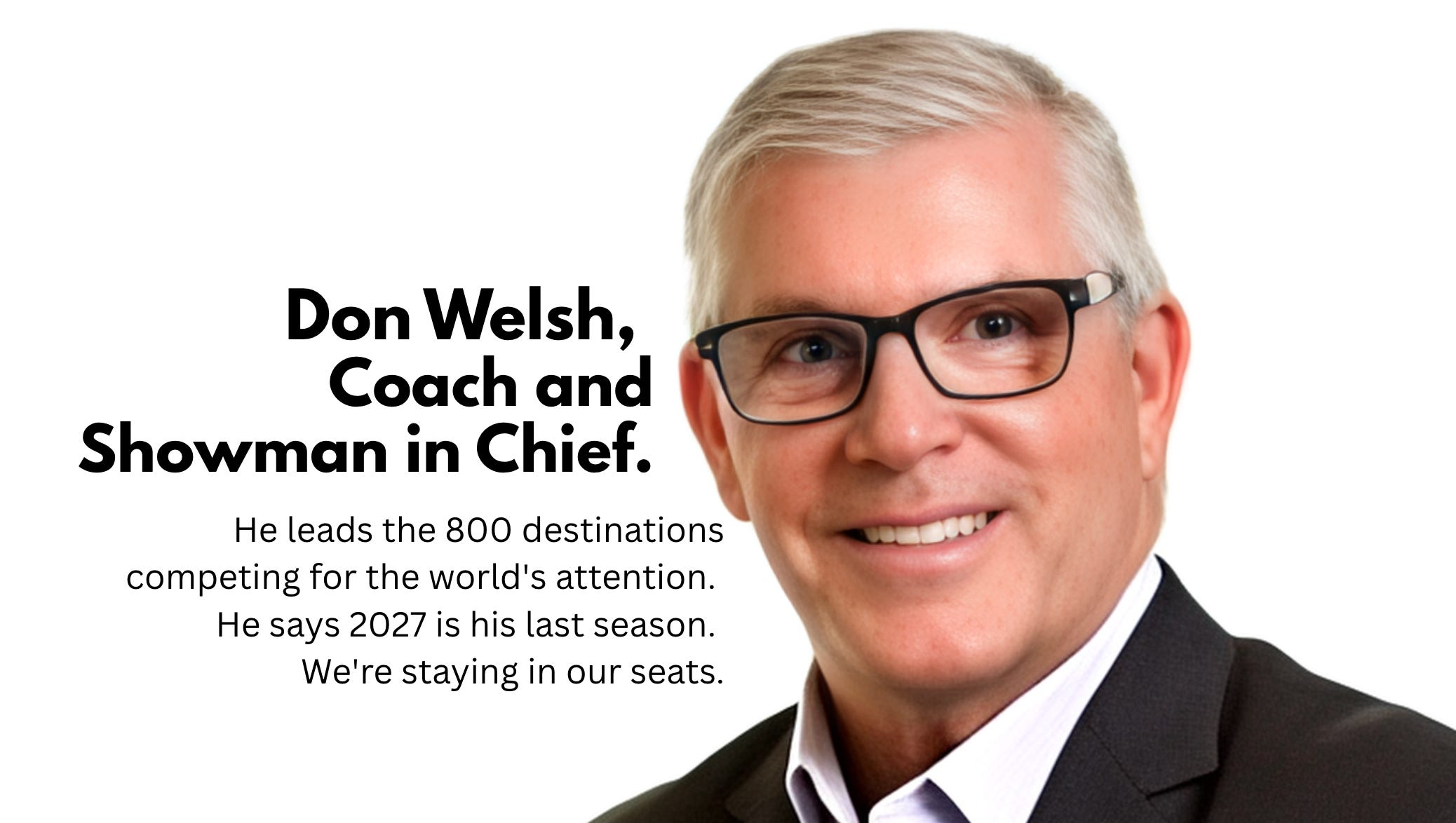
Don Welsh apologizes at the top of the call. He had been on the phone with his daughter Sarah, whose one-year-old has just learned the word hi, and hi plus pop-pop, he reports, is currently the most important thing in the world. This is the man who runs Destinations International, the global association of the people who sell cities, seventy years old, dialing in from Sarasota with the unhurried warmth of a hotel general manager who has all day for you and a flight in an hour.
Consider what that association is. Every city on earth is now in the same business, competing for the scarcest commodity of the age, human attention, and for the conventions, visitors, athletes and capital that follow it. The people hired to win that competition, the destination chiefs of about 800 places across dozens of countries, all report, in a sense, to the same coach. Welsh leads the league the competitors belong to, which makes him something unusual in any industry: the one figure whose job is not to make his city win but to make every city better at playing. When the association talks, ten thousand members listen, from three-person bureaus in small American towns to the tourism authorities of nations.
We establish quickly that we are the same person from different frequencies. He grew up in Baltimore City. I grew up in Washington, but my family owned WAYE, the Baltimore rock and roll station, and I remember riding up from DC with my father during the riots of 1968 because we were covering them. Welsh remembers the riots too, from the other side of the credential. His father was chief clerk of the Baltimore City Council, a part-time gig under Mayor Tommy D’Alesandro, the father of Nancy Pelosi, and when the city burned, the elder Welsh took his twelve-year-old son toward the smoke with the firemen and the policemen. There was a clear line of demarcation, Welsh recalls, between where the riots were taking place and where they were not. The family lived maybe five miles from the line. Two kids of the same era drawn to the same burning city, one formed by the transmitter, one by the front seat of a municipal sedan, both of us destined to spend our lives studying how people come together and what happens when they don’t.
None of Welsh’s Baltimore has ever been in print. His official biography begins, as all of them do, in mid-air: forty years in travel and tourism, Westin, Ritz-Carlton, MGM Grand, then the CEO roles in Seattle, Indianapolis and Chicago, then the 2016 arrival at the association he was tasked to rebuilt. The public record contains no high school, no college, no parents, no boyhood. It turns out the record was hiding a sports movie.
The Catcher Who Lost His Eyes
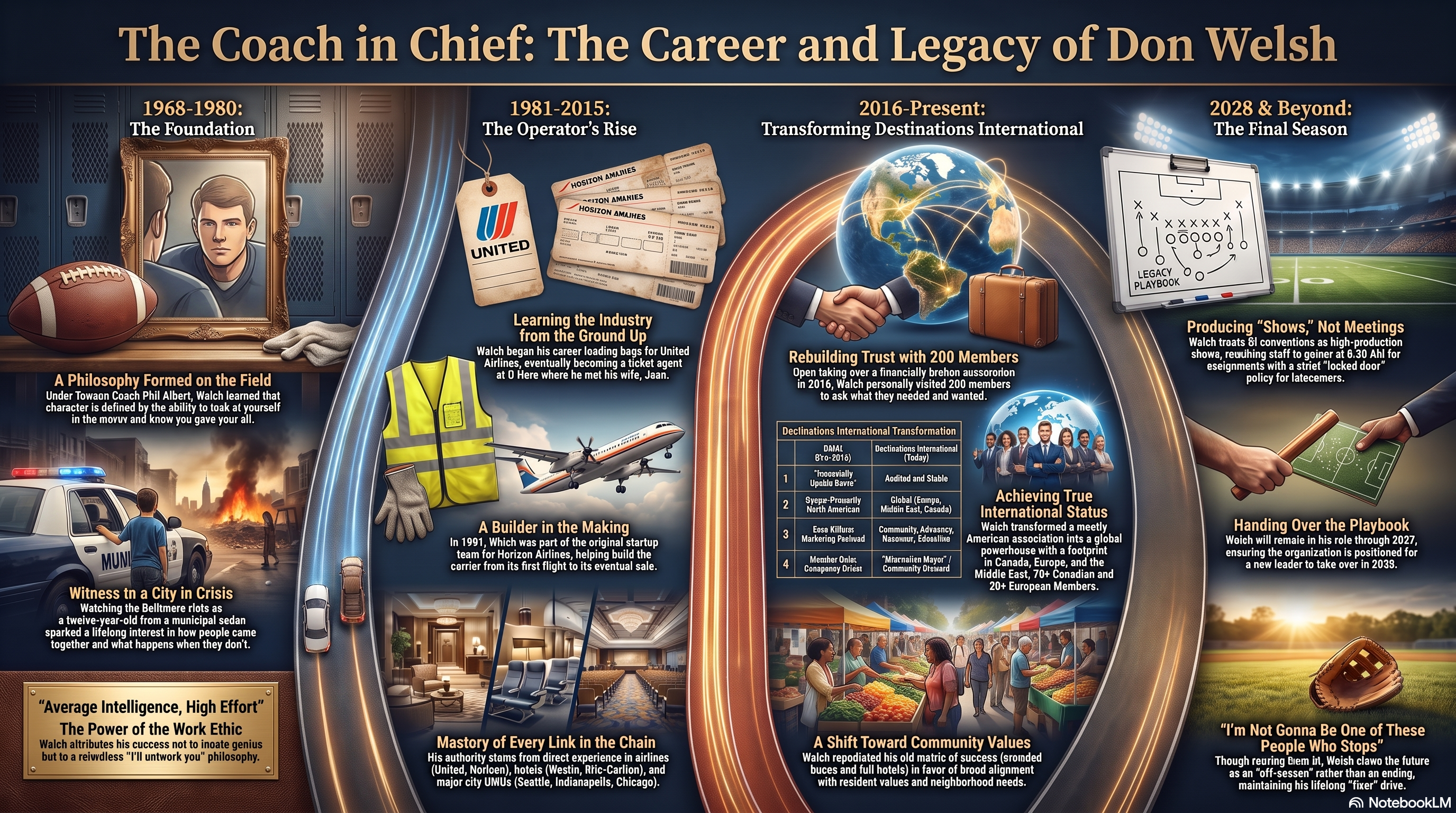
Welsh went to Calvert Hall, the Christian Brothers school that has been supplying Baltimore with lacrosse players and monsignors since 1845, and he played everything. He was a catcher, and he will tell you he knew he was a much better baseball player than a football player. Then, in eleventh grade, with no hereditary warning, his eyes went. A catcher in glasses, a hitter who cannot pick up the ball, is a boy being handed his first roster cut by his own body. He turned to football, all 5’10” and 210 pounds of him, and in what he cheerfully calls his delusional juvenile mind, he believed he was going to be a great NFL player.
He was not. What he became instead was a member of the Towson University football team that reached the Amos Alonzo Stagg Bowl, the national championship, fifty years ago this fall. And he became the property of a coach named Phil Albert, now deceased, whom Welsh describes as a beautiful person, very spiritual, a man who believed he was raising men to be better human beings and not merely better athletes. Albert had a policy that sounds almost eccentric in the profession of the thrown clipboard: you would probably never hear him yell and rant and rave after a loss. His reasoning was the whole curriculum. If you are a person of character and you gave everything you had, you will have no problem looking at the person in the mirror directly in the eye. If you start shying away from the mirror, you know you didn’t give it your all.
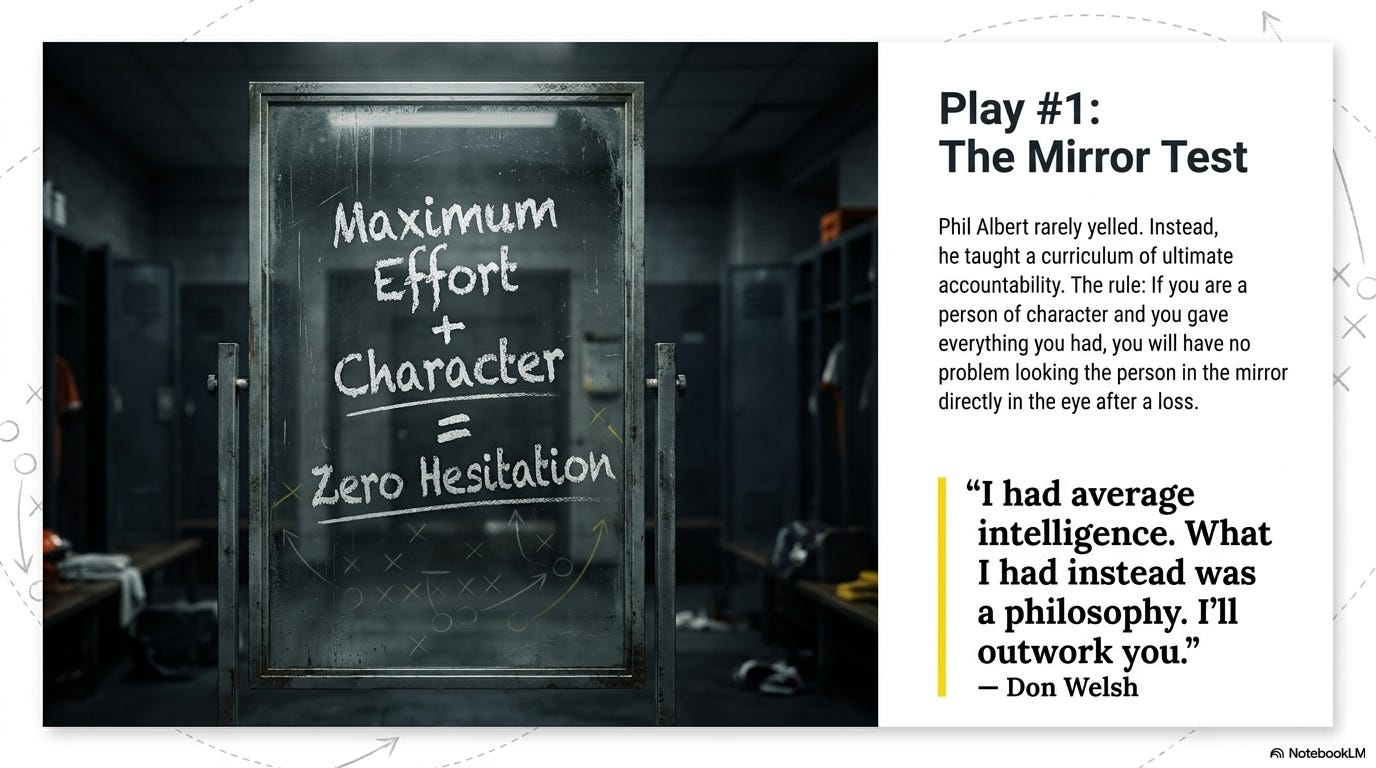
Welsh calls the mirror test his mantra, and once you have heard it, you can see it running under everything he has done for half a century. Ask him how sports shaped his management style and he answers with a self-assessment so unfashionable it stops you: he had, he says, average intelligence. What he had instead was a philosophy. I’ll outwork you.
Free Passes
The gathering economy loves an origin myth, and Welsh’s is better than the one in circulation. The published version says he started as a baggage loader for United Airlines. The full version, which he has never told a reporter, starts with a death and a benefit.
His brother, who has since passed away, worked for United as a manager at BWI. In an Irish Italian Baltimore family where, as Welsh puts it, nobody left, the brother’s job unlocked the one privilege that mattered: free airline passes. His mother started flying him young, Hawaii, Las Vegas, across the United States, a city kid accumulating boarding passes like other boys collected baseball cards. Then there was the uncle, based in Saudi Arabia in the sixties and seventies with Aramco, and who eventually retired to Novato, outside San Francisco. Welsh remembers flying there with his parents, looking around at California, and reaching the conclusion that would organize his life: I don’t think I’m going to be staying in Baltimore like the rest of my family.
He loaded bags through high school and college, and his first legitimate job out of Towson was as a United ticket agent at O’Hare, where he met a flight attendant named Jean. He married her. The romance of the gathering economy is usually a banquet or a ballroom; theirs was a ticket counter in the world’s busiest airport, two people whose jobs were literally moving strangers toward each other.
What did the ramp teach him? He answers first as a romantic, confessing that to this day he can get off an eighteen-hour flight and simply hang around the airport watching airplanes, which he used to do in Hong Kong for pleasure. Then he answers as an operator: you learned the fueling side, the operational side, what happened when a bag was lost. And then, unprompted, he offers the most unguarded self-diagnosis I have heard from a CEO in years. At seventy, he says, he has come to believe he probably would have been diagnosed with some form of ADD or ADHD, and he does not say it lightly. He was highly caffeinated for years, to the point of heart palpitations. But he thinks the wiring served him, because it produced the sentence that explains his entire career: I like when things are either in a building stage or in a broken stage. I’m not a good maintenance person.
A fixer or a builder. The aviation chapters prove it. He left United for Evergreen, the outfit run by Del Smith, the visionary who flew DC-8s into Saigon during the war and later bought the Spruce Goose. Then, in 1980, Welsh became part of the team behind a startup called Horizon Airlines, first flight September 1981, sold to Alaska Airlines in 1986. A young man with no money and no car, commuting between Seattle and McMinnville, Oregon, helping will an airline into the sky. When he answered a blind Wall Street Journal listing that turned out to be Westin, the hotel industry got him almost by accident, and the destination world got him two decades after that.
Tally the seats and you begin to understand why the wisdom overflows. Ramp agent, ticket counter, startup airline founder, hotel corporate at Westin, luxury at Ritz-Carlton, casino at MGM Grand, three destination organizations, one global association. Welsh has worked, at ground level, nearly every link in the chain that moves a human being from a departure gate to a name badge, and he knows it is the source of his authority. If I’ve had any success in this industry, he says, it’s because I’ve worked in the airline industry, I’ve worked in the hotel industry, and I’ve run three DMOs. He can tell you why an airline thinks like a transportation company and will never love your city back, why a hotel’s loyalty lives not in the brand but in the general manager down the street, and why the destination sits in the middle navigating between all of them, because he has drawn a paycheck from every party at that table. The industry is full of executives who studied the ecosystem. Welsh loaded its bags.
The Listening Tour
The chapter that made Welsh an industry legend began in the fall of 2015, when the association then called DMAI discovered it was, in his words, financially upside down. The CEO was let go. Welsh, freshly finished with five record-setting years at Choose Chicago, was recruited by people who had known him since his hotel days and time in Seattle, Indianapolis and Chicago. He did not ask for the job. Between Chicago and the wreckage, he took exactly one break, for a hip replacement, and started March 1, 2016.
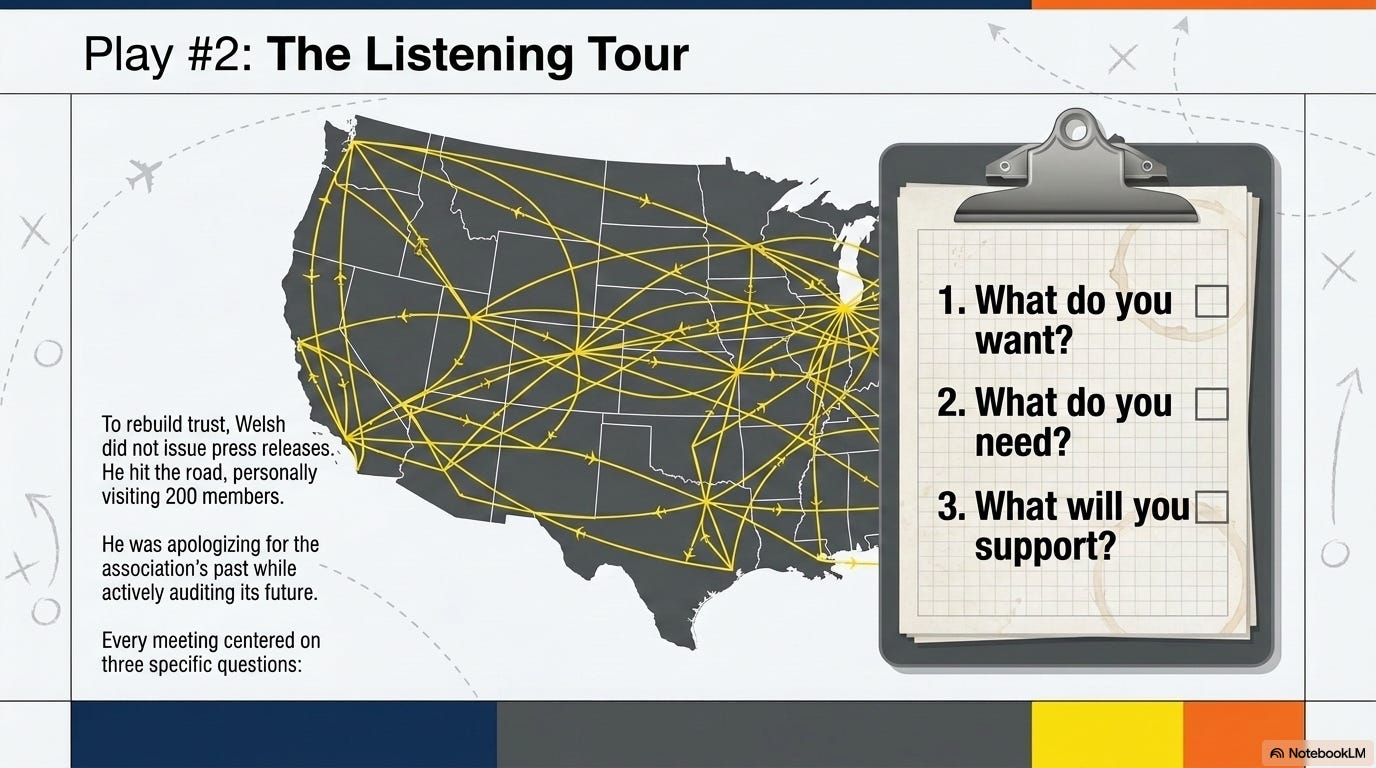
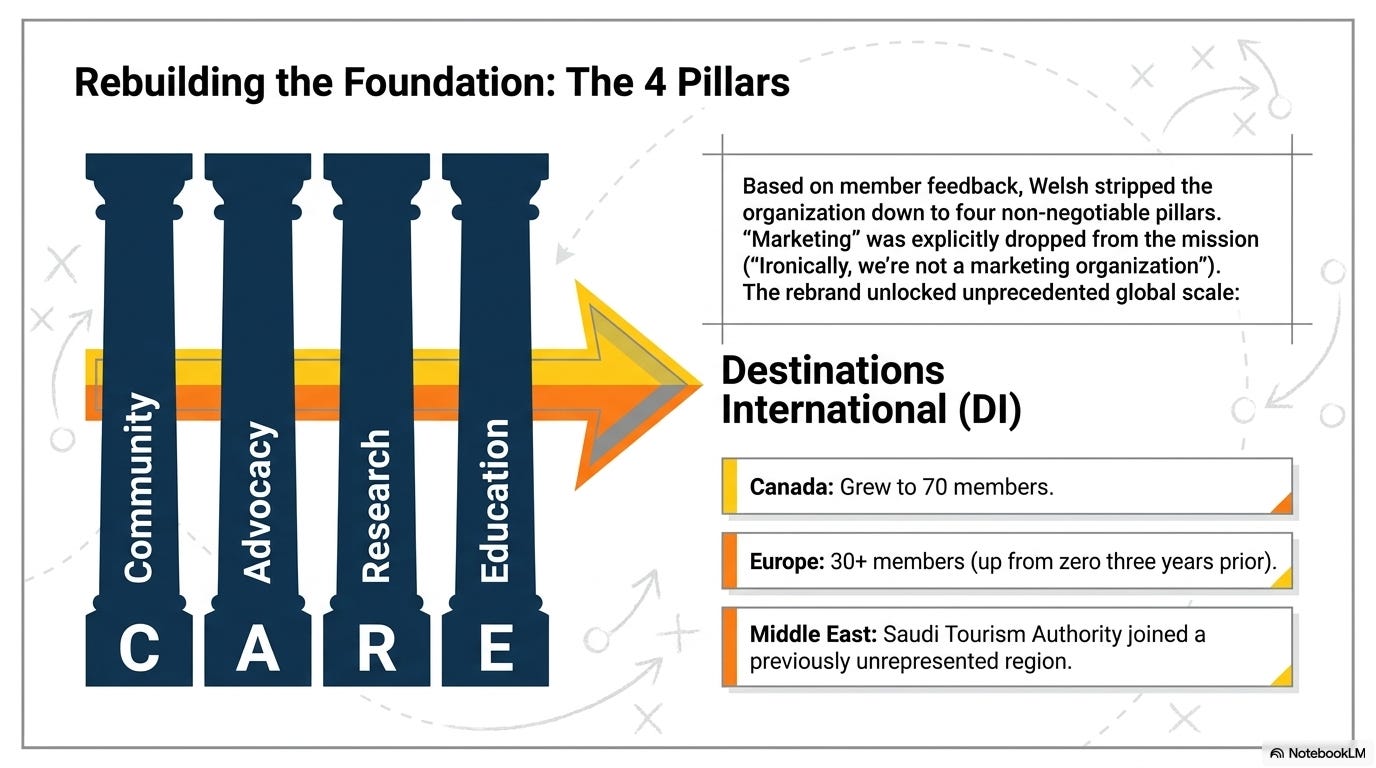
What he did next has entered the association playbook, but the inside name for it has not. Welsh went out and personally visited approximately two hundred members, asking each the same three questions: What do you want? What do you need? What will you support? His colleague Chelsea, watching him crisscross the country like a band on the road, printed the dates and gave the campaign its private title: the DI Apology Tour. He was apologizing, he confirms, at the same time he was learning. Out of the answers came the four pillars, community, advocacy, research, education, and out of the pillars came the rename. Marketing left the letterhead because, as he says with a shrug you can hear, ironically, we’re not a marketing organization. The bolder word was the second one. International was, at the time, nearly aspirational; the membership was American with a handful of Canadians and Mexicans. Today there are seventy members in Canada, more than thirty in Europe where three years ago there were none, the Saudi Tourism Authority in a Middle East where DI once had no presence at all, and a Canadian in the board chair. The association that was lying to itself a decade ago now audits the world.
Retiring Gridlock
The most quietly radical thing Welsh says in our conversation is a repudiation of his own greatest hit. In Chicago he had a flippant definition of success, and it was a good line: gridlock. Conventions and tourists in such volume that restaurants were packed, hotels were full, and the buses could barely move. He now describes that thinking as 180 degrees from where the profession must live. The modern destination organization, he argues, succeeds only if it models and emulates the community’s shared values, meaning the brand must align with the neighborhoods and the residents, with the Chicago beyond Michigan Avenue, with Seattle’s guarded and deliberate sense of who it wants to welcome. The job he was originally hired to do, maximize occupancy regardless of what it did, no longer exists. When the industry’s most decorated salesman retires his own best line, something structural has shifted.
What replaced it is a job he describes with the phrase I offered and he immediately claimed: the alternative mayor. The destination chief today is on stage twenty-four hours a day, under the political microscope, managing multiple stakeholders, and in many cases carrying a greater public profile than the elected official next door. Welsh learned the hazard personally in Chicago, where victories were sometimes credited to Choose Chicago and Don Welsh even when Mayor Rahm Emanuel had launched the initiative, an attribution problem that, he allows, did not always fly well between the two of them. He’s proud of what he and Mayor Emanuel accomplished in five years even if it was a challenge at times.
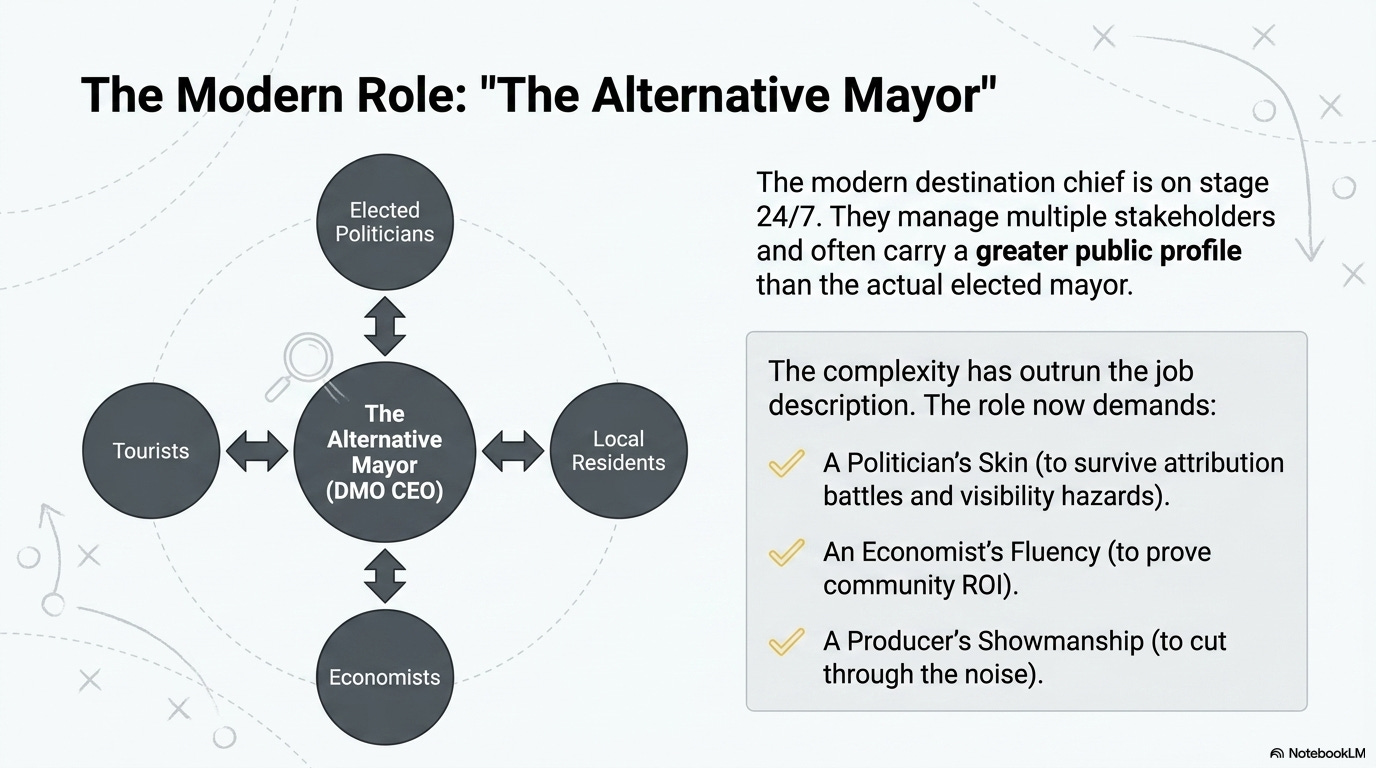
Sit with Welsh long enough and the modern job description assembles itself, and it is a portfolio no business school prepares anyone for. The DMO chief must be the diplomat who brokers a permanent negotiation between parties who want different things: the airlines, which Welsh says have concluded flatly that they are transportation companies and will use a destination for statistics but not for love; the hotel brands, whose loyalty gets granular only at the local level, with the general managers and directors of sales who are, in his phrase, where a community starts coming together; the restaurants, the convention facilities, the elected officials, and above all the residents. The chief must be a financial strategist, because the fight for what Welsh calls your fair share of funding has become the profession’s central anxiety, and a portfolio manager too, filling a convention center with the right business rather than the most business, the way he watches Elliott Ferguson’s team balance citywide bookings in Washington against a town where transient demand arrives whenever Congress is in session. It is a job of strategic balance, he says, performed in public, graded by everyone.
And in most of the world, it is performed by a skeleton crew. Many of DI’s members are organizations with operating budgets of $3-5 million and less than a dozen staff, entrusted with the entire brand of their community, which is why Welsh built the association into a tool chest of shared resources and subject experts, forty full-timers now serving what a small bureau cannot staff for itself. The newest demand arriving on those small desks is the one his CEOs are, in his word, sponges for: making artificial intelligence understandable and applicable, sliced by role, alongside the older unsolved puzzle of leading a multigenerational team that no longer shares one idea of what work is. The consequence of all this weight is the industry’s quietest crisis, which he names without hedging: a lot of people don’t want their jobs. The complexity has outrun the job description, and the profession’s next generation must be recruited into a role that now demands a politician’s skin, an economist’s fluency and a producer’s showmanship
On that last count, Welsh has been leading by conversion. Since he arrived, DI does not hold meetings. We produce shows, he says, a music fanatic building every convention around a musical and visual theme, this year borrowing from the World Cup, whose final ends two days before his own opening night. And the coach in him still runs the locker room. For the three core days of the annual convention, his entire staff gathers at 6:30 each morning to review yesterday’s developments and take today’s assignments. From the stage he tells two thousand attendees to put their phones down and close their laptops to fully engage and take in the limited time together, the producer protecting the audience’s attention long enough for the goosebumps to arrive.
The Season
Jean Welsh died last October. Forty-four years after the ticket counter at O’Hare, after a valiant eleven-year fight with breast cancer, after the twenty-plus family moves with his wife and four daughters Ashley, Laura, Amanda and Sarah, that Welsh admits were probably to excess and that the family would confirm. He mentions her early in our conversation, gently, the way men of his generation hand you the heaviest thing they are carrying while assuring you it is manageable.
During these personal and unsettled times, board chair Leslie Bruce the board asked him to extend his contract beyond the agreed term that was due to expire this year. They reached an agreement to extend one more year, through 2027, when he will be seventy-one and twelve years into the job. He figures that is sufficient time and the organization is in a great position for somebody else to come in, as he puts it with a grin, with a maybe less intense personality, and pick it up in 2028. He is staying through the end of next year. This is not a farewell lap, and he would bristle at the word retirement. Asked what comes after, he answers like a man planning an off-season, not an ending: the first quarter of 2028 doing really whatever the hell he wants, probably a month in a rented house in Hawaii, where he and Jean lived twice, because if he stays home in Sarasota the mind never stops. And then, he says flatly, I’m not going to be one of these people who stops.
But the season knows what it is. This October, Welsh will fly from Malta via Istanbul to Baltimore, halfway around the world for a single day, to stand with the surviving members of the Towson team that played for the national championship fifty years ago. A lot of my friends, he says, are starting to kick away. The coach who taught them all the mirror test is gone. The catcher who lost his eyes, the linebacker of average intelligence and inexhaustible effort, the baggage loader who married the flight attendant, the fixer who answered a blind ad and ended up rebuilding the oldest association in the gathering economy, will be in the room, again welcoming guests from around the world.
Somewhere in Baltimore there is still a mirror. He can look it in the eye.
Sourcing note: this profile is drawn from the author’s recorded interview with Don Welsh in July 2026. Biographical anchors, Calvert Hall, Towson’s Stagg Bowl appearance, the Horizon Airlines founding and 1986 sale to Alaska Airlines, the 2015 to 2016 DMAI financial crisis and leadership transition, and the DI membership expansion, are consistent with the public record. Details of Welsh’s family history, his contract timeline and the reunion travel are per Welsh’s own account, single-sourced to the interview, and subject to the pre-publication review he was promised.

Ten Deposits from the Coach in Chief
Drawn from Don Welsh’s conversation with David Adler, July 2026. The view from altitude: what fifty years across airlines, hotels, casinos, three destination organizations and one global association teach about leadership, cities, and gathering.
Deposit No. 1: The Mirror Test The only performance review that counts is conducted alone, at night, with an audience of one. Welsh’s college coach, Phil Albert, never yelled after a loss, because the scoreboard was never the measurement; the question was whether you could look yourself in the eye afterward. Shy away from the mirror and you already have your answer, and Welsh has run every job by that test for fifty years.
Deposit No. 2: Effort Is a Strategy Welsh calls his own intelligence average and credits one sentence for every job he has won: “I’ll outwork you.” In industries built on relationships and reputation, effort compounds like interest, and the executive who visits two hundred members in person will always know more than the one reading two hundred reports.
Deposit No. 3: Know Whether You Are a Fixer, a Builder, or a Maintainer The most useful thing an executive can know is which stage of an organization they belong to. Welsh wants a company either building or broken and admits he is a poor maintenance man. Careers derail when fixers take maintenance jobs and maintainers inherit fires, so diagnose yourself first and choose the job to match.
Deposit No. 4: Before the Plan, the Apology Handed a broken institution, Welsh skipped the strategy deck and went to two hundred members with three questions: what do you want, what do you need, and what will you support? His staff called it the Apology Tour, and the third question is the one most leaders never ask, because it is the only one that turns applause into commitment.
Deposit No. 5: A Corporation Has a Balance Sheet. A Community Has a Soul. A corporation has no soul; a destination does, because its leaders are entrusted with the brand of an entire community, which Welsh calls the highest trust in the world. It took him years inside hotels and casinos to see that the two must be led differently, and every leader should know which of the two they have actually been handed.
Deposit No. 6: Retire Your Own Best Line In Chicago, Welsh measured success by gridlock: full hotels, packed restaurants, buses that could not move. He now calls that thinking backward, because a destination only succeeds when it models the shared values of its residents and not just its visitors, and the harder discipline is retiring the idea that once made you famous.
Deposit No. 7: The Alternative Mayor Gives the Credit Back The destination chief now lives on stage around the clock, often with a bigger profile than the elected officials next door. Welsh learned in Chicago that crediting the wins to him instead of the mayor who launched them did not fly, and power held in trust has to be visibly returned: hand the credit to the person whose city it is, and you get to keep the job.
Deposit No. 8: Every Place Is a Terroir Welsh leads more than 770 destinations on a single premise, that no two are alike. Each carries its own soil, story and self-image, like wines from neighboring hillsides, and the fatal error is selling places as interchangeable inventory, because the moment a city markets itself like every other city it has nothing left to sell.
Deposit No. 9: Don’t Hold Meetings. Produce Shows. People no longer assemble for information; they assemble for feeling. Welsh has Destinations International stage productions built on musical and visual themes and tells two thousand attendees to close the laptops and put the phones down, a right he earns the way a coach does: the whole team in the room at 6:30 every morning, doors locked on latecomers.
Deposit No. 10: Play the Season You Are In Welsh lost Jean, his wife of forty-four years, last October. He declined the board’s push to stay several more years and committed only through 2027, and this fall he will fly around the world for a single day to stand with his college team fifty years on; seasons are finite and unlike one another, and the only way to play one is all the way through.
Sourcing note: all deposits are drawn from David Adler’s recorded interview with Don Welsh, July 2026, and are single-sourced to that conversation. Biographical anchors are consistent with the public record; membership figures and timeline details are per Welsh and DI materials and subject to the pre-publication review he was promised.

Edible Profile of Don Welsh