
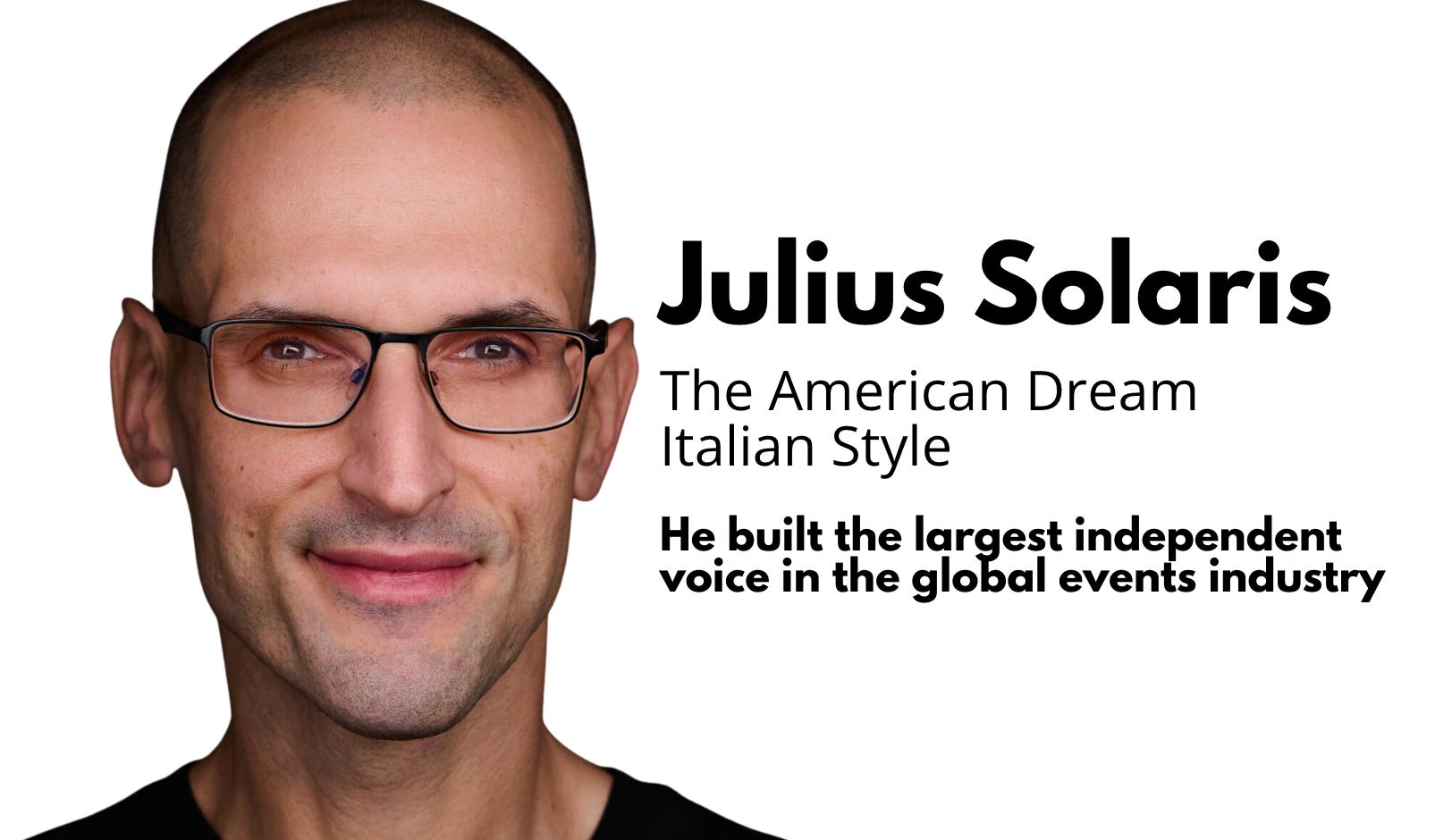
The American Dream, Italian Style
Julius Solaris built the largest independent voice in the global events industry one week at a time. This is the story of how.
Julius Solaris is the most-followed independent voice the global events industry has ever produced. His newsletter lands in thirty-eight thousand inboxes, one week at a time. The LinkedIn group he founded passed four hundred thousand members and remains, by a wide margin, the largest professional community in the trade. LinkedIn named him a Top Voice and reports that approximately ten million people now read his content on the platform each year. He has keynoted in twelve countries to crowds totaling more than two hundred thousand attendees. His research reports have been downloaded more than three hundred thousand times. The United States government has certified him, in writing, as an alien of extraordinary ability. The Events Industry Council inducted him into its Hall of Leaders in 2024, the highest honor the industry confers. BizBash, the trade publication that has spent twenty-five years tracking the people who run the rooms, named him one of the most influential figures of the entire quarter century. He runs all of it from an apartment in Las Vegas with his wife as his only business partner.
He is forty-something. He is Italian. He was, until about twenty years ago, a heavy introverted boy in a small town in the heel of southern Italy who could not get the cool kids at his school to stand near him at lunch. The distance between those two sentences is the subject of this piece.
What is harder to convey on a credentials list is the way he carries the credentials. He has, by any reasonable measure, become the most recognized independent figure in his industry. He is also one of the few people at that altitude who has not, on the way up, traded the humility of the boy he used to be for the polish of the man the trade press now profiles. Asked how he had ended up with a global audience, he says, I don’t know. If you ask me, I don’t know. Asked about his early work, he looks back at it with what he calls embarrassment. Asked about the Hopin collapse he had been working inside, he refuses to blame anyone, including the executives whose decisions he had quietly warned against from the start. Asked about the audience that opens his newsletter each week, he says, I am one of them. That is why they read me. The credentials at the top of the page are real. The man receiving them is still, in some meaningful way, the introverted kid in the Apulian schoolyard who could not quite believe the cool kids had finally come inside the room.
The other thing the credentials list does not show is the cost. He arrived in London the month Lehman Brothers collapsed with no job. He sold his first business on the third try after two prior deals fell through and a family payroll waited to see whether the third would close. He took the institutional job at the unicorn and was let go in month six when the unicorn started to fall apart. He launched the company he runs now the same week the layoff arrived. He has been on the road for eighteen years, in twelve countries, filing from press rooms and hotel lobbies and the back of conference halls because the only way to write about the industry was to be in it. The thirty-eight thousand readers who open the newsletter each week do not open it because the writer is famous. They open it because the writer has been one of them, in every chapter, since he was fourteen.
The first event he ever planned was a club night for the fourteen-to-eighteen-year-old crowd in the heel of Italy, sometime in the late nineteen-nineties. He was fourteen himself, with no inheritance ahead of him, no obvious path out, and no social capital to draw on. He partnered with a friend, put his own money into a venue, brought in a DJ, and opened the doors. The kids who would not come near him in the hallway came inside the gathering because he was the one who had decided where it would be and what time it would start. He had not found a way to be admitted to the social order. He had built the thing the social order had to come to. He learned, that night, the only thing he would ever really need to know about commerce.
He is not alone in this. The people who end up running the global events industry, almost without exception, were already running it before anyone told them it was an industry. Solaris is one version of a pattern the trade press has never quite named, and the version worth telling first because his version is, in the truest sense, the American Dream told in an Italian accent. He just happens to have lived it from the wrong continent.
He left home at sixteen, ostensibly to be closer to school, actually to start the life he had been planning since he was small. He went to Milan for university and studied communication and media with a marketing major. He went to Australia in 2002 for the exchange and ran free networking cruises on Sydney Harbor, renting boats and giving away pizza to the crowd that showed up. He went back to Australia for the two-year MBA. He arrived in London in 2008, the month Lehman Brothers collapsed, with no job, no plan, and a degree the British economy had no use for.
This is the structural fact of his life. He has been moving since he was sixteen. Every move was a choice he made without a job waiting on the other end, without a plan in place, and without anyone holding the door. The independence was not a posture. It was a method of being in the world. He absorbed early what most people learn late, which is that nobody is coming to make your life for you.
He started running free networking events in London because it was the only currency he had. He built tweet-ups, BarCamps, and hundred-and-fifty-person mixers on Twitter and Meetup and a now-vanished social platform called A Small World. He convinced bars that had just opened to give him the room on a weeknight in exchange for the foot traffic. He had begun a blog from his apartment in Apulia called Event Manager Blog and he kept posting to it every week. He answered every message. He went to every show. He filed from planes. He filed from hotel rooms in Las Vegas. He filed from the developer meetups where he met Julia Hartz and Kevin Hartz before Eventbrite was Eventbrite. He gave away frameworks the established consultancies were charging six figures for. He did not skip a week. He has not skipped one since. Carmen had moved with him.
The platform did not happen by accident, but it did not happen entirely by intention either. The intentional part was a method. He has hit every social-media wave the modern media economy has produced, on time and often early, and he has done it with the same three verbs every time. Study. Explore. Execute. The blog wave in 2007. The Twitter wave in 2008. The LinkedIn group wave in the late 2000s, when most of the industry still thought of LinkedIn as a résumé site. The BarCamp and user-generated community wave that same period. The virtual-events wave when COVID arrived and most of the trade press was still figuring out how to use Zoom. The newsletter wave when Substack proved single-voice publications could carry real economics. The AI wave that is rewriting the work right now. He studies each new wave longer than most operators do, with the attention of a man who reads instead of skims. He explores it by building inside it, in public, with small experiments anyone can watch and most do not. Then he executes at scale, weekly, until the audience is too large to ignore.
The unintentional part was timing he could not have engineered. He sold Event Manager Blog to Skift in September of 2019, on his third try, after two earlier deals had fallen through. Six months later the world locked down. He had cashed in his independent media business at exactly the moment when the next twelve months would prove that the business was either going to be worth ten times more or worth nothing, depending on which way the pandemic broke. He had no way of knowing which way it would go. He sold anyway. The world broke in his direction.
The luck compounded from there. He joined Swapcard, watched the virtual-events curve start to bend, and let his non-compete expire at the exact moment Hopin called. He moved into the company at the precise inflection point where the platform was about to become, briefly, the fastest-growing European startup in history. He drew an institutional salary at a unicorn during the eighteen months when virtual events looked like the permanent future. Then the music stopped. He was let go in month six of the contraction, before the deepest cuts. He launched Boldpush the same week, two years before the Substack-led newsletter economy made the model obvious to everyone else. He began building on the Anthropic stack in 2024, three years before the rest of the events industry would understand what an MCP was.
He is candid about this. Asked how he had ended up with a global audience from a desk in southern Italy, he said I don’t know. If you ask me, I don’t know. It is the most revealing sentence he has put on the record, and the one the rest of his career depends on. He has built the most-read independent voice in the global events industry, and he is the first person to admit he cannot fully explain it. Method and luck arrived together, in proportions he did not engineer. The willingness to say so out loud is itself rare.
The frameworks are the second half of the platform. In the last three or four years, he has built a visual identity for Boldpush that is unmistakable inside the industry and increasingly outside it. The graphics are flat, color-blocked, typographically disciplined, institutional in tone, and built around tight grids that compress complex operational thinking into a single shareable image. The Post-Event Analysis Framework. The Experience Design Framework. The Sponsor Architecture grid. The Event Operator’s Playbook. Each one is a single PDF or PNG, downloadable for free, sized for LinkedIn, optimized for share. Each one has his face printed at the bottom under a small black bar that reads Julius Solaris did this for you. The signature is the marketing. He has built his name into the file itself.
He talks about the frameworks the way most operators talk about their flagship products. He builds them on the Anthropic stack. He uses Claude to structure the underlying logic, then designs the typographic and color systems himself, then ships them weekly. The Post-Event Analysis Framework he released this year includes, printed inside the framework itself, a recommendation that reads Build unified dashboard with Claude and MCPs. He is one of the first independent publishers in any industry to position himself publicly as a Claude-native operator, with the AI stack named as part of the framework rather than hidden behind it.
The visual register matters because the industry he is writing for has, for two decades, produced some of the worst editorial graphics in modern professional life. Trade-show decks are visual cemeteries. Conference programs read like phone books. The Boldpush frameworks land the way they do because they are the first time an industry that designs experiences for a living has been given communication graphics designed the way it should have been designing its own all along. He noticed the gap. He filled it. The frameworks are the reason a single-operator publication is out-publishing companies a hundred times its size during the AI rupture.
The third leg of the platform is the reviews. He goes to the show. He writes what he saw. He has been doing it for eighteen years across more than two hundred shows in twelve countries, and his arrival at a major event is now an event in itself. IMEX Frankfurt. Cannes Lions. Dreamforce. Google Cloud Next. ServiceNow Knowledge. South by Southwest. Web Summit Vancouver. He has reported from all of them, often in the same year. He files from the press room. He files from the show floor. He files from the bar at the hotel where the after-party is happening. The reviews are not summaries. They are reads. He tells the reader what the show was trying to do, whether it worked, who was running the room well, who was not, and what the larger industry should take from the moment. He is not a critic. He is a witness.
The reviews also happen to be the most-shared content he produces, which is not an accident. The events industry is, in its essence, the FOMO business. Trade shows sell tickets on the proposition that the deals are happening on the floor. Conferences sell registrations on the proposition that the room contains people you need to know. Festivals sell passes on the proposition that the moment will not come again. Every gathering in the world runs on the same engine, which is the fear of missing out on something the people who showed up will be talking about for the next year. Julius is the man who tells you what those people are talking about. The people who were there share his review to validate that they were there. The people who were not there share it to signal that they wish they had been. Either way, the post moves.
What unifies the four parts of the platform, the newsletter and the frameworks and the reviews and the research, is what they actually deliver. Event pros are the people in their organizations who have to make the registration number, defend the sponsor renewal, justify the catering line, brief the keynote, manage the run-of-show, recover from the keynote running long, and explain to leadership why any of it mattered. Julius gives them what they need to do that work better. The frameworks compress what a six-figure consultancy engagement would have produced into a single PNG they can paste into a planning deck. The reviews tell them whether to spend their budget on the show. The research gives them the benchmarks they can take into a budget meeting and use to defend the line item. The newsletter gives them the early read on every platform shift that is about to change their job, two years before the trade press catches up. He gives them tools that work the day they need them and the language to explain to leadership why the tools matter. That is why ten million people read him a year. The recognition is real. The frameworks are what get downloaded.
He could have lived anywhere. The newsletter is written from his apartment. The clients are global. The keynotes are in twelve countries. He chose Las Vegas. The choice is not incidental. Vegas is the convention capital of the United States, the only American city whose entire economy depends on the gathering, and the city more than any other in America still operating on the proposition that anyone can arrive with nothing and become someone if they are willing to hustle hard enough and stay long enough. The Italian who chose Vegas is the same boy who chose to leave home at sixteen. Both choices say the same thing. He goes where the work he wants to do is being done, and he builds his life around the work.
He has not done any of it alone. Carmen Boscolo has been with him since high school. They met as teenagers in Apulia and have been together for twenty-six years. They have built three businesses side by side, in three countries. Across all of them, the division of labor has been identical. He runs voice and brand and writing. She runs sales and operations. She made the green card happen. He has said, plainly, that he is a mess without her. He is not a process person and never has been. The operational machinery of three businesses across two continents has been her work from the first one to the third.
The independence is real. So is the partnership. Carmen is the reason the independence has not turned into isolation, and the reason the company has never had to scale into a fifty-person agency. She is also the reason he gets to be the watcher, the writer, and the keynote speaker.
The first exit was Showthemes in 2018, the WordPress event-template business he had built quietly, six thousand customers strong, a clean small sale. The second was Event Manager Blog to Skift in September 2019, on his third attempt, after two earlier deals collapsed and a family business of seven freelancers and Carmen on payroll waited to see whether the third try would close. It did. He has said publicly that the negotiation was psychologically brutal and that the lesson was know your worth. That phrase belongs in the piece because it is the operator’s vocabulary, not the analyst’s.
Then Swapcard, then Hopin. The Hopin chapter is the one he has spoken about most carefully in public until now, and the cleanest version has been this one. The company wanted to have Julius without a clear plan. The CMO at the time, Anthony Kannada, was big on building media companies inside technology companies, which gave the hire a logic. The operational structure underneath the hire was improvisational. There was a sense of growth and acceleration, of too many decision-makers in the building and not enough coordination. He does not blame the company. Some of the brightest minds in event technology were inside it. The in-person team alone included the founders of Attendify, the leadership that had come up through CrowdCompass including Matthew Donegan-Ryan, and colleagues he still references today like Kristen, who has since landed at RingCentral.
Hopin reached a $7.75 billion valuation in August 2021 at its Series D, briefly the fastest-growing European startup in history, with more than a billion in venture capital from Andreessen Horowitz, General Catalyst, Tiger Global, Salesforce Ventures, and the sovereign wealth funds GIC and Temasek. The company employed close to twelve hundred people across forty-seven countries. By month six of the contraction, the entire in-person team was let go because in-person was no longer a priority. No team could have countered the drop in the market that Julius had been warning the company about. He said all of that without bitterness, which is itself a kind of evidence.
He went inside the operating company. He took the institutional salary. He let someone else carry the platform. Six months later he was out and Hopin was on its way to a fifteen-million-dollar fire sale to RingCentral on a billion in capital raised. The company that had been worth, briefly, more than Manchester United and Aston Martin combined had lost ninety-nine percent of its enterprise value in under two years. He has not made the same mistake since.
Step back from the Hopin paragraph and the larger pattern becomes visible. Julius arrived in London the month Lehman Brothers fell. He sold his media business six months before COVID. He watched the virtual-events bubble collapse from inside the unicorn that briefly defined it. He is now positioning himself, three years early, at the front of the AI rupture that is rewriting the trade press, the consultancy economics, and the working life of the corporate event marketer all at once. Four once-in-a-generation economic shocks in eighteen years. Most operators in any industry would have been knocked out by one of the four. Julius has taken all of them and kept the platform alive. He is one of the very few public figures in the events economy whose career maps cleanly onto the four major dislocations of the twenty-first century, and he has been visible, publishing, and gaining audience through all of them.
In May of 2026, Boldpush and Encore released the Experience Design Report, built on 447 event professionals across corporate, agency, association, and independent planning roles. One finding has carried the report. Forty-nine percent of attendees say connection is the biggest reason they show up to an event. Eight percent of planners design programming for it. The largest single disconnect in any industry research the events economy has produced this year, surfaced by the man who has been writing about the events industry longer than almost anyone else still doing it.
The reason the finding lands the way it lands when he says it is the reason this piece has been building toward this section. He came up inside the personality type the industry has historically ignored. The 49 / 8 finding is the events industry confessing, in research form, what he has known by experience since he was fourteen. The gatherings have been built for the people who were already going to come. They have not been built for the people who needed them most. He has spent his career writing for the second group while serving the first one. The data has finally caught up to him.
Ask him to read the global market and he will say, in his own register, that Europe is too intellectual, the United States is too transactional, and the British are the sweet spot because they balance the two. He has the receipts. Every dominant operator in the global events economy, from Informa to RX to Hyve to the Tarsus-to-Informa flow, is British or British-shaped. The reason the trade press cannot see what he can see, he will note without quite saying so, is that the trade press has never stood where he has stood. He is the European who moved through three Anglo-Saxon working cultures and ended up in Las Vegas. The global map he draws is a function of the biography. Only the operator who has lived in all three registers can read it.
Method, luck, grit, independence. Underneath all four is a fifth disposition, deeper than any of them. He is, and has been since he was fourteen, a student of the situation. Every platform shift, every economic shock, every framework, every gathering he has reported from, he has approached the way a student approaches an unfamiliar text, with curiosity, with humility, with the assumption that there is something to learn before there is something to teach. He has been a student through Lehman, through COVID, through the virtual-events bubble, through the AI rupture, through two exits and one fall. He has been a student of his own field, of his own audience, of his own marriage, of his own city.
That is the platform. Method, luck, grit, independence, studentship, and a refusal to skip a week. The boy in Apulia who could not be admitted to the social order spent thirty years building the platform that admits everyone else. He has not stopped. He shows up every week. He writes what he saw. He gives the people who run the rooms what they need to run them better. That is the work he has chosen, and the work he keeps choosing.
The fourteen-year-old in Apulia who rented a club because nobody was going to invite him to one is now the man in Las Vegas who has spent eighteen years, one week at a time, writing to the people who run the rooms. The frameworks are real. The reviews are real. The research is real. The credentials at the top of the page are real. The American Dream, Italian style, turns out to have been about something larger than the dream itself. It was about the kid who decided, very young, that he was going to make his own life, in his own language, on his own terms, by serving the people who had decided the same thing. He still shows up. Week after week. He still writes the way he has always written, with a tool in one hand and a thesis in the other, for the operators who needed both.
Ten depositable lines from the Julius Solaris conversation, extracted for the GatheringPoint Wisdom Bank archive.
On origin. “If you cannot be admitted to the social order, build the thing the social order has to come to.”
The lesson he learned at fourteen, in a rented club in Apulia, when the kids who would not stand near him at school came inside the gathering because he was the one who had made it happen. The whole career descends from this single sentence.
On the audience. “I write for the people who have to deliver. The quota, the budget, the sponsor, the boss. I am one of them. That is why they read me.”
The single clearest articulation of who Boldpush serves. He is not writing for the philosophers. He is writing for the operators who have payroll due Friday.
On method. “Study. Explore. Execute. The wave changes. The method does not.”
The three verbs that have governed his approach to every platform shift since 2007. Blog, Twitter, LinkedIn, BarCamp, virtual events, newsletter, AI. Ahead of all of them with the same operating system.
On luck. “If you ask me how I got here from a desk in southern Italy, I don’t know. I really don’t know.”
The most revealing sentence in a two-hour interview. The man with the largest independent platform in the global events industry is the first to admit he cannot fully explain his own arc. The willingness to say so is itself a credential.
On the partner. “I am a mess without her. She makes things work, she runs the operations, she made the green card happen. The whole thing is the two of us.”
Carmen Boscolo, twenty-six years, three businesses, two continents. The architecture of his career has always been a two-person operation.
On the Hopin lesson. “No team could have countered that fall. I was warning internally that in-person was coming back.”
The cleanest summary he has given of the Hopin chapter. The structural argument underneath it is bigger than Hopin. Any operator inside a company that is rewarding the wrong thing should hear the line and recognize the warning.
On the industry’s deepest disconnect. “Forty-nine percent of attendees say connection is why they show up. Eight percent of planners design for it.”
The Boldpush 2026 Encore research finding, distilled. The industry has been building events for the people who were already coming. The data has finally caught up to what the operators have known by experience for years.
On the global map. “Europe is too intellectual. The United States is too transactional. The British are the sweet spot. That is why Informa, RX, Hyve, and every other dominant operator is British or British-shaped.”
His single sharpest line on the geopolitics of the industry. He is the only commentator in print who has the standing to make this call, because he has lived inside all three working cultures.
On worth. “Know your worth. The first two deals collapsed because I did not.”
The lesson he draws from the third try at the Event Manager Blog sale to Skift. Operator vocabulary, not analyst vocabulary. The deposit belongs in the bank because it is the line he wishes someone had told him when he was twenty-eight, and the one he tells every founder now.
On the work itself. “I show up every week. I write what I saw. I have not skipped one in eighteen years. That is the whole job.”
The clearest articulation of the discipline that produced the platform. Not strategy, not method, not philosophy. The simple refusal to skip a week, sustained over eighteen years, in twelve countries, across two continents. The platform is the cumulative interest on that refusal.

Why the song.
Every Wisdom Bank profile on GatheringPoint comes with an original song. The song is not decoration. It is a second telling of the story, in a different register, that the reader can carry with them after they have closed the article. The events industry is, at its heart, an emotional industry. The work it does at its best is the work of producing moments that people remember. A profile that ends on the page misses something. A profile that ends on the page and continues in a song stays with the reader longer.
For Julius, the song had to be the American Dream told in an Italian accent. I worked it through several drafts. The early versions leaned Italo-soul, in the register of Paolo Conte. The version that landed is closer to American heartland, in the register of Tom Petty and John Mellencamp. The shift mattered because the story is not about the country he came from. It is about the country he chose. The hook stays Italian, la strada lunga, the long road, because that is the part of him no amount of choosing erased. The rest of the song is American, because the rest of him chose it.
The Edible Profile of Julius Solaris from Smallbitecarchitecture.com
Why the edible profile.
Every Wisdom Bank subject on GatheringPoint is rendered as a tasting menu. Four small bites, four small sips. Each one keyed to a specific moment or insight from the profile. The Julius version sits at the top of this post.
The franchise exists because the events industry is, before it is anything else, a sensory industry. The work it produces lives in the body of the attendee, not just in the mind. A profile that closes on the page reaches the reader’s intellect. A profile that closes on a focaccia square, a negroni, a terrine, and a clarified milk punch reaches the part of the reader the industry actually serves. The edible profile is the way GatheringPoint honors its own subject matter.
The pairing for Julius runs all the way through his story. The Apulian focaccia square with burrata, sun-dried tomato, and basil is the club night at fourteen in the heel of Italy, the room he built so the cool kids would have to come in. The negroni built one-to-one-to-one with a Las Vegas neon-orange twist is the American Dream told in an Italian accent, Italy’s bitter heart poured in the convention capital of America. The three-layer terrine is Study, Explore, Execute, the operating system that caught every wave. The clarified milk punch, cloudy ingredients made crystal clear, is the honest answer of a man who cannot fully explain his own success. I don’t know.
A profile is a record of the mind. The edible profile is a record of the man. Both are necessary. Neither is complete alone.


