In 2018 Greg Hitchen went to Birmingham to look at a solar trade show and came away convinced it was a bad event. Its owner was, by Hitchen’s account, losing about £500,000 a year on roughly £400,000 of revenue, which is the arithmetic that sends most buyers back to the car park. Hitchen concluded instead that his company could do better with it, and he called the owner. The first show under Terrapinn doubled the revenue. He is an executive who reads a loss that size as an invitation.
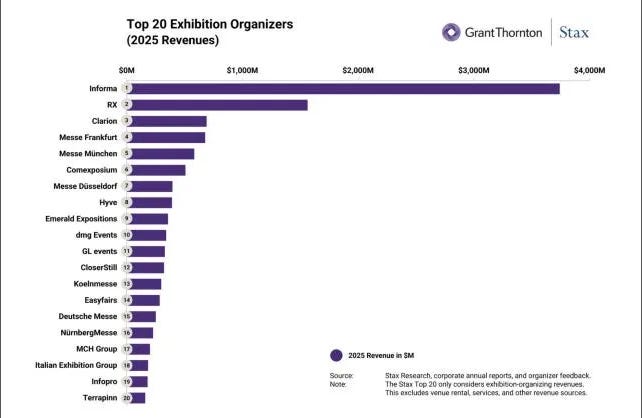
Covid interrupted, and seven or eight years on, he says, the UK show turns over about £8 million, twenty times what it did. Terrapinn now runs twenty solar events around the world, none of them in the United States or Latin America, and a columnist who tracks the industry’s deals credits solar with pushing the company past $30 million in EBITDA. Terrapinn entered the ranking of 2024 revenues for the first time at number twenty, as Hitchen noted on LinkedIn in September 2025, and he told Skift Meetings in March that it brings in about $180 million a year and expects roughly $40 million in profit this year. It produces about ninety events with some 450 people, run from London, and it is the only company in the top twenty that, by his account, private equity does not own. A good deal of that sunshine started in a Birmingham exhibition hall that he thought needed fixing.

He was back in Birmingham on 23 September, and he posted about it on LinkedIn. “What a great night out at the Solar & Storage Live Awards,” he wrote, calling it “an opportunity to meet new people and celebrate the industry’s achievements. And to celebrate with the outstanding Terrapinn team.” The photographs show a hall washed in purple light and a chief executive in a conference lanyard, leaning into a selfie with a group of colleagues, under a headline that describes him as someone who builds global events at scale. The post says nothing about the £500,000 loss that came first, and it needs to say nothing: the company that once nearly closed was celebrating its industry in the city where it fixed a bad show.
In conversation Hitchen is ebullient, a man who describes a bank traineeship, a collapsed Asian business and a spreadsheet bot in the same delighted register. His vocabulary gives him away. The Philippines solar show was “unbelievable,” the experienced salespeople his managers hired were “way too average,” the crisis response is “a moving feast,” the Gulf damage is “disastrous,” and an acquisition is judged on “vibes.” His LinkedIn posts run to exclamation marks, and he spent six or seven years as a professional rock musician. He treats a room, I would say, as a gig.
Solar was not a new idea for the company, only a newly serious one. It began as an offshoot of the power and electricity events Terrapinn had produced in South Africa since the mid-1990s: a show director suggested a solar event, the Philippines followed and was, in Hitchen’s word, unbelievable, then Vietnam and Cairo. The pattern is how the company says it grows, with someone proposing a show and someone senior answering with the question Hitchen credits to Tony Steel, who founded the Sydney company in 1986 or 1987 as a publishing house financed with his brother-in-law’s money. When that money’s venture company got into trouble, Hitchen says, Steel flew to London to talk to Euromoney Publications. Steel keeps out of the limelight, but his temperament runs the place: “Why not? Let’s go for it.” Conferences began as a hobby attached to the publishing, and the hobby proved more interesting, and financially more interesting, than the publishing.
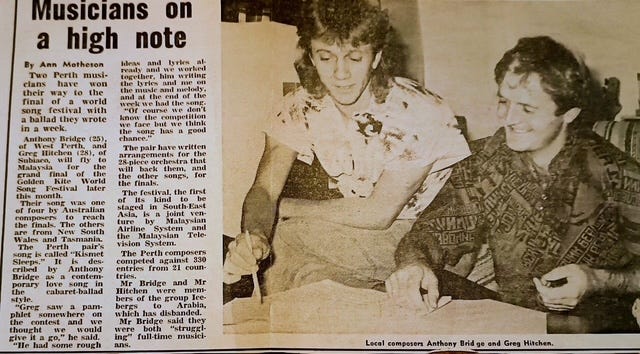
Hitchen came to that company by an unlikely road. His father died when he was five, and his mother devoted herself to making sure he and his brother had economic stability and studied hard, in a household he describes as limited when it came to collaboration or intellectual adventure. What formed him instead was a set of rebellious friends in Australia in the late 1960s and early 1970s, and an economics degree he says he mostly had fun with. His first real job was as a trainee manager in a bank, which taught him within a short time that the career was too straight-laced for him, and he then spent six or seven years as a professional rock musician, in bands he places, without much conviction, as post-punk, earning nothing. At thirty he had no career and no clear idea what came next. After some travelling he joined Australian Investment Publishing, studied for a part-time diploma in corporate finance, and within a couple of years was running the company’s business in Singapore, and a few years later had nearly two hundred people reporting to him. “Did anyone really prepare me for that? No,” he said. “But I just had to learn on the job.”


Click to hear our musical profile of Greg Hitchen
The sunshine is easier to credit because of the weather that came before it. By 1995, by Hitchen’s account, the hobby was a conference factory, producing 1,500 conferences and 1,000 public training seminars a year through fifteen offices, and he says it had become the second-largest conference producer in the world, bigger at the time than IBC, the company that became Informa. Euromoney Publications had owned it since about 1991, and it represented half of Euromoney’s revenue. It made, in Hitchen’s telling, no money. Four of the offices, in Sydney, Singapore, London and Johannesburg, were doing well, and then the company opened in Mexico, Chile, Argentina, Germany, Holland, France and the United States, and in Jakarta and Kuala Lumpur, until it had too many offices in too many places.
Euromoney lost patience, and the two separated. A trade-press profile records that a profit collapse led Steel to buy the conference company back, and that revenue fell from about $70 million to $38 million between 1996 and 1999 while headcount was halved to 200. Then came the crisis. On the thirtieth of June 1997 the company had close to two hundred people in Asia, and on the fifteenth of March 1998 it had sixteen. Hong Kong and Singapore were, in Hitchen’s words, the best business, and the Asian financial crisis left it “wiped out, destroyed,” taking with it “the whole engine for all of Terrapin.” Hitchen says that in theory the company should have gone out of business, and Terrapinn’s website today still lists Singapore among its four offices, alongside Dubai, London and Sydney.
What he took from the wreckage was dissatisfaction, which in his hands turned out to be a productive mood. He was unhappy with the high-volume conference business and resolved to build event brands of higher value and recurring income, which took years. By the time it was done the numbers belonged to another company: about ninety events where there had been 1,500 or 1,600, depending on which telling you hear, a shift he described on the Trade Show Talk podcastas moving from “high volume, low quality of earnings” to “low volume, high quality of earnings.” In that same Q&A he calls the conversion from a conference business to “an Exhibitions/Large Scale Events business” his biggest strategic bet, and credits what he learned at SISO, where he sits on the board, with giving him “the confidence to do this.” The growth he dates to about 2018, which is to say to Birmingham.
The music stayed with him more usefully than the bank did. Hitchen says he has always thought of the events he produces as show business for business people, with the lighting, staging and backdrop that implies, and that a band needs everyone “on the same wavelength” or the thing does not work. He read The Experience Economy by Joseph Pine and James Gilmore around 2000 or 2001 and says it changed his outlook on events completely, and about twenty-five years ago the company began to think of an event as four overlapping circles: knowledge, showcase, fun and networking. A great event sits where all four intersect, and in a Q&A for the Society of Independent Show Organisers (SISO) posted on LinkedIn in early October he put the old model more bluntly: leading events are now “more than a bunch of people wandering aimlessly around a shed.” Speed networking, roundtables and one-to-one meetings followed about twenty years ago, and Hitchen is candid that the company conceived them early and monetized them badly: “we were even ahead of the game,” he said, but “we weren’t able to translate it” as Jonathan Weiner, the founder of Money20/20, Shoptalk, HLTH and HumanX, has.
The same appetite governs what he buys, though he has become more clinical about it. Hitchen built a crude bot on ChatGPT that scores any acquisition out of ten, and he wants an average above seven. An event he bought before the scorecard existed rates about three and a half in retrospect, largely, he told Trade Show Talk, because of the integrity of the seller and the people: “We got sold something that really was not what it was portrayed to be.” He judges integrity by vibes, he said, tested where possible by visiting the seller’s workplace and watching how the boss and the employees deal with each other. Terrapinn bought the Digital Health Festival in Melbourne and the EV Charging Summit & Expo in Las Vegas in 2025, then FMS, the Future of Memory and Storage conference in Santa Clara, in March, and Skift reports it also bought Smart Energy Conference & Exhibition in Sydney. When he spoke to Trade Show Talk he was reading John Malone’s Born to Be Wired, and he sees in Malone’s roll-up of small cable companies a parallel to what everyone in trade shows is doing now.
He stopped writing five- and ten-year strategies, he told me, ten or fifteen years ago, on the grounds that life does not cooperate with them. What replaced the plan is a statement of purpose, to promote innovation and technology that changes people’s lives for the better. The company will not run a defense event, a gambling event or anything to do with tobacco, and it will run vaccines, orphan drugs, digital health, solar and storage, and electric vehicle charging. It is a filter more than a strategy, and it has produced a portfolio that reads like a strategy. The optimism is built into the filter: a solar show and a vaccine show are both bets that the future will be better than the present.

To see interactive map link here
The people who run that portfolio were mostly raised inside it. Every senior person at Terrapinn, Hitchen says, is a lifer who started young and grew into the job, and no senior role goes to a headhunter’s candidate: it is filled from inside or it stays empty. In recent years, he told me, middle managers drifted from the rule, hiring experienced salespeople at high salaries who turned out to be “way too average,” and the company has gone back to hiring graduates and to excluding anyone who has worked for another events company. He wants hunters, not account managers, and in a company built on the optimism of a good show that makes his salespeople sellers of sunshine, the promise that the right room will be full of the right people. The metaphor is this profile’s, not his. He holds that a sales manager cannot manage targets, only activities, and that the best salespeople generate their own from ideas and relationships. Value in his industry, he says, comes from three sources: knowledge and concept, relationships, and how well you grow and mentor people. “Almost anything else is just filling in forms.”
He is careful to say what he did not learn from Weiner, a friend of mine, whose Shoptalk and HLTH events ended up with Hyve. Terrapinn, Hitchen says, will never invest five million dollars a year for three years and then flip the result. What he took from Weiner is vision: the ability, as Hitchen tells it, to look at any subject in the world, even large landholdings in Virginia, and build the definitive event on it. On the Trade Show Talk podcast he also credited Weiner with an instinct for creating extra inventory and selling it, which is the difference between the one-to-one meetings Terrapinn bundled into packages for fifteen years and the price they deserve.
He took no large leadership role in the industry’s associations earlier in his career, he told me, but he sees their benefit now, and SISO shows why. Years of conversations with its members, he says, taught him the global possibilities of trade shows and how to execute them, and when he first attended, Terrapinn was “predominantly a ‘Conference’ organiser.” He praises SISO’s “spirit of entrepreneurship and the energy around this,” and he says it must “resist the temptation of being too big and too corporate.”
Away from the business, he plays golf, listens to music and plays the guitar less than he would like. He loves Australian rules football, wants to see ABBA Voyage in London, eats no meat, keeps sparkling mineral water as his go-to drink, and loves falafel. His wife, Heather has had what he calls a profound influence on him in all aspects of his life and offers advice on how he dresses, and his family includes his son, Lewis.
The sun has a shadow, and at the moment it falls on the Gulf. About 30 percent of Terrapinn’s revenue comes from Dubai and Saudi Arabia, he said, and since the war the company has lost between 40 and 50 percent of that. Multiplied out, his two figures put the damage at somewhere between 12 and 15 percent of the group, a number he calls disastrous. Hitchen describes the response as a moving feast of rescheduling, reorganizing, rationalizing and improvising, says the situation is not over, and believes that in the medium term the region will be good again and that any company that pulls out will not be looked on kindly when it tries to return. Skift reported in March that the company had about eighteen events across Dubai and Riyadh, another in Cairo, and roughly 120 staff in the region. He does not draw the comparison to 1997, when one region carried a business that could not survive losing it, but a reader who knows the story will, and what the Gulf is now teaching is what it means for nearly a third of a company to sit inside one region’s weather.
On 23 November, Solar & Storage Live is scheduled to open in Riyadh, one of Terrapinn’s biggest solar shows, in the market that has cost him the most this year. In the early-October Q&A he named doing business in the Middle East as his biggest issue and added: “Otherwise, I see nothing but opportunity.” Hitchen, who stopped drawing up five-year plans a decade ago, has committed the company to the calendar. The exhibitors will be selling panels, batteries and the proposition that energy from the sun is the surest thing in the Gulf. It is a hard place to argue that the sun has stopped coming up.

Volume versus earnings: Greg Hitchen cut Terrapinn from about 1,500 conferences a year to about 90 events, because volume is not earnings. A company that runs fewer, better events with recurring income makes more than a factory that runs everything.
What the crisis taught: When the 1997 Asian crisis took Terrapinn’s Asian staff from about 200 to 16, Hitchen used the dissatisfaction to rebuild toward higher-value event brands. A business that depends on one region for its survival has no margin for that region’s weather.
Buy what your platform can fix: Hitchen bought a Birmingham solar show that was losing about £500,000 a year because he believed Terrapinn could run it better, and the first show under his company doubled the revenue. A loss that comes from weak operation, not weak demand, is an invitation to a buyer with the operation.
Score the seller: Hitchen scores every acquisition out of ten and wants an average above seven. He now judges a seller’s integrity by visiting the workplace and watching how the boss and the employees deal with each other, after one deal scored about 3.5 because the seller and the people were not what they had been portrayed to be.
Lifers: Every senior role at Terrapinn is filled from inside or stays empty. Hitchen found that experienced hires on high salaries proved “way too average,” and the company went back to hiring graduates and growing them.
Manage activity, not targets: Hitchen holds that a sales manager cannot manage a target, only the activities behind it, and that the best salespeople generate their own targets from ideas and relationships. Manage the work, and let the results follow it.
Four circles: Terrapinn designs an event as four overlapping circles: knowledge, showcase, fun and networking. A great event sits where all four intersect, which is what makes it more than a bunch of people wandering aimlessly around a shed.
People are the hard partA; Hitchen places the value in his industry in three things: knowledge and concept, relationships, and how well you grow and mentor people. Almost anything else, he says, is just filling in forms.
Purpose over plan: Hitchen stopped writing five- and ten-year strategies because life does not cooperate with them. A statement of purpose, to promote innovation and technology that changes people’s lives for the better, now decides what Terrapinn will run and what it will not.
Stay in the market: Hitchen believes any organizer that pulls out of the Gulf during the crisis will not be looked on kindly when it tries to come back. His own response is to reschedule, reorganize and improvise, on the bet that the region will be good again.
Borrow confidence from peers: Hitchen calls the conversion from a conference business to large-scale exhibitions his biggest strategic bet, and credits what he learned from fellow organizers at the Society of Independent Show Organisers (SISO) with giving him the confidence to make it. When a decision is big, peers who have run the playbook are the cheapest source of courage.
Sell sunshine: In a company built on the optimism of a good show, a salesperson sells the promise that the right room will be full of the right people. A seller who believes the future will be better than the present sells it better. This is the profile’s metaphor, not Hitchen’s phrase.

Edible Profile of Greg Hitches.