
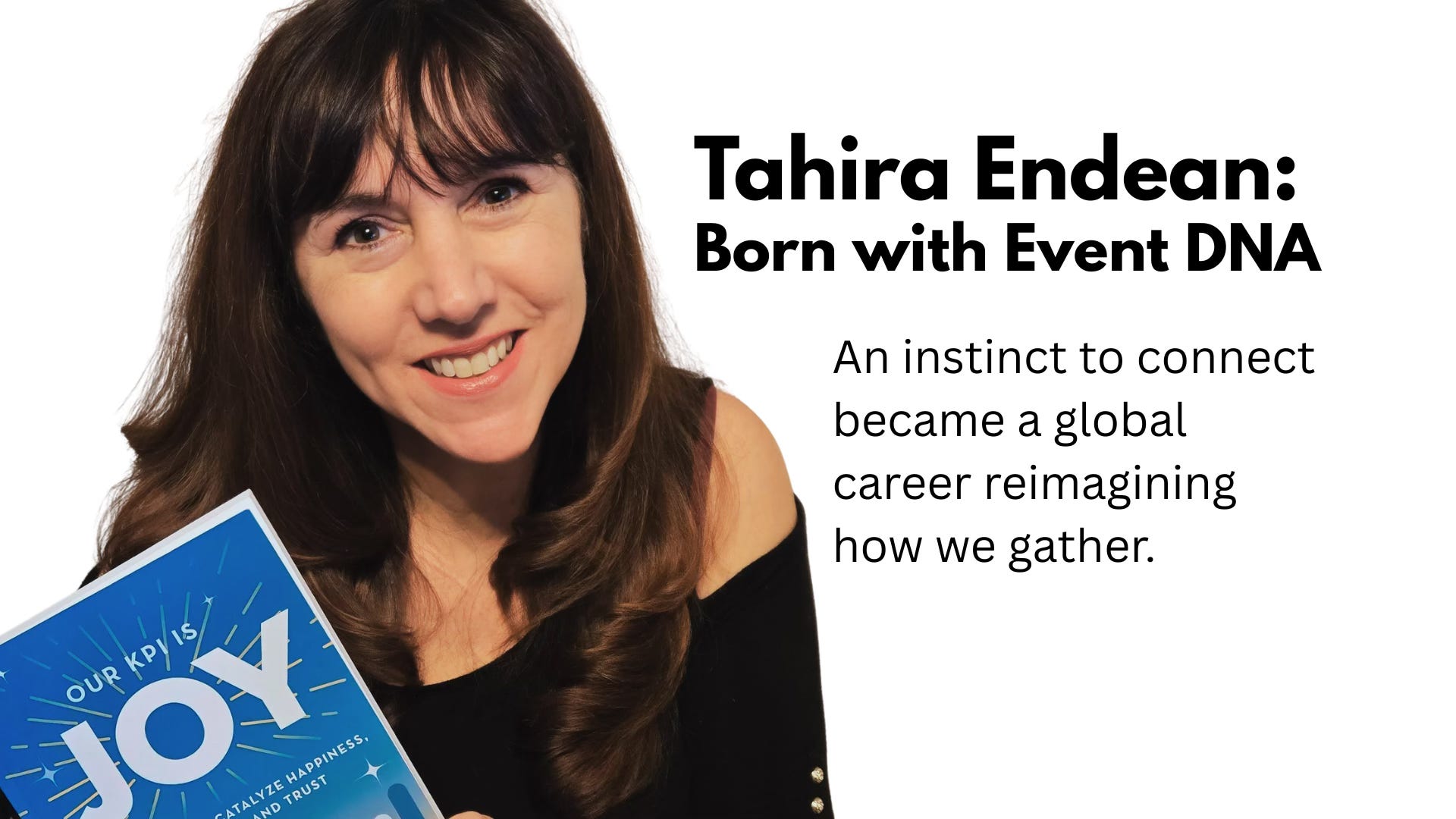
Tahira Endean: Born with Event DNA
From childhood pool parties to global summits, Tahira Endean has spent a lifetime turning gatherings into something more than events—places where people connect, learn, and change.
Somewhere on a glacier outside Whistler, a red carpet unfurled across the snow. Guests stepped off helicopters five at a time, their breath visible in the alpine air. A butler in formalwear offered champagne. Their names—carved by hand taking hours—waited for them in the snow.
It was a corporate lunch, technically. But in truth, it felt closer to theater. A moment so precisely designed and so improbably executed, it didn’t just dazzle. It whispered: someone thought about you.
That someone was Tahira Endean.
She didn’t stand at the center of the spectacle. She never does. But make no mistake—she was the gravity behind it.
In the global events world, Endean’s name carries a quiet reverence. She is Head of Education for IMEX, one of the most respected platforms in the meetings and experience design industry. She is also an author, a strategist, a convener of conveners, and, perhaps most importantly, a thinker who believes that logistics and emotion are not opposites—but partners in the pursuit of meaning.
Her superpower? Creating environments where people feel safe enough to open up, curious enough to connect, and seen enough to change.
It’s a skill that’s hard to teach—because for Tahira, it was never taught. It’s who she has always been.
She was born on Haida Gwaii, a remote archipelago off the coast of British Columbia. When she arrived, the islands were still known as the Queen Charlottes. Her father was a logger and fisherman; her mother, a teacher. The closest thing to a supply chain was a boat that came twice a year. Her family fished. Her mother baked bread. Vegetables were grown, not bought.
“If you wanted something,” she says, “you figured out how to make it happen.”
That philosophy never left her.
She was the child who organized Christmas. The one who gathered people before she knew why it mattered. When the family moved inland, she threw her first co-ed pool party at ten—counting heads, balancing dynamics, worrying about who might be left out.
It wasn’t about control. It was about care.
At fifteen, her parents divorced. She became a caregiver, a planner, a quiet force of order inside emotional chaos. At sixteen, she was working in a hair salon. By the time she graduated high school, she was already a licensed hairstylist—with 1,500 hours of training behind her.
Hairdressing, she would later say, taught her everything she needed to know about people. “You’re connecting all day,” she says. “You’re listening. You’re creating safety.”
She grew a salon team from five to fourteen. She made people feel better—because she knew what it felt like to need that. But then, her hands began to go numb. What was first misdiagnosed as carpal tunnel was eventually traced to a rare condition: an extra rib pressing into the nerve bundle beneath her collarbone.
Surgery followed. Then more surgery. And then the words that gutted her: you’ll never cut hair again.
She went home and cried for two days. Then she opened a newspaper. A small ad—Event and Convention Management, new program launching at the local college—caught her eye.
“It looked glamorous,” she says now, smiling. “So I thought—sure. Let’s do that.”
That instinct—grief giving way to reinvention—would become another of her trademarks.
The program compressed two years into one. Ten classes per semester. She excelled. After graduation, she moved to Vancouver and began working as a professional conference organizer, quickly landing with a firm called Events by Design.
There, she learned everything by doing. Her early projects were immersive, high-pressure, logistical high-wire acts. She worked on major medical conferences, including the 1996 International AIDS Conference, one of the most significant global health convenings of its era. She learned how to plan for the things people don’t think about: how crowds move, how power grids fail, how people panic, how they rest.
Her father, a safety inspector, taught her to look for invisible risks. Her mother, the educator, instilled in her a hunger for lifelong learning. Between them, Tahira absorbed a kind of holistic intelligence: one that values design not just for beauty, but for belonging.
She moved through the industry in five-year cycles—five years with one firm, then another. Always moving toward more creative work, more impact. She developed immersive events for global incentive groups. Sometimes this meant organizing private helicopter lunches on glaciers. Other times, it meant staging a port opening in a remote Canadian town with no plumbing and 4,000 attendees.
If it was hard, she was interested.
In 2010, she became part of the EventCamp movement—an underground but influential experiment in co-created, participatory gatherings. There were no passive attendees. Everyone contributed. On the final day, organizers shared how every element had been built, so others could recreate it.
She later hosted one of the most memorable editions in Vancouver, assembling a coalition of hotels, convention centers, AV partners, and hybrid technologists to build the event together. To this day, she says, the EventCamp community remains bonded.
“If we all got together tomorrow,” she says, “we’d still have that connection.”
As the industry evolved, so did she. The rise of mobile tech and real-time data meant many creatives were focused on tools. Tahira went wider, weaving tech, behavior, and purpose into her work like threads in a larger tapestry.
During her time with the event tech company QuickMobile (acquired by Cvent in 2018), she helped pioneer new ways to use apps—not just for navigation, but for connection. It was around then that we collaborated on a series of experimental gatherings we called Planathons—pop-up hackathons for event professionals, hosted in cities across North America.
In each one, ten participants were randomly selected from a room of a hundred and given a short window to design and pitch a fully realized event experience. The results were always the same in one sense, and totally surprising in another: strangers became collaborators, time constraints sparked outrageous creativity, and camaraderie bloomed under pressure.
It was classic Tahira—part structure, part serendipity, fully human. She knew instinctively how to create a room where people didn’t just ideate, but connected.
It was also during that chapter that she and her then-boss handed me a copy of Alex Pentland’s Social Physics. The book changed my life. Its central premise—that the flow of ideas between people predicts success more than individual brilliance—resonated like a tuning fork.
That small gesture, a book passed in conversation, was pure Tahira. She wasn’t just designing better events. She was shifting how people thought about interaction itself.
Her appetite for deeper frameworks led her to the College of Extraordinary Experiences, a highly curated, immersive design lab hosted in a 13th-century castle in Poland. There is no printed schedule. No keynote speakers. Just a series of orchestrated collisions that pull participants into co-creation, challenge, and play.
“You’re invited to test ideas in real time,” she says. “You don’t know what’s next. No two people have the same experience. And that’s what makes it powerful.”
One rule she brought back with her and still lives by: always leave an empty chair. Every conversation should be open enough for someone new to join.
That ethos followed her into the World Experience Organization (WXO), a global collective of immersive designers, strategists, and storytellers building what comes next. “They’re literally creating new worlds,” she says. “Experiences that change you—just enough.”
She’s also the author of The KPI Is Joy, a deceptively simple title that carries a radical argument: if you want business outcomes—trust, alignment, retention—you must design for joy.
Not entertainment. Not distraction. Joy as resonance. As belonging. As the emotional infrastructure that allows transformation to take root.
The book began as a thesis project during her master’s in creativity and change leadership. But not long after she started writing, her life was engulfed in loss. Over the course of a single year, twelve people in her orbit—colleagues, friends, family—passed away.
The grief was sharp. And it silenced her.
She didn’t write for nearly a year. It felt impossible—almost disrespectful—to think about joy while holding so much absence.
But eventually, something shifted. She realized that grief and joy were not opposites. They were co-travelers—showing up at every gathering, inside every room, woven through every attendee’s unspoken story.
“We are messy, emotional humans,” she says. “We show up to events carrying all of it—our work stress, our family grief, our fear, our hope. If we don’t design with that in mind, we miss the point.”
And so the book became something deeper. A framework for intentional event design, yes—but also a quiet manifesto. A reminder that behind every agenda, there are real people, navigating real lives. And that every gathering is a chance—not to perform, but to care.
In recent years, she’s brought that philosophy to IMEX, where she leads global education strategy. But that’s only one part of a much wider constellation.
She teaches at British Columbia Institute of Technology (BCIT), mentoring the next generation of event designers. She co-hosts The Accessible Disruption Podcast, where innovators share how real change happens—messily, imperfectly, and all the more urgently. She’s a founding voice at The Strategy Table, an initiative for leaders ready to engage complexity and build something new.
And somehow, amid it all, she remains deeply present. Her gatherings—whether boardroom or backyard—still leave room for the unexpected. She still trusts that people will find each other. And she still believes that the best work happens when you let go of control, just enough, to let the magic in.
When asked about leadership, she shrugs.
“If you think you’re a leader,” she says, “you probably aren’t one.”
But watch how people gravitate toward her. Listen to the care she builds into a room. And then ask yourself: who taught you how to gather?
If you trace the line back far enough, you may find that the person who helped you understand events as something deeper—as an act of attention, emotion, and care—was someone who never needed to be center stage.
She just wanted to make sure the light reached everyone else.


