
Still Making Magic
Colja Dams has been creating moments of belief since he was sixteen. The stage just keeps getting bigger.
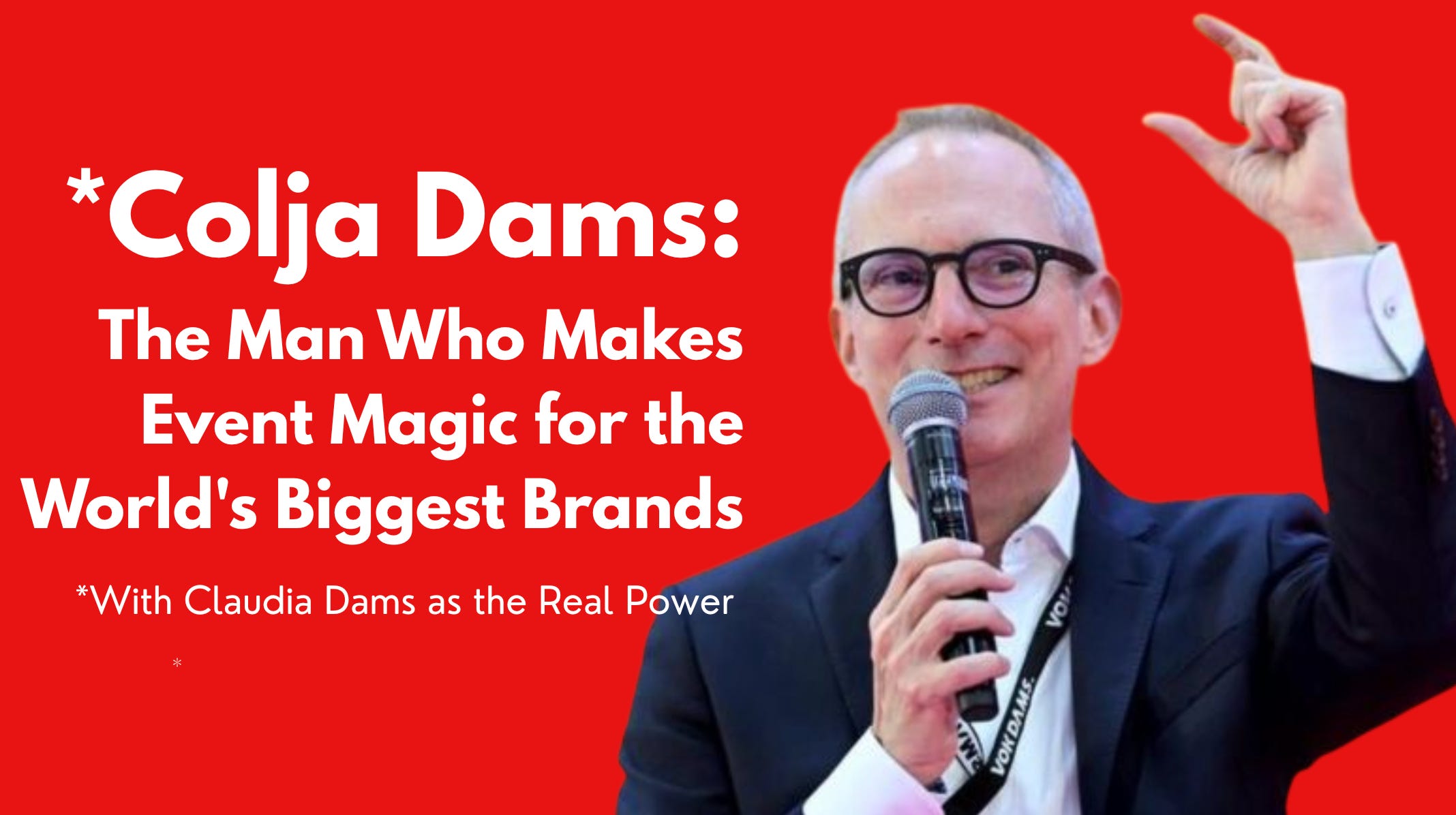
The first thing you notice about Colja Dams is the smile. It arrives before the sentence does and stays after the sentence ends, which is not charm exactly but something closer to a philosophical position made visible. This is a man who spent his teenage years performing magic shows in German children’s hospitals, working for the attention of kids who had every reason not to give it to him, and the experience left a mark that fifty years of running a global agency has not touched. He learned something in those wards that no management school has ever figured out how to teach. He has been applying it at increasing scale ever since.
The agency he runs, VOK DAMS, does something that sounds straightforward until you look at it closely. It produces events for the world’s largest brands: the product launches, the leadership summits, the dealer conferences, the global roadshows, the intimate client dinners that close the deals the splashier events only set up. Founded in Wuppertal, Germany, in the early 1960s by his father Volkwart, the agency now operates 19 offices across three continents with 300 professionals serving clients including BMW, Bayer, Bugatti, Deutsche Telekom, Lamborghini, L’Oréal, Porsche, and SAP. What separates VOK DAMS from the crowded field of agencies that make similar claims is a structural fact that has become more valuable as the world has fragmented: genuine local expertise in North America, Europe, and Asia simultaneously, not a headquarters-and-partners model but actual offices with actual teams who know the room they are working in. For any multinational brand that needs its events to land the same way in Shanghai, Stuttgart, and São Paulo on the same calendar, this is not a nice-to-have. It is the thing.
Colja took the leadership in 1998, formally succeeded his father in 2007, and has spent nearly three decades deepening a business built on a principle he learned before he had language for it: that the gathering of people in a room around a shared experience is the most valuable thing a human being can engineer. The spectacular and the intimate are, for him, the same philosophy applied at different scales. He built a business around both. He will tell you without hesitation which one is growing faster.
The Slide Duster
Volkwart Dams described himself as a practitioner of direct communication with defined target groups, which Colja dutifully repeated to his schoolmates at a time when other children had parents who were firemen, police officers, people whose professions resolved into a single word. It did not go over well. What it gave him instead was a childhood spent inside the machinery of gatherings before he had vocabulary for what a gathering was, or why it mattered, or what distinguished one that worked from one that did not.
Volkwart, in partnership with Kodak, had developed a multi-projector system called Soft Edge in the late 1970s that allowed composite images at a scale with no equivalent outside of Hollywood film production. The choices at the time were a 35-millimeter production that took months and cost fortunes, or a Kodak slide system from Wuppertal that could fill a convention hall with something that looked like cinema. Conventions hired the Dams family. Trade shows hired the Dams family. And Colja, as a child, went along to dust the slides with a compressed-air gun, keeping the sequence with care, because the sequence mattered, because even at age ten there was something at stake in whether the image appeared correctly or not. By twelve he was attending trade shows. By sixteen, he was performing magic.
The civil service requirement in Germany offered a choice between military service and community work, and Colja spent his service hours in children’s hospitals with a deck of cards and seventeen minutes of material. What he found there was that an audience which is frightened, which is suffering, which has every rational reason to withhold its attention, will nonetheless give it to you if you earn it correctly. He learned how attention moves through a room. He learned what holds a crowd and what loses it, and why the transfer that happens between a performer and an audience is not illusion but something genuinely given and received. His father was, at one point, shocked to discover that his teenage son was being paid surprisingly well for those seventeen minutes. The money was beside the point. What Colja had understood, before he was old enough to vote, was that the gathering of people around a shared experience was the most valuable thing a human being can engineer. Everything since has been a question of scale.
Tarpon Springs
When Colja was seventeen, Volkwart made a decision shaped by a private regret. He was a war-generation German, a man denied the chance to learn English as a boy because the war had taken the schooling with it. He was not going to allow his children to carry the same limitation. He paid for Colja to spend a year at a high school in the Tampa Bay area, specifically in Tarpon Springs, Florida, a city on the Gulf Coast known for its Greek sponge-diving community and not, as Colja quickly established, particularly inclined to employ German exchange students through official channels. There was one establishment willing to take the chance: a Chinese restaurant called Sun Yen, which hired him as a weekend busboy on an arrangement that neither party examined too closely.
He learned his English. He also learned what he now calls China speed: the efficiency and the positive agenda and the absolute commitment to both the quality of the food and the level of the service, the particular quality of people who had built something from nothing and made every aspect of the work excellent, every day, without drama. Decades later he still stops in when he passes through Tampa, and he still gets a free dinner. Twenty-two years after he first walked into that kitchen, VOK DAMS opened its first office in Beijing. The agency now has four offices in China, with a fifth in Shenzhen opened in May 2026. He traces the line directly and without sentimentality. The busboy from Wuppertal built the agency that now serves the technology brands defining the next era of the global economy.
His brother, two years younger, had a different education. Where Colja went to Florida, the brother went to Bordeaux to learn French, fulfilling the same paternal argument that the sons of Volkwart Dams would not be limited by language. The brother studied in Bordeaux and never came back. He built his life there. The Dams family is now, without having planned it, distributed across three of the geographic zones that Colja has made the structural case for in every client conversation he has had for the last decade. He tells this story with the same smile that opens every subject, entirely aware of what it means.
The Global Bet
The decision to go global was not obvious, not cheap, and not without argument. VOK DAMS had spent forty years building its reputation inside the German-speaking corporate market, serving the kinds of industrial brands, automotive companies, pharmaceutical giants, and financial institutions that form the backbone of the Mittelstand and the DAX. Going to Beijing in 2004 was not a logical extension of that model. It was a bet, made by a man who had been running the business for six years and had not yet formally taken the reins from his father, that the fragmentation of the global economy into distinct geographic zones was not a temporary condition but a structural reality that his clients would eventually be forced to confront.
The clients who sent their product launches to three continents needed an agency that could execute with genuine local expertise in all three, not a German agency with a list of foreign contacts. He went to Beijing in 2004. Shanghai followed in 2009. The Shenzhen office opened in May 2026, positioned explicitly as a tech hub serving clients in the orbit of Huawei, Tencent, DJI, and the automotive companies whose next chapter is being written in southern China’s Greater Bay Area. When the Shenzhen opening was announced, Colja put it plainly: “Shenzhen is not just another city in China. It is the engine room of the country’s tech revolution. By opening an office here, VOK DAMS is making a clear commitment to being where the future is being built.” The world has since organized itself into exactly the three zones he bet on: North America, Europe, and Asia, each increasingly self-contained, each requiring genuine local fluency rather than remote coordination. He called it early. He built for it while others were still debating whether it was real.
In a world increasingly mediated by algorithms and synthetic connection, the unmediated moment is more valuable than ever. We are already living in a simulation, but the room where people are actually present together is the last thing that cannot be faked or automated. Watch how global event agency VOK DAMS engineers real human connection, proving that the live, face-to-face experience is the one thing AI cannot replicate
Claudia
Colja returned from Florida, studied at Universität Witten/Herdecke, a private reform university just down the road from Wuppertal founded on the conviction that interdisciplinary thinking and entrepreneurial instinct mattered more than conventional academic formation, and joined the agency in 1998 as its youngest member. He made a decision on the first day that has not changed since. He was not there to tell people how to do their jobs. He was there to make it possible for people to do their jobs without anyone telling them how, which is a different thing entirely. The philosophy he developed in those early months he named decentralized context management, and the phrase has not changed in twenty-seven years: the person standing in front of the customer must have the authority to make the decision in real time, because the moment they refer back up the chain, the customer experience has already degraded. He learned this in Tarpon Springs, where a language barrier and a teenage busboy’s initiative were the entire customer-facing operation.
Running a 300-person agency across 19 offices on three continents is not something one person does, and Colja names his wife before he names anything else. Claudia Köhler-Dams is co-CEO of VOK DAMS, sharing the leadership in a structure that is rare at this scale in any industry and rarer still in the event world. The division between them is both practical and clear. Colja focuses on new trends, forward movement, and the next opportunity. Claudia manages the operational reality that would otherwise consume everything, and she also manages Colja himself, which is a more demanding assignment. Before certain meetings he receives a text or an email telling him what not to chase that day, which directions to leave alone because the agency already has enough on its plate. There is no shortage of opportunities in the world Colja inhabits. There is a perpetual shortage of focus. Claudia supplies the focus, and he is openly, specifically grateful for it.
She also enforces something more important than operational discipline: the expectation that people at every level will say directly what they think, including to the people running the organization. There is an internal principle at VOK DAMS that if someone does something because Claudia or Colja said to do it, rather than because they believe in it themselves, they are not supposed to do it. The logic is not contrarian. It is motivational: people perform from autonomy, from competence, from belonging, not from being told what to do by someone above them on a chart. A former VOK DAMS project manager sent Colja a message recently saying they had more decision-making authority at the agency as a project manager than they now have as a managing director at a competitor. He found this deeply satisfying, not because it was flattering, but because it meant the philosophy was working the way he intended it to work twenty-seven years ago.
Almost half of VOK DAMS’s current clients are former employees, people who left the agency, took senior positions at major brands, and then hired the people they used to work for. They know exactly how the sausage is made. They choose to call Wuppertal anyway. That is not a marketing claim. It is a measurement of culture, and it is the measurement Colja trusts above any other.
Rituals
The rituals that hold 300 people together across 19 time zones are not elaborate, and Colja does not believe they need to be. Every Monday morning, every office in the world dials into a single meeting that is open to everyone. Teams present their projects, flag their active RFPs, and ask questions into the group. Someone from one office needs a specialist in southern France for an upcoming project. Someone from another office happens to know one. This exchange happens every week, across every time zone the agency occupies, and it is the connective tissue that keeps a global organization from becoming a collection of independent outposts.
At the Wuppertal headquarters, Colja recently invited the entire staff for ice cream in honor of his birthday, which falls on June 17 and is now known to the organization. The annual gathering, the internal event VOK DAMS throws for itself, is organized by the most successful office of the year: that office hosts the others, and it is the junior members of the hosting team who build the entire program. This December it is Hamburg, and the junior Hamburg team has already delivered presentations that Colja describes as impressive, for a program that runs a full day of learning followed by what he calls, with evident pleasure, a wild party at night. He and Claudia review the program. They almost always say yes. The point is not approval. The point is that the people closest to the work design the experience for everyone else, which is the same logic he has been running since 1998 and the same logic he applies to every client event the agency produces.
He has four children. The eldest, Corvin, is studying Business Economics and Marketing in Vancouver and is already stepping into the industry, joining his father at conferences and learning the business the same way his father learned it: by being in the room before you have the language for what you are seeing. Corvin will join Colja on stage at the upcoming Cvent conference in Nashville. His second son, Vic, is doing his internship in Singapore, deepening the family's connection to the Asian zone his father bet on two decades ago. His two daughters are still at school in Wuppertal, where the whole story began. The man who runs one of the most globally consequential event agencies in the world is texting his kids about matcha tea from Shenzhen. This, too, is a ritual, and he would not have it any other way.
PMA
There is a concept that motivational coaches and sales trainers have been using since the 1950s called positive mental attitude, the deliberate choice to approach circumstances from a position of opportunity rather than threat. It sounds like the kind of thing that gets printed on a poster and ignored. Colja Dams, when he first heard the abbreviation PMA, had not encountered it before. When it was explained, he absorbed it immediately and said he had literally written a LinkedIn post in German that same week about what he called the German angst: the national disposition toward pessimism and catastrophizing, the cultural default that treats every open door as a potential trap and every opportunity as a risk to be managed rather than a momentum to be seized. His counterargument is not naive optimism. He reads the same newspapers everyone reads. He is fully aware that the world is complicated. What he chooses, deliberately and as a management philosophy, is to focus on the opportunities rather than the shortfalls. In a country where the ambient cultural mood trends toward fear, choosing to operate from a position of positive momentum is, he argues, a genuine competitive advantage.
He learned this from his father, who built an agency from a photography studio in Wuppertal at a time when there was no industry, no trade association, no agreed-upon vocabulary for what he was doing, and who managed to do it with a disposition of forward motion rather than institutional caution. Colja inherited the disposition along with the business. The smile that opens every conversation is not a sales technique. It is the outward sign of a man who decided, at some point early enough that he no longer remembers deciding it, that the world contains more opportunity than threat, and that the correct response to a complicated morning is to focus on what is possible by evening.
The Goosebump Business
Colja’s current argument about where the industry is going is counterintuitive enough to stop a room, which is probably why he leads with it in conference keynotes. Artificial intelligence, he says, will drive more live events, not fewer. The mechanism is simple and structural. There are only three categories of things, in an AI world, that people and corporations will pay for: easing someone’s pain, providing convenience, and delivering experiences. The first two are being automated at speed. The third, the gathering of people in a room where something real can happen between them, is the category AI cannot replicate and will not replace. The more the world is mediated by algorithms and synthetic connection, the more the unmediated moment is worth.
He has a term for the current cultural condition that arrived to him mid-conversation and became the title of his next trend presentation on the spot: we are already living in a simulation. Everything is increasingly simulated. The only thing left that is genuinely not simulated is the room where people are actually present together, where what happens between them is not generated or approximated or optimized by a model. That room is what VOK DAMS sells, and Colja is not modest about the timing. The industry he has been building toward for twenty-seven years has arrived at a moment when its central product, the live human experience, is the one thing the most powerful technology in the world cannot produce. He finds this satisfying in the specific way that a person finds satisfaction when a long bet pays out.
He also has a specific and unflattering observation about what has happened to conferences, which is that hyper-personalization has become its own form of cognitive punishment. Nobody wants to open an app with seventeen tracks and five thousand sessions and navigate it while also trying to have a meaningful conversation with the person standing next to them. Nobody wants to trust an algorithm to curate their three days in a convention hall. What brand-owned events can offer that large-scale public conferences increasingly cannot is editorial judgment: the willingness to reduce the program to what the audience actually needs, to cut the white-paper content and the Teams-call material that has no business occupying a stage, and to give people the one thing they actually came for. By the end of the day, as Colja puts it with the plainness of someone who has been thinking about this since the beginning, why do people attend events? To meet other people. Not because of the brand that invited them, or the venue, or the food. The agenda of the person in the seat has almost nothing to do with the agenda of the person who built the stage, and the events that close that gap are the ones that work.
He also notes that the behavior of the people in those seats varies considerably depending on where in the world the event happens. Americans arrive energized, ready for a morning program, open to strangers in a way that requires no warming-up period. Germans need more time. The cultural disposition toward reserve means that a morning session that generates immediate energy in New York will feel flat in Munich until the room has had a chance to settle into itself. Asian networking protocols follow different rhythms entirely, and an event design that ignores this will not land the same way it landed in Chicago. VOK DAMS’s nineteen offices are not a growth strategy. They are a product quality argument. Local expertise is not a courtesy. It is the thing that makes the difference between an event that works and one that merely happens.
The Two Hundred Events
The fastest-growing part of the VOK DAMS business is not the landmark events, though the agency produces those at the highest level the industry can offer. The Bugatti Tourbillon reveal at the Château Saint Jean in Molsheim, staged as a dance-theater production for 2,000 guests marking both the brand’s 115th anniversary and the debut of a new era. The BMW Vision iNEXT World Flight, which placed a concept car inside a Lufthansa cargo plane and took it across Munich, New York, San Francisco, and Beijing in five days. The Lamborghini launch that closed Miami airport. These events define what VOK DAMS can do at the extreme edge of ambition and execution. They are not where the growth is.
The growth is in what Colja calls implant business: embedding VOK DAMS event managers directly inside client organizations to run the day-to-day portfolios that every multinational corporation produces continuously and almost never thinks of as a coherent strategy. Every corporation has two lighthouse events that command all the management attention, the RFPs, the agency pitches, the board-level scrutiny. Those same corporations may have two hundred other events running throughout the year. The combined budget of the two hundred events exceeds the two that get the credit. The sales leverage they generate, when run with consistent brand standards and genuine skill, exceeds it further. The attendee at a regional briefing in Düsseldorf has the same brand experience as the attendee at the annual summit in Zurich. The client who might have a mediocre Tuesday afternoon meeting that contradicts the excellence of their flagship event in January no longer has that problem. Colja says, without qualification, that this is the fastest-growing part of his operation. American companies in particular are coming to VOK DAMS and asking the agency to take over their entire global event portfolios.
Clients, he adds, regularly ask whether VOK DAMS can extend into adjacent functions once they see the quality of the event work up close. He keeps redirecting them. He knows what the core is, and he knows that the moment an agency stops knowing what its core is, it stops being good at anything.
Roughly a third to half of the agency’s business now comes not through RFPs but through long-term partnerships where clients are not buying a project but engaging a partner for two, four, or six years at a time. This is also what the Digital Doppelgänger makes possible at scale. The tool, which VOK DAMS developed initially by accident and then spent two years building into a formal capability with a dedicated team, creates an AI model of a client’s target audience and allows every event concept to be tested before a dollar is spent. Colja describes three eras of event data. The no-data era, when nobody collected anything and success meant a photograph on the front page. The post-data era, when everyone collected data after the event but the world had moved on by the time it was available and even if you ran the same event with the same people six months later the data was essentially useless. And the pre-data era, which is the current moment, where the Digital Doppelgänger allows a client to arrive at an event with actual predictive intelligence rather than retrospective measurement.
A client who runs global events for a major brand told him recently that the tool transformed her relationship with her own board: instead of preparing long presentations to explain why the C-suite’s event ideas would not resonate with the actual audience, she now runs the ideas through the model and lets the data carry the argument. He found this solution deeply satisfying, not because it sold a technology, but because it solved the problem the industry has been carrying since the beginning: everyone thinks they know what the audience wants, and almost no one actually does.
Volkwart Dams passed away on May 19, 2023, a few days after his 85th birthday. He had been a founding member of fwd: Bundesvereinigung Veranstaltungswirtschaft, the principal German event industry association, a member of the German Journalists’ Association for sixty years, and the man whose original question, how do you put something in front of a large group of people that makes them feel something, became the organizing logic of everything his son would build. The Digital Doppelgänger, the AI destination finder, the embedded event managers inside client organizations: all of it descends from that first question, asked in a photography studio in Wuppertal sixty years ago.
Wuppertal is not Frankfurt or Munich or London. It is an industrial Rhineland city of 350,000 people, home of the Schwebebahn, the suspended monorail that has run above the Wupper river since 1901, and the birthplace of Friedrich Engels. VOK DAMS has been headquartered there since the beginning and shows no inclination to move. The credibility is in the work, and the work is everywhere. When Colja talks about where the industry goes next, the answer is always the same underneath, regardless of which specific prediction he is making about technology or geopolitics or the future of the conference format. The room where people are present together is the last thing that cannot be faked, automated, or arbitraged away. He has known this since he was sixteen years old in a children’s hospital in Wuppertal, standing in front of an audience that had not asked to be there, making something real happen between himself and a room full of people who had no particular reason to believe in anything. He has been proving it, at scale, across three decades and three continents, ever since.
The smile is still there. It was never a trick.
GatheringPoint covers the people who build the gatherings. Subscribe at GatheringPoint.news.
1. The Two Hundred Events Nobody Photographs Every corporation has two events everyone talks about and two hundred nobody photographs. The two hundred carry more combined budget and produce more sales leverage than the two that win the trophies. The agency that figures out the two hundred wins.
2. Culture Is Measured by Who Calls You Back Almost half of VOK DAMS clients are former employees who left, built careers at major brands, and then hired the agency they used to work for. People who know exactly how the sausage is made choose to call Wuppertal anyway. That is not a marketing claim. That is a measurement.
3. The Busboy Knew Before the MBA Did The person standing in front of the customer must have the authority to make the decision in real time. The moment they refer back up the chain, the experience has already degraded. Colja learned this not in a business school but in a Chinese restaurant in Florida where a teenage busboy from Wuppertal was the entire customer-facing operation.
4. Everyone Thinks They Know What the Audience Wants The event industry has lived through three data eras: no data, post-event data that arrived too late to use, and now pre-data, where a synthetic model of the target audience tests every concept before a dollar is spent. Everyone thinks they know what the audience wants. Almost no one actually does.
5. AI Will Drive More Live Events, Not Fewer Pain relief and convenience are being automated. Experiences are not. The more the world is simulated, the more the unmediated room is worth.
6. He Called the Three-Zone World Early Going to Beijing in 2004 was not a growth strategy. It was a product quality argument. A brand sending launches to three continents needs genuine local expertise in all three, not a headquarters with a list of foreign contacts. He built for it while others were still debating whether it was real.
7. They Did Not Come for the Seventeen Tracks Nobody came for the seventeen tracks and the five thousand sessions. They came to meet the person standing next to them. The events that understand this are the ones that work.
8. PMA Is a Competitive Advantage in a Country That Defaults to Fear In a country where the ambient mood trends toward fear, choosing to operate from positive momentum is a genuine competitive advantage. Colja learned it from his father, who built an agency from a photography studio at a time when the industry had no name, no association, and no agreed-upon vocabulary, and did it anyway.
9. The Rituals Do Not Need to Be Elaborate A Monday morning global call where someone in Singapore asks if anyone knows a specialist in southern France and someone does. Ice cream on the CEO’s birthday. The most successful office of the year builds the annual program and the junior members run it. Simple structures, applied every week, are what keep a global organization from becoming a collection of independent outposts.
10. Close the Gap Between the Stage and the Seat Why do people attend events? To meet other people. Not because of the brand that invited them, the venue, or the food. The agenda of the person in the seat has almost nothing to do with the agenda of the person who built the stage. Close that gap and you have done something real.
Edible Profile of Colja Dams
Why I Do These
Every leader profiled in the GatheringPoint Wisdom Bank receives an edible portrait from Small Bite Architecture. Four bites. Four sips. Each one a translation of a life into taste.
I started doing this because I believe the gathering economy is ultimately about the senses, and a profile that lives only on a screen misses something fundamental. The people I write about have spent their careers designing experiences that land in the body, not just the mind. The least I can do is return the favor.
The bites are not garnish. They are argument. Every ingredient is chosen for what it means, not just how it tastes. The cocktails distill a philosophy into something you can raise a glass to. Together they are a portrait you can serve at a table, a conversation starter that requires no introduction, and a tribute that disappears in two chews and stays with you considerably longer.
For Colja Dams, the bites begin with a parmesan tuile dusted clean and end with a warm chocolate-chili truffle that delivers a genuine physical shiver. That arc, from the sequence that must be kept exactly right to the unmediated moment no algorithm can produce, is his entire philosophy in four bites.
Why I Commission These Songs
Every leader profiled in the GatheringPoint Wisdom Bank receives an original song. This is not a gimmick. It is a conviction.
I have spent fifty years in the events industry believing that the most powerful things that happen between people happen in rooms, not on screens. A magazine profile tells you what someone built. A song tells you what they believed while they were building it. The two together get closer to the truth than either one alone.
The song for Colja Dams is called Still Making Magic. It is written in the register of U2’s Achtung Baby era, the period from 1991 to 1993 when Bono was making grandiose claims about human connection at arena scale that turned out to be completely correct. Colja was at university during those years. More importantly, the register fits the argument: that the gathering of people in a room is the most valuable thing a human being can engineer, that the small room closes the deal the big room only opens, and that real is the only currency that never goes away.
The song names Colja and Claudia because VOK DAMS is not a solo act. It names BMW, Bugatti, Bayer, L’Oréal, SAP, Telekom, Porsche, and Lamborghini because the philosophy is proven by the clients who trust it. And the bridge lands on three words that are the structural argument of everything Colja has built across twenty-seven years and nineteen offices: the room, the room, the room


