


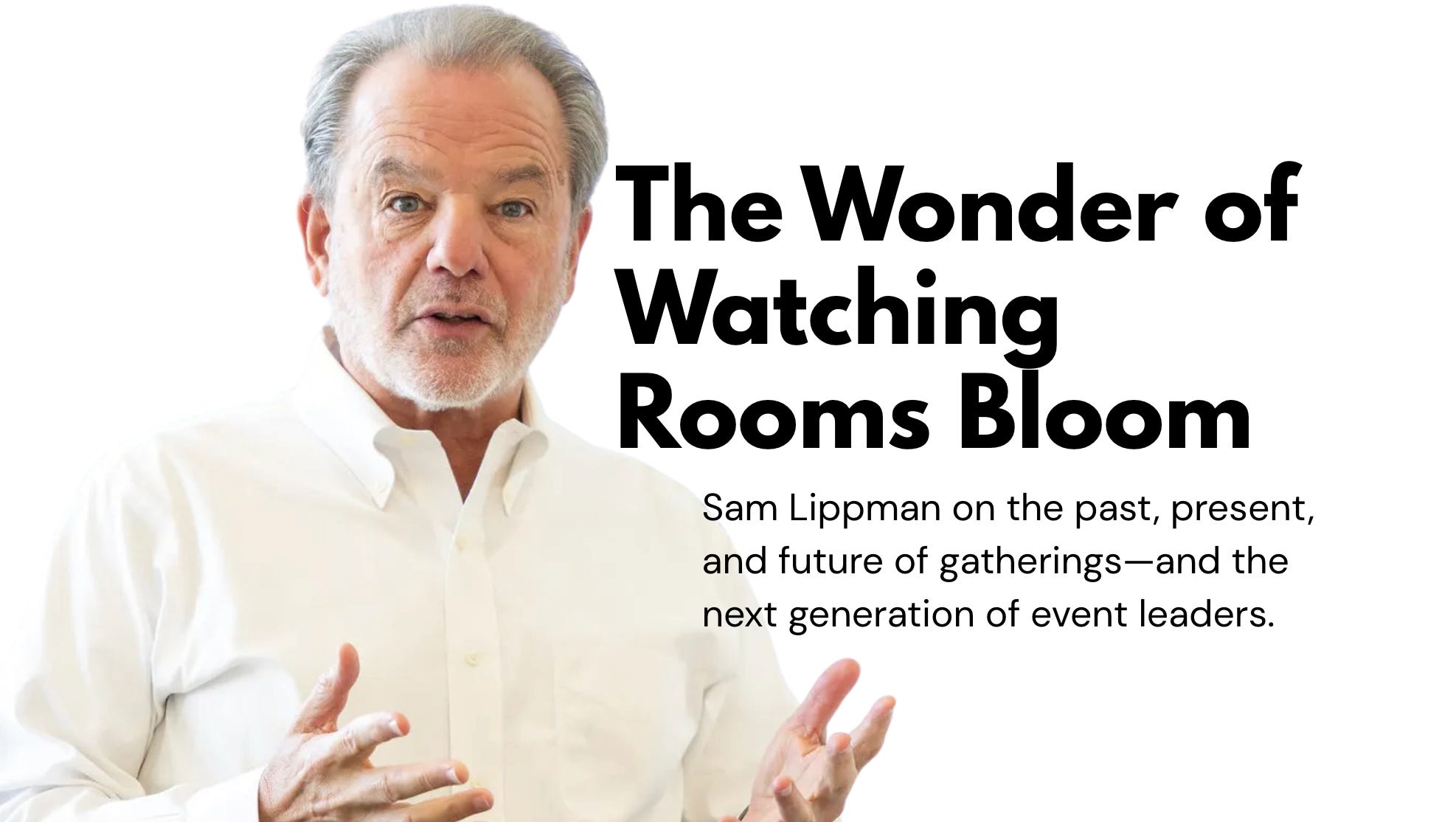
Editor’s Note:The career of Sam Lippman offers an unusually clear lens into how the modern events industry evolved. Over the past half century exhibitions moved from something largely mechanical—moving freight, building booths, calculating drayage—into something far more strategic: gatherings where the leaders of industries come together to exchange ideas, compare strategies, and quietly influence the direction of entire markets.
Lippman’s journey traces that transformation almost perfectly. From the loading docks of Atlantic City to senior leadership roles at some of the largest trade shows in the world and ultimately to the executive forums he now convenes through his company, Lippman Connects, his path mirrors the arc of the exhibition business itself.
His flagship gathering, the Exhibition & Convention Executives Forum, now brings together roughly 250 senior executives each spring in Washington, D.C., creating one of the most concentrated leadership meetings in the exhibition industry. The next forum is scheduled for May 27, 2026, continuing a tradition that has quietly become an annual checkpoint for the business. Over time the event has also become part of a broader week of industry conversations in the capital that includes policy discussions organized by the Exhibitions & Conferences Alliance, the coalition representing the interests of the business and professional events industry in Washington.
Understanding how the exhibition industry arrived at this point—where conversation itself has become one of its most valuable strategic tools—requires looking at a career that began far from Washington boardrooms and strategic roundtables.
Every industry eventually develops a few rooms where the real conversations happen. They are rarely the giant conferences that dominate marketing calendars or fill convention centers with thousands of attendees. More often they are smaller gatherings where the people who actually run an industry sit together long enough to speak candidly about what is changing and what might come next.

In the exhibition business, many of those rooms have been convened for more than two decades by Sam Lippman. Through gatherings such as the Exhibition & Convention Executives Forum, the Attendee Acquisition Roundtable, the Exhibit Sales Roundtable, and the Large Show Roundtable, he has built a network of meetings where the executives responsible for some of the largest trade shows in North America compare notes about the business they collectively operate.
The gatherings themselves are intentionally focused rather than enormous, yet the people inside them frequently run events measured in hundreds of thousands of square feet. CEOs who oversee global exhibition portfolios sit beside marketing leaders rebuilding attendance pipelines, while sponsorship sales executives responsible for millions of dollars in revenue trade strategies with organizers whose shows function as marketplaces for entire industries. Seen from the outside, these meetings may appear modest compared with the sprawling exhibitions that dominate convention centers around the world. Yet the conversations that unfold inside them often influence how those larger events evolve. Ideas circulate. Concerns about shifting markets are aired openly. A new approach to audience growth or sponsorship strategy surfaces in one discussion and quietly spreads across the industry in the months that follow.
Listen to the Song about this Story
To understand how Lippman arrived at this role, however, you have to return to the beginning—long before executive forums and industry roundtables, and long before he managed exhibitions measured in acres rather than aisles.
He grew up in Atlantic City, the son of a physician whose professional world had little connection to trade shows or hospitality. When he left for the University of California, Santa Barbara, he chose English largely because he had not yet discovered a more precise direction. The moment that would eventually redirect his thinking arrived in a Shakespeare seminar taught by a professor who insisted that the plays were never meant to be read silently. Shakespeare, the professor explained, was written to be heard.
Students acted out scenes in class, learning to listen for the rhythm of language and the pacing that gives dramatic dialogue its emotional shape. Later the class traveled to the Oregon Shakespeare Festival in Ashland, where Lippman saw the full machinery of theatrical production at work. What fascinated him was not simply the actors performing on stage but the ecosystem surrounding them: lighting designers adjusting cues, stagehands moving props in darkness between scenes, technicians orchestrating the choreography that allowed an audience to believe a complete world had appeared before them.
It was his first encounter with the logic of live production.
He did not realize it then, but the lesson would follow him into an entirely different industry.
When Lippman returned to Atlantic City after graduation, he had no particular plan for a career. His father told him plainly that most of the professionals he knew had little use for an English major. But there was one local businessman who might allow him to observe how his company worked.
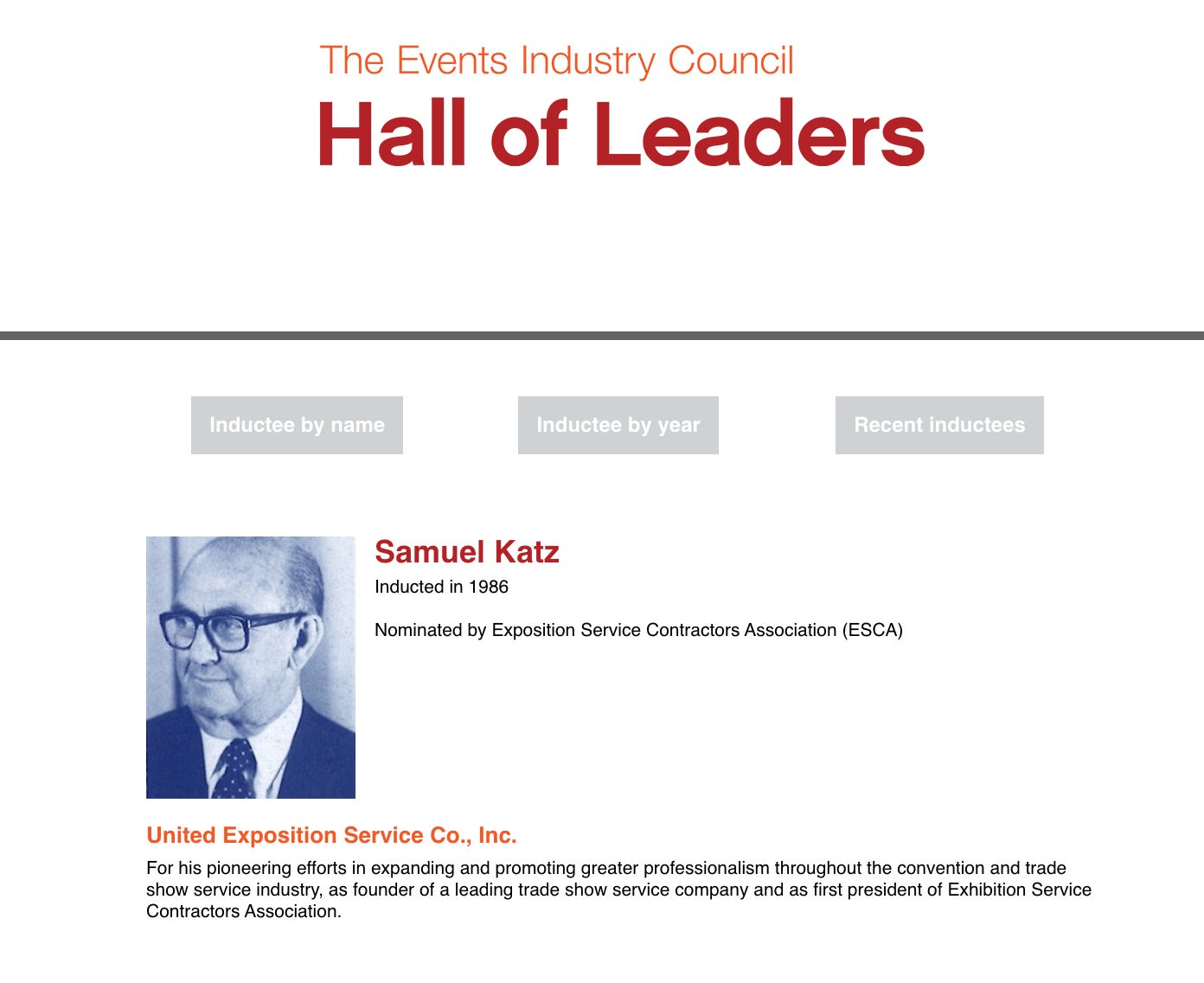
That man was Sam Katz, founder of United Exposition Service Company, one of the early pioneers of the contractor model that would eventually power the American trade show industry.
The company’s origin story belonged to an earlier era of the exhibition business. When Atlantic City built one of the country’s first purpose-built convention centers after World War II, someone walked into the Katz family furniture store looking to rent fifty chairs for a trade show. The store sold furniture; it did not rent it. Katz improvised. Soon the company was renting furnishings, moving freight, and building exhibits. In solving practical problems for exhibitors, Katz had essentially invented a new service industry.
When Lippman asked Katz for a job, the response was cautious. There was no training program and no junior executive pipeline. The business ran on experience and hierarchy. But Katz gave him a simple instruction: if he wanted to see what the business actually looked like, he should arrive at the loading dock at six in the morning.
What he saw there never left him.
At six o’clock the freight doors rose and trucks began unloading. Crates rolled across the concrete floor while forklifts carried them to chalked squares mapping out the future layout of the show. Over the next several days the empty hall transformed piece by piece into a functioning marketplace. Machinery appeared, carpet stretched across the aisles, lighting rigs rose overhead, and just before the doors opened floral arrangements arrived to soften what had been only hours earlier an industrial space.
Then the process reversed itself. The flowers disappeared first, followed by the carpet, the machinery, and the booths. Crates were resealed, forklifts carried freight back toward the loading docks, and within a short time the hall was once again nothing more than concrete.
Watching the transformation unfold in both directions, Lippman realized he had just witnessed something remarkable: a temporary world created with precision, inhabited briefly, and dismantled as if it had never existed.
Except this stage was built with forklifts.
The early years that followed were less romantic but equally instructive. In Chicago he filed freight hard cards in a warehouse, learning the economics of drayage and the operational backbone of exhibitions. Eventually he was sent to Navy Pier to manage what a senior executive described dismissively as a “little city job.” The assignment turned out to be ChicagoFest, a ten-day food and music festival drawing nearly half a million people. With little guidance he learned the mechanics of event production by doing them.
When the festival ended he wrote the invoices by hand. The billing exceeded $100,000. Minutes later he overheard another executive presenting the work upstairs as his own.
It was an early lesson about the realities of the business.
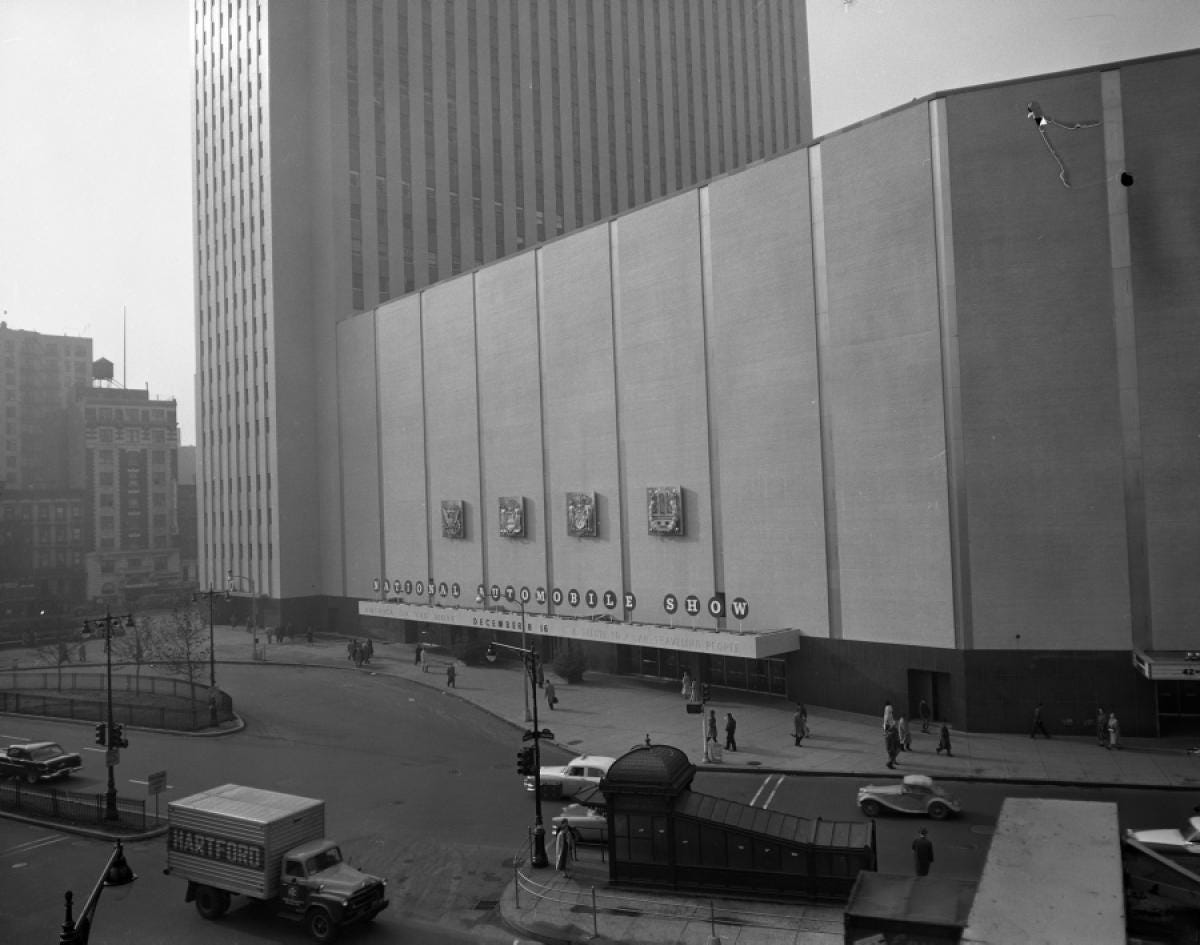
New York proved even rougher. Inside the old New York Coliseum freight logistics resembled improvisational theater. The building had a ramp up to the second floor but no ramp down, which meant trucks could easily become trapped. At the Waldorf Astoria, freight for a ballroom show had to move through the kitchen, where a furious chef once confronted him, insisting that the vibration from rolling crates might ruin two hundred soufflés rising in the ovens.
Eventually Lippman crossed from the contractor side of the industry to the organizer side, becoming director of operations for the National Computer Conference, a major technology exhibition that rotated among cities such as Anaheim, Chicago, Houston, and Las Vegas. From there he moved to the Consumer Electronics Show, where he eventually rose to vice president.
CES in those years ran twice annually and covered more than a million square feet. Running a show of that scale required managing people through extraordinary pressure. Staff members worked sixty- and seventy-hour weeks leading up to opening day. Someone once summarized the culture bluntly: the consumer electronics industry eats its young.
Long before the events industry spoke openly about burnout, Lippman could see the strain on teams. When someone looked close to breaking, he would quietly take them out for coffee and listen until the tension subsided.
After two decades running large association shows, he left to start a consulting practice advising exhibition organizers and facilitating strategic planning sessions. The next phase of his career began with a call from veteran show organizer Mike Howe, who had begun experimenting with an idea: bring together the executives responsible for the largest trade shows and give them a room to speak candidly with one another.
The first Large Show Roundtable proved something simple but powerful: once the right people were in the room together, the conversation flowed.
That experiment eventually led to the creation of ECEF and the broader ecosystem of executive gatherings Lippman now organizes. Over time he made a deliberate design decision that surprised many conference organizers. Instead of compressing networking into brief breaks between sessions, he expanded the breaks dramatically. Some stretches lasted forty minutes or more, allowing conversations to move beyond introductions and into real discussion.
At one recent forum the ballroom session paused for what looked, on paper, like an unusually long networking interval. Within minutes the room reorganized itself into clusters of conversation. One group debated whether digital-native audiences would travel to trade shows in the same numbers as previous generations. Another discussed how artificial intelligence might reshape attendee acquisition. Nearby two sales executives compared notes about sponsorship economics and corporate events competing with traditional exhibitions.
None of these conversations appeared on the official agenda.
Yet they were the reason people had come.
Looking back across Lippman’s career, the progression reveals something about the exhibition industry itself. The earliest phase was defined by logistics—forklifts, freight schedules, and square footage. The next phase belonged to giant marketplace shows where industries gathered to launch products and conduct business. The current phase is quieter but no less important: the recognition that the people who run those marketplaces also need rooms where they can talk honestly about what comes next.
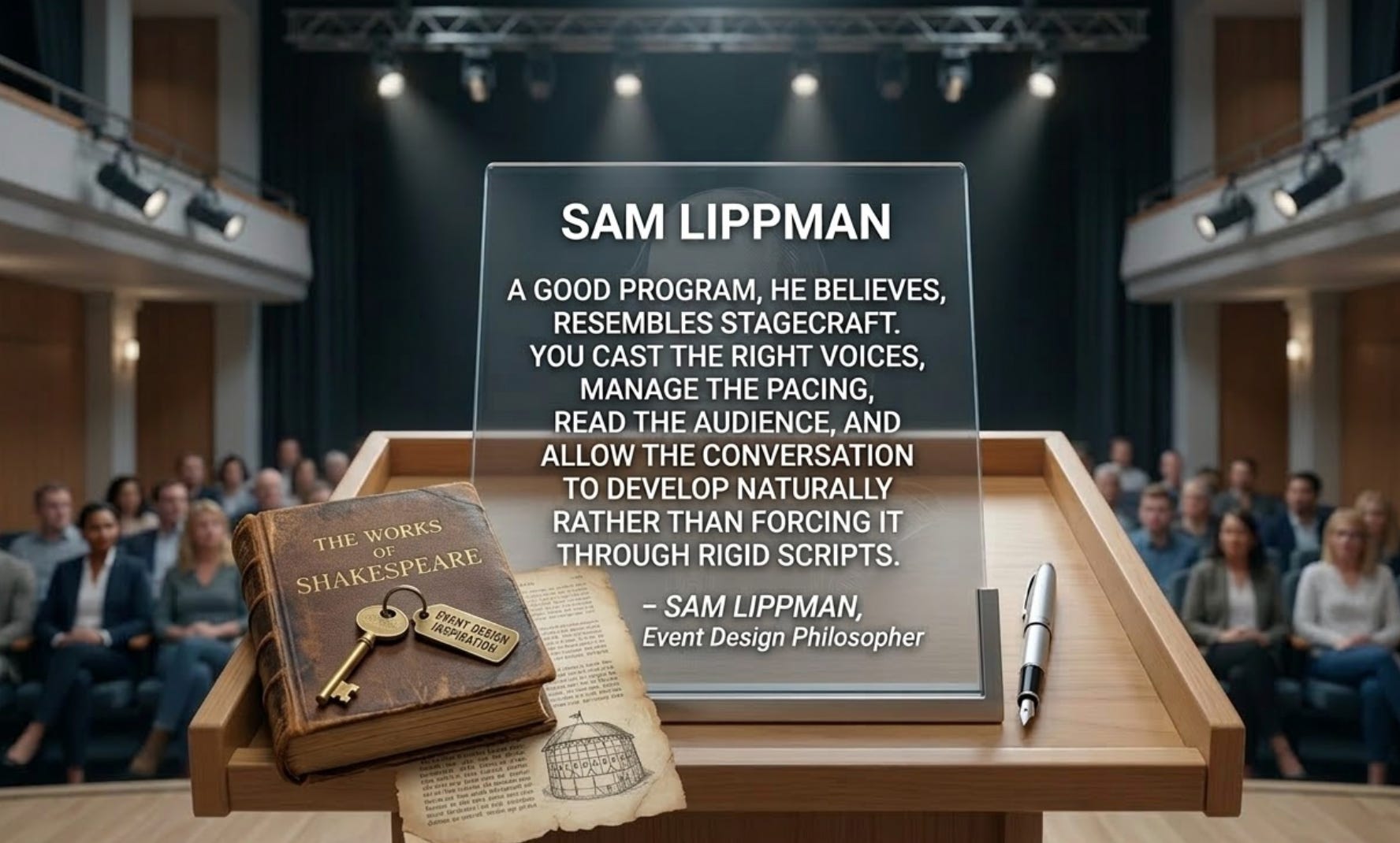
Lippman often describes event design in the language he first encountered studying Shakespeare. A good program, he believes, resembles stagecraft. You cast the right voices, manage the pacing, read the audience, and allow the conversation to develop naturally rather than forcing it through rigid scripts.
After decades in the industry, he has come to believe that the most valuable part of gatherings rarely happens on the stage.
The temporary cities are still built.
But what changes the industry now is what happens once the people inside them start talking.
BONUS Personalization

View Sam’s Edible portraits designed to capture who they are in a single taste.
Sam Lippman: Watching Rooms Bloom — The convener who built the rooms where the exhibition industry talks honestly