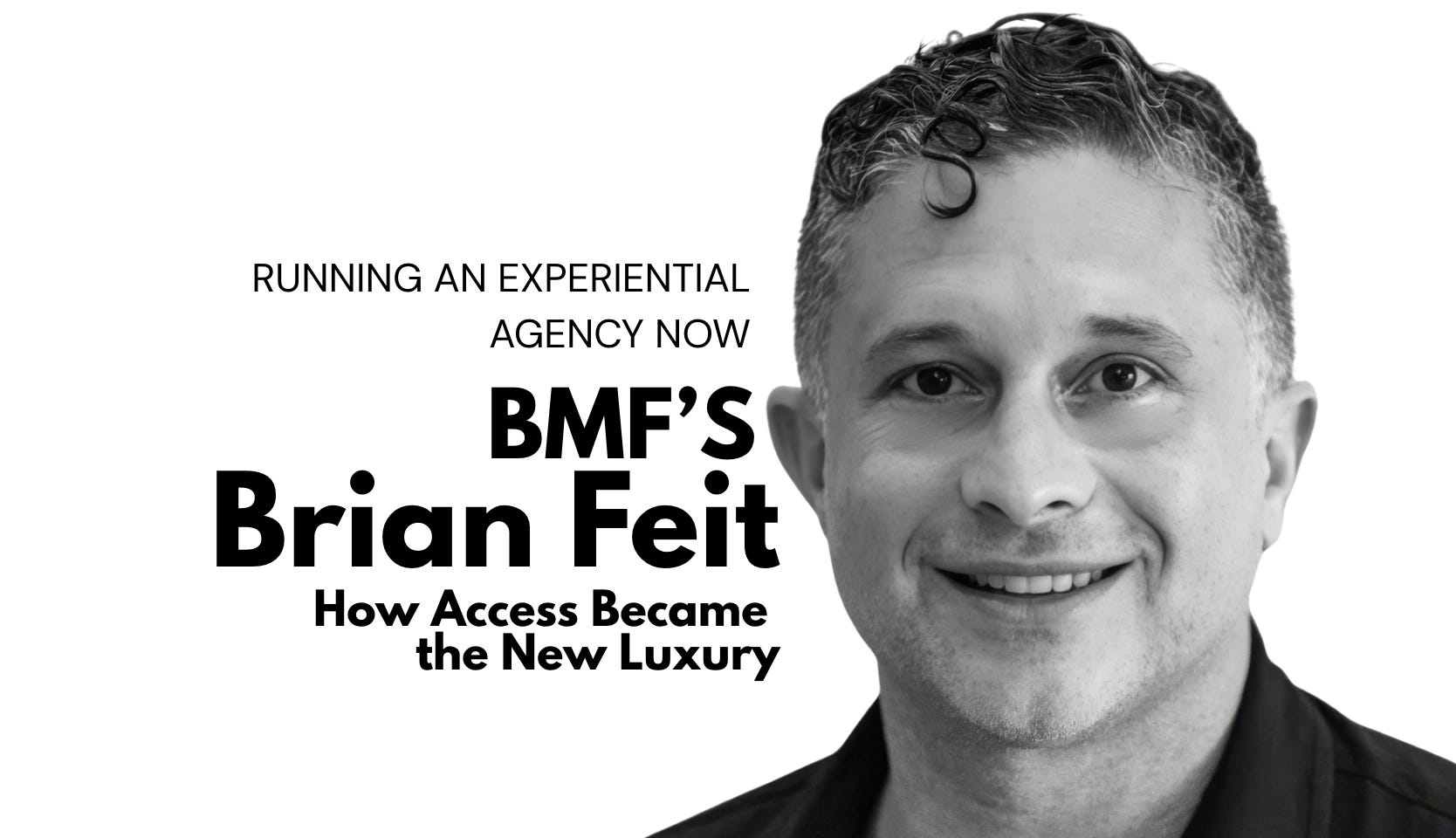
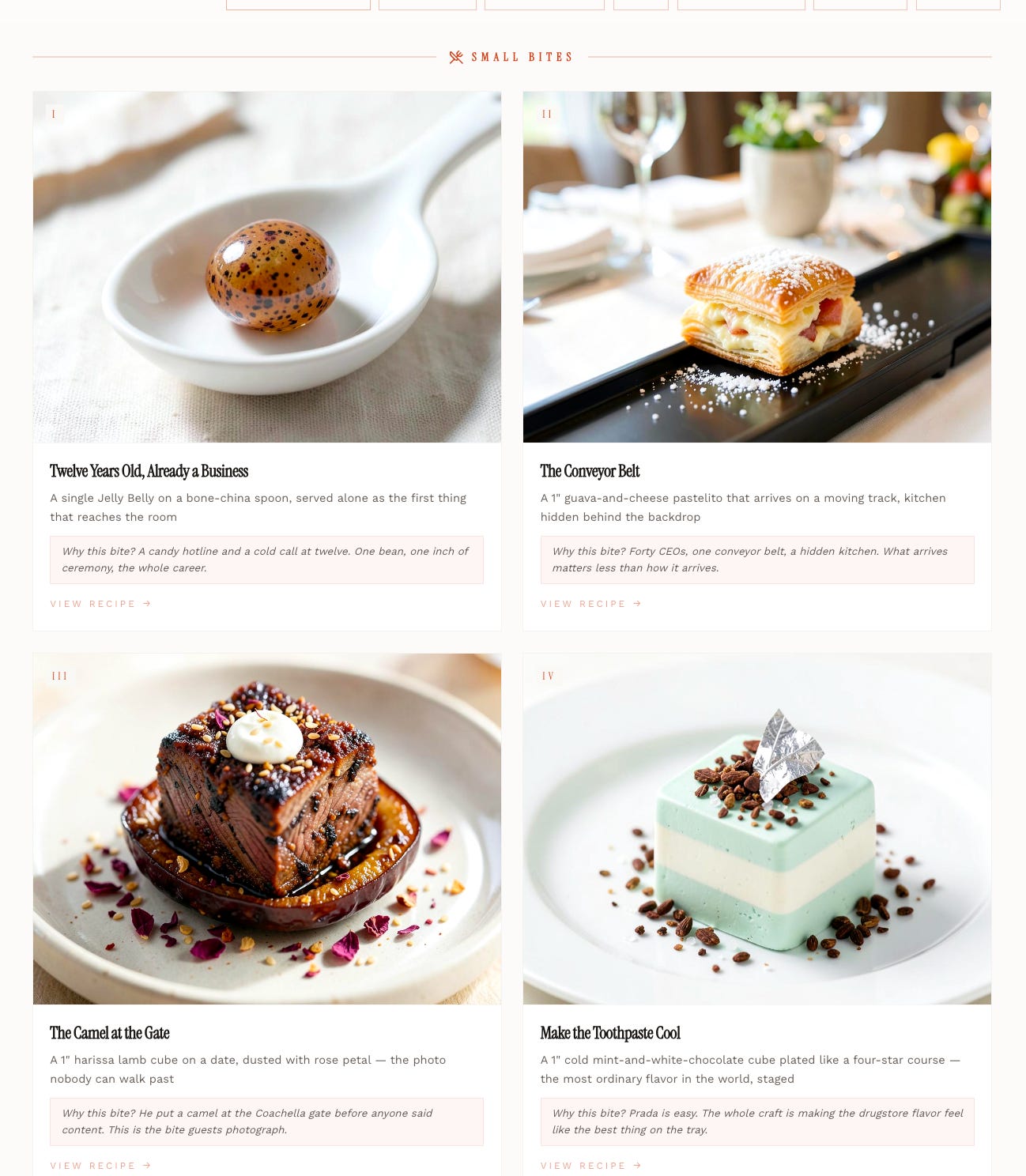
Forty CEOs sat around a conveyor belt in a villa above the French Riviera this summer, and the food came to them. BMF had built a custom dining table with a track running down its spine, hidden the kitchen behind the backdrop, and staged the whole thing so each course arrived as theater, a small piece of engineered wonder delivered to some of the most powerful executives in hospitality. The dinner was for Bilt. It was one of fifteen events BMF ran at the Cannes Lions festival this year, across five clients, in the agency’s tenth consecutive year on the Croisette.
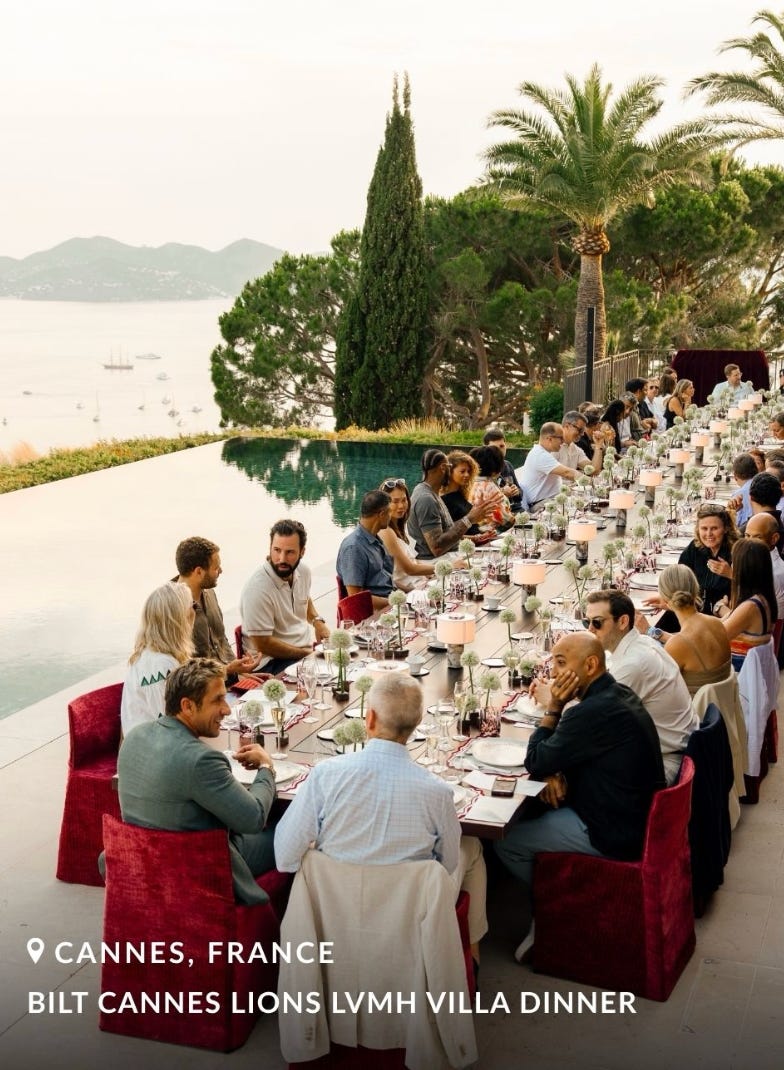
Cannes has become the Olympics of activations, and the strange part is how little it has to do with the festival it is named after. The Cannes Lions is officially an advertising awards show, five days of trophies and panels inside the Palais des Festivals, but almost nobody who matters is in the Palais. The real week happens outside, along the Croisette, where the beach clubs have been rented and rebranded into temporary brand worlds with names like Spotify Beach, Sport Beach, Meta Beach, and Amazon Port. The deals get made on the sand. The relationships get made on the yachts. The status gets conferred at the invitation-only dinners in the villas above the town, and the awards ceremony most people fly in for is the thing they are least likely to attend. The festival is the pretext. The activation is the point, and BMF is in the business of building the point. What makes the week different from the hundreds of other activations BMF stages in a year is who shows up. Cannes is the one event the boss actually attends. A regional brand team can green-light a pop-up in a mall and never see it in person, but the CMO and the chief executive fly to the Riviera themselves, walk the villa, sit at the conveyor belt, and watch their own brand perform in front of their peers. That turns an activation into something personal. It is no longer a line item a marketing director signs off on from a distance. It is the boss’s own reputation, staged in real time, in a room full of the only people whose opinion the boss cares about. Feit builds for that pressure specifically, because at Cannes the client is not a company. It is a person, standing right there, hoping to look brilliant.
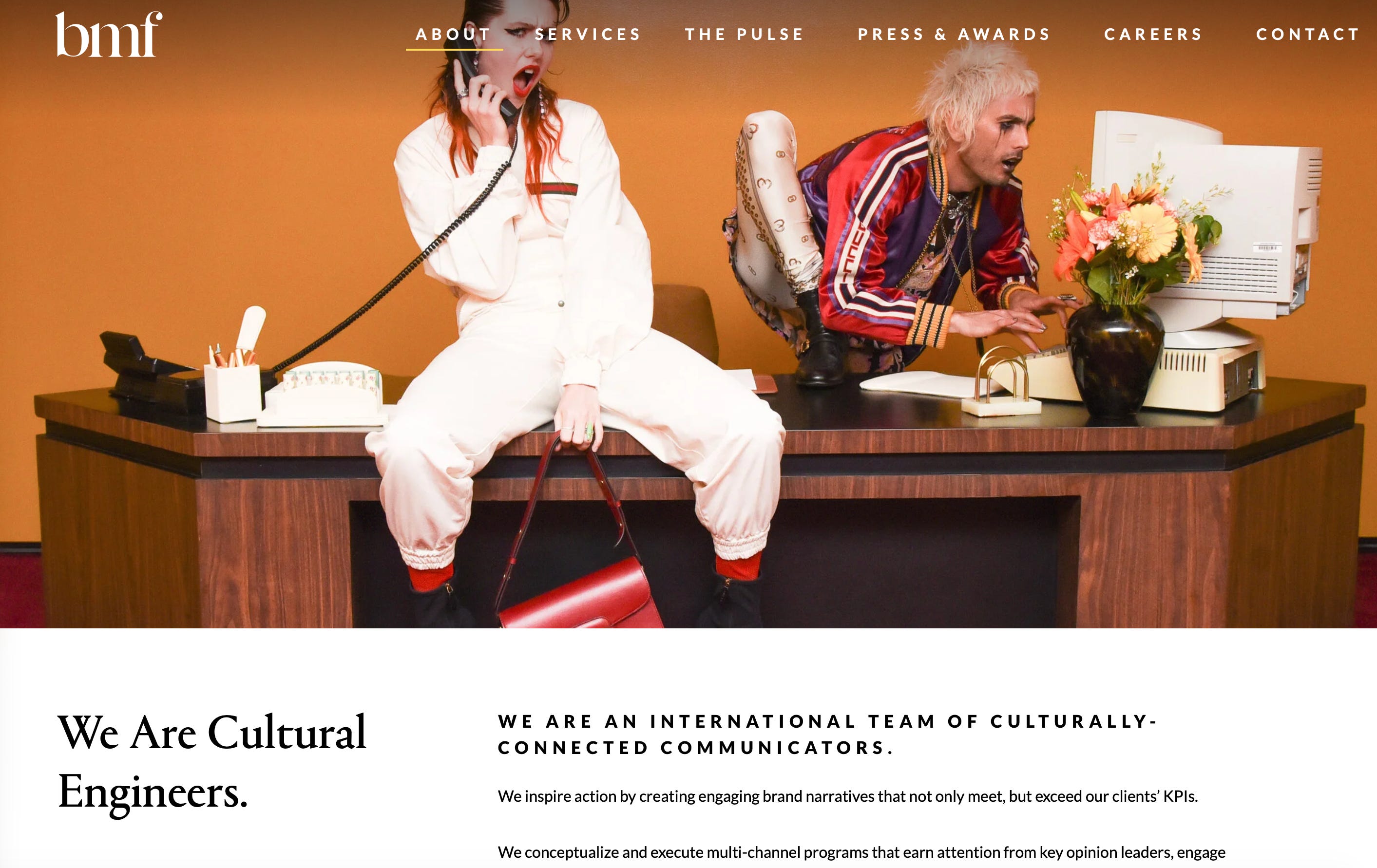
BMF is the experiential marketing agency Brian Feit founded in 2003 and still runs as a founding partner alongside Bruce Starr, his business partner since the beginning and the person he credits before he credits himself. What started as two people and two clients, Madonna’s Maverick Records and Kiehl’s, in a West Village apartment stacked with boxes is now a global integrated shop operating out of four offices, New York, Miami, Los Angeles, and London, with a full-time staff grown past a hundred and a freelance bench that swells it further for the big builds. Industry trackers put annual revenue in the low twenty-million range. The agency runs on the order of three hundred campaigns a year across roughly twenty countries, spanning travel and tourism, fashion and beauty, hospitality, financial services, luxury, streaming, wine and spirits, and consumer packaged goods. The client list reads like a directory of the brands trying to stay in the cultural conversation: Amazon, Netflix, Disney, Marriott, Estée Lauder, Mastercard, Google, Capital One, Japan Airlines, Lamborghini, Gucci, and the TikTok-owned editing app CapCut. Kiehl’s, the second client BMF ever signed, is still on the roster more than two decades later.
To understand how a kid from St. Louis ended up building conveyor belts for CEOs, you have to go back to the candy. Feit was twelve years old, an only child in a big house with a single working mother who did sales and marketing, and he was eating a box of Jelly Bellies when he noticed the toll-free number printed on the back. He called it. He told the person who answered that he was a business. By the end of the call he had made himself a reseller, and shortly after that he had made a one-sheet, and shortly after that he was selling the candy to family and friends. He was twelve, and he had already grasped the thing most people in his industry spend a career trying to learn, which is that the distance between wanting to sell something and selling it is often just the nerve to pick up the phone and announce that you already do. The conveyor belt on the Riviera is that same phone call, twenty-three years later, at a scale the twelve-year-old could not have pictured. Feit will tell you the hustle in between has never changed character, only size.
The origin runs, as the public record has always said, through a handwritten letter to Clive Davis. What the record does not carry is what that letter was tangled up with. Feit was a teenager who had watched Madonna’s Truth or Dare and decided, watching her manager Freddy DeMann work the film, that he wanted to be in the music business. He worked radio stations and record stores, became Mercury Records’ college street-team kid in Illinois, and wrote letters to every label CEO he could name, Tommy Mottola, Sylvia Rhone, Clive Davis. Davis wrote back, which Feit still marks as an act of grace, a man at the height of his career taking the time to answer a no-name kid. He used the letter to persuade his mother to double her tuition bill and let him transfer to NYU. And in the same season that he moved to New York and started interning for Davis, he took his mother to a downtown restaurant called Bar Eighty Nine, where the bathroom doors fogged opaque when you locked them and turned clear when you did not, and he came out to her there. She was, as he tells it, entirely unsurprised, in the way of all mothers. The letter and the coming-out are the same moment in his life. Both were a no-name kid deciding to stop tempering himself and announce who he actually was.
The partner who would become the other half of BMF started out working for him. Feit knew Bruce Starr from Illinois, and when Starr came to NYU years later, he interned for Feit, who by then was running around the city doing press and promotion and retail for a small electronic-music label his cousin had started. The company that carries both their initials was decided in Starr’s dorm room. Feit had already taken the LSAT, and his father thought law school was the smart, safe move, and it would have been. Instead the two of them sat in that dorm room weighing a side project they were doing under the BMF name, a job for Madonna’s Maverick Records, against the sensible path, and Starr, who Feit describes as confident and a rock in exactly the moments Feit was not, said they would be the nice guys and build the thing. So they did. The intern became the strategist, the reader of the culture’s pulse, the person Feit now credits before he credits himself, and the whole company is proof of the bet Feit still makes on the people the rest of the industry has not looked at closely yet. He made it first on Bruce.
The Music Lounge is where the announcement became a business model. Feit and Starr, working alone, looked at a music festival and saw what everyone else in the ecosystem was ignoring, which was the dead time. The artists on the Lollapalooza stage were only on the stage for an hour. The rest of the day they were idle, and idle talent surrounded by idle press and idle brands was, to Feit, the most valuable unclaimed real estate at the entire event. BMF pitched the Hard Rock Hotel on a lounge across the street from the festival, got the space, and watched the program explode to the point that Lollapalooza itself began wondering how so much activity had migrated across the road. The lounge ran for eleven years. It moved to Coachella, where Feit once installed a live camel because he understood, before Instagram existed and while Facebook was still the only game, that no one could resist a photo next to a camel on the way in. Lady Gaga played one of the lounges before she was Lady Gaga. Katy Perry did too. The insight was never really about music. It was about finding the gap and owning it before anyone else noticed there was a gap to own.
It is hard to remember now how strange all of this looked in 2003. When Feit and Starr started sending record labels’ artists out into the arms of brands, the two worlds held each other at a distance. Brands were not sponsoring music festivals the way they blanket them today, and creating commercial opportunities for an artist was faintly disreputable, the kind of thing that got Feit eye-rolled by people who thought a musician and a toothpaste had no business in the same sentence. The early BMF product was a CD packaged thematically to match the record, dried rose petals for a sensual album, mailed to a brand in the hope of starting a conversation, and Feit is quick to point out that the exact same gesture, the branded package sent to a tastemaker, is now a whole industry aimed at influencers. What was eccentric in 2003 is table stakes in 2026. The temperament of marketing inverted underneath him. The fusion of brand and culture that once made buyers wary is now the entire premise of the business, and the practitioners who were dismissed as hustlers turned out to be early. Feit did not predict the shift so much as bet his company on the version of marketing he wanted to exist, and then wait for the rest of the industry to arrive.
Ask Feit where the ideas come from and the honest answer is everywhere, which is less a slogan than a description of how he actually works. The Jelly Belly business came off the back of a candy box. The camel came from imagining what a person would stop to photograph. The Music Lounge sponsorship that ran for years came because he blasted a deck to his contact list and a woman named Ashley Barrett at Coty wrote back and asked what he would do with fifty thousand dollars instead of the thirty-five he was asking for. Early in his career, before BMF was even a name, he gathered thirty people in a bar, went around the room so everyone could say what they did, and called it the New Business Network, because he had already worked out that the room is the asset and the conversation is the raw material. He keeps the tickler file. He tells anyone who asks for advice to read the trade press cover to cover, because the next idea is usually sitting in plain sight in someone else’s paragraph. The through-line of a BMF activation is not a signature look or a house style. It is a posture. Stay open, take the meeting, keep the note, follow up, and treat every conversation as a place an idea might be hiding, because in his experience that is exactly where they hide.
The Music Lounge was the first proof of a thing Feit has since turned into a working theory of value. When the conversation turns to luxury, he states it plainly. Access is the new luxury. The point is not that experiences are nice. The point is structural. When people learned how cheaply luxury goods are actually made, the object lost some of its power to confer status, and status migrated to the thing that cannot be knocked off, which is the invitation. Being at the Dolce and Gabbana event this week is the ticket. Being in the F1 suite shaking hands with Lewis Hamilton is the ticket. Social media is the engine underneath all of it, because the invitation is only worth having if you can be seen having received it, and life is short enough that people would rather brag about where they were than what they bought. Feit is careful about the failure mode, though, and he names it fast. Access curdles the instant the experience is bad. If the Dolce event is overcrowded and the room is hot and the bar has a line and the napkins are dirty, the invitation was worthless, because the story the guest tells afterward is a story about a line. There can’t be lines at the bar. That is not a hospitality nicety. It is the entire economic logic of the model. The scarcity only holds if the thing behind the velvet rope is actually worth having crossed the rope for.
Part of the luxury of running BMF at this scale is that Feit now gets to choose. He and Starr keep a vision board of the brands they want, the ones they think are cool, and go after them, which is how CapCut ended up a client at Cannes, the editing app every creator is already using. But the vision board is not the fun part, and here Feit says something that cuts against how most agencies posture. The thrill is not adding cool to a brand that already has it. It is hard to make Prada cooler, and not very interesting to try. The thrill is the toothpaste. Feit lights up about Colgate, about making Tide cool at the Super Bowl, because the mass consumer brands are where a BMF idea can actually move the needle, and where the budget is big enough to do something real. Anyone can throw a party for a fashion house. Making America’s toothpaste feel like it belongs in the cultural conversation is the harder, better trick, and it is the one Feit would rather be doing.
Pulling it off requires finding the one person inside the client who can see it. The executives do not start out convinced, and Feit is precise about the pattern. It almost always takes a visionary somewhere inside the company to push everyone else forward and bring in an agency like BMF to make it happen, and once that internal champion has cover, the rest of the executives get genuinely into it. Feit’s real skill, the one underneath the activations, is finding that person and handing them a win, helping them look good to the bosses who signed off, sometimes helping them win awards. He becomes, in the client’s own hierarchy, a kind of rabbi, the outside counsel the visionary trusts to make a risky idea land. The relationships compound from there, because an executive he made look brilliant once will bring him along to the next brand, and the next.
The failures, when they came, were almost always about venues, and Feit is unbothered telling you so. A fragrance launch collapsed because the venue, which BMF had found listed in BizBash of all places, turned out to be at war with its own landlord, and the team had to improvise a plan B on the spot to save face. A Hamptons event for a major client lost its permit at the last minute, after someone was injured outside the venue weeks earlier and the town decided it no longer wanted the risk. He says he never wants to work in the Hamptons again. The lesson he takes from the fires is not a grand one, which is part of why it is credible: be buttoned up about venues and permits, because that is where the disasters live, and the difference between a professional and an amateur is almost never the idea, it is whether the idea survives contact with a municipality.
What has not changed since the apartment is the arithmetic of the beast. Feit is candid that even now, with retainers and blue-chip relationships, BMF is an agency that always has to feed itself, and that the anxiety he felt in the apartment, knowing he had this month and next month covered but not the third, has never fully left. It has only gotten bigger, more mouths, more money that has to come in. He manages it the way he has always managed everything, through the tickler file he inherited from his mother’s sales desk and turned into a database of a couple thousand people, and through a refusal to let the size of the operation talk him out of the hunger that built it. Feeding the beast is not a complaint when he says it. It is the closest thing he has to a creed.
The same hunger makes him decent to everyone, and that decency contains a prediction, the one Feit seems most certain about. The person manning the pop-up booth, the freelancer running the sampling table, the gig worker no client bothers to learn the name of, that is the future marketing director, and probably the future superstar. He believes it because he lived the reverse of it, the kid nobody took seriously in an apartment full of boxes while the established players rolled their eyes and guessed wrong. The booth worker is standing where the culture is actually happening, closest to the consumer, ear pressed to a pulse the executives upstairs can only read about in a deck three months later. He has already watched the first wave arrive: the social-media kids who cracked viral content are opening companies and pulling ad dollars out of the television networks, and at Cannes this year the creator economy had become the whole conversation. He calls it a Game of Thrones and says the only move is to get on the right list and enjoy that the power is going into the people’s hands. The booth workers are next.
He would enjoy that, of course, because the kids are running his own play. The nineteen-year-old opening a company off a viral video is doing the exact thing the twelve-year-old did when he called the Jelly Belly hotline and announced he was a business, which is refusing to wait for permission to be taken seriously. The letter to Clive Davis was the same move. The Music Lounge across the street from Lollapalooza was the same move. The difference is only that the tools got faster and the audience got bigger, so the distance between a good idea and a company you can point to has collapsed from years to an afternoon.
What has not collapsed is the part nobody posts, and it is the same part Feit has been quietly betting on the whole time: the openness, the conversations, the attention paid to the people the industry overlooks. The creators who look like overnight superstars are, most of them, running the same unglamorous engine Feit has run since the apartment, the follow-up call, the tickler file, the decency to the person who cannot do anything for you yet, the quiet terror of not knowing where the third month’s money comes from. It looks easy from the outside because the hustle is the one thing that never makes it into the edit. Feit is proof of the trade the whole industry keeps trying to skip. He has been at it for twenty-three years and still runs on the hunger from the apartment, still takes the meeting, still keeps the note. The superstars of this moment make it look effortless. The ones who last will be the ones who figure out, the way he did at twelve with a candy hotline and a one-sheet, that it was never effortless at all. It was just hustle, and hustle, done long enough and generously enough, is the thing that finally pays.

Ten deposits from the founding partner of BMF on hustle, access, the cool factor, and the thing that has never once left his blood.
On the new scarcity. “Access is the new luxury. Being invited to the Dolce and Gabbana event, being invited to the F1 suite and meeting Lewis Hamilton, that’s the ticket. Luxury goods got knocked when people revealed how cheaply they’re actually made. People know life is short, they value experiences, and social media helps them brag about it.”
On the hustle. “The hustle doesn’t end, though. It’s in my blood. Back in the day I think people wouldn’t give me the time of day and would roll their eyes a little bit. But the hustle didn’t stop. You gotta keep going and not take no.”
On how far the business has come. “Brands were not sponsoring music festivals at that time the way they are now. We were creating brand opportunities for the artists before that was even okay or cool. Those packages we sent with CDs, going to influencers is a thing now”
On the business he is really in. “It really is a people business. If you don’t like people, then don’t go in this business. I received help from people, so I always give. Be someone that people wanna work with.”
On the partner who started as his intern. “Bruce came to NYU and was my intern. We were in his dorm room, doing a side project for BMF, and I’m like, do we do this BMF thing, or do I go to law school? He’s been a rock for me. He was like, we’ll be the nice guys, and we formed BMF. Everything BMF is the two of us”
On the discipline of the follow-up. “I call it my tickler file, because my mom did sales back in the day. She’d have a file for every day and put a note in the file date she wanted to follow up with somebody. Mine is really my database, and there’s a couple thousand people in there now.”
On the people the room ignores. “The gig workers out on the street are gonna become the marketing directors of tomorrow, because they’re in touch with what’s going on. The money is going into the creator hands that produce content. It’s a Game of Thrones. Get on the right list.”
On the consumer journey. “If you’re doing an event, there can’t be lines at the bar. Can’t be dirty napkins everywhere. Too much effort and a bad consumer journey is a deal breaker. That’s always how we design events.”
On making the unglamorous glamorous. “It’s hard to bring more cool to Prada. It’s more fun to work with brands like Tide at the Super Bowl. They might have more budget, and we can move the needle bringing our cool factor.”
On selling the vision inside. “It usually takes a visionary inside to push everyone forward and bring on someone like us to help make it happen. But then the execs get really into it. I just hope we make them look good, since they brought us on.”


Edible Profile of Brian Feit


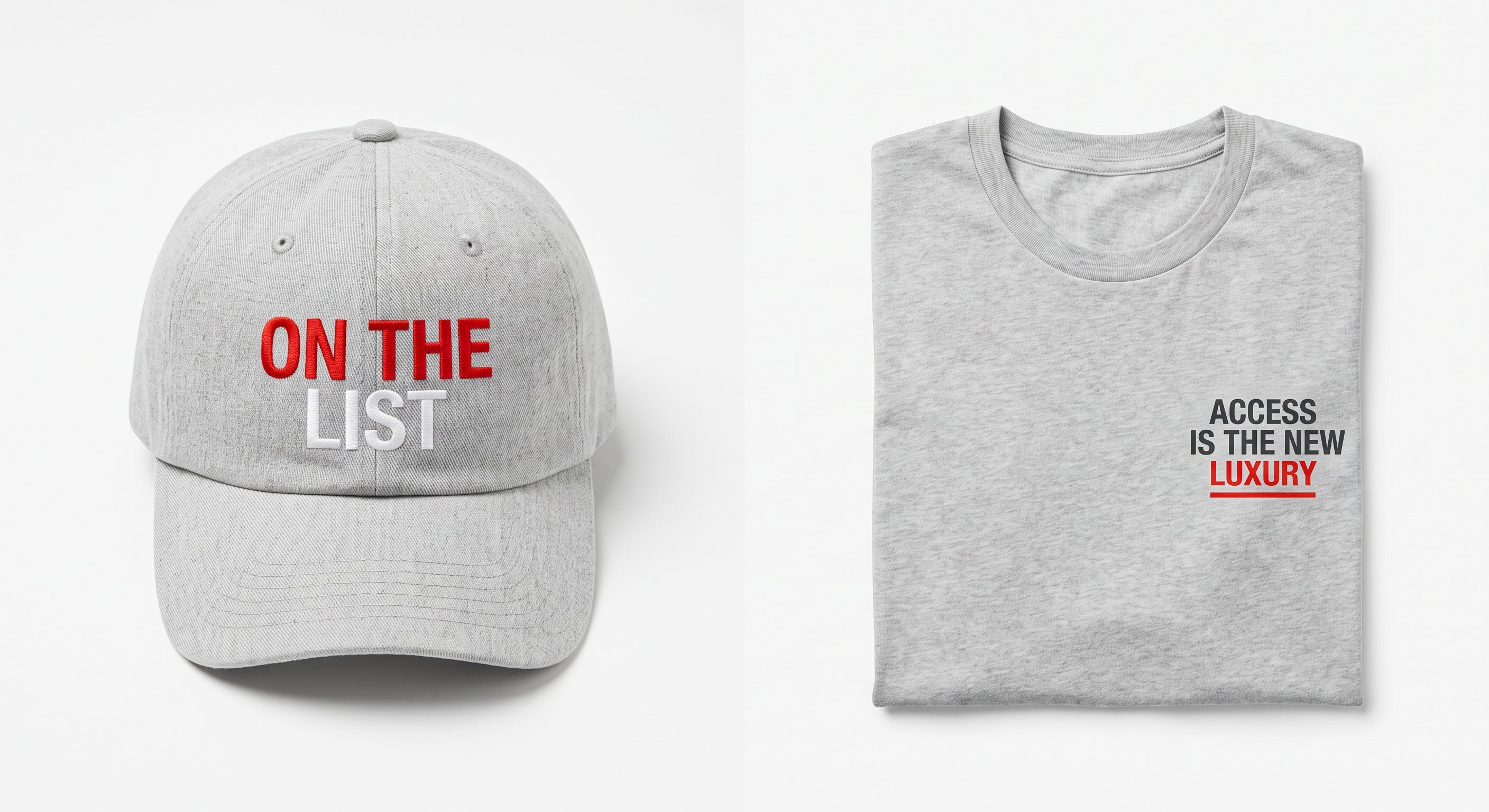
The Merch: Wearing the Argument
Every Wisdom Bank profile throws off an artifact you can wear, and the rule is simple: the object has to carry the thesis, not just the name. For Feit that bar sits especially high, because the shareable object is the thing he actually sells. Two pieces, built Vignelli-clean, three colors, no ornament.
The hat. An unstructured cap with ON THE LIST across the front, red over white. The velvet-rope thesis in three words, and the wearer is announcing, with a wink, that they made the list.
The tee. A crew with ACCESS IS THE NEW LUXURY set small on the left chest, the last word in red under a short rule. The manifesto worn as a manifesto. With the cap it is a two-part set: the argument on the shirt, the punchline on the hat.