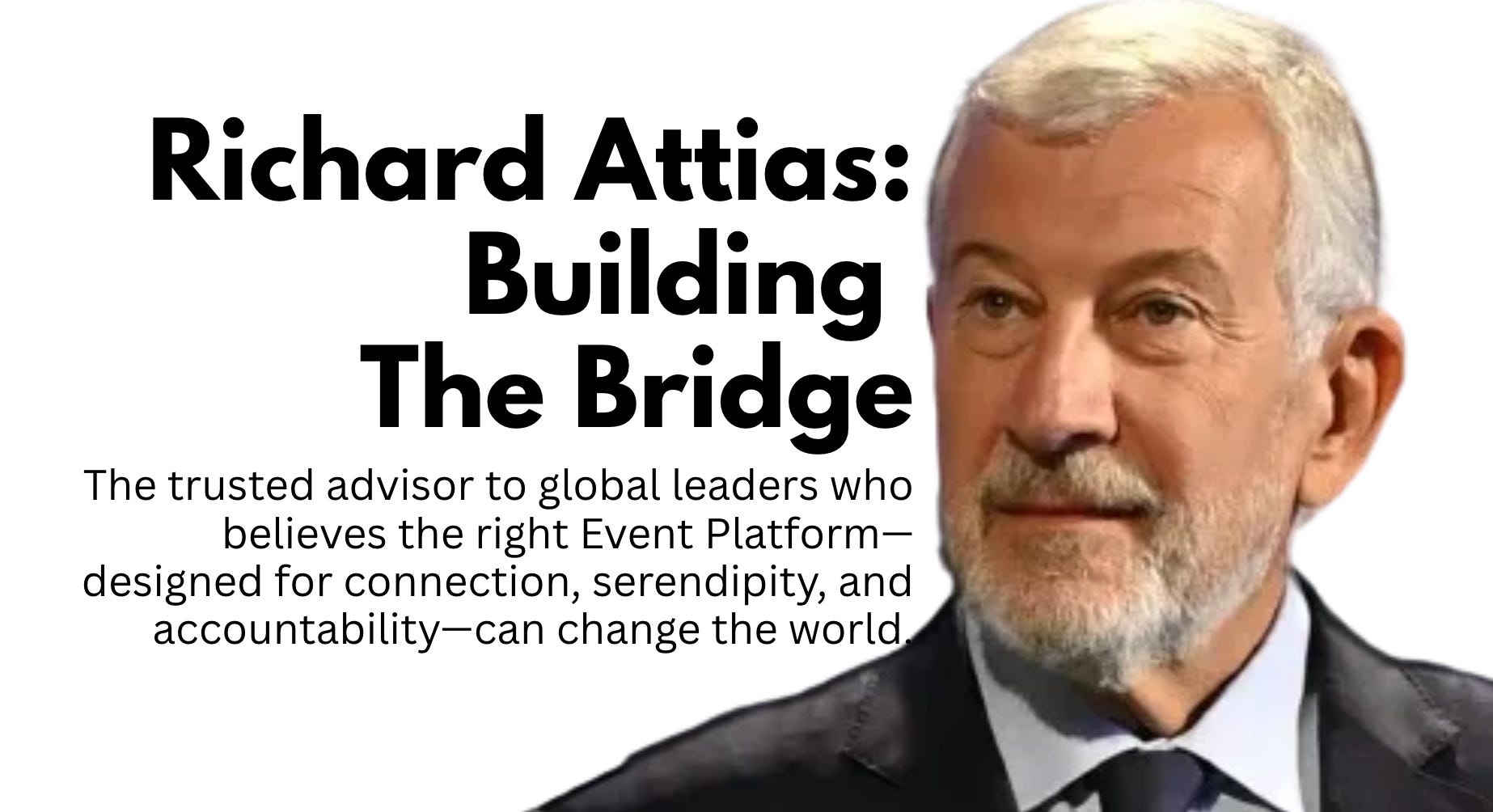
Richard Attias Builds Bridges
Richard Attias’s Bridge Summit is not a more democratic Davos. It is a bet that power, media, capital, and culture are ready to gather on different terms.
The ambition behind the Bridge Summit was unapologetically large, even if its tone was deliberately restrained. Conceived not as a spectacle but as a platform, Bridge set out to address what Richard Attias believes is the central failure of the contemporary public sphere: not a lack of ideas, but a collapse of connection. The premise was demanding in its simplicity. Create a space where media, culture, business, technology, and public figures could meet without performance, where dialogue could slow rather than accelerate, and where trust might begin to be rebuilt across divisions that no longer speak to one another naturally. Bridge was designed not as a conclusion, but as a starting point, a place where conversations would be asked to carry responsibility beyond the room.
Listen to the song
That vision made its first test in Abu Dhabi, where Attias brought the platform to life with partners, fully aware that the concept itself would have to earn its audience. Bridge was never meant to rely on prestige or habit. It was intentionally opened to a broader, younger, and less predictable public than the closed circuits of global summits, and its success would depend not on who felt obliged to attend, but on who chose to.
The risk became unavoidable thirty minutes before the opening, when the room was still empty. Vast, silent, and suddenly unforgiving, the space reflected the fear every convener knows: not that something will go wrong, but that nothing will happen at all. For Attias, the moment carried particular weight. This was not an event produced at arm’s length for an institution. It was a platform he had built with partners, one whose vision, credibility, and future he now shared responsibility for. If the idea failed to travel, there would be no buffer to absorb the consequence.
Then the space filled. Movement replaced stillness. Density replaced doubt. What followed did not resemble the familiar choreography of elite gatherings. The audience was attentive, responsive, and visibly impatient with noise. Questions arrived in real time, reactions surfaced instantly, and engagement extended well beyond the physical room. What Attias felt was not relief alone, but recognition. People were exhausted by spectacle and hungry for meaning.
Only later did he come to describe the inaugural Bridge as a moment of discovery rather than proof, closer to understanding the temperament of a child than measuring success. First gatherings, he believes, reveal personality before habit sets in. You learn what the platform responds to, what unsettles it, what draws it into focus, and what it resists becoming. The first Bridge delivered signals, not answers, and Attias listened carefully, aware of how easily early instincts can be overwritten by scale.
That sensitivity did not emerge suddenly. Attias grew up in Morocco, born into a Jewish family in a Muslim country where coexistence was not an abstraction but a lived condition. Difference was ambient and formative. From an early age, he became curious not about sides, but about passage, about what lay between people and how misunderstanding could be softened before it hardened.
Central to that education was his father, who served as an advisor to the King and the royal family of Morocco. Attias recalls not ceremony, but conduct. He watched his father navigate situations where words carried consequence and listening was essential rather than performative. Dignity, restraint, and consistency mattered more than persuasion. Power, he learned, did not need to announce itself loudly. Authority depended on trust built patiently over time.
Those lessons followed him into his professional life. Trained as a civil engineer, Attias learned to think in systems, to anticipate stress, and to respect constraints. Shortcuts eventually fail. A structure that cannot carry weight is not a success. A bridge, in particular, must rest on solid foundations on both sides, be tested before it is trusted, and be built for durability rather than appearance.
Over time, these principles migrated into how he approached gatherings. He learned to read rooms the way a doctor reads a pulse, paying attention to what others miss. How speakers arrive. Whether teams are calm or defensive. Whether transitions feel forced. Whether silence signals focus or tension. Transportation that fails, arrivals that feel chaotic, pacing that exhausts rather than holds people—these are not inconveniences to him. They are early indicators that meaning will not survive the day. Audiences may not articulate these failures, but they register them instantly, and once that energy turns, it is nearly impossible to recover.
For years, Attias applied this discipline to platforms designed for others. Bridge marks the moment that philosophy became explicit. From the beginning, he resisted the idea of building a festival. Festivals arrive, consume attention, and disappear. Bridge was conceived as a city. A city has values, rhythms, recurring faces, and shared memory. Life does not happen only during ceremonies. It happens in between.
That distinction reshaped everything. Programming changed. Partnerships changed. Governance changed. Participants were no longer treated as guests, but as members of a community with responsibility. Attias describes his role less as owner or host than as steward, closer to a mayor than a master of ceremonies, responsible for the health and coherence of the environment he helps convene.
The agenda itself makes this clear. Read as a whole, it functions less as a schedule than as a statement of belief. Again and again, conversations return to intent, trust, and consequence. Media is framed not as a distribution problem, but a credibility problem. Creators are placed alongside editors, investors, and policymakers as central actors, reflecting the reality that influence now moves through people as much as institutions.
Technology appears not as evangelism but as governance. Artificial intelligence, platforms, and code are framed around oversight and responsibility. Capital is treated with candor. Ownership and investment are acknowledged as forces that shape editorial reality rather than distortions to be politely ignored. There are no siloed regional panels. Voices from the Gulf, Africa, Asia, Europe, and North America are distributed across the program, reflecting power as transnational and networked rather than neatly bordered.
The seriousness of Bridge is visible not only onstage, but in who commits to it. The agenda includes figures such as Idris Elba and Alexis Ohanian, alongside senior media leaders including Emily Maitlis, Nancy Gibbs, Joanna Coles, Jeff Zucker, and Jim Bankoff, with participants tied to organizations such as Bloomberg Media, Vox Media, Semafor, Grupo Prisa, China Media Group, MBC, Meta, and Palantir. The exhibitor and partner base reflects similar breadth, including Google, Dubai Media City, Abu Dhabi University, and the Ministry of Information of Bahrain, alongside creator-economy, gaming, and AI companies from China, the Gulf, Africa, India, and Europe.
See the agenda, exhibitors, and partners
There is also the business reality. Bridge is not insulated from market forces. Revenue matters. Growth matters. Sustainability matters. Building a platform of this scale, with partners, staff, year-round infrastructure, and institutional backing, carries real financial exposure. A poorly executed edition does not merely bruise reputation. It risks partnerships, future investment, and the confidence of those who have tied their credibility to the project. Durability, not spectacle, is what makes a platform viable.
The next edition of Bridge is scheduled for early November 2026, again in Abu Dhabi. Attias is careful in describing what will evolve. Not scale, but depth. Not more content, but stronger connective tissue. More geographic inclusion, particularly across Africa and Asia, without sacrificing coherence. The ambition is to strengthen what exists between gatherings, so the annual moment becomes a convergence rather than a conclusion.
It is no longer avoidable to measure Bridge against the gatherings that have traditionally defined the global calendar. For decades, forums like Davos have functioned as default meeting grounds for institutional power. Bridge does not attempt to replicate that model. It tests whether a new center of gravity can emerge, one less dependent on institutional permanence and more responsive to how power now actually moves, through media, technology, culture, capital, and narrative operating in the same contested space.
It is still early. Attias does not claim inevitability. But the conditions that give rise to consequential institutions are already present: seriousness of intent, unusual adjacency, real economic exposure, and a refusal to confuse visibility with authority.
Bridge is not a more democratic Davos. It is a post-Davos experiment, a test of whether power is ready to meet without choreography and remain accountable once the room empties.