
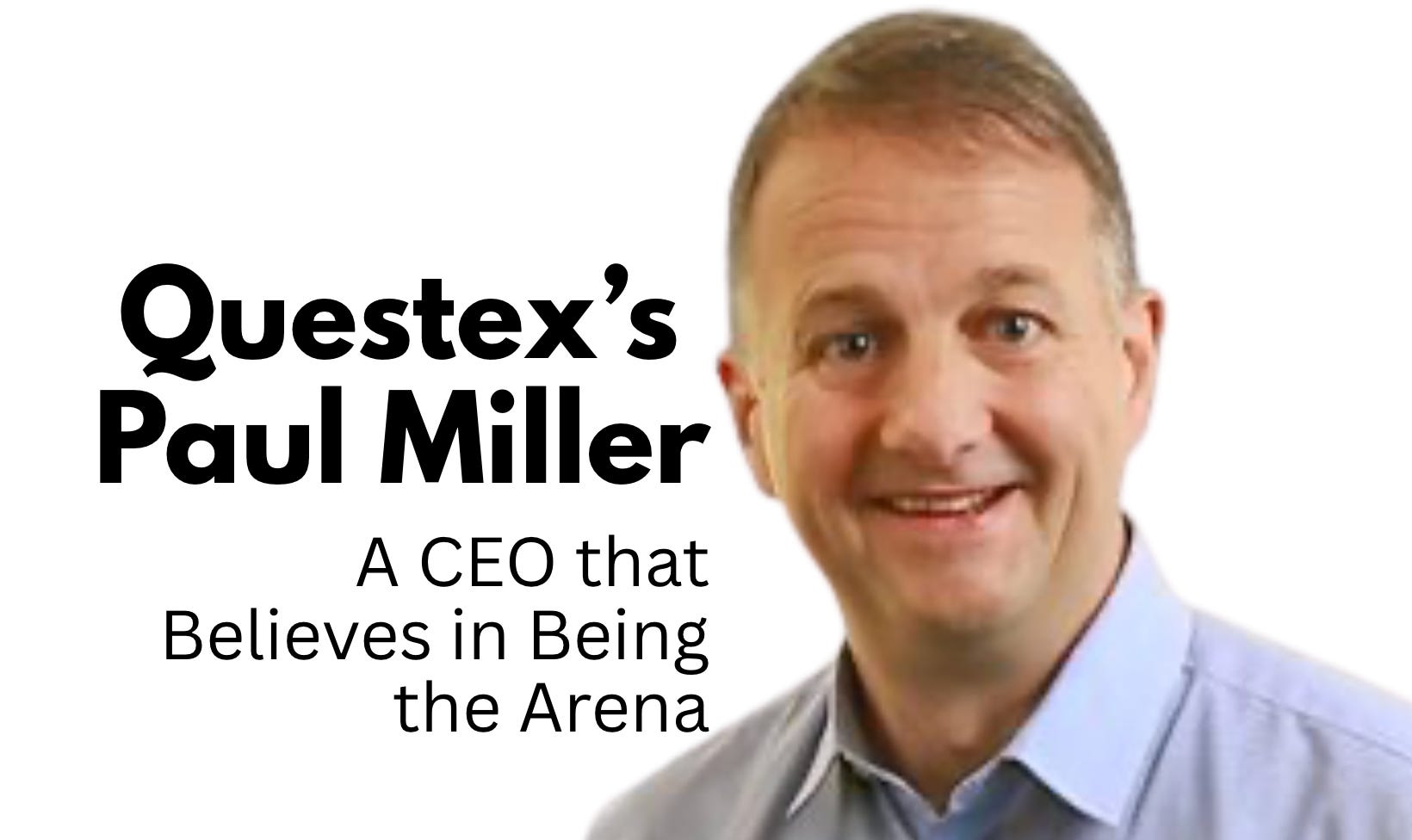
Paul Miller and The Business of Information Flow
After Reed, UBM, Penton, Informa and now Questex, Paul Miller has spent a career moving markets—and now questions whether evenA marketplace builder who now wonders if the industry is still listening.
Authority in the events industry rarely announces itself. It accumulates over time, in the decisions that don’t make headlines and the rooms where people speak more freely because they assume no one outside is paying attention. Paul Miller occupies that kind of authority. As CEO of Questex, he runs a portfolio that stretches across hospitality, wellness, beauty, and life sciences, sectors that increasingly define what is now described as the experience economy, but his influence extends beyond the boundaries of his own company. Leadership in this business circulates in a relatively small orbit, passing informally between the executives who run the world’s largest exhibition platforms, and he has been part of that rotation long enough to understand both its strengths and its blind spots. More unusually, he is the only executive to have served two consecutive terms as chairman of Society of Independent Show Organizers (SISO), a distinction that reflects not just tenure but trust, the willingness of independent operators to place the same person in the role twice.
It was during that second term, within the CEO program he helped shape, that a moment occurred which has stayed with him in a way that feels disproportionate to its scale. The session itself was straightforward: three corporate buyers—IBM, Danaher, Siemens—speaking directly about how they evaluate events, how they allocate budgets, and how those expectations are shifting. It was moderated by Nicola Kastner, the CEO Event Leaders Exchange (ELX) and the former VP of Global Event Marketing Strategy at SAP. ELX is a newly formed organization representing some of the most influential corporate event leaders in the world, a group that is beginning to exert its own gravitational pull on where event dollars go. The conversation was clear, practical, and unusually candid, the demand side of the market explaining itself without translation. Miller would later call it “30 minutes of pure gold.” What stayed with him, however, was not just what was said, but what happened around it. The room was half empty. Competitors had stepped out, drifting toward more familiar conversations, the rituals of networking that feel productive even when they are not. The signals were there, unfiltered, and much of the system chose not to listen.
That moment lingers because it reveals something deeper than a missed session. It exposes a tension at the heart of the industry: the difference between presenting information and understanding how it actually moves. For much of its history, the business he grew up in—Reed, CMP, the early years of UBM—was built on a model of controlled amplification. Editors decided what mattered. Publishers controlled distribution. Audiences received. Information moved in a straight line, from source to audience, measured by reach and frequency.
It was a megaphone.
Events never worked that way. They did not broadcast. They convened. Information moved laterally, not linearly, passing between people, shaped by conversation, tested through reaction, altered by context. Its value was not in how clearly it was delivered, but in how it held up when it circulated. What emerged, almost unintentionally, was a different kind of system, one in which information gained meaning not from authority but from interaction.
What changed was not just the mechanics of distribution, but the posture of the people inside the system. The media world he had been trained in carried, at times, a quiet arrogance, a belief that authority flowed from expertise and position, that the audience would receive what was presented without challenge. Events disrupted that dynamic in ways that were not immediately obvious. They forced proximity. They removed the distance that allowed ideas to be delivered without resistance.
Editors who had been comfortable behind the page or the screen found themselves in front of audiences that could respond in real time. Some adapted. Others did not. Video made that divide even more visible, exposing who could engage and who could not. The effect was not a wholesale democratization, but something more precise. Authority became contingent. It had to hold up in the room.
He did not set out to change how information moves. He was trying to run businesses inside a system that was beginning to fail. The transition from print to digital, from controlled distribution to fragmented attention, was not experienced as a theory but as a series of operational problems that refused to resolve cleanly. And yet, in navigating those problems—seeing where the model held, where it broke, and where something new was beginning to take shape—he became, almost by necessity, one of the stewards of that shift. Not because he designed it, but because he learned, earlier than most, how to read it.
The instinct to read systems, to notice when something is slightly off, does not come from the environments he now operates in. It comes from a place that, on the surface, has very little to do with global exhibitions. He grew up in Lincolnshire, a farming region in England that he describes, with characteristic understatement, as “the Iowa of England.” His family were farm laborers, not landowners, people whose relationship to the land was defined by necessity. His parents did not have running water in their home in the early 1960s. What remains with him is not the hardship itself but the structure of it, the understanding that work is not optional and that systems depend on every part functioning. He remembers picking strawberries and potatoes, the pace of it, the physical demand, the absence of illusion. He remembers what happened when someone dropped a crate of fruit, how quickly the others moved to pick it up, not because they were told to, but because they understood the consequence of not doing so.
That early exposure to interdependence was reinforced in other ways. During his college years, he worked in a pet food factory alongside miners displaced during the Thatcher era, men who brought with them a sense of camaraderie forged under pressure. The work was difficult, often unpleasant, but it carried the same lesson: systems hold because people hold them, and people hold them because they understand what is at stake. He was the first in his family to go to university, navigating a transition into environments shaped by different expectations and signals, surrounded by peers from more affluent backgrounds and carrying a version of imposter syndrome that did not disappear but became something he learned to manage. What shifted that dynamic was not academic success but something less expected: his time as the singer in a punk rock band, booking venues above pubs, negotiating with skeptical landlords, assembling audiences without infrastructure. The ethos of that world—that no one is inherently better than you—provided a counterweight to the hierarchies he was encountering elsewhere.
His entry into the professional world was unplanned. He wanted to work in radio or sports broadcasting and instead found himself in recruitment sales at Reed Business Information, dialing for dollars, learning through repetition how to engage with customers. Reed functioned as a training ground, instilling a discipline around listening, trust, and the relationship between information and action. It was there that an early moment shaped both his trajectory and his philosophy of leadership. Late one evening, he was still in the office, working through a struggling product that had been handed to him, when the CEO happened to walk past, stopped, and asked what he was doing. The exchange was brief, but it led to a conversation the following day that placed him on the radar of senior leadership. He has returned to that moment often, not because it flatters him, but because it revealed something about how talent is recognized in practice. It is not always the person who is most visible or most vocal, but the one who is still in the room, paying attention, trying to understand a problem without being asked.
That belief has stayed with him. He looks for people the same way—through observation rather than self-promotion, by watching how they behave when they think no one is watching, by noticing who leans into the work and who waits to be directed. It is a quiet form of talent recognition, one that resists the more performative aspects of corporate life, and it shapes how he builds teams.
There is a period he returns to more than once, not because it was the most successful stretch of his career, but because it forced him to confront how quickly a model can unravel while the people inside it are still debating what it means. In the early digital era, working in semiconductor and engineering media, he was operating inside one of the most advanced technology environments in the world. They were not late to change. They were writing about artificial intelligence seriously in 2006, mapping its implications before it became mainstream.
And still, they got caught.
Not because they ignored technology, but because they misinterpreted it. Inside the organization, the conversation became inward, focused on platforms, formats, and transition strategies. Leaders either deferred to specialists or embraced new tools without sufficient skepticism. What slipped was the external signal—what customers were actually doing. “We were talking about ourselves,” he says, and the phrasing carries the weight of experience.
That lesson has not faded, and it shapes how he sees the present moment. Artificial intelligence is being adopted rapidly, discussed constantly, and understood unevenly. The risk is not simply resistance but misalignment, building systems that appear advanced but are not anchored in real customer need. For him, the requirement is not technical fluency but judgment, the ability to interpret innovation rather than outsource decisions to it.
His first encounter with events came through acquisition, when CMP became part of UBM and he found himself responsible for a portfolio that included live shows. Coming from a media background, he and his colleagues initially dismissed events as secondary. That perception shifted as the economics of media changed and events revealed something content could not: the physical manifestation of a community. From that came an insight that would shape his later work, that content and events are interconnected parts of a system, one attracting attention, the other concentrating it.
At Questex, the challenge was fragmentation, a collection of businesses operating without a shared center. His response was to simplify and align, organizing the company around sectors and a unifying principle of experience, understood as intention rather than spectacle. Every interaction became part of the product, from the moment a customer entered the space to the moment they left it, not as an afterthought but as a designed element of the system.
What defines him in practice is not how he describes the business but how he engages with it. He moves through events as an observer and participant, treating them as environments where signals can be read in real time. “A dense focus group,” he calls it, though what he is doing is closer to immersion. He sits with operations teams, listens to sales conversations, watches how leaders show up, whether they are present or removed, believing that leadership in this context requires something more than oversight. It requires hosting. It requires noticing who is standing alone and bringing them into the room, understanding that an event is only as strong as the connections it enables.
If given the freedom to invest, he would not build a single dominant event but strengthen the infrastructure around them, particularly the fragmented technologies that define the current landscape. He sees opportunity in connecting the lifecycle of participation, creating continuity where there is currently disconnection, stitching together the experience from first interaction through follow-up.
The pressures on the model are increasing. The convergence of B2B and consumer experiences is reshaping expectations without eliminating the need for clear transactional value. Corporate-owned events are redirecting attention and resources toward platforms that operate with a different kind of alignment and control, environments that function as expressions of identity as much as marketplaces.
The risk is not that events disappear. The demand for gathering, for presence, for shared experience is not going away. What is less certain is who retains the authority to convene. That authority has moved before. It moved from media to marketplaces when broadcast lost its grip on attention. It can move again.
What determines that shift is not scale or production quality, but proximity to the signal. The organizations that stay closest to their customers, that listen with enough discipline to understand not just what is being said but what is changing, are the ones that retain the right to convene. Those that drift inward, that optimize their systems without recalibrating against the outside world, risk something quieter but more consequential than decline.
They risk becoming irrelevant to the decision.
In that sense, corporate-owned events are not so much a threat as an indicator. They are what happens when organizations decide to control their own information flow, to build environments that align directly with their customers without mediation. They are not replacing the industry. They are revealing what it looks like when the center of gravity shifts.
And then, at the end, he offers a simpler explanation. His daughters, both in their twenties, question the premise of his work with a directness that cuts through the language of the industry. Why go to an event, they ask, when the same information can be accessed remotely? Why travel, why gather, why invest the time?
He answers with a question.
Why go to a Taylor Swift concert instead of watching it on television?
Because you want to be there.
Because something happens in that room that does not translate through a screen.
For all the systems he has built and the structures he has navigated, that remains the clearest articulation of what he is working toward. The challenge is not to explain it.
It is to deserve it.
The Infographic of Paul Miller’s Vision for the Experience Economy
1. Media Creates Authority. Events Test It.
What gets published isn’t what matters. What holds up in the room does.
2. The System Breaks When It Talks to Itself
You lose relevance the moment you stop listening to customers and start listening only to yourself.
3. Don’t Outsource Judgment to Technology
New tools don’t fix bad decisions. Leaders fail when they stop interpreting and start delegating thinking.
4. Stay Close to What Customers Actually Do
Behavior tells the truth. Everything else is commentary.
5. Walk the Floor
The real data isn’t in reports—it’s in how people act when no one is performing.
6. You Don’t Lose It All at Once
You lose it slowly by missing small shifts until they become big ones.
7. The Right to Convene Can Shift
If you stop listening, someone closer to the customer will take your place.
The Bonus:
Check
out More Personalization: Paul Millers Edible Profile from SmallbiteActhitecture.com
https://suno.com/s/ESx3EXskRboJ2oGY


