
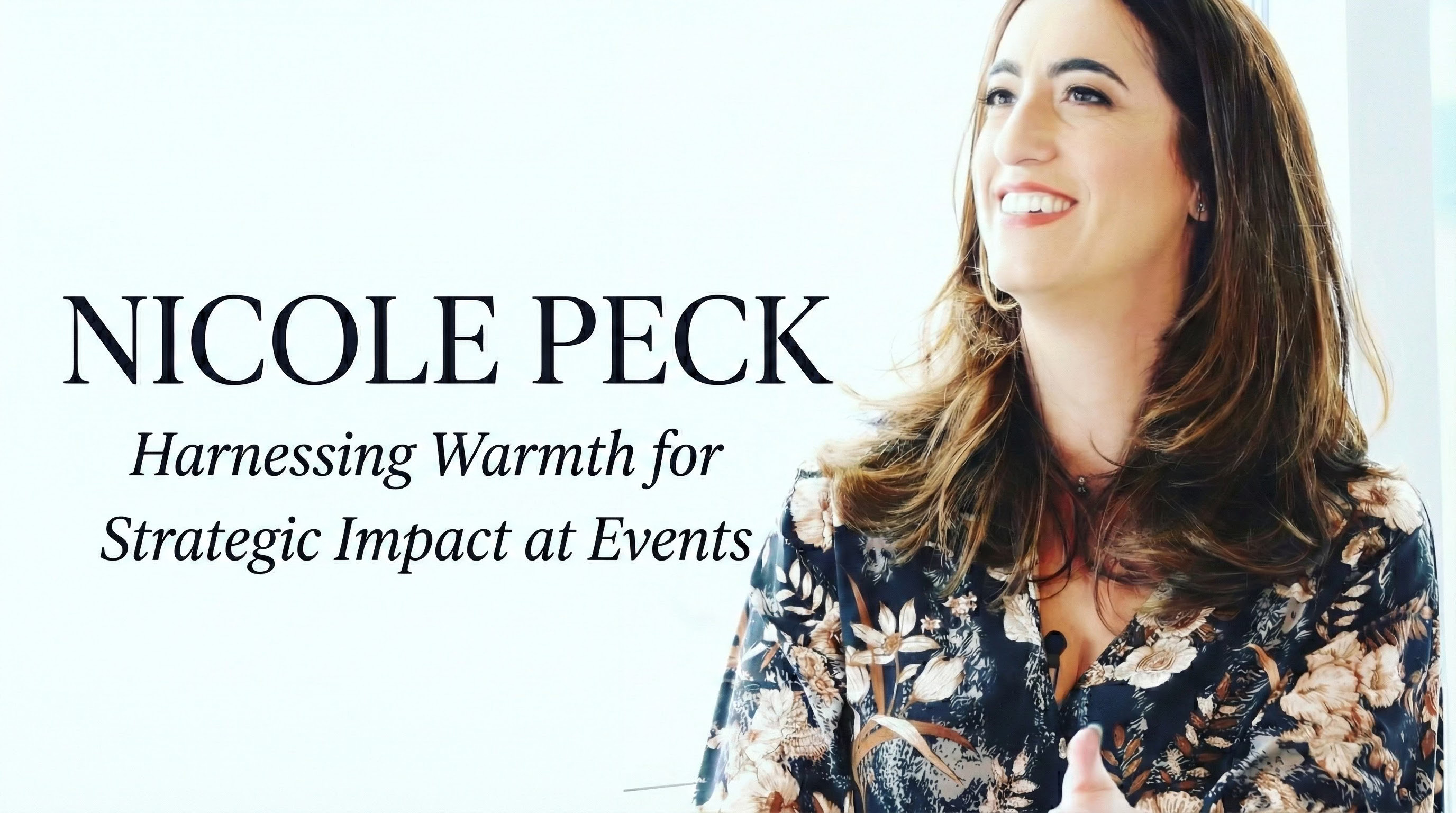
Editor’s Note: Nicole Peck is not a stranger to this newsroom. Before her rise at Clarion Events and her stewardship of ITC Vegas and MAU Vegas, she spent formative years with me at BizBash as our Executive Vice President—an essential partner in reimagining our shows, reshaping our brand, and guiding the company through its sale to Tarsus just two months before the pandemic arrived. I first met her while redesigning the SISO Executive Conference, where I asked the top exhibition chiefs in North America to volunteer their highest-potential employees for a collaborative experiment. Nicole didn’t merely show up. She changed the room. That early glimpse of her quiet, exacting sensibility has only magnified ever since.
It’s always before the doors open. Nicole Peck walks a venue like a set designer assessing a scene: sightlines, posture shifts, nervous corners, fluorescent buzz. She’s not scanning checklists—she’s scanning for friction. And she knows the moment she feels it.
What Peck looks for isn’t something the data will catch right away. The badge scans come later. The dashboards will populate in the postmortem. But before any of that, there’s the moment someone walks in the door and either feels welcome—or doesn’t. It’s her belief that if you don’t get that first emotional beat right, everything else is damage control.
Peck’s events are industry juggernauts and are carefully staged for a feeling: not excitement, not inspiration—warmth. But not warmth as personality, warmth as design output. “I am often not perceived as a warm and fuzzy person until you get to know me” she admits. “But I know how to create it .”
That ability—quiet, methodical, learned from floor-walking more than frameworks—is what sets her apart. She reads the room not just during the event, but before it starts, before the signage is hung, while the room is still a question.
Nicole Peck’s instincts aren’t PowerPoint-deep. They’re human. And they trace back to a pair of stories she only recently rediscovered.
The first: freshman year of high school. Prom was four years away, but the class was already fundraising. Nicole wrote to Ben’s Kosher Deli and secured a pickle sponsorship for homecoming. No money down, just vats of pickles and handwritten signage. She sold them for a dollar apiece. They were cheap, fun, and they made people smile. “Put a pickle in someone’s hand,” she jokes, “and you’ve already won the engagement metric.”
The second: summer camp. Recognizing her innate leadership skills she was appointed a color war general at 20 years old. She won not because she had the best athletes, but because she drafted the staff better. She knew who could paint. Who could sing. Who could lead. Because she’d spent the summer noticing. Asking. Logging who people really were beneath the roles they’d been assigned.
That’s her edge. It’s not instinct. It’s observation, catalogued.
At Clarion, she turns that same skill into trade show strategy—but not by rebranding or adding polish for its own sake. She builds annual themes that act as emotional frameworks, inviting attendees into a shared narrative. These are not slogans. They are structured metaphors, designed to drive cohesion and create a sense of journey across the show.
ITC Vegas, the flagship event she now oversees, is no ordinary trade show. Originally founded by Jay Weintraub and known for its sponsor-first, high-growth startup energy, ITC was built on a distinctly entrepreneurial DNA—speed, scale, and shock-and-awe experiences. Since its acquisition by Clarion, Nicole has preserved its spark while layering in editorial intelligence and emotional architecture.
One year, she themed the show around space: “A Universe of Possibilities.” She mapped zones into planetary metaphors, brought in astronaut Scott Kelly for the fireside chat with her, and translated abstract business risk into the language of cosmic exploration. The following year, she pivoted to “A Wonderland of Possibilities,” aligning AI disruption with the psychological destabilization of Alice’s journey down the rabbit hole.
These themes aren’t just creative. They’re functional. They anchor signage, guide programming flow, and shape the energy of the floor.
She once staged a badge check-in activation while at Bizbash where attendees chose whether they were “salty” or “sweet”—then carried that badge designation into food pairings, social cues, and entertainment touches throughout the show. It was simple, analog, and joyful—and it worked. Because it gave people a way to connect quickly, to laugh, and to self-identify inside a larger narrative. She didn’t rename pavilions to sound clever—she called them neighborhoods so they’d feel emotionally legible. And then she gave them mayors. Because people want orientation. They want metaphor. They want something that makes a map feel like a place.
There are planners who rely on tech stacks. There are those who trust the feedback form. Nicole Peck watches trash cans. She listens to shoe sounds on industrial carpet.
She doesn’t walk a room with an agenda. She walks it with questions:
Where do people hesitate?
Where do their eyes go when they enter?
Are they smiling—or scanning for exits?
If warmth is her goal, friction is her biggest threat.
And the friction points rarely show up in the recap deck. They’re in the unclaimed coat, the overlit hallway, the awkward placement of garbage bins near the grand reveal. These are not errors. They’re tells. And she catches them before they calcify.
Peck sees the entire experience as a behavioral system. The garbage can, the theme, the badge ribbon, the badge reader—they all tell you something about belonging. And if people don’t feel like they belong, she believes, they won’t come back. Not even for a bigger keynote next year.
When she’s managing her budgets, she treats them like her own money—delivering high-performing results through disciplined fiscal leadership.
What makes her distinctive isn’t just the poetry of her programming—it’s the precision of her portfolio strategy. Nicole doesn’t simply run shows; she operates businesses. That means managing seven- and eight-figure revenue lines, orchestrating sales ops, advising on pricing strategy, and mapping every attendee experience against both revenue and renewal. “I’m not designing a mood board,” she says. “I’m designing a business outcome. The story only works if the numbers follow.”
Her leadership philosophy is orchestral. She sets tone. She appoints section leads. She lets the music rise on its own. Her morning meetings don’t open with KPIs—they open with one-word emotion checks. It’s not a ritual. It’s a diagnostic.
If her team’s energy is off, nothing on the floor will fix it.
She sees her role not as chief fixer—but as final line of clarity. Her ability to orchestrate isn’t limited to emotional tone or floor flow. The events she leads are complex ecosystems that demand cross-functional fluency: marketing, ops, tech, partnerships, content. She doesn’t try to own every answer—she brings the right minds to the table. “I don’t need to know everything,” she says. “I just need to know who does—and make sure they’re heard at the right moment.” It’s how she navigates scale without diluting specificity.
She empowers. She gets out of the way. But if the vibe veers? She intervenes quickly, quietly, and often before anyone notices.
She understands cultural nuance. A New York ballroom brims with conversational chaos; a Washington audience listens like policy is being shaped on stage. What works in one room may misfire in another—and Nicole reads that quickly. But she doesn’t design for geography or job title. She designs for the humanity in the room. People don’t arrive as blank slates. They come carrying grief, ambition, boredom, burnout, curiosity, obligation. She maps for all of it, knowing that warmth only works when it acknowledges the full person, not just the badge they’re wearing.
She believes wasted time is the greatest violation. Time is her second North Star. If someone chooses to leave their job, family, and comfort to attend your event, you owe them clarity, speed, orientation, and connection.
In the future, she hopes to map emotion like traffic. She’s exploring behavioral heat maps that chart attendee momentum—not just footfall, but energy. She envisions dashboards that flag when connection is lagging. But until the tech catches up, she still relies on what she sees, hears, and senses.
And when it feels off, she still moves the trash can.
Nicole Peck doesn’t design events. She designs how people feel inside them. She builds belonging with the precision of an engineer and the curiosity of someone who never stops learning. She creates emotional architecture sturdy enough that thousands of strangers walk into a room and feel—without knowing why—that they are in the right place.
Not because it’s branded. But because it’s human.
The GatheringPoint.news Wisdom Bank: Takeaways from Nicole Peck’s Playbook
1. Warmth isn’t a personality trait. It’s a design outcome.
Nicole doesn’t rely on charisma to drive connection. She engineers warmth into the event—through story, signage, rhythm, and symbolism. It’s not about being friendly; it’s about designing belonging.
2. Observation outperforms automation.
While others obsess over dashboards, Nicole still listens to the room. She watches for hesitation, hears the difference between buzz and burnout, and fixes friction before the feedback form catches up.
3. Themes aren’t decoration. They’re schema.
Her event metaphors—space, Wonderland, neighborhoods—aren’t cute. They’re emotional frameworks that help people navigate complexity with ease and joy.
4. Leadership means orchestration, not control.
She appoints “mayors” for neighborhoods. She asks for vibe checks. She empowers her team to lead so she can focus on feel. Her best decisions are often quiet ones.
5. Budget stewardship is creative integrity.
With full P&L responsibility for ITC Vegas and MAU Vegas, Nicole proves that commercial discipline and imaginative risk-taking are not opposites—they’re partners.
6. Experience is emotional architecture.
From “salty or sweet” activations to badge ribbons that double as social cues, she treats every moment as a chance to signal identity and spark connection.
7. The most human insight wins.
She designs for whole people—parents, introverts, first-timers, skeptics—not just personas or job titles. Her motto: “If they don’t feel it, they won’t stay.”


It’s very thoughtful writing as always and your identification of Nicole’s prowess is notable. I’d add commitment to outcome as a hallmark of her career.. not in the “ not taking no “ way but more in the obstacles are just a challenge way. Nice you shined a light.