
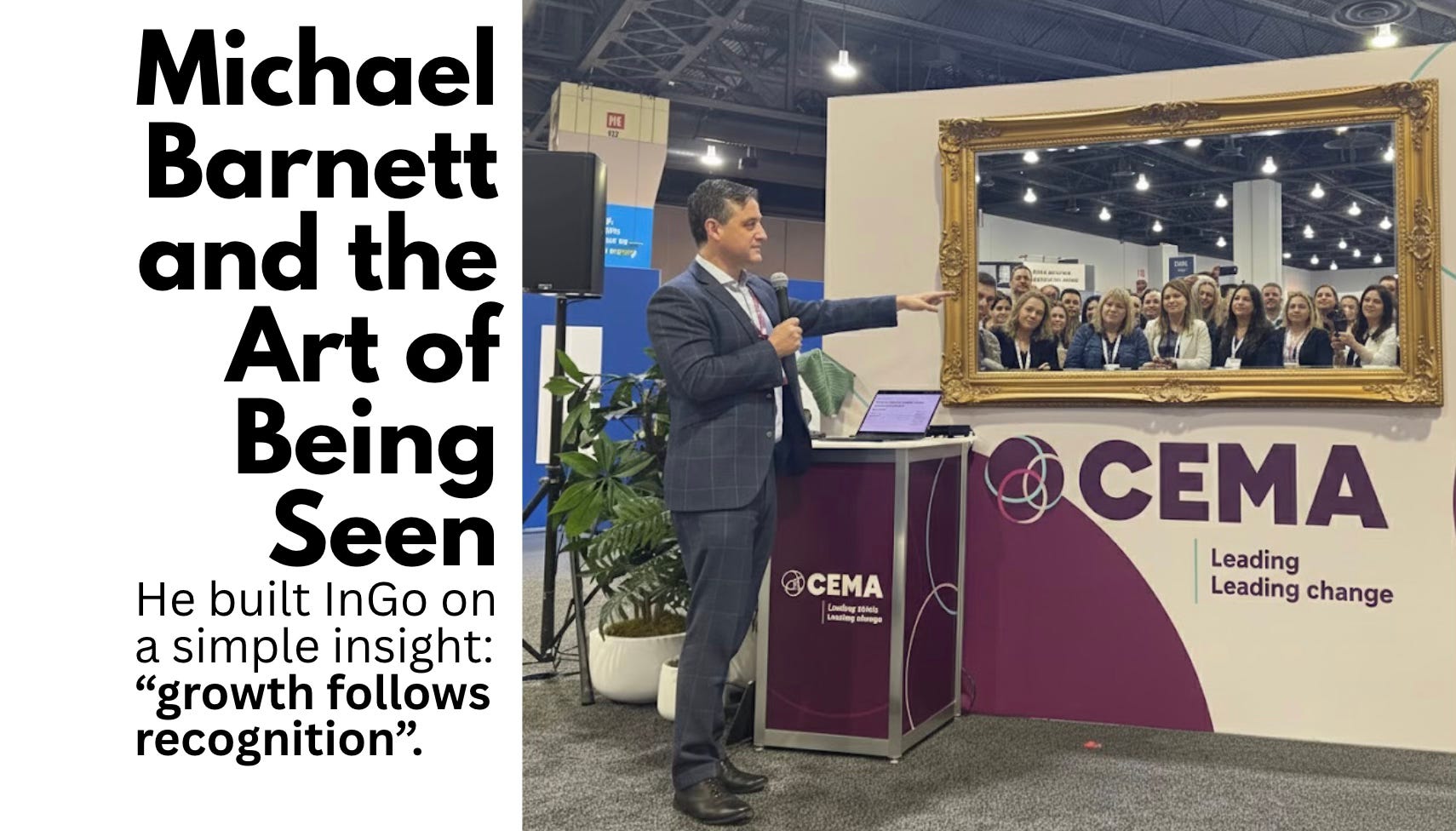
Michael Barnett and the Architecture of Being Seen
Why the founders who stay matter more than the ones who scale and sell.
If you spend even a few minutes on LinkedIn and other social media these days, you’ll notice a pattern. A steady stream of polished graphics announcing, “Excited to speak at…” or “Honored to be attending…” or “Looking forward to seeing everyone at…” The templates vary. The colors shift. The logos rotate. But the structure is consistent: a name, a title, a headshot, a declaration of participation.
They are everywhere now.
What most people don’t realize is that these posts are not merely digital vanity or polite enthusiasm. They are signals. They are social proof in motion. And in many cases, they are the visible edge of a much larger system designed to turn affiliation into momentum.

That system traces back to Michael Barnett.
Every few years the events industry receives a visitor with a familiar glint in his eye. He has just endured a chaotic registration flow or watched a speaker run fifteen minutes long and has concluded, usually before dessert, that he has discovered a structural flaw that the rest of us somehow tolerated out of habit. He sees inefficiency. He sees friction. He sees margin.
Within weeks there is a deck. Within months there is capital. Within a few years there is either an acquisition or a pivot into something shinier.
Events, in that worldview, are systems awaiting correction.
Michael Barnett never quite looked at them that way.
I have known him long enough to recognize the difference between someone passing through and someone choosing to belong. Barnett did not arrive announcing disruption. He began showing up — repeatedly, quietly, persistently. At SISO, where trade show operators debate the future of their industry in hallways that feel more consequential than the stages. On the board of PCMA, where corporate event leaders wrestle with whether their work will ever command the respect of the C-suite. In conversations that stretch long after panels conclude.
He did not hover at the edge of the ecosystem selling into it. He embedded inside it.
At the same time, he was building InGo, a company that, at its most straightforward, helps events grow by activating the networks of the people already attending. InGo integrates into registration systems, speaker pages, exhibitor portals, and event apps, allowing participants to share publicly that they are speaking, sponsoring, or attending — signals that ripple outward through professional networks.
It is clean in description.
It is more complex in origin.
Long before dashboards and referral engines, there was a teenage boy standing under fluorescent mall lighting in New Jersey, holding a bottle of perfume and calculating whether he had the courage to interrupt someone’s afternoon.
Barnett grew up in Texas before landing in New Jersey, slightly out of rhythm with his surroundings in the way children often are when they relocate. He was intellectually assertive — the student who raised his hand too often, who wanted to answer first — but when pressed about that impulse, he does not describe ambition so much as affirmation. He wanted the nod. The confirmation that he belonged in the room.
Recognition was not vanity. It was reassurance.
In high school he worked for his mother, who ran part of Procter & Gamble’s fragrance division. His job was to stand in malls like Short Hills and Rockaway and offer scent to passing shoppers. It paid well. It required a steadiness that does not show up in a résumé bullet.
Approaching strangers is a study in micro-rejection. You see instantly whether you are welcome. He remembers watching another spritzer push too aggressively and noticing how quickly people recoiled. Confidence without attunement reads as intrusion.
Perfume, he realized, was never about liquid. It was about aspiration. The woman who paused was trying on a version of herself — more magnetic, more composed, more noticed. If he could sense what she was reaching toward and meet her there, the exchange unfolded naturally. If he could not, nothing else mattered.
Selling fragrance forced him to confront a question most founders never articulate: how do you enter someone’s world without violating it?
Over time, the fear of saying hello reorganized itself into something more deliberate. He began pausing before speaking, asking himself what value he could bring to the interaction. Confidence did not arrive as bravado. It accumulated as calibration.
Years later, watching him move through a SISO reception, it is easy to mistake that fluency for innate charm. It was learned. The perfume counter was rehearsal.
There is a biological dimension to this that rarely appears in startup narratives. Human beings are exquisitely sensitive to recognition. When we are publicly acknowledged or affiliated with something respected, the brain’s reward circuitry activates; dopamine pathways associated with reinforcement light up. Social approval registers as reward. Conversely, exclusion activates neural regions that overlap with physical pain. To be unseen registers as threat.
The raised hand in childhood and the nod from a fragrance customer were early reinforcements of belonging.
By the time Barnett built an early political social media company in Washington — long before “social” became a corporate mandate — he had already internalized that influence travels relationally. It does not broadcast itself into existence. It moves through networks of trust.
When he entered the events industry, he did not see broken plumbing. He saw a social field already humming with affiliation. He noticed how often attendance decisions were influenced by who else was going, who was speaking, whose name appeared on the agenda. He noticed that a single post on LinkedIn from a respected executive often carried more persuasive weight than an expensive campaign.
InGo formalized that observation.
Instead of shouting at strangers, it made it easier for insiders to signal participation. Activation points appear where attendees already engage — registration confirmations, speaker dashboards, exhibitor portals, mobile apps. Motivation layers follow: personalization, leaderboards, incentives. Then comes optimization, the study of which titles influence, which industries respond, how engagement translates into registration.
The patterns are unsurprising and revealing. Speakers generate disproportionate attention. Senior titles influence differently than mid-level participants. Events framed around expansive ideas travel further than those framed narrowly around products.
InGo does not manufacture interest. It surfaces the social graph already embedded inside the event.
When someone publicly declares participation, the psychology shifts. Social proof reduces perceived risk. Familiar names create warmth before arrival. Commitment deepens. Behavioral psychology calls it commitment consistency; identity begins to intertwine with experience.
Loyalty, in that sense, is not a discount strategy. It is a neurological one.
Transactional tech culture often imagines growth as a mechanical equation — reduce friction, increase volume, accelerate scale. What it frequently overlooks is that gatherings operate on cumulative trust. They reward continuity. They respond to presence.
Barnett has demonstrated both.
He speaks about the under-measured ROI of corporate gatherings — events that may spend four to six thousand dollars per attendee at the high end — and about predictive analytics that attempt to model influence before doors even open. He believes events command only a fraction of the investment they could because their value remains partially invisible. Technology, properly used, can illuminate that.
Yet when he speaks about the future, the conversation inevitably bends back toward something less technical.
Events concentrate attention in a distracted world. They allow people to feel visible within a professional community. That sensation imprints more deeply than most marketing impressions.
During the pandemic, like many in the industry, he experimented with media and virtual models that did not endure. He recalibrated. He recapitalized InGo, bringing in outside capital while maintaining direction. The company has grown and reached profitability in recent years. He has sold companies before. He understands liquidity.
He does not speak as though he is waiting to leave.
The events industry has a long memory. It remembers who arrives loudly and who remains quietly. It remembers who treats gatherings as distribution channels and who treats them as rooms full of complicated human beings.

Barnett has been inside those rooms long enough that he no longer feels like a vendor passing through. He knows where the real conversations begin — not at the podium, but in the moments when someone decides whether they feel comfortable enough to extend a hand.
If you listen carefully, what he is still studying is that same moment he encountered as a teenager: the split second before someone leans in or pulls away. The calculation of whether this space will recognize them or ignore them.
The mechanics have evolved — referral engines, predictive models, optimization layers — but the exchange remains stubbornly analog. People arrive hoping, quietly, to be noticed by others whose noticing matters.
Barnett did not invent that impulse. He noticed it.
He noticed it in classrooms. He noticed it at fragrance counters. He noticed it in political rooms where introductions altered trajectories. And eventually, he noticed it in ballrooms where attendance itself functioned as signal.
He built a company around that noticing. Not because events were broken.
But because they were revealing something that optimization culture rarely measures: that growth, at its most durable, is social before it is technical, and belonging — once reinforced — lingers longer than any campaign cycle.
He did not rush in to correct the industry. He settled into it.
And over time, the room adjusted around him.


