
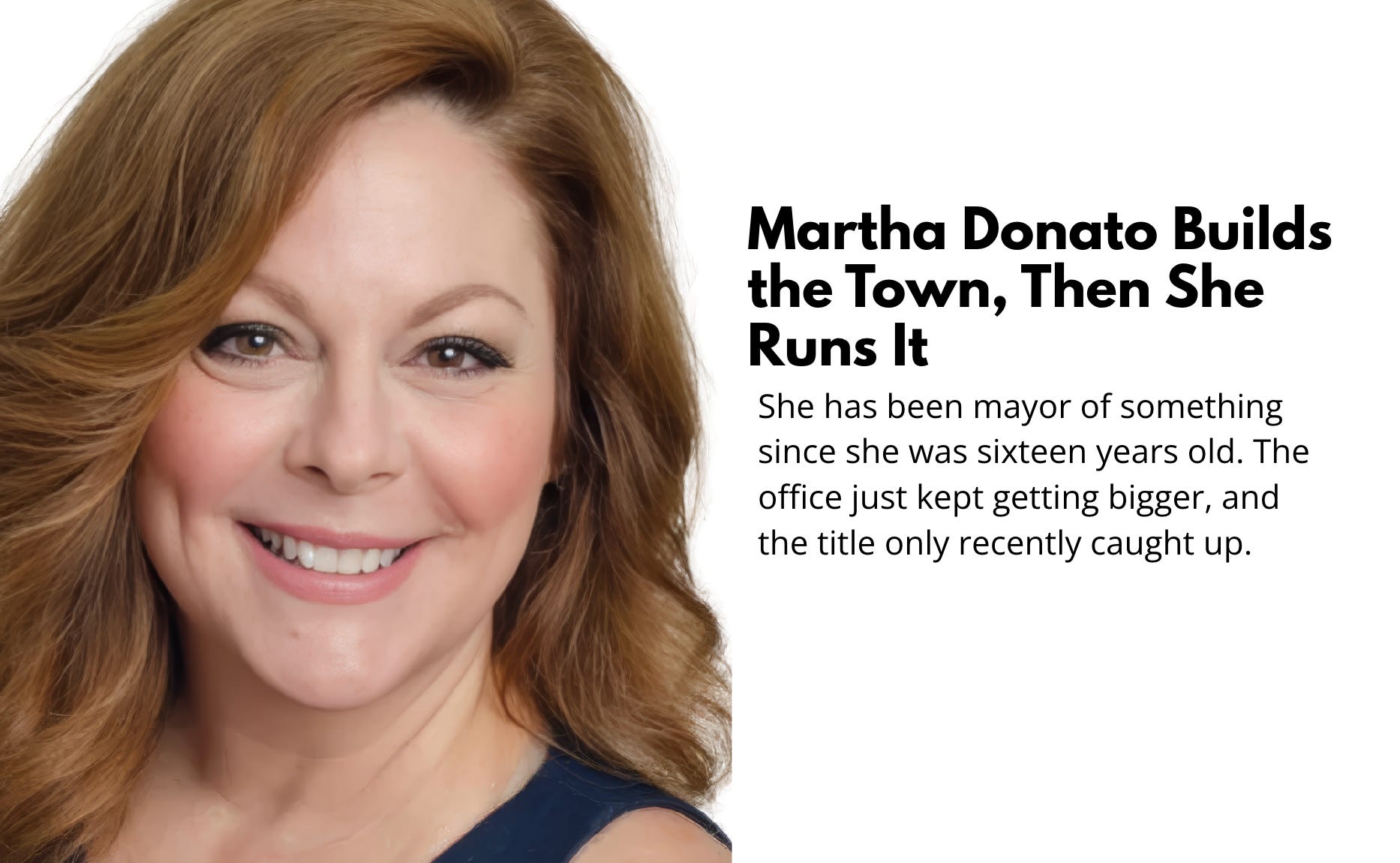
Martha Donato Builds the Town, Then She Runs It
She has been mayor of something since she was sixteen years old. The office just kept getting bigger, and the title only recently caught up.
Every entrepreneur knows the first half of the story, even if no one warns them about it going in. You put your head down. You build the thing nobody asked you to build, alone, on your own money, with no org chart to confer a title and no communications department to announce that you exist. You get very good at something while almost no one is watching, and for years the two facts of your life refuse to meet, the private excellence and the public silence, until it starts to seem possible they never will. This is the part of the entrepreneurial life that the founder mythology skips, the long-isolated middle where the work is real and the recognition is nowhere, and it is the part Martha Donato lived for the better part of three decades. She was building consumer shows that drew twenty thousand people and conferences a beat ahead of their markets, thirty-three events in all, financed out of her own pocket, and she was doing it in a kind of professional solitude that anyone who has ever started something will recognize in their chest.
What makes her worth a profile is the second half, the part that is harder to engineer and impossible to fake. The entrepreneur who has spent years building in isolation eventually does something a corporate climber never gets to do. She does not find a town and angle for a seat on its council. She founds the town, and the person who founds it governs by simple authorship, the way a settlement’s first citizen becomes its mayor without anyone needing to hold an election. This is the trait that organizes Donato’s entire life, and it explains why she would have been good at almost anything. What she has is not industry knowledge or a Rolodex, though she has both. It is the older and less teachable instinct to walk into a subject she knows nothing about, build a world around it, and discover that she is standing at the center of the thing she made. In her ecosystem, whatever she creates, she is the mayor of her niche, and she has created a great many niches.
She has built a remarkable number of those worlds, and the proof of the trait is in how little the subjects have in common. A consumer comic convention, handed to her when she knew nothing about comics, that she grew into a twenty-thousand-person spectacle. A drone conference for emergency responders when drones were still a toy. A think tank on the gap between the electric vehicles Washington mandated and the charging grid that did not exist. A blockchain event for the pharmaceutical industry before most people could define the word. A professional network for the women who run the industry’s towns. Thirty-three events in all, comics to drones to batteries to blockchain, each one a small town she founded and then governed, not by appointment but by authorship. The single exception, the one ecosystem she did not build herself, is the one that has lately put her on the international stage, and it is worth seeing precisely because it is the outlier that proves the rule.
She grew up in Bainbridge, in the part of upstate New York that calls itself the Central Leatherstocking Region, foothills of the Catskills, closer to Binghamton than to anything anyone outside the county has heard of. Her father was an engineer who worked the factories back when upstate still had them. Her mother worked in the schools and then at the plant that is now called Amphenol and used to be called Bendix, making the electrical connectors that go into aircraft, taking every extra shift she could get after the divorce. Donato was the oldest of five, with an Irish-twin brother a year behind her, and what that arrangement produces, when the mother is always at work trying to make the ends meet, is a child who runs the household. She was in charge of her siblings before she was old enough to understand that being in charge was a skill some people never acquire.
By high school the pattern had hardened into something a guidance counselor could put on a plaque. She was not the cheerleader. She was the head of the student council, elected unopposed, and when she graduated, they hung a plaque on the wall that read best citizen, and it is, she notes, still there. The first event she ever produced was her own high school prom, auditorium decorated and entertainment booked. The second category, the one she is funnier about, was the parties she threw at the house when her mother was working nights, which she ran with the same operational rigor she would later bring to consumer shows drawing twenty thousand people.
She has never once been a citizen of somebody else’s town. Long before Chicago, before UFI, she was mayor of a high school gymnasium on prom night and mayor of her mother’s kitchen when the party ran low on ice and needed a runner sent for more. The office just kept getting bigger. The skill never changed.
The only event that defeated her control was the graduation party where a classmate climbed the family flagpole and bent it permanently sideways, a structural failure she could not explain to her mother and did not try.
This is the formative logic, and it matters because it explains the thing she became known for and the thing she could not, for years, allow herself to claim. Donato learned leadership as a form of caretaking, and caretaking does not announce itself. It works best when no one notices it is happening. She carried that straight into her first real job in New York, where she had moved from Brooklyn to take classes and work in advertising at Grey, and then talked her way out of a Madison Avenue employment agency and into a role at Editel, the post-production house that cut The Cosby Show. She was assistant to the CEO. She managed his calendar, planned the events, kept the operation calm. From him she absorbed the discipline that would define her for the next twenty years, delivered as a set of instructions that doubled as a worldview. Be unfailingly polite, because the tempers in that business ran hot. Never let them see you sweat. And whatever happens in this office, at this level, is nobody’s business but ours, so do not go telling stories out of school. She took the last one as a sacred trust. In an era she describes as high-stakes gossip with pink slips flying, she knew a great deal and repeated none of it. The keeping of confidences is not a glamorous talent. It is, however, the talent that makes a person indispensable to powerful people, and Donato had it before she had anything else.
She moved through the video world into a sales role across the river in New Jersey, where she learned the commercial side of corporate America in the years around 1990, a period she describes with the flat candor of someone who lived it and does not expect to be believed. It was male-dominated and gratuitous in ways she says younger people would not credit if she spelled them out. She does not spell them out. What she took from it was sales, which she is careful to name as the foundation under everything the industry does, and then she carried that into publishing, and publishing is where the real story starts.
The publisher was Wizard Entertainment, a fan-magazine group built on the traditional media model where a little print operation makes its real money selling ads. In 1996 Wizard bought a thing called Chicago Comic Con, and Donato, by then the marketing director, was told the company had acquired this comic thing and would she mind taking a look. Six weeks later the brief had changed. The team running the show was not working out, and would she fly to Chicago and release them, and then they would, in the comfortable phrase that meant the opposite of what it said, figure it out. Figuring it out meant Donato. She ran a twenty-thousand-person consumer show with no experience producing a formal event, went from zero to a hundred over a single weekend, and spent part of that weekend crying behind a hotel door because she did not understand the rules or why there were so many of them. Then she went home and realized she had loved it.
What she loved is the thing that has organized the rest of her thinking about gatherings, and it is worth slowing down on, because it is the intellectual core of why she is good at this. Comic Con was not a market of buyers and sellers, which is the reduction the trade applies to everything. It was community happening in real time, the first time she had ever watched it happen at scale. The booths were not sales positions. They were gathering places. The artists were revered, the fans made a pilgrimage to be near them, and the whole apparatus existed so that people who loved a thing could gather under one roof with the people who made the thing, and with each other. She knew nothing about comics. She respected the enthusiasm completely. That distinction, between knowing the subject and honoring the devotion, is what she carried out of Chicago and into every B2B conference she has produced since, including, she points out, an oil and gas event in Houston last week where the man on stage was exactly the man everyone in the hall wanted five minutes alone with, for reasons that were commercial and tribal at the same time. You cannot fake that, she says, and she means it as both an observation about fandom and a thesis about why the industry will survive the machines. The tribalism is real. AI cannot manufacture it.
Then comes the part she calls the non-shiny part, because she is honest enough to flag when she is only giving you the polished version. In March of 2008, into the teeth of the collapse, she was let go from Wizard. The reason was not the economy, or not only the economy. The reason was that she had read the room and said what she saw, which is the other side of the caretaking instinct, the side that does not stay quiet. She had watched the independent comic shops, the small ones that were like bodegas for comic books, three thousand of them by her rough count, begin closing in droves because the distribution model was breaking and the print-first owners would not move to digital. She told the company it needed a real online presence and that the print franchise it was clutching was the fatal flaw. The owners, whose egos she describes as large and whose recent profits had convinced them the gravy train was permanent, decided a senior vice president who would not stop pointing at the iceberg was insubordinate. They released her and several others. Not long after, they closed. She had been right, expensively and unrewardingly right, which is the condition under which the person who reads the room first is usually correct, and usually punished for it.
The pivot, the moment the spotlight first turned toward her and she first tried to step out of its way, came in 2014. By then she had started her own Comic Con in Long Beach, and her general contractor was a man named Marty Glynn, who ran Metropolitan Expositions and wanted out of the back of the house and into show management. She wanted a partner. They discovered they lived in the same town, which is the kind of small-world detail that turns a working relationship into a life. Out of that partnership came MAD Event Management, the firm she still runs as founder and president, with Glynn as chief executive. What Glynn gave her, beyond a business partnership that has launched something like half of the thirty-three events she has put into the world, was a single piece of correction she had needed for twenty years and resisted hearing. Someone had asked her to speak, and she had said no, as she always said no, and Glynn asked her why she was forever putting herself behind the scenes. The next time someone asks, he told her, you say yes.
She said yes. She was, by her own account, awful at it, tongue-tied and red-faced and clutching her notes through the entire first year, the same media-training ordeal that humbles nearly everyone who has ever been good at the part of the job that happens off the dais. She kept doing it anyway, and what she discovered when she did was not that she had conquered a fear but that she had been pointed at the wrong thing the whole time. The visibility was never a personality flaw to be corrected. It was the missing half of a leadership that had been complete and idle for twenty years, waiting for a town to build itself around it. Something happens, she says, when you discover the fear was larger in your head than in the room. What happened, specifically, was that a born leader who had spent two decades doing the work in isolation finally stepped in front of the people she had been quietly serving, and the authority that had nowhere to go for twenty years simply walked out and took its place. The microphone did not make her a leader. It revealed the one she already was.
Those events, built with Glynn across the years that followed, read like a map of where the economy was about to go, each one produced a beat before anyone else arrived. The drone conference ran in Florida and California in 2017 and 2018, when most people had still never seen one overhead. The Detroit think tank sent a room full of government and industry people home agreeing the country had a charging problem nobody was solving. She self-financed nearly all of it out of whatever the other work threw off, never tapping the institutional capital that might have let any one of them scale faster, a regret she states plainly and without drama. The skill was always there. The funding architecture that rewards the skill arrived in the industry later than she did.
The through line is the right one. Donato’s entire career is the practice of reading the terrain, whether the terrain is a single difficult conversation, a twenty-thousand-person hall, or the entire publishing economy in the year before it cracked. She traces the skill to her grandmother and her five aunts, who taught her to listen the way listening used to be done, hands folded, eyes on the person, never forgetting a word she was told. It is not a coincidence that the woman who learned to listen that way became the woman everyone wanted in the room. What she had built, without ever calling it that, was soft power, the kind of influence that does not announce itself and cannot be assigned by a title, the kind that accrues to the person a town instinctively turns toward when something needs deciding. Listening is invisible labor. It is also the quiet machinery of authority, and it is the rarest competence in an industry that mostly talks.
Donato represents a leadership paradigm the events industry is only now learning to name. For most of its history, the skill she spent a lifetime perfecting was treated as support, the soft stuff, the thing the woman in the second chair handled so the man at the microphone could close the deal. That valuation is collapsing, and not for sentimental reasons. The work itself has changed. Leadership scholarship has spent the last two decades quietly dismantling the old assumption that command and technical mastery make the executive, and has installed in its place a less flattering finding, that the ability to read and manage emotion, your own and everyone else’s in the building, is now considered one of the fundamental qualifications for leading anything at all. The relational competence that used to be dismissed as women’s intuition turns out, under the regression analysis, to be the thing that actually moves careers and outcomes. And in this business in particular the stakes are not abstract. Event work ranks year after year among the most stressful jobs there is, a profession of unmovable deadlines and live failure in front of thousands, and the asset that determines who survives it is precisely the emotional read that Donato learned at her grandmother’s kitchen table.
The honest version of the argument is not that women are born better at this, a claim the research does not support, and Donato would be the first to wave off. It is that women were socialized into the relational skill, then penalized for it as though it were a weakness, and the industry is now waking up to discover that the penalized skill is the load bearing one. Add the machines to the equation and the shift accelerates. As artificial intelligence absorbs the logistics, the floor plans, the registration flows, the scheduling that used to fill the job, the only part of convening that cannot be automated is the human read on a crowd, the sensing of when a deal is about to turn or a hall is about to tip. That is the competence rising in value while everything around it commoditizes, and it is the competence the industry spent a generation extracting from women for free. The reason you will see more Martha Donatos in the first chair is not a diversity wave that might recede. It is that the job finally requires, out loud, the thing they were always doing in private.
Which brings us back to the outlier. When the pandemic erased her show calendar and left her, newly divorced and with a teenager still at home, without backup, she assembled a few MAD Event Management clients for cash flow and kept moving. Then in 2022, UFI came calling. The global exhibitions body was taking its congress to the United States for the first time, had never run an event on American soil, and told her, in the most honest brief a consultant can receive, that they did not know what they did not know. Here was the rare territory she had not founded, a town that already had its institutions and its history, and she governed it anyway, the only way she knows how. She did not arrive and demand a title. She served the organization through its first uncertain steps, emceed its European conference, spoke at its global CEO summit, and let the authority accrue slowly and then officially, until the title arrived to ratify what the town had already decided. Regional Director for North America, the first of its kind. It is the most visible thing she has ever been handed, and it tells you less about her than the comic convention she was told to go fix in 1996, because anyone can be appointed to a job. The interesting thing is that she runs a town she inherited exactly the way she runs the towns she built. The mayoralty does not depend on having poured the foundation. It depends on her.
The one town she built that she may be proudest of is the one she gave away, and it is not one she built alone. In 2021, Donato co-founded the North America chapter of the Women in Exhibitions Network alongside Stephanie Selesnick and Laura Purdy, three women who had each spent decades running things in this industry deciding, together, that the industry needed a room of its own where the women actually doing the work could find each other. Donato served as the chapter’s founding president. She holds honorary status now while a new generation carries it forward, which is the most Donato outcome imaginable: build the thing with the people who show up to build it, hand it to the next ones, keep your name on it only because they insisted you must.
The pattern is not hers alone. Look across the people this publication keeps returning to and the same shape appears again and again, someone running something well before anyone hands them a title for it. GatheringPoint’s profile of Howard Givner cast him as “the new mayor of the event agency world,” a founder who built the room the American event agency business had never had before anyone conferred a title on him for it. The instinct precedes the appointment almost every time. That is not a coincidence about individual biography. It is a pattern about how this industry actually selects its leaders. Authority here is rarely handed down from above. It is recognized after the fact, conferred on whoever has already been quietly running the thing while everyone else was still waiting for permission.
The numbers say why this is breaking open now for women specifically. Women make up roughly 77 percent of the event workforce by IBTM’s research, while only 16 percent of women in the industry hold director-level seniority, against 32 percent of men, a gap so wide it stops being a statistic and starts being a structure, the founder’s solitude made female and made permanent. What has changed, and what makes her appointment a story rather than a footnote, is that the top jobs are finally filling with the women who spent decades doing the work beneath them. Clarion Events named Liz Irving chief executive of its North American business at the end of 2024, and elevated Kelly Comboni to lead its Clarion Connect division weeks later, in January 2025. The Women in Exhibitions Network’s North American chapter is now led by Toni Piela of RX, with Danica Tormohlen of Informa Markets having steered it before her, the same Toni Piela whom Donato mentions almost in passing as one of the women now carrying the network forward.
These are not tokens, and they are not a wave. They are a small, specific cohort who held real power for years before anyone thought to put a title on it, and the network Donato helped start to gather them was never a support group. It was a succession plan.
The question that sits under the entire arc is the obvious one. How is it that she is not the CEO of one of the major companies right now. Donato does not flinch from it. The big organizers grow their executives from the inside, she says, out of RX or the old UBM, and she was never one of those homegrown few. And there is the harder question underneath that one, whether she would even have wanted it, the grinding life inside a large corporate machine, and here she gives the most honest answer of all. The younger me would have done terribly, she says. Maybe the older me would do well. I never had a chance to find out. It is the rare admission that lands as neither complaint nor false modesty, just an accurate accounting from a woman who has spent a lifetime accurately accounting for everyone but herself.
She walks the floor on the last morning of every show she produces, after the booths are gone and the hall has emptied back into the echoing space it was designed to be, looking for whatever got left behind. A product sample, a forgotten badge, a business card faces down on the carpet. Evidence that something happened here. A mayor’s job runs the whole distance, the charter and the zoning at one end, the curb and the trash at the other, and Donato has never treated the second half as beneath the first.
For thirty years she did that work in a kind of solitude, the founder’s solitude, building towns for other people to be celebrated in and trusting that the recognition would find her eventually, on its own schedule, the way it finds anyone who serves a community long enough to become indispensable to it. It found her. The lesson she leaves for whoever is building the next thing alone right now, head down, unrecognized, certain it will never connect, is the one her whole life argues. You do not climb into authority, and you do not wait to be appointed to it. You build the town, and you govern what you built, and the title, when it finally comes, only confirms what everyone in town already knew.
She has held some office or another since she was sixteen. Donato built towns for thirty years, gave the most personal one away with the women who built it beside her, and is only now being handed the public version of the authority she has quietly held the whole time. She would have been good at almost anything. The events industry got lucky that the worlds she kept building were theirs.
She Was Mayor of Something Before She Could Vote in a Real Election
Student council president at sixteen, elected unopposed. Her own prom, planned and run. Parties at home while her mother worked nights, a dollar at the door and a runner sent out when the ice ran low. The office kept getting bigger. The instinct never changed.
Listening Is Invisible Labor, and It’s the Load-Bearing Wall
Her grandmother and five aunts taught her to listen hands folded, eyes on the speaker, never forgetting a word. It reads as passive. It is the opposite. It is the quiet machinery that makes a town turn toward you when something needs deciding.
Respect the Devotion Even If You Don’t Know the Subject
She knew nothing about comics when Wizard handed her Chicago Comic Con. What she understood immediately was that the booths were not sales positions, they were gathering places, and the fans were on a pilgrimage. Honoring the fandom, not the merchandise, is what made the show work.
Being Right Early Can Get You Fired
She told Wizard’s owners in 2008 that the print-first model was dying and the company needed a real digital presence. They let her go for insubordination. The company folded not long after. Reading the terrain correctly is not the same as being rewarded for it.
The Fear Is Always Bigger in Your Head Than in the Room
Marty Glynn asked her why she kept saying no to speaking invitations and told her the next time someone asked, she should say yes. She was tongue-tied and red-faced for a year. She kept doing it anyway, and found the authority had been complete and idle the whole time, just waiting for a town to build itself around it.
Build the Company That Lets You Build the Towns
MAD Event Management, founded with Glynn out of the Long Beach partnership, is the vehicle behind roughly half of her thirty-three events. An independent operator needs an independent operation. She built both at once.
Self-Finance What You Can’t Get Funded, and Say So Plainly
Thirty-three events, financed almost entirely out of pocket, never tapping the institutional capital that might have scaled any one of them faster. She names this as a regret without drama. The skill was always there. The funding caught up to her late.
Found the Town With the People Who Show Up to Build It
The Women in Exhibitions Network’s North America chapter was not a solo project. Donato co-founded it with Stephanie Selesnick and Laura Purdy, three women deciding together that the industry needed a room of its own. She served as founding president, then handed it forward and kept only honorary status.
The Skill Dismissed as Soft Is Usually the One That’s Load-Bearing
Emotional intelligence, relational competence, the read on a crowd, all of it was extracted from women for free for a generation and filed under personality rather than qualification. As AI absorbs the logistics, the only thing left that can’t be automated is exactly what she was never credited for.
You Don’t Climb Into Authority, You Grow Into the Town That’s Already Yours
UFI handed her a territory she didn’t found, the first American congress in the organization’s history, and told her honestly they didn’t know what they didn’t know. She ran it the same way she runs everything else. Thirty years in the back of the hall, listening. The title, when it finally came, only confirmed what the town already knew
Why I Do Songs. Every Wisdom Bank piece comes with an original song because a song carries an argument differently than prose does. Prose persuades the reader. A song moves through them. A chorus settles into the back of the head and stays there long after the article has been closed and the laptop has been shut. Martha Donato's song is called "Mayors of Their Own Towns," and it does something this particular profile needed, it widens out from one woman's story into a roll call, because the real subject was never just her. It was the whole quiet generation of women who built the rooms this industry runs on and only recently got the titles to match..
Edible Profile of Martha Donato
Why I Do This. Food is the oldest form of biography. Long before anyone wrote a profile, a family told you who someone was by what they cooked for you, what they served when they wanted to impress you, what they made when someone they loved was hurting. That instinct never left us, it just got buried under a century of generic catering and rubber chicken banquet circuits. Small Bite Architecture is my attempt to dig it back out. Every dish on this page is built from an actual fact of Martha Donato’s actual life, not a theme, not a vibe, a fact. The scallop with the capers is the last morning on an emptied show floor. The canapé that never runs short is a teenager passing a hat at a house party her mother didn’t know was happening. I don’t do this because it’s clever. I do it because a person who has spent thirty years being understood through spreadsheets and org charts deserves, once, to be understood through a plate. One bite, two chews, and you know something true about them that a bio paragraph never gets to
.


